

Summarize this article with AI
Changing a company name in Turkey is a common corporate procedure that allows businesses to rebrand, expand into new markets, merge with other companies, or better reflect their commercial activities. Whether you operate a Limited Liability Company (LLC) or a Joint Stock Company (JSC), the process requires compliance with the Turkish Commercial Code (TCC) and registration with the relevant Trade Registry Office.
This comprehensive guide explains the legal requirements, required documents, timeline, costs, tax implications, and step-by-step process for changing a company name in Turkey.
A company name change is the legal process of changing the registered trade name of an existing company while preserving its legal identity. In Turkey, this procedure is carried out by amending the company’s Articles of Association and registering the new trade name with the relevant Trade Registry Office in accordance with the Turkish Commercial Code (TCC).
Changing a company’s name does not create a new legal entity. The company continues its operations with the same:
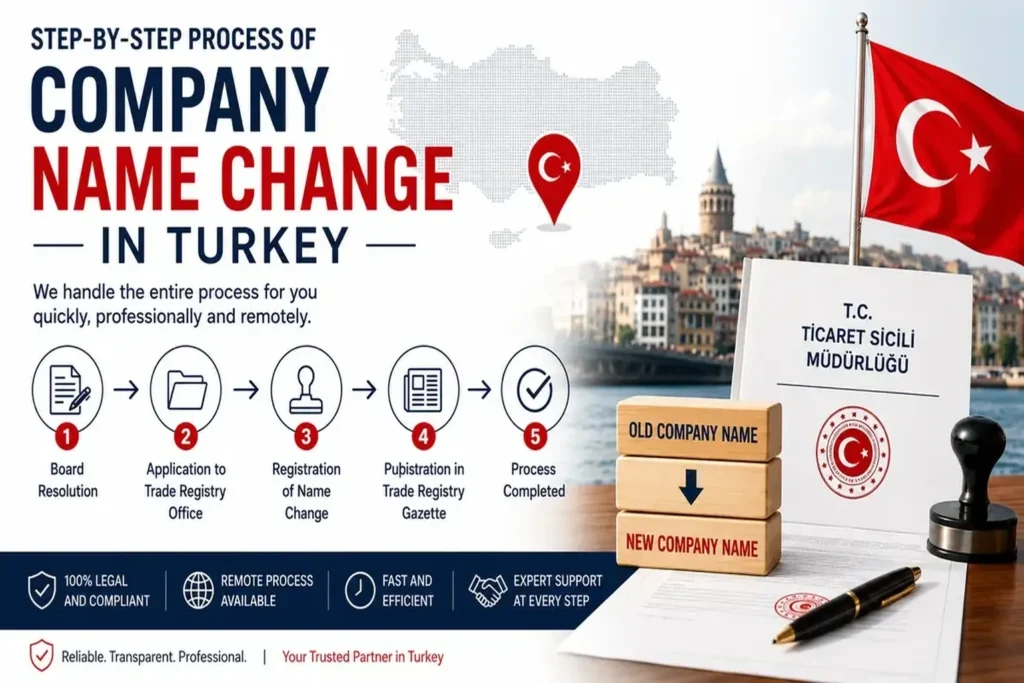
There are many strategic and legal reasons why a business may decide to change its company name. Whether driven by growth, branding, or regulatory requirements, a new trade name can better reflect the company’s vision, services, and market position. In Turkey, companies of all sizes—including foreign-owned businesses—may legally change their registered name by following the procedures set out in the Turkish Commercial Code.
Below are the most common reasons for changing a company name:
Businesses often update their company name to modernize their brand image, strengthen market recognition, or align with a new corporate identity. A fresh name can improve customer perception and support long-term marketing strategies.
As companies grow, they may enter new industries, introduce additional products or services, or expand into international markets. Changing the company name can better represent the broader scope of business activities.
Following a merger, acquisition, or corporate restructuring, businesses frequently adopt a new company name to reflect their combined operations, ownership, or strategic direction.
Companies planning to operate globally often choose a name that is easier to pronounce, remember, and recognize across different countries and cultures. This is particularly common among foreign investors establishing or expanding businesses in Turkey.
A company may need to change its name if it conflicts with an existing trademark, infringes intellectual property rights, or does not comply with Turkish Commercial Code requirements. Selecting a legally compliant name helps avoid disputes and registration delays.
If a company’s original name no longer reflects its current operations, products, or services, updating the trade name can provide greater clarity to customers, suppliers, and business partners.
Some businesses change their name to distance themselves from negative publicity, improve their reputation, or present a more professional and competitive image in the marketplace.
Although not always required, significant changes in ownership or management may lead to a new company name that better represents the company’s new leadership or strategic vision.
Under the Turkish Commercial Code (TCC), most registered business entities have the legal right to change their company name by amending their Articles of Association (where applicable) and completing the registration process with the relevant Trade Registry Office. The procedure is available to both Turkish-owned and foreign-owned companies, provided all legal requirements are met.
The following types of business entities can change their registered trade name in Turkey:
A Limited Liability Company (LLC) is the most common legal entity preferred by both local entrepreneurs and foreign investors. An LLC may change its company name following a shareholders’ resolution and registration with the Trade Registry.
A Joint Stock Company (JSC) can also amend its registered trade name. The name change must be approved by the General Assembly or another authorized corporate body, depending on the company’s Articles of Association.
A branch office of a foreign or Turkish company may change its registered name, provided the new name complies with Turkish Trade Registry regulations and accurately reflects the parent company’s identity where required.
A Collective Company (Kollektif Şirket) may change its trade name through the necessary partner resolutions and Trade Registry registration procedures.
A Commandite Company (Komandit Şirket) is also entitled to amend its registered company name by following the applicable legal procedures.
Registered cooperatives operating in Turkey may change their corporate name after obtaining the required internal approvals and completing the registration process with the Trade Registry
Yes. Foreign-owned companies in Turkey have the same legal right as Turkish-owned companies to change their registered company name. Turkish legislation does not impose any restrictions based on the nationality of the shareholders or directors. As long as the company complies with the requirements of the Turkish Commercial Code (TCC) and the relevant Trade Registry Office, a company name change can be completed without affecting its legal status.
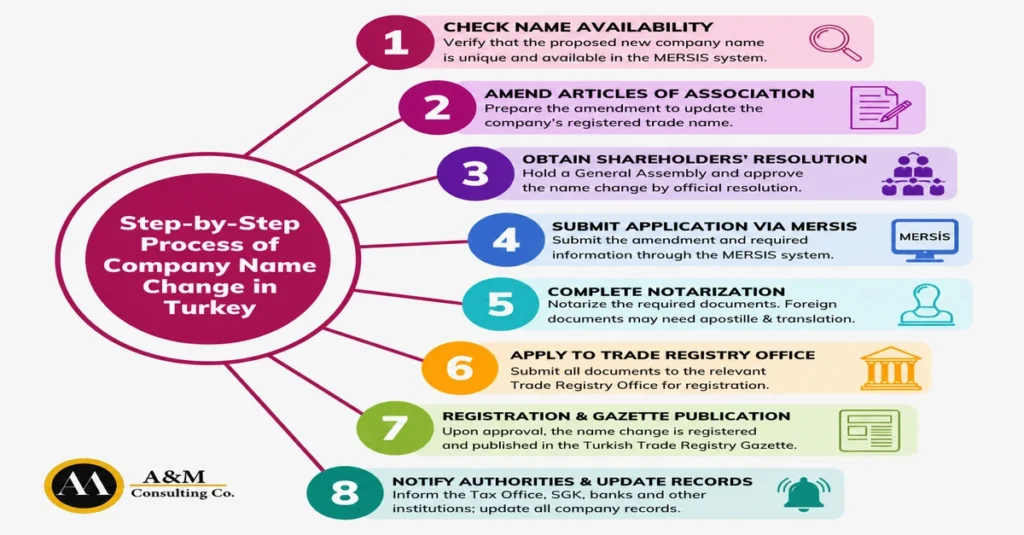
Changing a company name in Turkey is a straightforward legal procedure when all required documents are properly prepared. The process involves obtaining internal corporate approvals, amending the company’s constitutional documents, and registering the new trade name with the relevant Trade Registry Office. Once the registration is completed, the company may legally operate under its new name while maintaining the same legal identity.
Below is a step-by-step guide to the company name change process in Turkey.
The first step is to determine whether the proposed company name is available for registration. The new trade name must:
Conducting a trademark search before submitting the application is also recommended to minimize the risk of future legal disputes.
Since the company name is included in the Articles of Association (AoA), the relevant article must be amended to reflect the new trade name.
The amendment should clearly specify:
The company must formally approve the name change through the appropriate corporate body.
For a Limited Liability Company (Ltd. Şti.), the shareholders adopt a General Assembly Resolution approving the amendment.
For a Joint Stock Company (A.Ş.), the approval is generally granted by the General Assembly, unless the Articles of Association authorize another corporate body.
The resolution should clearly state the new company name and authorize the necessary registration procedures.
After the corporate resolution is adopted, the amendment is prepared and submitted electronically through the MERSIS (Central Registration System).
During this stage:
Certain corporate documents may require notarization before they are submitted to the Trade Registry.
Depending on the company’s structure and the specific circumstances, these may include:
If any documents are signed outside Turkey, they may also require:
The completed application file is submitted to the competent Trade Registry Office where the company is registered.
The application generally includes:
The Trade Registry reviews the application to verify compliance with Turkish corporate legislation.
Once the application is approved:
From this point onward, all official documents, invoices, contracts, and corporate records should display the new company name.
After the registration is completed, the company should update its information with the relevant public authorities and private institutions.
These typically include:
Updating these records helps prevent administrative issues and ensures consistency across all official and commercial documents.
Following the legal registration, companies should also update all branding and operational materials, including:
Maintaining consistent branding helps avoid confusion among customers, suppliers, and business partners.
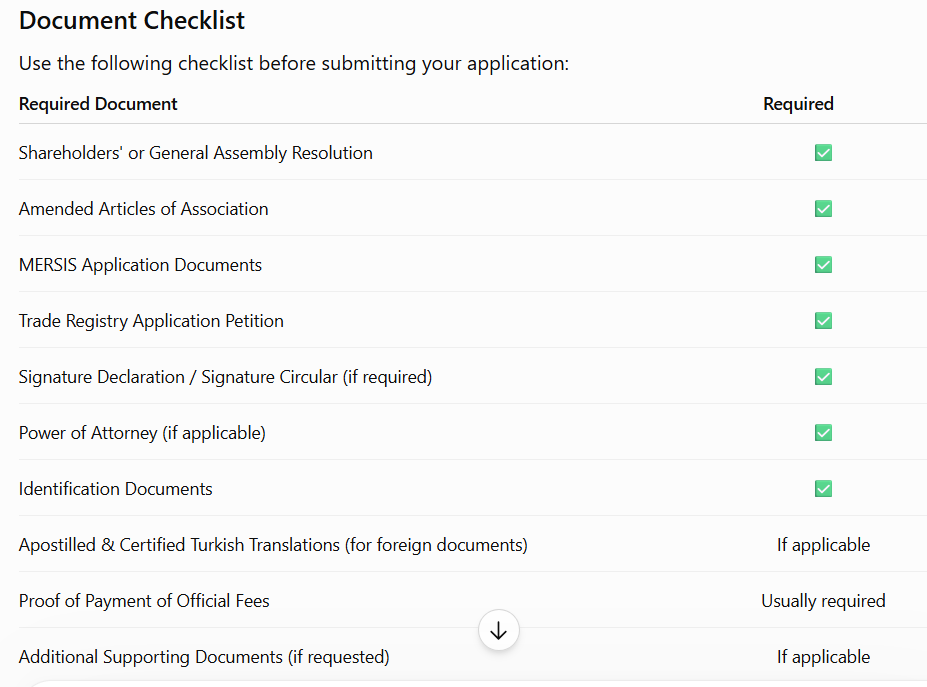
Changing a company name in Turkey requires submitting several corporate documents to the relevant Trade Registry Office. While the exact documentation may vary depending on the company’s legal structure (Limited Liability Company, Joint Stock Company, or Branch Office), most applications require a standard set of documents to support the amendment.
If the company has foreign shareholders or directors, additional notarization, apostille, or certified translation requirements may also apply.
Below are the documents typically required for a company name change in Turkey.
The company must adopt a formal resolution approving the company name change.
The resolution should include:
For a Limited Liability Company (Ltd. Şti.), this is generally a Shareholders’ (General Assembly) Resolution.
For a Joint Stock Company (A.Ş.), the approval is typically obtained through a General Assembly Resolution, unless otherwise permitted by the Articles of Association.
Since the company name is stated in the Articles of Association (AoA), the relevant article must be amended to reflect the new company name.
The amendment must be prepared in accordance with the Turkish Commercial Code and submitted through the MERSIS system.
The amendment application is prepared electronically through the Central Registration System (MERSIS).
The application package generally includes:
A signed application petition requesting the registration of the company name change must be submitted to the competent Trade Registry Office.
Depending on the company’s circumstances, the Trade Registry may request:
This helps verify the authority of the individuals signing the application.
If the application is submitted by an attorney, accountant, or other authorized representative, a Power of Attorney (PoA) authorizing the representative to complete the company name change procedures may be required.
The Trade Registry may request copies of identification documents for:
Foreign nationals generally submit copies of their passports or other officially recognized identification documents.
When documents are signed outside Turkey or issued by foreign authorities, they may need to be:
These requirements commonly apply to powers of attorney and corporate resolutions executed abroad.
Depending on the Trade Registry Office, applicants may also need to provide proof of payment for:
In certain cases, the Trade Registry may request additional supporting documents, such as:
Foreign-owned companies generally follow the same procedure as Turkish companies. However, they should also ensure that any documents prepared abroad comply with Turkish legal formalities, including apostille certification, notarization, and certified Turkish translations where required.
Working with a local legal or corporate advisor can help ensure that all foreign documents meet the requirements of the Turkish authorities and prevent unnecessary delays during the registration process.
Preparing the required documents accurately is one of the most important steps in a successful company name change in Turkey. Missing, incomplete, or improperly certified documents can delay the registration process or result in the rejection of the application. Ensuring that all documentation complies with the requirements of the Turkish Commercial Code, MERSIS, and the Trade Registry Office will help complete the process efficiently and without unnecessary complications.
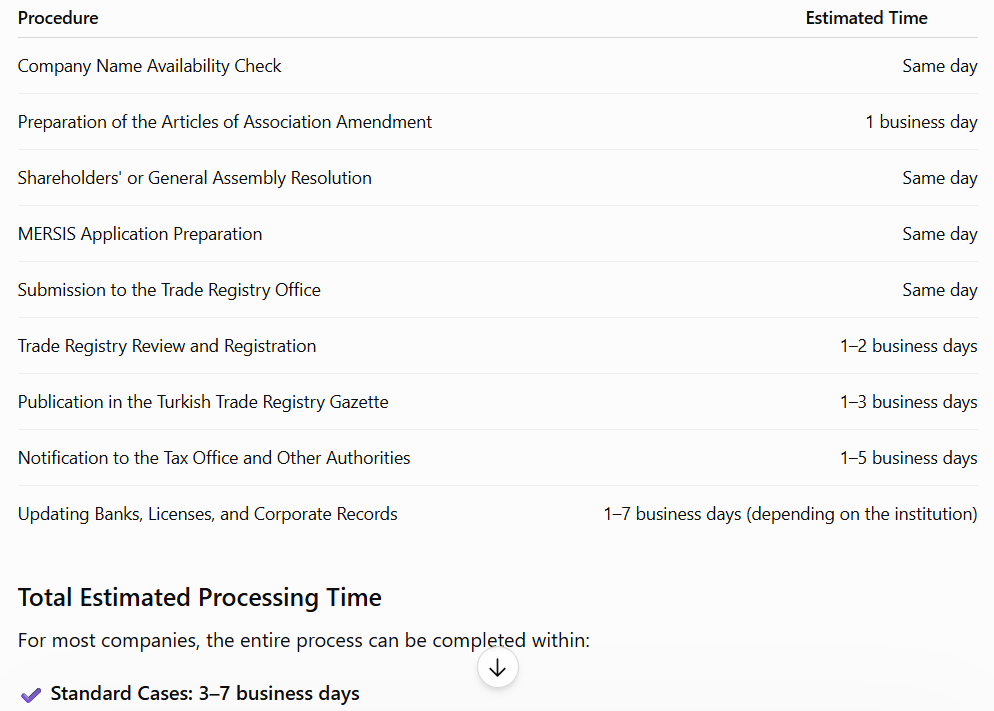
The company name change process in Turkey is generally fast and can be completed within 3 to 7 business days, provided that all required documents are prepared correctly and the application is submitted without errors. The exact timeline may vary depending on the workload of the relevant Trade Registry Office, the complexity of the company structure, and whether any foreign documents require apostille certification or certified translation.
Below is an overview of the typical timeline for changing a company name in Turkey.
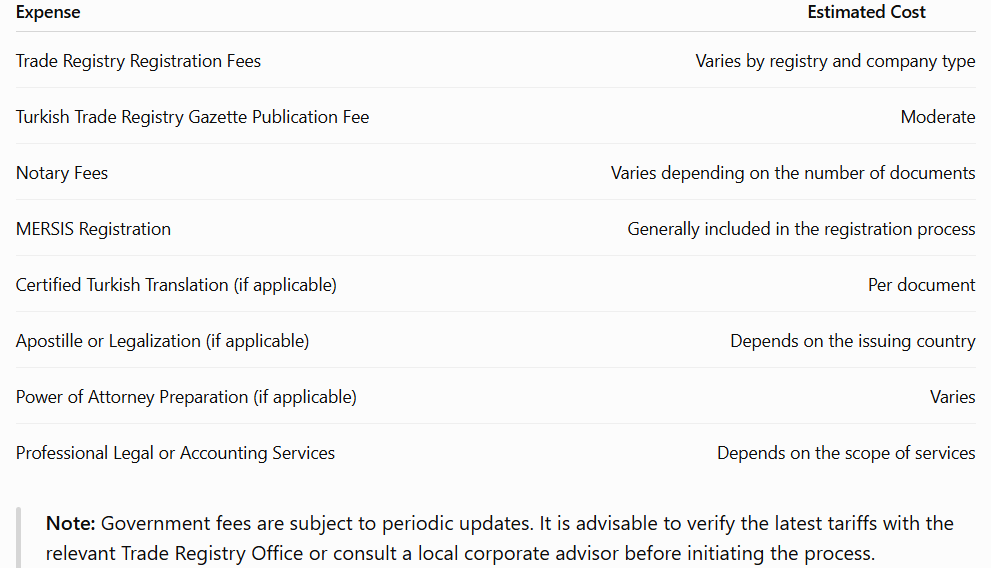
The cost of changing a company name in Turkey is relatively low compared to establishing a new company. However, the total cost depends on several factors, including the company’s legal structure, the number of documents requiring notarization, whether foreign shareholders are involved, and the professional services used during the process.
In addition to official government fees, companies should also consider notary expenses, Turkish Trade Registry Gazette publication fees, and, where applicable, translation and apostille costs.
Below is an overview of the typical costs associated with a company name change in Turkey.
Changing a company name in Turkey is generally a straightforward procedure, but even minor errors can lead to delays, additional costs, or the rejection of the application by the Trade Registry Office. Careful planning and compliance with the Turkish Commercial Code (TCC) can help ensure a smooth and efficient process.
Below are some of the most common mistakes businesses should avoid when changing their company name in Turkey.
One of the most common reasons for application delays is selecting a company name that is identical or confusingly similar to an existing registered trade name.
Before submitting your application, always verify that the proposed name is:
Conducting a trademark search is also recommended to avoid future intellectual property disputes.
The company’s trade name is included in its Articles of Association (AoA). If the amendment is incomplete or contains inconsistencies, the Trade Registry may reject the application.
Ensure that the updated Articles of Association accurately reflect the new company name and comply with the requirements of the Turkish Commercial Code.
Missing signatures, outdated forms, incorrect corporate resolutions, or incomplete application documents are common causes of delays.
Before filing the application, verify that all required documents are:
A company name approved by the Trade Registry may still conflict with an existing registered trademark.
Before finalizing your new company name, consider conducting a trademark search to reduce the risk of legal disputes, rebranding costs, or future infringement claims.
After the company name change is registered, many businesses overlook the need to notify public authorities.
The new company name should be updated with:
Failure to update these records may result in administrative complications or inconsistencies in official records.
Although the legal registration is complete once the Trade Registry approves the amendment, the company should also notify:
Updating contracts, invoices, and banking records helps prevent payment delays and confusion in commercial transactions.
A company name change is not limited to legal registration. Businesses should also update:
Maintaining consistent branding strengthens corporate identity and avoids confusion among customers.
Certain words and expressions are regulated under Turkish law and may require additional approvals or may not be permitted in a company name.
Examples include terms such as:
Choosing a compliant company name from the beginning can help prevent unnecessary delays during the approval process.
Some businesses postpone updating internal records after the company name becomes legally effective.
Important documents that should be updated include:
Prompt updates help ensure operational continuity and legal consistency.
Although changing a company name is a relatively simple corporate procedure, errors in documentation or registration can lead to rejected applications, repeated filings, and additional costs.
Working with experienced legal or accounting professionals can help ensure that:
To complete the process efficiently, businesses should:
Avoiding these common mistakes can save businesses significant time, money, and administrative effort during the company name change process in Turkey. By preparing complete documentation, selecting a legally compliant trade name, and updating all official and commercial records promptly after registration, companies can complete the process smoothly while maintaining full compliance with Turkish corporate regulations.
Although the procedure is generally straightforward, errors in documentation or delays in post-registration notifications can lead to unnecessary costs, rejected applications, or interruptions to daily business operations. Working with experienced local advisors helps ensure that every stage of the process is completed accurately, efficiently, and in full compliance with Turkish legislation.
A&M Consulting Co. specializes in assisting both local businesses and foreign-owned companies with company name changes in Turkey. Our experienced team manages the entire process—from checking the availability of your proposed company name and preparing the required corporate documents to handling MERSIS filings, Trade Registry registration, and coordinating post-registration updates with the relevant authorities.
Our comprehensive services include:
Our goal is to make the company name change process in Turkey as smooth and efficient as possible, allowing you to continue your business operations without unnecessary delays while remaining fully compliant with Turkish corporate regulations.
Whether you are rebranding your business, expanding into new markets, or restructuring your corporate identity, A&M Consulting Co. is ready to guide you through every step of the company name change process with practical, reliable, and cost-effective solutions tailored to your business needs.
You can reach out to our experienced consultans via email or by filling out the Contact Form on our website’s contact page.
For most companies (especially Limited and Joint Stock Companies), the decision must be approved by:
Yes. The company’s Articles of Association must be updated to reflect the new trade name and registered with the Trade Registry.
The change must be registered with the relevant Trade Registry Directorate (Ticaret Sicili Müdürlüğü) in Turkey.
Yes. The shareholder resolution approving the name change is typically notarized before submission to the Trade Registry.
Yes. Foreign shareholders have the same rights as local shareholders to approve a name change, provided they act through proper representation (e.g., power of attorney if needed).
Generally:
Typical documents include:
Yes. After registration, the change is automatically or separately notified to:
No. The company’s tax ID number and trade registry number remain the same. Only the name changes.
Yes. The company continues its business activities without interruption during and after the name change process.
Usually no. However, banks may request updated registry documents reflecting the new company name.
Yes. You can check and reserve availability through the Trade Registry system before formally applying.
Share:


Follow us!
WhatsApp Us