

Summarize this article with AI
Turkish Social Security System is a comprehensive structure that provides protection against social risks for citizens and foreigners working in the country. Social security aims to provide individuals with economic security in situations such as unemployment, illness, old age and death. This article will discuss the functioning, scope and benefits of Turkey’s social security system
The Turkish Social Security System largely follows the Bismarck model, one of the four fundamental insurance systems: Continental Model (Bismarck), Liberalistic Model (Beveridge), Northern European Model, and Mediterranean Model.
The Bismarck Model
The Bismarck Model involves collecting premiums from employees’ wages according to their insurance status into a joint pool. Benefits, including old-age pensions, are provided based on these paid premiums. The amount of benefits for retirement, accidents, and sickness varies according to the individual’s previous income. Key participants in this system include employees, employers, and public sector representatives. The Bismarck Model imposes more regulatory measures on the labor market compared to the liberalistic system, resulting in less labor market flexibility. It emphasizes strict rules and collective bargaining mechanisms.
Elements of the Mediterranean Model
The Turkish Social Security System also incorporates elements of the Mediterranean Model. Since the 1990s, the system has faced several financial challenges due to early retirement practices, high rates of unregistered employment, low rates of premium collection, and insufficient income replacement. These issues, along with the fragmented service provision by various social security institutions, have led to a lack of uniformity in the rights and obligations of employees. The aging population further strained the system, necessitating reforms to ensure its financial sustainability.
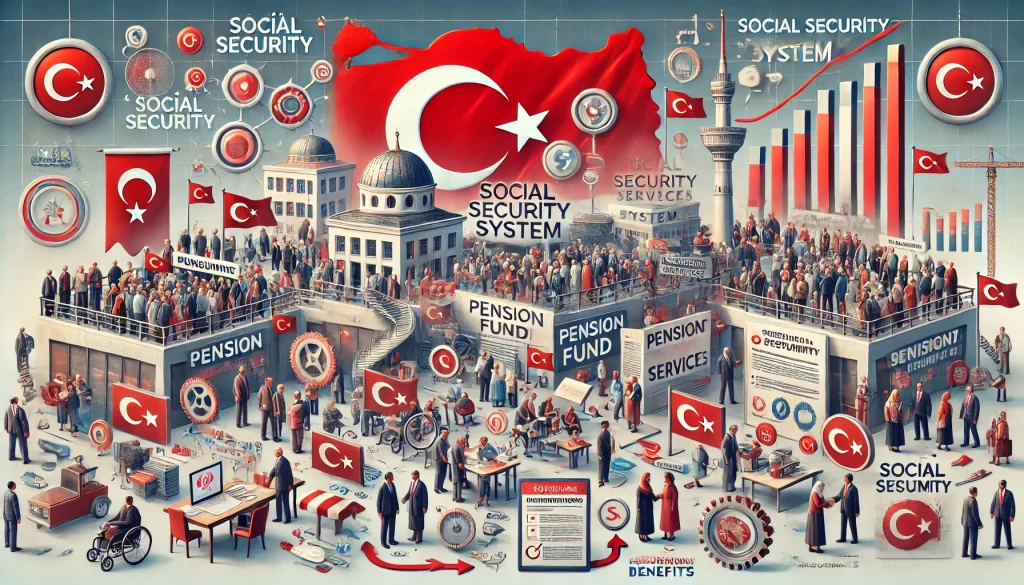
2008 Social Security Reform & Turkish Social Security System
To address these issues, significant reforms were introduced in 2008 with the enactment of Law No. 5510. The reform aimed to resolve prominent problems such as the increasing deficit and inconsistent service delivery by different institutions. The primary objective was to establish an equitable, easily accessible, and financially sustainable social security system that offers effective protection against poverty.
Key Components of the 2008 Social Security Reform
Universal Health Insurance: Ensuring equitable, protective, and quality healthcare services for the entire population.
Aid System: Enabling all individuals in need to access services through a combination of non-contributory payments and organized social benefits.
Single Retirement Regime: Incorporating short and long-term insurance branches, excluding health insurance.
Conclusion:
The Turkish Social Security System, influenced by both the Bismarck and Mediterranean models, has undergone significant reforms to address financial challenges and improve service delivery. The 2008 reform was a critical step towards creating a more equitable, accessible, and sustainable social security system in Turkey.
The long-term insurance branches in Turkey include services related to invalidity, old-age, and survivors’ benefits. Here’s a detailed overview:
Old-age insurance is a mandatory and contributory social insurance that provides an old-age pension when insurance holders reach a specific age. The main benefits under this insurance are the old-age pension and old-age lump-sum payments.
Invalidity insurance is a mandatory social insurance providing an invalidity pension to those who lose at least 60% of their working capacity or earning power due to work accidents or occupational diseases.
Survivors’ insurance is compulsory and contributory, providing a monthly pension to the survivors (spouse, children, parents) of deceased insurance holders. Benefits include survivors’ pensions, death grants, marriage allowances, and funeral allowances.
The total pension amount cannot exceed the deceased’s pension; reductions are applied if necessary.
The Turkish Social Security System provides both treatment and cash benefits under its short-term insurance branches, which include work accident and occupational disease, sickness, and maternity insurance.
While treatment benefits are covered by Universal Health Insurance, cash benefits fall under short-term insurances.
Work accidents are incidents that occur:
The allowance is half of the daily earning for inpatient treatments and two-thirds for outpatient treatments. If multiple conditions apply, the highest benefit level is used.
Sickness refers to conditions causing incapacity in insurance holders due to reasons other than work accidents or occupational diseases.
Maternity Insurance covers both the sickness and invalidity statuses related to pregnancy and maternity for:
This coverage starts from the date of pregnancy and extends up to eight weeks post-delivery, or ten weeks in the case of multiple births.
To qualify for the breastfeeding benefit:
If female insurance holders, who have earned the right to receive the breastfeeding benefit, give birth within 300 days after their insurance status ends, they or their spouses will still receive the benefit, provided they have paid a minimum of 120 days of premiums within fifteen months before the birth.
Universal health insurance, as defined by Law No. 5510 in Turkey, ensures the maintenance of individuals’ health and covers costs arising from health risks. This system, introduced by Law No. 5510, offers comprehensive, fair, and equitable access to healthcare services for all insured and uninsured residents, regardless of their economic status.
Optional Insurance Holders:
Foreign Residents: Foreigners with residence permits not covered by foreign insurance legislation, considering reciprocity principles.
Individuals Benefiting from Social Security and Unemployment Benefits: Individuals receiving income or pensions from the Social Security Institution.
Special Cases:
To benefit from healthcare services, universal health insurance holders and their dependants must meet specific conditions:
The State contributes one-fourth of the collected premiums for invalidity, old-age, and survivors’ insurance. Premium income is strictly used for administrative expenses, healthcare services, and other rights under universal health insurance.
Turkey has signed social security agreements with 23 countries, of which agreements with the following countries include healthcare insurance:
Foreign nationals with insurance from these countries, whether temporarily staying or permanently residing in Turkey, must obtain a formulary from their home institution. This formulary should be submitted to the Departments of Foreign Services within Social Security Provincial Directorates/Social Security Centers or to designated Social Security Centers in Turkey.
With the Document of Healthcare Benefits under Social Security Agreement, these individuals can access healthcare services in contracted health facilities in Turkey. They receive these services free of charge, except for legally mandated contribution rates and shares that must be paid by the insured themselves.
Emergency Healthcare Services for Foreign Insured Persons
In emergencies, insured individuals from countries with applicable social security agreements can receive the necessary formulary for healthcare services from the “Department of Foreign Services” at their location in Turkey. This requires submission of documentation from their home country’s social security institution. Alternatively, these documents can be confirmed at designated Social Security Centers.
To receive healthcare services, foreign insured individuals should apply to contracted health facilities of the Ministry of Health, private health facilities, or training hospitals using the Document of Healthcare Benefits under Social Security Agreement. Services from non-contracted health facilities can only be accessed through referrals from contracted units. However, if an insured person directly approaches a non-contracted health facility in an emergency, their treatment costs can still be covered by the Institution. The determination of whether a situation is an emergency is made by reviewing relevant medical documents submitted by the contracted health facilities.
Key Points for Foreign Insured Persons in Turkey:
By following these steps, foreign insured individuals can ensure they receive the healthcare benefits they are entitled to while staying or residing in Turkey.
Unemployment insurance in Turkey is a mandatory insurance designed to provide financial support to individuals who lose their jobs through no fault of their own. It compensates for the loss of income for a specified period, ensuring that individuals who are willing, able, and healthy enough to work but find themselves unemployed can still support themselves.
For those opting for optional unemployment insurance, the premium includes:
Unemployment insurance in Turkey offers comprehensive coverage and support for various types of workers. By understanding the scope, premium contributions, and benefits, individuals and employers can better navigate the system and ensure they are adequately protected against job loss.
Turkish Social Security Specialists play a critical role for companies and employers operating in Turkey. These experts are key to sustainable growth, ensuring smooth market entry, full compliance with Turkish Social Security legislation, and optimizing benefits from incentives and discounts.
Turkish Social Security Experts offer essential guidance to both companies and employees. With deep knowledge of Turkish Social Security laws, they protect workers, employers, and businesses from legal pitfalls and ensure full legal compliance.
Experienced Turkish Social Security Experts stay updated with all regulations affecting commercial activities in Turkey. They provide detailed advice on your rights and obligations, helping you navigate the complexities of the system efficiently.
A&M Consulting Co. is a premier Turkish Social Security Consulting Firm based in Istanbul, serving clients nationwide. Our team of experts, with extensive experience in the Social Security Institution, is known for their dedication to excellence and professional leadership.
At A&M Consulting Co., we offer affordable and reliable consultancy services. Our Turkish Social Security Experts are ready to manage all aspects of your investments and company’s Social Security needs in the Turkish market.
Our experienced Social Security Specialists provide a wide range of services, including:
At A&M Consulting Co., we continue to support individual and corporate investors and employers in Turkey with our Social Security Consultancy services and professional solutions that fully comply with the Turkish Social Security System
Yes, foreigners can retire in Turkey. Foreign nationals must meet the same retirement conditions as Turkish citizens.
The foreign investors who are company shareholders & managers has been including in the Turkish social security system automatically and mandatorily, They may be entitled to receive retirement benefits after paying their social security premiums and fulfilling other legal conditions. Even they may leave a legacy this rights to theirs heirs.
Citizens of countries with a bilateral social security agreement with Turkey are exempt from being insured in Turkey for the duration specified in the agreement. To qualify for this exemption, they must submit their insurance registration document from their home country to the Turkish authorities,
Citizens of countries without a bilateral social security agreement with Turkey are exempt from being insured in Turkey as long as they are insured in their home country. To qualify for this exemption, they must submit their insurance registration certificate to the Turkish authorities.
Retirement conditions in Turkey depend on various factors such as the type and duration of work, gender, and age. Here are the specific conditions for those insured for the first time:
Independent Employees (including company shareholders):
Dependent Employees:
SSI registration in Turkey varies depending on the type of insured individual and the nature of their work.
For Independent Employees (including company shareholders), insurance is automatically registered by system with tax registration.
For Dependent Employees, employers must complete the insurance registration before the employees start working. In certain sectors, such as construction, this registration can be done on the same day.
Independent Employees (including company shareholders) can pay their insurance premiums using their TR ID Number or Foreign TR ID Number through banks or their online banking platforms.
The insurance premium payments for Dependent Employees must be made by their employers using the employer’s registry numbers through banks or their online banking platforms.
A&M Consulting Co. as a Turkish Social Security Consulting Firm specializes on end to o end performing Social Security Consulting Services for particularly foreign investors and corporate companies in Turkey.
We’re beside you to ease the process of compatible with Tukish Social Security system of companies and emloyers and help get best social security services in Turkey
DISCOVER OUR SERVICES:
Reach out to our experienced Turkish Social Security via email or by filling out the Contact Form on our website’s Contact page.
Recent Posts


WhatsApp Us