

Turkey has undergone a significant digital transformation in tax administration over the past decade. Today, nearly all interactions between businesses and the Turkish Revenue Administration are carried out electronically through integrated digital platforms and e-services. From company registration to tax filings, invoice issuance, bookkeeping, and official notifications, electronic tax applications have become an essential part of doing business in Turkey.
For both domestic and foreign investors, understanding these electronic tax applications is crucial. Shortly after establishing a company, businesses are generally required to complete several digital tax registrations before they can fully operate and comply with Turkish tax regulations. These registrations may include obtaining access to the Interactive Tax Office, activating electronic notifications (e-Notification), applying for a Financial Seal (Mali Mühür), and, where applicable, registering for e-Invoice, e-Archive Invoice, and e-Ledger systems.
Many foreign entrepreneurs mistakenly believe that obtaining a Tax Identification Number and completing Trade Registry registration are sufficient to start operating in Turkey. In reality, electronic tax applications are equally important because they enable businesses to communicate electronically with the Turkish Revenue Administration, issue legally valid electronic documents, receive official tax notifications, and fulfill ongoing tax compliance obligations.
Failure to complete the required electronic registrations on time may lead to operational delays, difficulties in issuing invoices, missed official notifications, administrative penalties, or non-compliance with Turkish tax legislation.
This comprehensive guide explains everything foreign investors and business owners need to know about electronic tax applications in Turkey, including:
Whether you are establishing a Limited Liability Company (LLC), a Joint Stock Company (JSC), a Branch Office, or another business entity in Turkey, this guide will help you understand the country’s electronic tax infrastructure and ensure your business is prepared to meet all digital tax compliance requirements.
Professional Insight: Completing electronic tax applications should not be viewed as a separate administrative task after incorporation. They are an integral part of the company formation process and should be completed as early as possible to ensure uninterrupted business operations and full compliance with Turkish tax regulations.
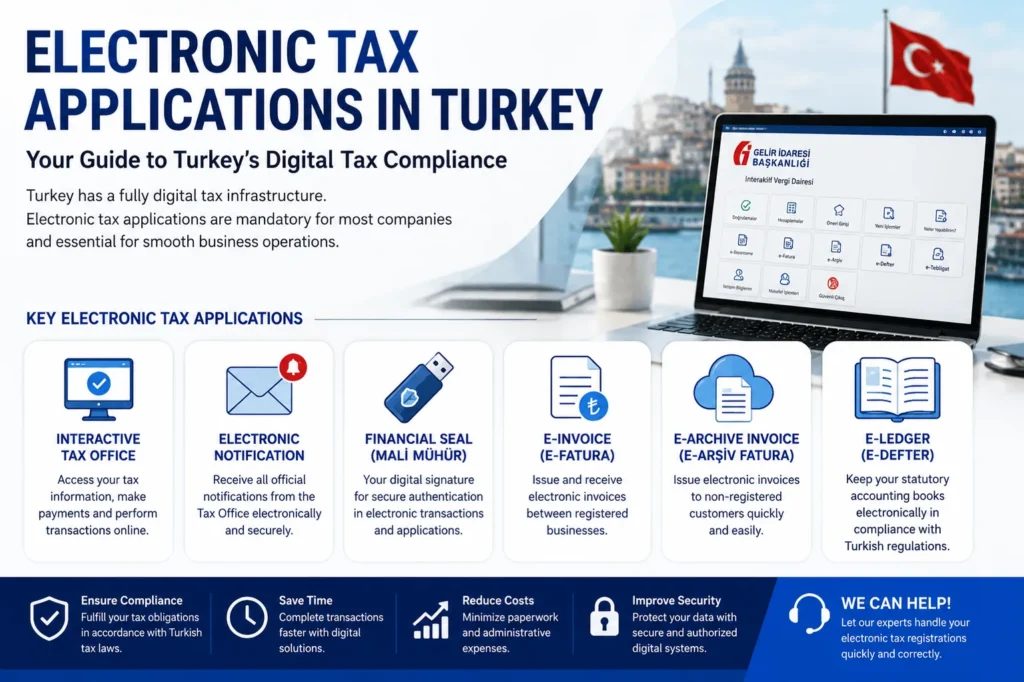
Electronic Tax Applications are a collection of digital systems developed by the Turkish Revenue Administration (GİB) to enable taxpayers to fulfill their tax obligations electronically. Instead of relying on paper documents and in-person visits to tax offices, businesses can now complete many tax-related procedures online through secure government platforms. These systems support everything from company registration and tax payments to invoice issuance, bookkeeping, and official communication with the tax authorities.
For companies operating in Turkey, electronic tax applications have become an integral part of day-to-day business operations. Shortly after incorporation, businesses are generally required to complete several electronic registrations before they can fully comply with Turkish tax legislation and begin issuing electronic tax documents where applicable.
Unlike traditional tax administration, Turkey’s digital tax infrastructure enables businesses to:
Although numerous electronic services are available, the following applications are the most important for newly established companies.
The Interactive Tax Office (İnteraktif Vergi Dairesi / Dijital Vergi Dairesi) is the primary online portal provided by the Turkish Revenue Administration. It enables taxpayers to access tax records, submit applications, monitor liabilities, make tax payments, request official documents, and manage many tax-related procedures through a single digital platform.
The e-Notification (e-Tebligat) system allows the Turkish Revenue Administration to deliver official tax notices electronically instead of by traditional mail.
Once registered, companies receive official notifications through the electronic system, making it essential to monitor the account regularly to avoid missing statutory deadlines.
The Financial Seal is a digital authentication certificate issued to legal entities. It verifies the authenticity and integrity of electronic tax documents and is generally required for businesses using electronic document systems such as e-Invoice and e-Ledger.
It serves as the company’s digital signature for many electronic tax applications.
The e-Invoice system enables businesses to issue and receive invoices electronically in accordance with Turkish tax legislation.
Electronic invoices have the same legal validity as traditional paper invoices while providing greater efficiency, security, and automation for businesses.
The e-Archive Invoice system complements the e-Invoice system by allowing businesses to issue electronic invoices to customers who are not registered e-Invoice users.
It plays an important role in business-to-consumer (B2C) transactions and many domestic commercial activities.
The e-Ledger system allows companies to maintain their statutory accounting books electronically instead of in paper format.
Businesses subject to e-Ledger obligations prepare, digitally sign, and submit their electronic accounting records in accordance with the requirements established by the Turkish Revenue Administration.
Electronic tax applications are not simply optional digital tools—they form the foundation of Turkey’s modern tax administration system.
Depending on the company’s activities and legal obligations, these systems may be required to:
For foreign investors, understanding these applications from the beginning helps prevent compliance issues and ensures a smoother company formation process.
Professional Insight: Many foreign investors assume that electronic tax applications are completed only after a company starts trading. In practice, several registrations should be completed immediately after incorporation to avoid delays in banking, invoicing, tax compliance, and other essential business operations.
One of the most common questions asked by foreign investors after establishing a company is:
“Which electronic tax applications are mandatory, and which are optional?”
The answer depends on the company’s legal structure, business activities, annual turnover, and whether it falls within the scope of the electronic document regulations issued by the Turkish Revenue Administration (TRA).
Some electronic applications are required for every company established in Turkey, while others become mandatory only if the company meets specific legal thresholds or operates in designated sectors.
| Electronic Application | Mandatory | Who Should Apply? |
|---|---|---|
| Interactive Tax Office (Digital Tax Office) | ✅ Yes | All companies |
| Electronic Notification (e-Notification) | ✅ Yes | All companies |
| Financial Seal (Mali Mühür) | ⚠️ Required for companies using electronic document systems | Companies using e-Invoice, e-Ledger and other applicable e-services |
| e-Invoice (e-Fatura) | ⚠️ Depends on legal criteria | Companies meeting the mandatory scope or applying voluntarily |
| e-Archive Invoice (e-Arşiv Fatura) | ⚠️ Usually together with e-Invoice | e-Invoice users and other eligible taxpayers |
| e-Ledger (e-Defter) | ⚠️ Depends on legal criteria | Companies subject to e-Ledger obligations |
Regardless of the company’s size or industry, every newly established company should complete the following registrations shortly after incorporation.
The Interactive Tax Office serves as the company’s primary online portal for communicating with the Turkish Revenue Administration.
It allows taxpayers to:
Every company should activate its access as part of the post-incorporation process.
Electronic Notification enables official correspondence from the Turkish Revenue Administration to be delivered electronically instead of by post.
Since official notices are legally effective once delivered through the electronic system, businesses should ensure that their e-Notification account is activated and monitored regularly.
Not every company must immediately register for every electronic document system.
Whether these applications become mandatory depends on factors such as:
The e-Invoice system is mandatory only for taxpayers falling within the scope defined by the Turkish Revenue Administration.
However, many businesses choose to adopt e-Invoice voluntarily because it simplifies invoicing, improves efficiency, and supports digital business operations.
Businesses required to use e-Invoice generally also use the e-Archive Invoice system when issuing invoices to customers who are not registered e-Invoice users.
This application is particularly important for B2C transactions and domestic sales.
The obligation to maintain electronic accounting books depends on the company’s legal obligations.
Many companies that become subject to mandatory e-Invoice are also required to transition to e-Ledger under the applicable legislation.
A Financial Seal is generally required for companies that use electronic document systems such as e-Invoice and e-Ledger.
It functions as the company’s secure digital authentication tool and enables legally valid electronic signing of tax documents.
Yes.
Even if a company is not legally required to use certain electronic tax applications, it may voluntarily register for services such as:
Many businesses choose voluntary registration to streamline accounting processes, reduce paperwork, improve operational efficiency, and prepare for future growth.
Professional Insight: Most newly established foreign-owned companies should activate their Interactive Tax Office and Electronic Notification accounts immediately after incorporation. Other electronic applications—such as e-Invoice, e-Archive Invoice, e-Ledger, and Financial Seal—should then be evaluated based on the company’s business activity, projected turnover, and legal obligations. Early planning helps avoid future compliance issues and ensures a smooth transition to Turkey’s digital tax environment.
Now that you know which electronic tax applications are mandatory, let’s examine each system in detail.
Although these applications are all part of Turkey’s digital tax infrastructure, each serves a different purpose. Some are required immediately after company incorporation, while others become mandatory only if your business meets specific legal criteria.
Understanding the role of each application will help you establish and operate your company in full compliance with Turkish tax legislation.
The Interactive Tax Office (İnteraktif Vergi Dairesi)—now integrated into the Digital Tax Office (Dijital Vergi Dairesi)—is the primary online platform provided by the Turkish Revenue Administration (TRA).
It enables taxpayers to perform a wide range of tax-related transactions electronically without visiting a Tax Office.
For most companies, this is the first electronic tax system they will use after incorporation.
The platform allows companies to manage many day-to-day tax matters, including:
As Turkey continues to digitalize its tax administration, new services are regularly added to the platform.
Yes.
Every company established in Turkey should activate access to the Interactive Tax Office immediately after completing its Tax Office registration.
Without access, companies may have difficulty monitoring their tax obligations, receiving important information, or completing many electronic tax procedures.
The Interactive Tax Office is intended for:
Using the Interactive Tax Office offers several advantages:
For foreign investors, this significantly reduces the need for in-person visits to Turkish tax offices.
Following company registration and Tax Office registration, authorized company representatives or their certified public accountant (CPA) can complete the necessary procedures to activate the company’s digital tax account.
Once activated, the company can access a wide range of electronic tax services through the Digital Tax Office platform.
Professional Insight: The Interactive Tax Office serves as the central gateway to Turkey’s electronic tax system. Many other electronic applications—including e-Notification, tax payments, petitions, and various online services—are managed through this platform. Activating it as soon as possible after incorporation helps ensure smooth tax compliance and efficient communication with the Turkish Revenue Administration.
The Electronic Notification (e-Tebligat) system is an official digital communication platform operated by the Turkish Revenue Administration (TRA). Instead of sending tax notices, assessments, penalty decisions, payment orders, and other official correspondence by post, the TRA delivers these documents electronically through a secure online system.
Today, electronic notification is one of the most important components of Turkey’s digital tax administration and plays a critical role in ensuring timely communication between taxpayers and the tax authorities.
The e-Notification system was introduced to:
Once a document is delivered through the e-Notification system, it is considered legally served in accordance with the applicable legislation.
Yes.
Electronic Notification is mandatory for all Corporate Income Tax taxpayers, including Limited Liability Companies (LLCs), Joint Stock Companies (JSCs), Branch Offices registered as corporate taxpayers, and other legal entities subject to Corporate Income Tax. Certain Income Tax taxpayers are also required to use the system.
For newly incorporated companies, registration should be completed as part of the post-incorporation tax registration process.
The Turkish Revenue Administration may send various official documents through the e-Notification system, including:
Receiving these documents electronically eliminates delays associated with traditional postal delivery.
Ignoring an electronic notification can have serious legal and financial consequences.
Many tax procedures are subject to strict statutory deadlines. If a company fails to review an electronic notification promptly, it may miss deadlines for:
For this reason, businesses should regularly monitor their e-Notification account or authorize their Certified Public Accountant (CPA) to do so on their behalf.
Once registration has been completed, authorized users can access their electronic notifications through the Digital Tax Office (Dijital Vergi Dairesi) using their authorized credentials.
Companies may also authorize their CPA or another representative, where legally permitted, to monitor and manage electronic notifications on their behalf.
A common misconception among foreign investors is that a notification becomes legally effective only after it has been opened or read.
This is not the case.
Under the applicable legislation, an electronic notification is deemed to have been legally served after the statutory notification period prescribed by law, regardless of whether the recipient has actually opened or read it. Consequently, failing to monitor the system does not prevent legal deadlines from running.
Foreign-owned companies should establish an internal procedure to ensure that electronic notifications are reviewed regularly.
Many international businesses appoint their Turkish CPA to monitor the Digital Tax Office and notify management immediately whenever an important tax notice is received. This helps minimize compliance risks and ensures that statutory deadlines are not missed.
Professional Insight: Among all electronic tax applications, e-Notification is arguably the most critical because it is the official communication channel between your company and the Turkish Revenue Administration. Even if your company has no tax debt or ongoing audit, monitoring electronic notifications regularly is essential to protect your legal rights and maintain full tax compliance.
The Financial Seal (Mali Mühür) is a secure electronic certificate issued to legal entities in Turkey. It functions as the digital equivalent of a company’s official stamp and is used to verify the authenticity, integrity, and origin of electronic tax documents. Rather than signing paper documents manually, companies use the Financial Seal to digitally sign electronic documents submitted through the Turkish Revenue Administration’s (TRA) electronic systems.
For companies operating in Turkey, the Financial Seal is one of the most important components of the country’s electronic tax infrastructure. Without it, many electronic tax applications cannot be activated or used.
The Financial Seal is designed to:
In simple terms, the Financial Seal performs the same function in the digital environment as a company stamp and an authorized signature do on paper documents.
The Financial Seal is not mandatory for every company immediately after incorporation.
However, it becomes mandatory for legal entities that are required to use certain electronic document systems, including:
Many newly established companies choose to obtain a Financial Seal shortly after incorporation to prepare for future electronic tax obligations and avoid delays when transitioning to electronic document systems.
Financial Seals are issued exclusively by the Public Certification Center (Kamu SM), which operates under TÜBİTAK BİLGEM and is the only authorized provider of Financial Seal certificates in Turkey.
Applications are submitted online, and once approved, the certificate is delivered to the applicant.
A Financial Seal is commonly used for:
As companies adopt additional electronic tax applications, the Financial Seal becomes an essential tool in their day-to-day operations.
In most cases, the Financial Seal is issued as a USB token or smart card containing the company’s electronic certificate.
For businesses with high-volume electronic document processing, hardware security module (HSM) solutions are also available, allowing secure centralized signing of electronic documents.
Financial Seal certificates are issued for a fixed validity period and must be renewed before they expire to ensure uninterrupted access to electronic tax applications. Companies should monitor expiration dates carefully to avoid disruptions in electronic invoicing and other digital tax processes.
Yes.
With the appropriate authorization or Power of Attorney, a Certified Public Accountant (CPA) or professional advisor may assist companies with the Financial Seal application process and the subsequent activation of electronic tax applications.
This is particularly beneficial for foreign investors who are unable to complete the procedures in person.
Although some companies are not legally required to obtain a Financial Seal immediately after incorporation, applying early is often recommended if the business expects to use electronic invoicing or other digital tax systems in the near future.
Obtaining the certificate in advance helps avoid delays when mandatory electronic document obligations arise and ensures a smoother transition to Turkey’s digital tax environment.
Professional Insight: A common misconception is that obtaining a Financial Seal automatically activates e-Invoice or e-Ledger. In reality, the Financial Seal is only the digital authentication certificate. Separate applications must still be submitted to the Turkish Revenue Administration to register for each electronic document system
The e-Invoice (e-Fatura) system is Turkey’s official electronic invoicing platform developed by the Turkish Revenue Administration (TRA). It enables businesses to issue, transmit, receive, and store invoices electronically instead of using paper invoices.
An e-Invoice has the same legal validity as a traditional paper invoice. The difference is that it is created, exchanged, and archived entirely in electronic format in accordance with the standards established by the Turkish Revenue Administration.
Today, e-Invoice is one of the cornerstones of Turkey’s digital tax system and is widely used by companies of all sizes.
The e-Invoice system was introduced to modernize invoicing and improve tax compliance by:
For businesses issuing hundreds or thousands of invoices each month, e-Invoice significantly improves operational efficiency.
It depends.
Not every company is required to use e-Invoice immediately after incorporation.
The obligation depends on various criteria determined by the Turkish Revenue Administration, including:
Companies that do not fall within the mandatory scope may still apply voluntarily and begin using the e-Invoice system.
The e-Invoice system is available to:
Many startups and foreign-owned companies voluntarily adopt e-Invoice from the beginning to establish a fully digital accounting system.
Unlike paper invoices sent by email or post, e-Invoices are exchanged through the Turkish Revenue Administration’s electronic infrastructure or via authorized private integrators.
A typical process is:
Businesses using e-Invoice benefit from:
These advantages are particularly valuable for businesses with frequent invoicing activity.
Yes.
Legal entities generally need a Financial Seal (Mali Mühür) to activate and use the e-Invoice system, unless they use another legally accepted authentication method permitted under the applicable regulations.
The Financial Seal verifies the company’s identity and ensures the authenticity of electronically issued invoices.
Many foreign investors wonder whether e-Invoices are legally different from paper invoices.
The answer is no.
Both documents have the same legal validity under Turkish tax legislation. The primary difference lies in the method of issuance, transmission, storage, and verification.
Yes.
Foreign-owned companies established in Turkey may register for the e-Invoice system provided they satisfy the applicable legal requirements.
Many international companies choose to implement e-Invoice immediately after incorporation to simplify accounting, improve operational efficiency, and facilitate electronic document management.
Even if your company is not yet legally required to use e-Invoice, adopting the system voluntarily can provide long-term operational benefits. It reduces paperwork, streamlines invoicing, integrates easily with modern accounting software, and prepares your business for future digital compliance requirements.
Professional Insight: A common misconception is that every invoice issued electronically is an e-Invoice. In reality, e-Invoice (e-Fatura) can only be exchanged between users registered in the e-Invoice system. When issuing an electronic invoice to a customer who is not an e-Invoice user, businesses generally use the e-Archive Invoice (e-Arşiv Fatura) system instead.
The e-Archive Invoice (e-Arşiv Fatura) system is an electronic invoicing application developed by the Turkish Revenue Administration (TRA) that allows businesses to issue invoices electronically to customers who are not registered in the e-Invoice (e-Fatura) system.
While e-Invoice is used exclusively between registered e-Invoice users, e-Archive Invoice extends electronic invoicing to all other customers, including individual consumers and businesses that are not part of the e-Invoice network. It enables companies to create, send, archive, and report invoices electronically while maintaining the same legal validity as traditional paper invoices.
The e-Archive Invoice system was introduced to expand digital invoicing beyond the e-Invoice network.
Its main objectives are to:
Today, many businesses issue thousands of e-Archive invoices every month without producing a single paper invoice.
An e-Archive Invoice is generally issued when the recipient is not registered in the e-Invoice system.
Typical examples include:
In many cases, the invoice is delivered electronically by email, while the issuing company retains and archives the document electronically in accordance with legal requirements.
It depends.
Companies that become subject to mandatory e-Invoice obligations are generally also required to use the e-Archive Invoice system whenever they issue invoices to customers who are not e-Invoice users.
Businesses that are not legally required to use e-Invoice may also voluntarily adopt e-Archive Invoice if they wish to digitize their invoicing processes.
Many foreign investors confuse these two systems.
The distinction is straightforward:
Together, these two systems enable businesses to issue electronic invoices to virtually all customers.
Using e-Archive Invoice offers several advantages:
For businesses serving large numbers of retail or online customers, these benefits can result in significant time and cost savings.
Yes.
Foreign-owned companies established in Turkey may register for the e-Archive Invoice system once they satisfy the applicable legal and technical requirements.
Many international businesses implement both e-Invoice and e-Archive Invoice simultaneously to create a fully digital invoicing process from the outset.
If your company expects to issue invoices to both business customers and individual consumers, implementing both e-Invoice and e-Archive Invoice from the beginning can simplify operations and eliminate the need for paper invoicing. This is particularly beneficial for companies engaged in e-commerce, professional services, retail, and international trade, where customers may or may not be registered e-Invoice users.
Professional Insight: A common misconception is that e-Archive Invoice replaces e-Invoice. In reality, the two systems complement each other. Businesses issue e-Invoices to registered e-Invoice users and e-Archive Invoices to everyone else, ensuring that all invoices can be generated electronically regardless of the recipient’s status.
The e-Ledger (e-Defter) system is Turkey’s official electronic bookkeeping system developed by the Turkish Revenue Administration (TRA). It enables businesses to maintain their statutory accounting books electronically instead of using traditional paper ledgers.
Under the e-Ledger system, the Journal Book (Yevmiye Defteri) and the General Ledger (Defter-i Kebir) are prepared in a standardized electronic format, digitally authenticated, and maintained in accordance with the requirements of the Tax Procedure Law and the Turkish Commercial Code.
For companies subject to the e-Ledger obligation, paper accounting books are replaced by legally recognized electronic records.
The e-Ledger system was introduced to modernize accounting records and improve tax compliance by:
Electronic ledgers also help ensure that accounting records remain authentic, complete, and tamper-resistant throughout the statutory retention period.
The e-Ledger system primarily covers two mandatory statutory books:
These books are generated electronically from the company’s accounting records and prepared in the format prescribed by the Turkish Revenue Administration.
It depends.
Not every company must use e-Ledger immediately after incorporation.
The obligation generally applies to taxpayers that fall within the mandatory scope determined by the Turkish Revenue Administration. In many cases, businesses that become subject to mandatory e-Invoice obligations are also required to transition to the e-Ledger system. Additional sector-specific rules may also apply.
Companies outside the mandatory scope may choose to adopt e-Ledger voluntarily where permitted.
A typical e-Ledger process consists of the following steps:
Using e-Ledger provides several important advantages:
For businesses with high transaction volumes, e-Ledger significantly reduces administrative workload while improving operational efficiency.
Yes.
Legal entities using the e-Ledger system generally require a Financial Seal (Mali Mühür) to authenticate their electronic ledger files before submission.
Without a valid Financial Seal, companies cannot complete the digital authentication process required for e-Ledger compliance.
Yes.
Foreign-owned companies established in Turkey may register for the e-Ledger system once they become subject to the applicable legal requirements or choose to participate voluntarily where permitted.
Many multinational companies implement e-Ledger alongside e-Invoice and e-Archive Invoice to maintain a fully digital accounting environment.
Businesses expecting significant growth should assess their future e-Ledger obligations early in the company formation process. Implementing compatible accounting software and digital compliance procedures from the outset can make the transition much smoother if the company later becomes subject to mandatory e-Ledger requirements.
Professional Insight: A common misconception is that e-Ledger replaces accounting records. It does not. Companies must still maintain accurate bookkeeping in accordance with Turkish accounting and tax regulations. The e-Ledger system simply provides the legally prescribed electronic format for maintaining and authenticating the statutory accounting books required by law.
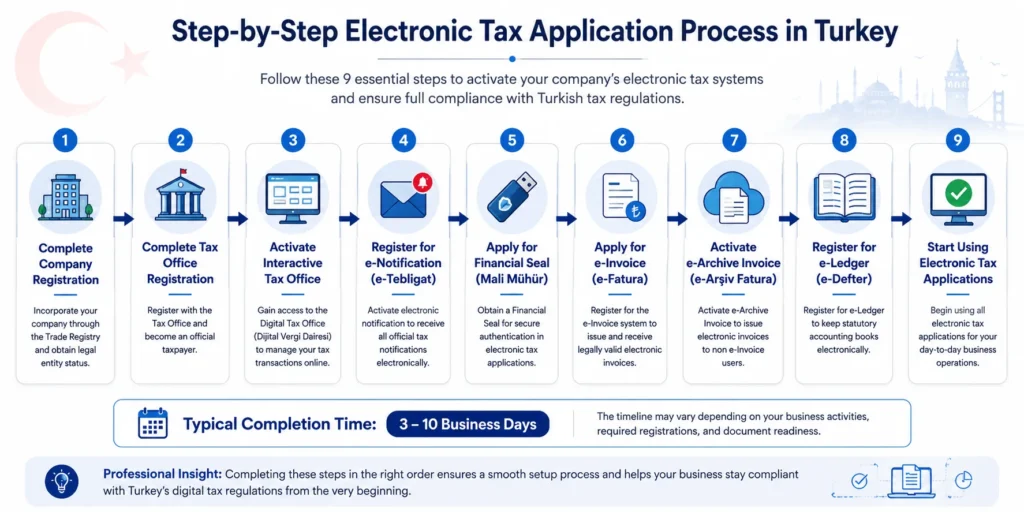
After completing the company registration process, businesses must activate several electronic tax systems before they can fully comply with Turkish tax regulations and begin using digital tax services.
Although the exact requirements vary depending on the company’s activities and legal obligations, the overall process generally follows the same sequence.
Before applying for any electronic tax services, you must first establish your company in Turkey.
The incorporation process includes selecting the appropriate company type, preparing the Articles of Association, obtaining Tax Identification Numbers for foreign shareholders, completing Trade Registry registration, and registering the company with the relevant authorities.
Related Guide: Company Registration in Turkey
Once the company has been incorporated, it must complete its Tax Office registration and become an official taxpayer.
Only after this registration can the company activate and use Turkey’s electronic tax systems, including the Interactive Tax Office, Electronic Notification (e-Notification), Financial Seal, e-Invoice, e-Archive Invoice, and e-Ledger.
Related Guide: Tax Office Registration in Turkey
The company should activate access to the Interactive Tax Office (Dijital Vergi Dairesi).
This platform serves as the primary portal for managing tax obligations, submitting applications, paying taxes, monitoring liabilities, and accessing various online tax services.
The company should then complete its Electronic Notification (e-Tebligat) registration.
Once activated, all official tax notifications from the Turkish Revenue Administration will be delivered electronically through this system.
If the company is required—or plans—to use electronic document systems such as e-Invoice or e-Ledger, the next step is to obtain a Financial Seal.
The Financial Seal serves as the company’s official digital authentication certificate.
Companies that fall within the mandatory scope—or those choosing voluntary participation—should complete their e-Invoice (e-Fatura) registration.
This enables them to issue and receive legally valid electronic invoices.
Companies using e-Invoice generally also activate the e-Archive Invoice (e-Arşiv Fatura) system.
This allows electronic invoices to be issued to customers who are not registered e-Invoice users.
Businesses subject to electronic bookkeeping obligations should complete their e-Ledger (e-Defter) registration.
This enables statutory accounting books to be maintained electronically in accordance with Turkish legislation.
Once all required registrations have been completed, the company can begin using Turkey’s electronic tax infrastructure for its day-to-day operations.
Depending on the company’s activities, this may include:
For most newly incorporated companies, the entire electronic tax application process can usually be completed within 3–10 business days, depending on:
Companies with more complex operational structures or regulated activities may require additional registrations.
Professional Insight: Rather than treating each electronic tax application as a separate task, businesses should complete them as part of a coordinated post-incorporation checklist. This approach minimizes delays, ensures uninterrupted business operations, and helps companies achieve full compliance with Turkey’s digital tax system from the outset.
Before applying for Turkey’s electronic tax systems, companies should ensure that all required corporate and tax documents have been prepared.
The exact documentation may vary depending on the electronic application being requested. For example, applying for e-Notification requires different information than registering for e-Invoice or obtaining a Financial Seal (Mali Mühür).
However, most newly established companies will generally need the following documents during the application process.
The company’s Tax Identification Number issued by the Turkish Tax Office is required for virtually all electronic tax applications.
Without an active tax registration, electronic tax services cannot be activated.
A copy of the Trade Registry Gazette showing the company’s incorporation and registration details is commonly requested during various electronic application procedures.
The company’s Articles of Association may be required to verify the company’s legal structure, authorized representatives, and registered business information.
The Signature Circular (İmza Sirküleri) identifies the individuals authorized to represent and sign on behalf of the company.
Many electronic application procedures require verification of the company’s authorized signatories.
The Turkish identity card or passport of the company’s authorized representative may be requested during certain applications, particularly when identity verification is required.
For foreign-owned companies, a valid passport is generally sufficient.
Applications for electronic document systems such as e-Invoice and e-Ledger generally require a valid Financial Seal issued by the Public Certification Center (Kamu SM).
If the applications are submitted by a Certified Public Accountant (CPA), attorney, or another authorized representative, a properly executed Power of Attorney (PoA) or other authorization document may be required depending on the specific procedure.
This is particularly common for foreign investors who authorize professional advisors to complete the registration process on their behalf.
Depending on the electronic tax application and the company’s specific circumstances, the Turkish Revenue Administration or the relevant authority may request additional documents or information.
These may include:
Yes.
Preparing the necessary documents before starting the electronic tax application process can significantly reduce processing times and help avoid unnecessary delays.
Many foreign investors choose to authorize their Turkish CPA to coordinate the entire process, ensuring that all required documents are submitted correctly and in accordance with current legislation.
Professional Insight: Most delays in electronic tax applications are not caused by the approval process itself, but by incomplete documentation or missing authorizations. Preparing the required documents immediately after company incorporation allows businesses to activate Turkey’s electronic tax systems more quickly and begin operations without unnecessary interruptions.
One of the most common questions foreign investors ask after incorporating a company is:
“How much do electronic tax applications cost in Turkey?”
The answer depends on which electronic tax applications your company is required to use.
Some applications, such as the Interactive Tax Office and Electronic Notification, are provided by the Turkish Revenue Administration free of charge. Others, such as the Financial Seal, e-Invoice, and e-Ledger, involve one-time setup fees and, in some cases, annual service or software costs depending on the service provider you choose.
| Electronic Application | Estimated Cost (EUR) | Notes |
|---|---|---|
| Interactive Tax Office | Free | Government online portal |
| Electronic Notification (e-Notification) | Free | Mandatory registration |
| Financial Seal (Mali Mühür) | €100 – €200 | Depends on certificate validity and device type |
| e-Invoice Setup | €100 – €500 | Varies depending on the software provider or private integrator |
| e-Archive Invoice Setup | Usually Included | Often included with e-Invoice services |
| e-Ledger Setup | €500 – €1,000 | Initial setup and integration costs |
| Annual e-Ledger Maintenance | €100 – €300 | Storage, updates, and technical support |
| CPA / Professional Assistance (Optional) | Varies | If outsourced to an accounting or consulting firm |
It is important to distinguish between government fees and private service costs.
The Turkish Revenue Administration does not charge businesses for activating services such as:
However, businesses typically incur costs for:
These costs vary depending on the selected software provider and the company’s operational requirements.
Yes.
Although the mandatory government registrations are relatively inexpensive, foreign-owned companies should include electronic tax application costs in their overall company formation budget.
In practice, the largest expenses usually relate to:
These are generally one-time implementation costs, while software subscriptions or maintenance services may be billed annually.
Absolutely.
Many foreign investors prefer to authorize their Turkish Certified Public Accountant (CPA) to complete all electronic tax applications on their behalf.
This approach offers several advantages:
For businesses unfamiliar with the Turkish tax system, professional assistance often saves considerable time and helps avoid compliance issues.
Professional Insight: The cost of implementing electronic tax applications is relatively modest compared to the potential penalties and operational disruptions that may result from delayed or incorrect registrations. Completing the required applications correctly from the outset allows businesses to operate efficiently and remain fully compliant with Turkey’s digital tax regulations.
Turkey’s electronic tax system is designed to simplify tax compliance. However, many foreign investors encounter delays or compliance issues not because the procedures are complicated, but because certain applications are overlooked or completed incorrectly.
Understanding the most common mistakes can help businesses avoid unnecessary costs, administrative penalties, and operational disruptions.
Some investors assume that electronic tax registrations can wait until the company begins trading.
In reality, several electronic applications—particularly Interactive Tax Office and Electronic Notification (e-Tebligat)—should be completed immediately after the company’s Tax Office registration.
Delaying these registrations may postpone banking, invoicing, and other essential business operations.
One of the most serious mistakes is failing to monitor the Electronic Notification (e-Tebligat) account.
Official tax notices, payment orders, audit requests, and other legal communications are delivered electronically.
Missing an electronic notification does not prevent statutory deadlines from taking effect and may result in penalties or loss of appeal rights.
Not every newly established company is required to use e-Invoice (e-Fatura) immediately.
The obligation depends on the company’s business activity and the criteria determined by the Turkish Revenue Administration.
Many companies voluntarily adopt e-Invoice, while others become subject to mandatory registration only after meeting specific legal requirements.
Many foreign investors believe these systems are identical.
They are not.
Understanding the distinction helps businesses implement the correct invoicing process from the beginning.
A common misconception is that companies can activate e-Invoice immediately after incorporation.
For most legal entities, obtaining a Financial Seal (Mali Mühür) is a prerequisite before activating e-Invoice and certain other electronic document systems.
Completing these steps in the correct order helps avoid unnecessary delays.
Many businesses postpone electronic tax applications until they become legally mandatory.
While this approach is permissible in some cases, it may create operational challenges, especially if the company begins growing rapidly or starts working with large corporate customers.
Voluntary registration can make future compliance much easier.
Not all accounting software integrates seamlessly with Turkey’s electronic tax infrastructure.
Before selecting an accounting solution, companies should verify that it supports:
This is particularly important for foreign companies planning to use international ERP systems.
Turkey’s electronic tax regulations are updated periodically.
Although many applications appear straightforward, choosing the wrong registration sequence or overlooking a legal obligation may result in unnecessary delays or compliance risks.
Working with an experienced Turkish CPA can significantly simplify the process and help ensure that all registrations are completed correctly.
To ensure efficient implementation of electronic tax applications, businesses should:
Professional Insight: Most problems encountered during electronic tax registration are procedural rather than technical. Following the correct sequence—Tax Office Registration → Interactive Tax Office → e-Notification → Financial Seal → e-Invoice/e-Archive → e-Ledger (if applicable)—greatly reduces the risk of delays and helps businesses achieve full compliance from the outset.
Turkey’s tax administration has undergone a remarkable digital transformation, making electronic tax applications an essential part of doing business in the country. Today, almost every company interacts with the Turkish Revenue Administration through digital platforms, whether for receiving official notifications, issuing electronic invoices, maintaining electronic accounting records, or managing day-to-day tax obligations.
For foreign investors, understanding these electronic systems is just as important as completing the company incorporation process itself. Activating the required electronic tax applications at the right time helps businesses operate efficiently, remain compliant with Turkish tax legislation, and avoid unnecessary delays or administrative penalties.
Although the number of electronic applications may initially seem overwhelming, they generally fall into six key categories:
When implemented correctly, these applications simplify tax compliance, reduce paperwork, improve operational efficiency, and support the digital management of your business.
If you are planning to establish a company in Turkey, electronic tax applications should not be treated as an afterthought.
Instead, they should be integrated into your overall company formation plan.
A well-organized implementation process should include:
Following this sequence will help ensure that your business is fully prepared to meet Turkey’s digital tax requirements from day one.
Setting up Turkey’s electronic tax systems involves more than simply completing online applications. Each company’s obligations depend on its legal structure, business activities, anticipated turnover, and the latest requirements issued by the Turkish Revenue Administration.
At A&M Consulting Co., we assist foreign investors with every stage of the electronic tax registration process, including:
Whether you are establishing a Limited Liability Company (LLC), Joint Stock Company (JSC), Branch Office, or another business entity in Turkey, our team can help ensure that your electronic tax applications are completed accurately, efficiently, and in full compliance with Turkish legislation.
Contact us today to receive professional assistance with your electronic tax registrations and start your business in Turkey with confidence.
Electronic tax applications are digital systems provided by the Turkish Revenue Administration (TRA) that allow businesses to manage tax-related procedures online, including tax registration, electronic invoicing, electronic bookkeeping, tax payments, and official tax communications.
Yes. Certain electronic applications, such as the Interactive Tax Office and Electronic Notification (e-Notification), are mandatory for most companies. Other applications, including e-Invoice and e-Ledger, become mandatory only if the company meets specific legal requirements.
Most companies should activate:
Additional applications depend on the company’s business activities and legal obligations.
Toggle Content
No. e-Invoice is mandatory only for taxpayers falling within the scope determined by the Turkish Revenue Administration. Companies outside the mandatory scope may also register voluntarily.
e-Invoice is exchanged only between businesses registered in the e-Invoice system.
e-Archive Invoice is used when issuing invoices to customers who are not registered e-Invoice users.
A Financial Seal is generally required for companies using electronic document systems such as e-Invoice and e-Ledger.
The Financial Seal is issued exclusively by Kamu SM (Public Certification Center) operating under TÜBİTAK BİLGEM.
Yes. Foreign-owned companies incorporated in Turkey can use the same electronic tax systems as Turkish companies, provided they satisfy the applicable legal requirements.
Yes. A Certified Public Accountant (CPA) or another authorized representative may complete many electronic tax application procedures on your behalf with the appropriate authorization.
For most newly established companies, the required registrations can usually be completed within 3–10 business days, depending on the company’s activities and the applications required.
Some services, such as the Interactive Tax Office and Electronic Notification, are free of charge. Others, including the Financial Seal, e-Invoice integration, and e-Ledger implementation, may involve setup or annual service fees.
Not always. Most companies must first complete their Tax Office registration and, where required, obtain a Financial Seal before activating the e-Invoice system.
No. The obligation depends on the company’s legal status, business activities, and the criteria established by the Turkish Revenue Administration.
Official notifications are legally effective even if you do not read them. Ignoring them may cause you to miss payment deadlines, appeal periods, or requests from the tax authorities.
Only if your company is not legally required to use the e-Invoice system. Companies subject to mandatory e-Invoice obligations must comply with the applicable electronic invoicing rules.
Yes. Many companies voluntarily adopt e-Invoice before it becomes mandatory to improve efficiency and prepare for future compliance requirements.
Typical documents include:
Yes. Many international ERP systems can integrate with Turkey’s electronic tax infrastructure through authorized private integrators or customized integration solutions.
Although incorporation may be completed, companies cannot fully comply with Turkish tax obligations without activating the electronic systems required for their business activities.
A Turkish CPA can manage registrations, monitor compliance, coordinate with the Tax Office, assist with Financial Seal applications, and ensure that all electronic tax obligations are completed correctly and on time.
Contact A&M Consulting Co. for professional assistance with Electronic Tax Applications in Turkey. We help foreign investors complete the entire digital tax registration process, including:
Our experienced CPAs ensure that your company is fully registered and compliant with Turkish tax regulations, allowing you to focus on growing your business with confidence.
Share:


Follow us!
WhatsApp Us