

Summarize this article with AI
A Joint Stock Company (JSC) is a popular corporate structure in Turkey, especially for large-scale businesses. The Turkish Commercial Code (TCC) governs the formation, operation, and dissolution of JSCs, making them one of the most flexible and widely adopted business entities in the country. This article will provide a detailed overview of Joint Stock Companies in Turkey, covering their formation, legal structure, governance
A Joint Stock Company (JSC) in Turkey is a legal entity where the capital is divided into shares, and the liability of shareholders is limited to the value of their shares. This type of company is often chosen for medium to large-scale businesses, especially those considering public offerings or seeking to raise capital through investors. JSCs are governed by the Turkish Commercial Code (TCC), which outlines the rights and obligations of shareholders, directors, and the company.

Joint-stock companies are required to withhold taxes on the following payments and remit them to the tax office on behalf of the recipient:
Need more detail about Turkish Tax System? Click then.
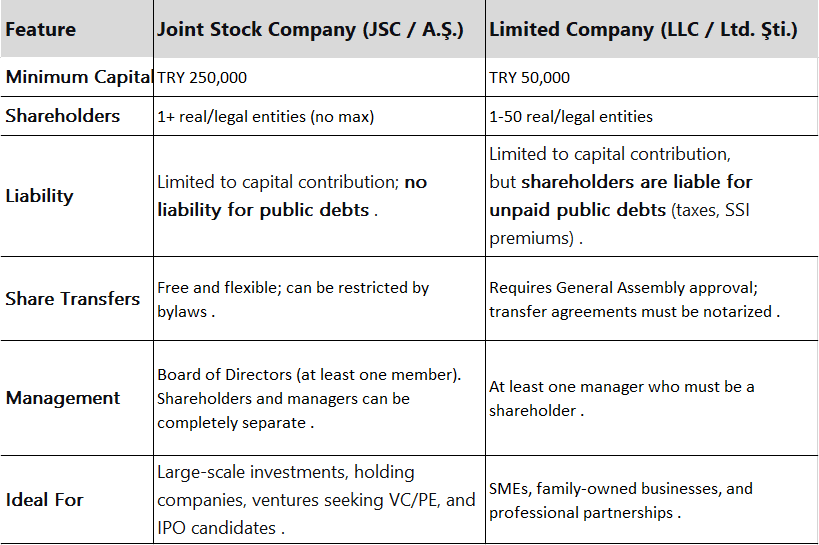
While the Limited Liability Company (LLC) is popular for small to medium-sized enterprises, the JSC is the preferred vehicle for larger ventures, those seeking investment, or operating in regulated sectors. Here are the critical distinctions:
The establishment process is centralized and streamlined through the MERSIS (Merkezi Sicil Kayıt Sistemi) online portal .
Capital Commitment: Determine your capital. The minimum is TRY 250,000. At least 25% must be paid in cash before registration, with the remaining 75% due within 24 months of incorporation . The paid-in portion must be blocked in a Turkish bank account, and a “blockage letter” is obtained .
Draft the Articles of Association: Prepare the company’s bylaws (ana sözleşme) in Turkish. While templates exist, it is advisable to customize them to include specific governance rules, share classes, and shareholder rights .
Submit via MERSIS: Log into the MERSIS system and upload the drafted articles of association and founder information.
Deposit Fees: Pay the required fee to the Competition Authority (four ten-thousandths of the capital) and obtain a receipt .
Trade Registry Application: Submit all documents (articles, bank blockage letter, competition fee receipt, ID documents, and notarized signature declarations) to the relevant Trade Registry Office. If all documents are in order, registration is typically completed within a few days .
Post-Registration Formalities:
Apply for e-ledger & e- invoice .
Obtain a signature circular from a notary .
Register with the Tax Office and the Social Security Institution (SGK) if hiring employees .
Resolve the capital blockage at the bank using your new registration certificate
1. Initial Capital Requirement
2. Regulatory Compliance
3. Operational Complexity
A Joint Stock Company in Turkey offers numerous advantages, including limited liability, ease of raising capital, and a formal governance structure. However, it also comes with challenges, such as the need for significant initial capital and compliance with regulatory requirements. For businesses looking to operate on a larger scale, particularly those with plans to go public or attract significant investment, a JSC is often the ideal corporate structure.
When considering forming a Joint Stock Company in Turkey, it is crucial to consult with Turkish Tax Advisors to ensure compliance with Turkish laws and to optimize the company’s operations for success.
A&M Consulting Co. is a Turkish Accounting and Tax Consultancy company specialized in providing end-to-end company establishment services for especially global investor and foreign entrepreneurs which wants to walk into to Turkey’s market
We continue to offer cost-effective solutions to global and individual entrepreneurs who want to enter the Turkish market smoothly and quickly, to ensure their full compliance with local legislation and to facilitate their access to tax exemptions and incentives.
DISCOVER OUR SERVICES:
You can reach out to our experienced consultans via email or by filling out the Contact Form on our website’s contact page
The minimum capital required is 250,000 Turkish Lira for private JSCs and 500,000 Turkish Lira for publicly held JSCs.
Yes, foreigners can establish a JSC in Turkey, either as individuals orcorparate.
Yes, JSCs may be subject to an independent audit if they meet certain size and turnover criteria.
The documents required to establish a joint stock company in Turkey vary depending on whether the shareholders are individual or corporate entities.
For Individual Shareholders:
For Corporate Shareholders:
Forming a JSC in Turkey typically costs about 4,000 – 5,000 EUR. This includes:
Establishment fees and costs may be higher for free zones or Technoparks.
The duration of the establishment of a JSC may vary depending on whether the shareholders are exist in Turkey phizicilly or not and whether they are indivicual or legal entities.
While this period is 1-3 days for indivicual founders located in Turkey, it may be longer for corparate and founders outside of Turkey.
Yes, a Joint Stock Company in Turkey can be established by a single real person or a single legal entity . There is no upper limit on the maximum number of shareholders .
“Capital blockage” refers to the requirement to deposit the initial 25% cash capital payment into a special temporary bank account opened in the company’s name before registration. The bank issues a “blockage letter” (bloke mektubu) confirming the funds are deposited. After the company is officially registered and receives its registration certificate, it can then resolve the blockage and freely use these funds for business operations .
The Board is responsible for the high-level management and representation of the company. The Turkish Commercial Code grants the Board certain non-delegable powers, including:
High-level management and direction of the company .
Oversight of accounting, financial auditing, and internal systems .
Supervision of managers and personnel with managerial duties .
Formation of risk detection committees, if required
Recent Posts


WhatsApp Us