

Summarize this article with AI
Amending the Articles of Association in Turkey is a high-impact legal process governed by strict procedural and regulatory requirements. While the process is standardized, it requires careful planning, proper documentation, and compliance with the Turkish Commercial Code.
For investors and companies operating in Turkey, understanding and correctly executing AoA amendments is essential for maintaining legal validity, operational flexibility, and long-term growth.
This guide provides a structured overview of the legal grounds, procedural steps, and regulatory requirements for amending the Articles of Association in Turkey in 2026.
The Articles of Association (AoA)—known in Turkish as Esas Sözleşme—is the founding legal document of a company. It serves as the “constitution” or “by-laws” of the corporate entity, defining its internal governance framework, operational boundaries, capital structure, and the rights and obligations of shareholders.
Under the Turkish Commercial Code No. 6102 (TCC) , every joint-stock company (anonim şirket) and limited liability company (limited şirket) must have a notarized and registered Articles of Association before it can be officially established. This publicly available document covers essential elements such as:
The company’s trade name, legal seat (headquarters), and duration.
The company’s business purpose and scope of activities.
The amount and type of share capital, including share classes and nominal values.
The structure, powers, and decision-making rules of the Board of Directors.
Shareholders’ voting rights, dividend entitlements, and pre-emptive rights.
Rules for general assembly meetings and profit distribution.
Procedures for liquidation in case of dissolution.
Any deviation from the rules set forth in the AoA is considered invalid unless the document itself permits such flexibility. Because the AoA binds both the company and all its shareholders, amending it is a strictly regulated process that requires formal board proposals, general assembly resolutions, notarization, and state approvals.
For any company, the Articles of Association is the fundamental document defining its internal governance, capital structure, and operational boundaries. In Turkey, governed primarily by the Turkish Commercial Code No. 6102 (TCC) , amending this “corporate constitution” is a strictly regulated process. Whether driven by capital needs, strategic restructuring, or legal compliance, a company must navigate a multi-layered procedure involving board proposals, general assembly resolutions, notarization, and state approvals.
Amending the Articles of Association is not a routine administrative task—it is a strategic corporate action often triggered by significant internal developments or external pressures. Companies in Turkey pursue amendments for a variety of business-critical reasons, including:
Capital Increases: Raising additional equity from existing shareholders or new investors to fund expansion, acquire assets, or meet regulatory capital requirements.
Capital Reductions: Decreasing capital to offset accumulated losses or return excess capital to shareholders.
Authorized Capital Updates: For companies operating under the registered capital system (primarily joint-stock companies), raising the authorized capital ceiling to allow future issuances without a full amendment each time.
Trade Name or Brand Changes: Following mergers, rebranding efforts, or changes in ownership.
Legal Seat Relocation: Moving the company’s headquarters to a different city or, in rare cases, abroad (which requires unanimous shareholder approval).
Business Scope Expansion or Restriction: Adding new commercial activities or discontinuing obsolete ones to reflect strategic pivots.
Board of Directors Restructuring: Changing the number of board members, their appointment procedures, or their authority limits.
Management Representation: Adjusting signature authorities and who can legally bind the company.
General Assembly Rules: Modifying meeting quorums, voting thresholds, or dividend distribution policies.
Share Transfer Restrictions: Introducing or removing pre-emptive rights or approval requirements for share transfers, particularly in family-owned or closely held companies.
Privileged Shares: Creating, modifying, or eliminating shares with special voting rights, dividend preferences, or veto powers.
Pre-emptive Rights: Adjusting shareholders’ rights to subscribe to new share issuances.
Alignment with TCC Amendments: Updating outdated clauses to comply with changes in the Turkish Commercial Code or other applicable laws.
Sector-Specific Requirements: Meeting regulations imposed by supervisory bodies such as the Banking Regulation and Supervision Agency (BDDK) or the Energy Market Regulatory Authority (EPDK).
Deadlock Solutions: Amending governance provisions to resolve shareholder deadlocks that paralyze decision-making.
Exit Mechanisms: Creating or clarifying buy-sell provisions (drag-along, tag-along rights) to facilitate smooth ownership transitions.
In essence, companies amend their Articles of Association when the existing document no longer reflects the economic, operational, or legal reality of the business. Failing to amend when necessary can lead to governance disputes, regulatory penalties, or missed strategic opportunities.
This guide provides a structured overview of the legal grounds, procedural steps, and regulatory requirements for amending the Articles of Association in Turkey in 2026.
Companies typically seek amendments for several strategic or operational reasons. The most common triggers include:
Capital Adjustments: Either increasing the share capital to secure new funding or decreasing it due to losses. In the registered capital system, this often involves raising the authorized capital ceiling.
Structural Changes: Changing the company’s trade name, address, or business scope.
Governance Revisions: Modifying the structure of the Board of Directors, share transfer restrictions, or shareholder privileges.
Regulatory Compliance: Updating clauses to align with new mandatory provisions of the TCC or sector-specific regulations.
Regardless of the reason, any amendment must respect the “indispensable rights” of shareholders and cannot violate mandatory provisions of the law.
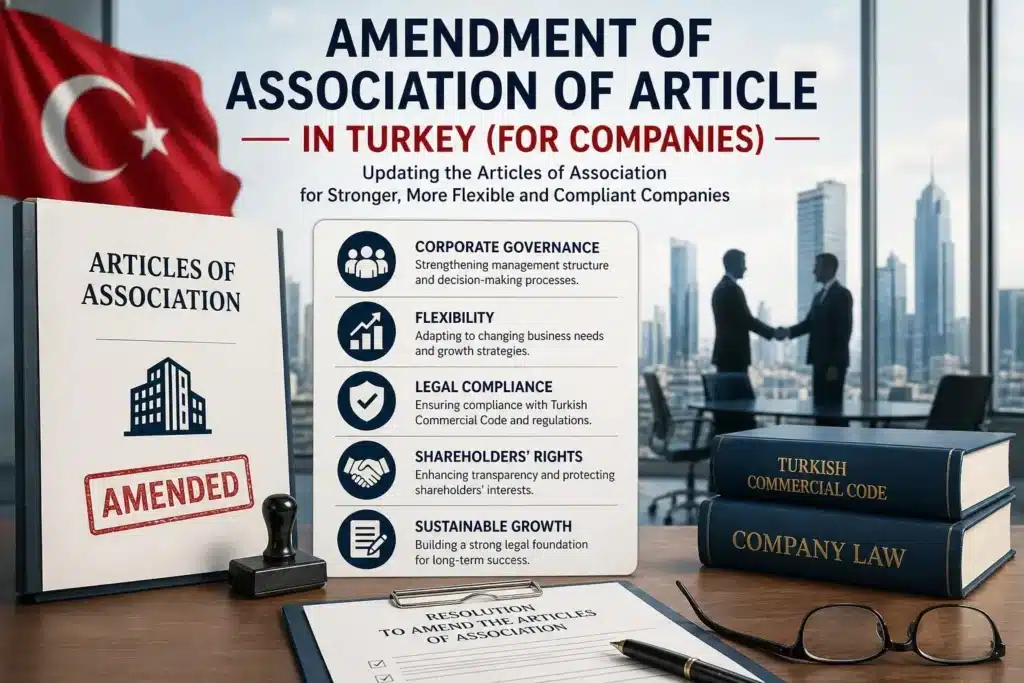
Amending the AoA requires a formal resolution by the General Assembly. The process follows a strict legal chain to ensure validity:
The process begins internally. The Board of Directors drafts the proposed amendment text or a full restated version of the articles. This draft must clearly identify the specific articles to be amended and be consistent with the TCC. In specific cases (such as moving the headquarters abroad or issuing privileged shares), the board may need to prepare a written report justifying the change.
Before calling a shareholders’ meeting, certain amendments require prior authorization from public authorities:
Capital Markets Board (CMB): Public companies must obtain CMB approval for amendments related to capital, dividends, or board structure.
Ministry of Trade: The Ministry reviews amendments for compliance with mandatory rules, particularly for companies of public interest.
It is common practice for companies to apply to these bodies simultaneously to receive draft approval before presenting the issue to shareholders.
The amendment must be submitted to the General Assembly for approval. The meeting invitation must explicitly list the amendment on the agenda.
Voting Quorums (Joint-Stock Companies):
General Rule: Unless otherwise stipulated, a resolution passes if it receives a majority of the votes present at a meeting where at least 1/2 of the company’s capital is represented.
Second Meeting: If the first meeting lacks quorum, a second meeting can be held within one month, requiring at least 1/3 of the capital representation.
Strict Quorums: Certain decisions, such as moving the company’s legal headquarters out of Turkey, require unanimous approval of all shareholders.
Special Cases: If an amendment prejudices the rights of privileged shareholders (e.g., holders of golden shares), those specific shareholder groups must approve the decision separately, usually at a special meeting convened after the general assembly.
Once the General Assembly approves the amendment:
Notarization: The General Assembly resolution and the amended text must be notarized to certify their authenticity.
Trade Registry: The company applies to the local Trade Registry Office for registration. The application includes the notarized resolution, the amended AoA, attendance lists, and proof of fee payment.
Effectiveness: The amendment becomes legally effective only upon registration. Following registration, the change is published in the Turkish Trade Registry Gazette, providing public notice to third parties.
The process does not end with registration. Once the amended Articles of Association are registered and published, companies must complete a series of post-registration compliance actions to ensure that all internal and external records reflect the changes. Failure to do so can lead to operational disruptions, legal disputes, or regulatory penalties. Below are the critical compliance steps:
Banks rely on the registered Articles of Association to verify signatory authorities and corporate identity. After an amendment, companies must:
Visit all branches where the company holds accounts (or submit applications through corporate banking channels).
Provide the notarized and registered amended AoA, the General Assembly resolution, and the Trade Registry Gazette publication.
Update authorized signatories (signature circular) if board membership or signature authority has changed.
Revise standing instructions, online banking limits, and multi-approval workflows.
Consequence of delay: Unauthorized transactions may be rejected, or prior signatories may lose access, freezing corporate accounts.
Tax and social security registrations must align with the company’s legal status:
Tax Office (Vergi Dairesi): Submit a notification (generally via the e-Declaration system or in person) attaching the registered amendment. This is essential for changes to trade name, legal seat, business scope, or capital. A new tax certificate may be issued.
Social Security Institution (SGK): Notify the SGK of changes affecting employer registration, particularly if the legal seat has moved to a different province or the company’s trade name has changed. This ensures continued validity of workplace accident insurance and premium payment records.
Consequence of delay: Mismatched records can trigger audits, penalty interest on presumed underreporting, or rejection of employee premium declarations.
If the company operates in a regulated sector or holds specific operating permits, the amendment must be reflected in those authorizations:
Sectoral Licenses: For banking, energy, telecommunications, transportation, healthcare, education, or tourism activities.
Municipal Permits: Business operation licenses (iş yeri açma ve çalışma ruhsatı) issued by local municipalities.
Professional Certifications: ISO certificates, quality management certifications, or industry-specific accreditations.
Import/Export Registrations: Customs registration and authorized economic operator (AEO) status.
Action required: Apply to the relevant issuing authority with the registered AoA amendment. Some authorities require a full re-issuance of the license.
Consequence of delay: Operating under a license that does not match the legal entity’s name, address, or scope may result in fines, suspension of operations, or invalidation of permits.
Internally and externally, all references to the company’s constitutional parameters must be aligned:
Commercial Contracts: Review and, where necessary, execute addenda to customer agreements, supplier contracts, leases, loan agreements, and distribution arrangements—especially if the trade name, legal seat, or authorized signatories have changed.
Company Seal/Stamp: If the trade name or headquarters address has changed, procure a new corporate seal from an authorized stamp maker. Destroy old seals and maintain a destruction certificate for audit purposes.
Internal Corporate Records: Update the company’s share ledger (pay defteri), board resolution book (yönetim kurulu karar defteri), general assembly minutes book (genel kurul toplantı ve müzakere defteri), and the official copy of the Articles of Association held at the company’s premises.
Central Registry Agency (MERSIS): Update the company’s registration in the MERSIS electronic system, particularly for changes to trade name, address, capital, or board members.
Chamber of Commerce Records: Confirm that the local Chamber of Commerce has updated its internal records to match the registered amendment.
Consequence of delay: Counterparties may refuse to honor contracts bearing outdated information; internal books may lose evidentiary value in legal disputes; and electronic systems may generate incorrect official documents.
| Action Item | Responsible Party | Deadline (Recommended) |
|---|---|---|
| Bank records update | Finance/Accounting | Within 7 days of registration |
| Tax Office notification | Tax Consultant/CPA | Within 30 days of registration |
| SGK notification | HR/Payroll | Within 15 days of registration |
| Licenses and permits | Legal/Compliance | Within 30 days of registration |
| Commercial contracts addenda | Legal Department | Within 60 days of registration |
| Corporate books and seal | Board/Company secretary | Immediately upon registration |
| MERSIS update | Authorized representative | Within 15 days of registration |
Understanding the financial implications of an amendment is essential for budgeting and planning. The total cost varies significantly based on the complexity of the changes, the company’s capital size, and whether regulatory approvals are required. Below is a detailed breakdown of typical expenses in Euro (EUR) as of 2026, with all figures increased by 30% from standard market rates.
Notarization is required for the General Assembly resolution and the amended AoA text. Fees are calculated based on:
Number of pages of the amended document.
Company’s capital amount (a percentage-based fee applies for capital changes).
Number of notarized copies required.
Estimated range: €75 – €560
Simple amendment (e.g., address change): €75 – €150
Complex amendment (e.g., capital increase with full restatement): €300 – €560
The Trade Registry charges fees based on:
Company’s registered capital (higher capital = higher fee).
Number of amended articles.
Publication in the Trade Registry Gazette.
| Fee Type | Estimated Cost (EUR) |
|---|---|
| Registration fee | €40 – €185 |
| Gazette publication fee | €20 – €55 |
| Document examination fee | €10 – €20 |
Estimated range: €70 – €260
For companies requiring pre-approval from public authorities:
| Authority | Estimated Cost (EUR) | When Required |
|---|---|---|
| Capital Markets Board (SPK) | €185 – €745 | Public companies |
| Ministry of Trade | €40 – €185 | Companies of public interest |
| Sectoral Regulator (BDDK, EPDK, BTK) | €370 – €1,860+ | Regulated sectors |
While not mandatory, most companies engage legal counsel to avoid errors and delays. Fee structures vary:
Hourly rate: €55 – €185 per hour
Fixed fee for simple amendment: €370 – €930
Fixed fee for complex amendment (including regulatory approval): €1,115 – €2,790+
Retainer for ongoing corporate support: €1,860 – €5,580 annually
Additional expenses that are often overlooked:
| Item | Estimated Cost (EUR) |
|---|---|
| Translation services (English-Turkish) | €40 – €185 |
| Travel and meeting expenses for General Assembly | €20 – €110 |
| New corporate seal/stamp | €10 – €20 |
| Courier and document shipping | €5 – €20 |
| Bank transaction fees for capital increase | €20 – €75 |
| Amendment Type | Low End (EUR) | High End (EUR) |
|---|---|---|
| Simple amendment (e.g., address change, minor typo) | €150 | €450 |
| Medium amendment (e.g., capital increase, board change) | €560 | €1,490 |
| Complex amendment (e.g., full restatement, with regulatory approval) | €1,490 | €3,720+ |
| Public company amendment (with SPK approval) | €1,860 | €5,580+ |
| Cost Component | Simple Amendment | Medium Amendment | Complex Amendment | Public Company |
|---|---|---|---|---|
| Notarization Fees | €75 – €150 | €150 – €300 | €300 – €560 | €300 – €560 |
| Trade Registry Fees | €70 – €150 | €110 – €200 | €150 – €260 | €150 – €260 |
| Regulatory Approval Fees | – | – | €185 – €1,860 | €185 – €745 |
| Legal Fees | €150 – €370 | €370 – €930 | €1,115 – €2,790 | €1,490 – €3,720 |
| Ancillary Costs | €40 – €110 | €75 – €185 | €110 – €300 | €150 – €370 |
| TOTAL (Low – High) | €335 – €780 | €705 – €1,615 | €1,860 – €5,770 | €2,275 – €5,655 |
Note: Totals may not sum exactly due to rounding. The “Complex Amendment” includes sectoral regulator fees up to €1,860, while “Public Company” includes SPK fees up to €745, resulting in different ranges.
Consolidate multiple changes into a single General Assembly resolution to avoid paying fees multiple times.
Prepare documents meticulously to prevent rejection and re-submission fees.
Use internal resources for translation if you have qualified staff, rather than outsourcing.
Negotiate fixed fees with law firms for straightforward amendments.
Check for exemptions: Some small businesses may qualify for reduced Trade Registry fees. Consult your local Chamber of Commerce.
Exchange rate assumption: 1 EUR = 35 TRY (used for conversion from original TRY figures). Actual exchange rates fluctuate daily.
30% increase applied: All figures above include a 30% adjustment from standard market rates to reflect potential inflation, increased demand, or revised fee structures for 2026.
VAT not included: All fees are exclusive of Value Added Tax (KDV), which is currently 20% for legal and notary services in Turkey.
Regional variations: Fees may vary by province and specific notary or law firm.
Annual adjustments: All fees are subject to annual adjustments based on the revaluation rate determined by the Turkish government
While the procedural steps for amending the Articles of Association are clearly defined, companies must navigate several critical considerations that can impact the validity, timeline, and outcome of the amendment process. Below are three key areas that demand particular attention:
The Turkish Commercial Code places strong emphasis on safeguarding shareholder interests during any amendment process. Key protections include:
Indispensable Rights: Certain shareholder rights are considered “indispensable” and cannot be eliminated or unduly restricted through amendments. These include the right to attend and vote at general assembly meetings (unless properly waived under specific conditions), the right to receive dividends when declared, and the right to challenge unlawful board decisions.
Minority Shareholder Protections: Amendments that disproportionately benefit majority shareholders may be challenged in court. Shareholders representing at least 10% of the capital (or 5% for public companies) can request the appointment of a special auditor or seek annulment of a resolution that violates the law or the AoA itself.
Pre-emptive Rights: When an amendment involves a capital increase, existing shareholders generally have a statutory right to subscribe to new shares in proportion to their existing holdings. Any restriction or removal of this right requires a separate shareholder resolution, must be justified by a valid corporate interest, and is subject to stricter quorum requirements.
Privileged Shareholders: If a proposed amendment negatively affects the rights of privileged shareholders (e.g., holders of shares with preferential voting or dividend rights), those shareholders must approve the change at a separate special meeting. Without this approval, the amendment is void.
Right to Withdraw: Under certain circumstances—such as a fundamental change to the company’s business purpose or a restriction on share transferability—dissenting shareholders may have the right to withdraw from the company and receive fair compensation for their shares.
Practical Tip: Before drafting an amendment, companies should conduct a shareholder rights impact assessment to identify any potential conflicts and avoid future annulment lawsuits.
Not all amendments can be implemented unilaterally by the General Assembly. Depending on the company’s legal status and industry, certain changes require prior approval from regulatory authorities:
Capital Markets Board (CMB): Publicly traded companies must submit any proposed amendment to the CMB for review before the General Assembly vote. The CMB examines compliance with capital markets legislation, disclosure requirements, and investor protection rules. Amendments implemented without CMB approval are invalid for public companies.
Ministry of Trade: While the Trade Registry ultimately registers amendments, the Ministry of Trade reviews filings for compliance with the TCC, particularly for companies of public interest or those involving complex capital structures. The Ministry may request revisions or reject non-compliant amendments.
Sector-Specific Regulators: Companies in regulated industries face additional approval layers:
Banking Regulation and Supervision Agency (BDDK): For banks and financial institutions.
Energy Market Regulatory Authority (EPDK): For energy sector companies.
Information and Communication Technologies Authority (BTK): For telecommunications firms.
Competition Authority: For amendments involving mergers, acquisitions, or changes in control that may affect market competition.
Foreign Investment Directorate: If the amendment involves the entry of foreign shareholders or changes in foreign ownership ratios, notification to or approval from the Foreign Investment Directorate may be required under the Foreign Direct Investment Law No. 4875.
Practical Tip: Identify all relevant regulators early in the process. Obtain draft approvals before convening the General Assembly to avoid costly delays or invalid resolutions. For public companies, simultaneous application to the CMB and Ministry of Trade is standard practice.
Failing to properly execute an amendment to the Articles of Association exposes the company and its management to significant legal and financial risks:
Administrative Fines: The Trade Registry and the Ministry of Trade impose administrative fines for:
Operating with outdated or non-compliant articles of association.
Failing to register amendments within the statutory period (generally 15 days from the General Assembly resolution).
Submitting incomplete or inaccurate documentation.
Annulment Lawsuits: Any shareholder, board member, or creditor with a legal interest may file a lawsuit to annul an amendment resolution that violates the law or the existing AoA. Grounds for annulment include:
Improper meeting notification or agenda.
Insufficient voting quorums.
Violation of indispensable shareholder rights.
Lack of required regulatory approvals.
If the court annuls the resolution, the company must revert to its previous articles, potentially disrupting ongoing operations, transactions, or capital raisings.
Criminal Liability: Under the TCC, company founders, board members, and managers may face criminal penalties (including imprisonment) for:
Knowingly registering false or misleading information in the articles.
Implementing an amendment without proper registration.
Operating a business activity not listed in the registered articles.
Third-Party Claims: Counterparties, banks, and regulators rely on the publicly registered articles. If a company acts beyond its registered authority (e.g., entering a contract outside its stated business scope), that transaction may be deemed ultra vires (beyond legal power), potentially voiding the contract and exposing the company to damages claims.
Tax Implications: Certain amendments—particularly capital reductions, share transfers, or changes in profit distribution rules—may trigger unexpected tax liabilities or require updated tax registrations. The Tax Office may impose penalties for failure to notify such changes.
Practical Tip: Engage both corporate law counsel and tax advisors before finalizing any amendment. Conduct a pre-filing compliance audit to identify potential risks. Maintain detailed minutes of all General Assembly meetings and board resolutions to evidence proper procedure in case of legal challenge.
No. All Turkish companies must have a registered address (şirket merkezi) in Turkey. This can be:
A rented office space
A shared or co-working space with dedicated address
A virtual office service ($100-1,500/month) providing address, mail handling, and basic reception services
The address is public and appears on all official company documents .
Turkey’s legal framework for amending the Articles of Association of companies offers significant opportunities for companies seeking to restructure, raise capital, or update governance. The combination of a clear procedure under the Turkish Commercial Code, the ability to convene General Assembly meetings remotely, and flexible rules for foreign shareholders makes Turkey one of the most accessible jurisdictions for corporate amendments in 2026.
However, the challenges facing companies—both local and foreign—are real. The amendment process itself is only the first step. Post-registration hurdles—updating bank records, notifying tax authorities and SGK, amending licenses and permits, and revising commercial contracts—require more planning and local support than many companies initially expect.
The non-negotiable pillars of success for amending the Articles of Association in Turkey are:
A Turkish CPA for drafting amendment texts, ensuring quorum compliance, and protecting shareholder rights and also for managing post-amendment tax notifications, capital increase filings, and ongoing compliance.
A realistic budget that accounts for notarization fees, Trade Registry costs, regulatory approvals (if applicable), and professional service fees.
These are not optional extras; they are the price of ensuring a valid, enforceable, and fully compliant amendment in a sophisticated but complex legal environment.
With the right guidance and expectations, your company can complete the amendment process—from board proposal to registered and published Esas Sözleşme—within 1 to 3 weeks, and complete all post-registration compliance within another 30 days.
At A&M Consulting Co. , we support local and international investors and companies throughout the professional and reliable amendment of Articles of Association, as well as ongoing CPA services in Turkey.
As a licensed accounting firm registered with TURMOB (the Union of Chambers of Certified Public Accountants of Turkey) and ISMMMO (the Istanbul Chamber of Certified Public Accountants), we combine technical expertise with practical guidance to help businesses navigate the entire amendment process—from drafting and notarization to registration and post-amendment compliance—smoothly and in full compliance with Turkish regulations.
By working with A&M Consulting Co. for amendment and accounting support, companies can:
Reduce legal risks associated with invalid amendments or annulment lawsuits.
Ensure proper handling of shareholder rights and regulatory approvals.
Establish compliant post-amendment tax and social security practices.
This allows management teams to focus on business growth while ensuring that corporate governance, amendment procedures, and accounting processes are handled professionally within Turkey’s dynamic regulatory environment.
DISCOVER OUR SERVICES:
You can reach out to our experienced consultans via email or by filling out the Contact Form on our website’s contact page
The timeline varies depending on the complexity of the amendment and whether regulatory pre-approval is required. For simple amendments (e.g., address change within the same city), the process can take 2 to 4 weeks from board proposal to registration. For complex amendments requiring CMB or Ministry approval, expect 2 to 3 months. Factors affecting duration include shareholder meeting scheduling, notarization queues, and Trade Registry processing times (typically 3 to 10 business days after application).
Generally, no. Most amendments require only majority approval (at least 50% representation and majority vote). However, certain fundamental changes—such as moving the legal headquarters out of Turkey, changing the company’s nationality, or imposing new obligations on shareholders—require unanimous consent of all shareholders. Additionally, if an amendment violates indispensable shareholder rights, even a single shareholder can challenge it in court after passage.
Costs vary widely depending on the complexity of the amendment, the company’s capital size, and whether regulatory approvals are required. Below are the updated estimated ranges:
| Amendment Type | Low End (EUR) | High End (EUR) |
|---|---|---|
| Simple amendment (e.g., address change, minor typo) | €150 | €450 |
| Medium amendment (e.g., capital increase, board change) | €560 | €1,490 |
| Complex amendment (e.g., full restatement, with regulatory approval) | €1,490 | €3,720+ |
| Public company amendment (with SPK approval) | €1,860 | €5,580+ |
Major cost components include:
| Cost Component | Estimated Range (EUR) |
|---|---|
| Notarization fees | €75 – €560 |
| Trade Registry fees (including Gazette publication) | €70 – €260 |
| Legal and consultancy fees | €150 – €3,720+ |
| Regulatory approval fees (SPK, Ministry, sectoral regulators) | €40 – €1,860+ |
| Ancillary costs (translation, travel, new seal, courier, bank fees) | €5 – €370 |
Important notes:
All figures above include a 30% increase from standard market rates to reflect inflation, increased demand, and 2026 fee adjustments.
VAT (20%) is not included and will be added to notary, legal, and most professional service fees.
Costs may vary by province, specific notary, law firm, and exchange rate fluctuations.
For a complete breakdown, including cost-saving tips and a detailed matrix, please refer to the “Cost of Amending the Articles of Association” section earlier in this guide.
While not legally mandatory, hiring a Turkish CPA or a corporate lawyer is strongly recommended. Consultans ensure compliance with quorum rules, draft amendment texts that avoid contradictory clauses, manage regulatory pre-approvals, and reduce the risk of annulment lawsuits. Mistakes in the process can lead to invalid amendments, fines, or operational disruptions that far exceed legal fees.
Partial digitalization exists, but full online amendment is not yet possible. You can:
Submit registration applications electronically via the MERSIS or Trade Registry systems.
Use e-Government for certain shareholder notifications.
However, notarization still requires physical presence with original documents. The General Assembly meeting (unless held via electronic meeting systems under TCC Article 1527) typically requires physical or remote participation with verified identities.
Operating with outdated AoA carries several risks:
Banks may freeze accounts or reject transactions.
Counterparties may void contracts citing ultra vires actions.
Tax Office and SGK may impose fines for mismatched records.
The Ministry of Trade can levy administrative fines.
In extreme cases, board members may face personal liability for unauthorized actions.
There is no legal limit on the frequency of changes. However, Joint Stock Companies are required to hold a General Assembly meeting every year.
Yes. Foreign shareholders have the same rights as Turkish shareholders to propose and vote on amendments. However, certain sensitive sectors (defense, energy, telecommunications, media) may impose foreign ownership restrictions that affect amendment feasibility. For companies with foreign shareholders, amendments involving share transfers or capital increases may require notification to the Foreign Investment Directorate.
Key differences include:
| Aspect | Joint-Stock (A.Ş.) | Limited (Ltd. Şti.) |
|---|---|---|
| Minimum shareholder number | 1 | 1 |
| Capital increase quorum | 50% representation + majority vote | Unanimous unless articles allow otherwise |
| Registered capital system | Available | Not available |
| Share transfer restrictions | More flexible | Typically requires notarization and board approval |
| Regulatory oversight (CMB) | For public companies only | None |
Limited companies generally face stricter unanimity requirements for certain amendments, making consensus-building more critical.
Yes. This is one of the most common amendments. You must:
Identify the new NACE codes (Turkish activity classification) you wish to add or remove.
Ensure the amended business scope does not require additional regulatory licenses (e.g., banking, insurance).
Register the change with the Trade Registry.
After registration, notify the Tax Office and, if applicable, obtain new operating licenses.
You cannot begin commercial activity in the new business line until the amendment is registered and any required permits are obtained.
Yes, but it is challenging. Disputes can lead to:
Failure to achieve quorum due to boycotts.
Lawsuits challenging the validity of the General Assembly meeting.
Post-amendment annulment litigation.
Recommendation: Attempt to resolve disputes through mediation or a shareholders’ agreement before proposing amendments. If disputes persist, consider court-supervised General Assembly meetings under TCC Article 418.
Rejection occurs when documents are incomplete, notarization is defective, or the amendment violates mandatory law. You will receive a written explanation. You can:
Correct and resubmit: Address the deficiencies within the rejection notice. No new General Assembly meeting is required if the correction is purely formal.
Appeal: File an objection with the local commercial court of first instance within the statutory period (typically 7-15 days). The court will review the Registry’s decision.
es. All amendments, regardless of size, must be published in the Turkish Trade Registry Gazette to achieve third-party effect. Publication ensures:
Creditors and counterparties are publicly notified.
The amendment becomes opposable to third parties in good faith.
The company can rely on the amended terms in legal proceedings.
Publication fees are calculated based on the length of the amendment text.
Generally, no. The AoA amendment process cannot unilaterally expel a shareholder. Shareholders can only be removed through:
Voluntary share transfer (purchase of shares by other shareholders or the company).
Court-ordered cancellation of shares for non-payment of capital contributions (under specific TCC provisions).
Corporate restructuring (merger, division, or spin-off) with proper compensation.
Any attempt to use an AoA amendment to deprive a shareholder of their ownership rights without compensation or legal grounds is void ab initio.
A capital increase amendment triggers pre-emptive rights (rüçhan hakkı): existing shareholders have the priority right to subscribe to new shares in proportion to their existing holdings. Key rules:
Shareholders receive at least 15 days’ notice to exercise this right.
The board can only restrict or remove pre-emptive rights with a separate General Assembly resolution passed by a heightened quorum (typically 75% of capital represented).
Waiver of pre-emptive rights must be justified by a legitimate corporate interest (e.g., strategic investor entry).
Failure to respect pre-emptive rights makes the capital increase voidable at the request of aggrieved shareholders.


WhatsApp Us