

Summarize this article with AI
Free Zones in Turkey offer unique opportunities for businesses looking to expand their operations with attractive tax incentives, simplified regulations, and strategic geographical advantages. These zones are specially designated areas where companies can enjoy various economic benefits, making them an appealing option for both domestic and international investors. This article explores the key aspects of Free Zones in Turkey and why they are a top choice for businesses seeking growth and profitability.
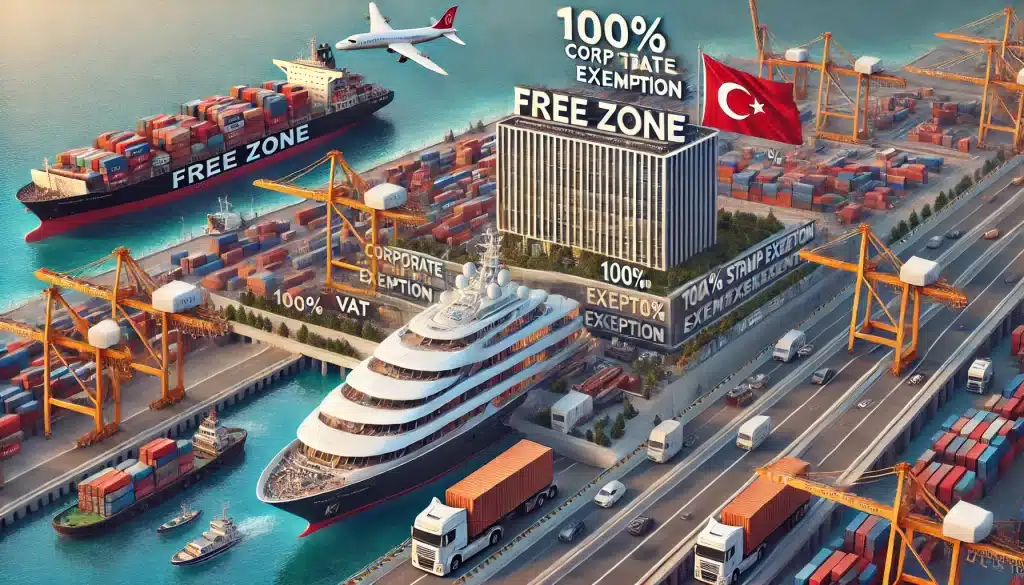
Free Zones in Turkey are special economic zones designed to promote export-oriented investment. They provide a business-friendly environment with significant advantages, including tax exemptions, reduced customs duties, and flexible operational rules. Established under the Free Zones Law No. 3218, these zones are strategically located to enhance trade and investment.
Located directly at Istanbul Airport, this is one of the newest and fastest-growing Free Zones in Türkiye. Its location provides unmatched access to global cargo routes, making it an excellent choice for:
International logistics companies
Spare parts distributors
High-value product storage (electronics, medical devices, aerospace)
E-commerce fulfillment centers (same-day global shipping)
Why investors choose it:
Located inside Türkiye’s largest airport
24/7 customs operations
Ultra-fast shipping to Europe, MENA, USA, and Asia
Although historically leather-focused, Tuzla FZ has evolved into one of Istanbul’s most diverse industrial bases. Today, it hosts companies from:
Automotive components
Pharmaceutical and chemical production
Leather and textile processing
Packaging & industrial manufacturing
Key advantages:
Well-developed manufacturing infrastructure
Direct access to Tuzla Ports and industrial zones
Suitable for medium-size and large-scale factories
Technically located in Çorlu (Tekirdağ) but widely included in “Greater Istanbul Free Zone options”, EFZ is preferred by many foreign companies due to:
Proximity to Istanbul
Large land plots for factories
Strong export infrastructure
Popular sectors in EFZ:
Machinery & equipment
Electronics
Medical technologies
Automotive parts
Consumer goods manufacturing
Situated on the European side near Çatalca, this zone is ideal for companies targeting EU, Balkan, and Eastern European markets.
Highlights:
Large warehousing capacity
Excellent logistics connections (TEM & E-5 highways, ports, airports)
Simplified customs & transit operations
This Free Zone is especially attractive for trading companies, global distributors, and sourcing offices.
While technically outside Istanbul’s provincial borders, it is considered part of Istanbul’s industrial ecosystem.
Ideal for:
R&D laboratories
High-tech manufacturing
Biotechnology
Energy & sustainability technologies
Software development centers
Mersin Free Zone: As one of the largest Free Zones in Turkey, Mersin offers excellent access to Mediterranean markets and is a hub for manufacturing, logistics, and export-oriented businesses.
Aegean Free Zone (ESBAŞ):The Aegean Free Zone in Izmir is the center of high-tech industries such as aviation, defense, electronics, automotive and machinery manufacturing.
Bursa Free Zone: Known for its strong automotive and textile sectors, the Bursa Free Zone is a prime location for industrial and manufacturing investments.Its proximity to the most important ports of the Marmara Sea and highways is one of its important advantages.
Antalya Free Zone: This zone is a hotspot for the maritime industry, offering facilities for shipbuilding, maintenance, and repair, as well as other industrial activities.
Establishing a business in Turkey’s Free Zone involves several steps designed to streamline the process and provide businesses with significant advantages. Here’s how to do it:
Establishing a business in Turkey’s Free Zones is a strategic move that can provide your company with significant financial benefits, operational flexibility, and access to global markets. By following the steps outlined above, you can efficiently set up your business and leverage the advantages offered by these specialized economic areas.
Whether you are a domestic company or a foreign investor, exploring benefits & opportunities of Turkey’s Free Zones can be a crucial step in achieving long-term financial success.
A&M Consulting Co. is a Turkish Accounting and Tax Consultancy company specialized in providing end-to-end Invest Consulting Services for especially global companies and foreign entrepreneurs which wants to walk into to Turkey’s Free Zones
We continue to offer cost-effective solutions to global investors who want to enter the Turkish market smoothly and quickly and to individual entrepreneurs who want to invest in Turkey, to ensure their full compliance with local legislation and to reach out tax & social security incentives in Turkey.
You can easily reach our experienced consultants via email or by filling out the contact form on our website.
DISCOVER OUR SERVICES:
A Free Zone (Serbest Bölge) is a designated area within Turkey where companies benefit from special tax incentives, simplified customs procedures, and flexible trade regulations. These zones are designed to attract foreign investment, increase exports, and support high-value manufacturing and service activities.
Companies in Free Zones can enjoy:
100% Corporate Tax exemption for manufacturing companies selling products abroad
100% Income Tax exemption for employees working in production activities
VAT and Customs Duty exemption on goods entering/exiting the zone
Free profit repatriation
Long-term operating licenses (up to 45 years)
No restrictions on foreign ownership
Companies wishing to operate in Turkish Free Zones must pay a Operating License Fee of $5,000 for each field of activity.
The validity period of an operating license varies depending on the specific Free Zone and the nature of the business. It typically ranges from 15 to 30 years and can often be renewed.
Foreign companies can establish a business in Turkey Free Zones by applying for an operating license, registering their company with the Turkish Trade Registry, and setting up operations within the zone.
Generally, Free Zones facilitate the import and export of a wide range of goods, but certain restrictions may apply based on Turkish trade laws and international regulations.
Approved activities include:
Manufacturing / production
Warehousing and logistics
Software development
R&D and design
Repair / maintenance
Value-added operations
Yes, but such activities lose the tax exemptions and may be subject to:
Corporate tax
VAT
Customs duties (if applicable)
A partial exemption structure may still apply depending on the activity.
Yes. All Free Zones require companies to have leased space or office modules inside the zone. Virtual offices are generally not allowed.
Yes. Turkey Free Zones allow 100% free profit repatriation without restrictions.
Recent Posts


WhatsApp Us