
A&M Consulting Co.

87 / 100 SEO Score

Hiring Employees in Turkey

Hiring Employees in Turkey: Legal Obligations for Employers

Hiring employees in Turkey requires a strategic approach that balances legal compliance with an understanding of the local business culture. As a country bridging Europe and Asia, Turkey offers a dynamic, multilingual workforce, particularly in sectors like technology, manufacturing, finance, and tourism . However, navigating its specific labor regulations, tax system, and cultural expectations is crucial for successful and compliant hiring.

This comprehensive guide walks you through everything you need to know about employing staff in Turkey, updated for 2026.

Table of Contents

Understanding the Turkish Employment Landscape

Understanding the market context is crucial before posting job advertisements. The Turkish economy is dynamic and boasts a large, young, and well-educated talent pool. The official language is Turkish, but there is a growing demand for multilingual professionals in multinational companies and sectors such as tourism and finance.

Among the key economic considerations for 2025/2026 is the regular updating of the minimum wage due to economic fluctuations. The net minimum wage is updated annually in line with the inflation rate, impacting salary comparisons across the private sector. This, in turn, increases many employer costs, such as fringe benefits and severance pay, affecting workplace policies and collective bargaining agreements.

Hiring Employees in Turkey

Options for Employing People in Turkey

Foreign companies typically have three main options for building a team in Turkey:

  • Via a Local Entity: This involves setting up a subsidiary or branch office. It’s is the most preferred methodIt offers full control and is ideal for long-term presence but requires significant time and capital investment .

  • Via an Employer of Record (EOR): It has a limited scope of application, mainly in sectors such as construction or public procurement projects. Although this method is not legally prohibited in Turkey and is widely used in many European countries, it is not a commonly practiced approach in Turkey.

  • Hiring Contractors: This offers flexibility for project-based work with lower costs, as you avoid employee benefits and social security. However, you must be extremely careful to avoid employee misclassification, which carries heavy penalties 

Step-by-Step Guide to Hiring in Turkey

Hiring employees in Turkey requires compliance with labor law, tax regulations, and social security obligations. Employers must follow a structured process to ensure legal employment and avoid penalties. Below is a step-by-step overview of how companies can hire employees in Turkey.

1. Establish a Legal Entity or Employer Structure

Before hiring employees, a company must have a legal presence in Turkey.

The most common options include:

  • Limited Liability Company (Ltd. Şti.)

  • Joint Stock Company (A.Ş.)

  • Branch office of a foreign company

  • Liaison office (limited hiring scope)

Employees must be hired through a registered employer entity that can register with the tax office and the social security system.

2. Register with the Social Security Institution (SGK)

All employers in Turkey must register with the Social Security Institution (SGK) before hiring employees.

This registration allows the employer to:

  • Declare employees

  • Pay social security premiums

  • Submit monthly payroll declarations

Employee registration must be completed before the employee’s first working day.

3. Prepare an Employment Contract

Employment relationships in Turkey are governed by **Turkish Labour Law No. 4857.

Employers should prepare a written employment agreement including:

  • Job title and responsibilities

  • Salary and payment terms

  • Working hours

  • Probation period (if applicable)

  • Term of employment (definite or indefinite)

Although verbal contracts are technically valid, written agreements are strongly recommended for legal clarity.

4. Register the Employee with SGK

Employers must submit a Social Security Entry Declaration to SGK.

Key points:

  • Registration must be completed one day before employment begins

  • Late registration may lead to administrative penalties

Once registered, the employee becomes eligible for social security and health insurance coverage.

5. Set Up Payroll and Tax Withholding

Employers are responsible for calculating and withholding employee taxes and social contributions.

Typical payroll obligations include:

  • Income tax withholding

  • Social security premiums

  • Unemployment insurance contributions

  • Stamp tax

Payroll must be processed monthly, and declarations must be submitted electronically.

6. Comply with Minimum Wage and Working Time Rules

Employers must respect national labor standards including:

  • Minimum wage requirements

  • Maximum weekly working hours (generally 45 hours)

  • Overtime compensation rules

  • Paid annual leave entitlements

These rules are strictly monitored by labor authorities.

7. Maintain Payroll Records and Employment Documentation

Employers must maintain accurate records such as:

  • Payroll reports

  • Employment contracts

  • Leave records

  • Social security filings

These documents may be requested during labor inspections or tax audits.

8. Termination and Employee Rights

If employment ends, employers must follow legal procedures related to:

  • Notice periods

  • Severance pay (if applicable)

  • Final payroll and benefits settlement

  • SGK exit notification

Failure to comply with termination rules may lead to labor disputes or compensation claims.

Key Turkish Labor Laws and Compliance

Employers hiring staff in Turkey must comply with a number of core labor and employment regulations that govern employment contracts, working conditions, social security obligations, and employee rights. Understanding these laws is essential for companies operating in the Turkish market to avoid legal risks and administrative penalties.

Below are the most important legal frameworks governing employment in Turkey.

1. Turkish Labour Law No. 4857

This is the primary law regulating employment relationships in Turkey.

It covers key employment matters such as:

  • Employment contracts

  • Working hours (generally 45 hours per week)

  • Overtime rules and compensation

  • Annual leave entitlements

  • Termination procedures and notice periods

  • Employee rights and employer obligations

Most private-sector employment relationships fall under this law.

2. Turkish Code of Obligations No. 6098

This law governs employment relationships not covered by Labour Law, such as certain managerial roles or special contractual arrangements.

It regulates:

  • General contractual principles

  • Employer–employee obligations

  • Compensation for damages

  • Contract termination conditions

3. Social Insurance and General Health Insurance Law No. 5510

This law regulates social security and health insurance obligations for employers and employees.

Employers must:

  • Register employees with the Social Security Institution (SGK)

  • Pay monthly social security premiums

  • Submit payroll declarations

  • Provide health insurance coverage

Failure to comply can result in significant administrative penalties.

4. Occupational Health and Safety Law No. 6331

This law aims to ensure safe working environments and prevent workplace accidents.

Employers are required to:

  • Conduct workplace risk assessments

  • Provide occupational health and safety training

  • Appoint workplace safety specialists and occupational physicians (depending on company size and risk level)

  • Maintain workplace safety documentation

5. Trade Unions and Collective Bargaining Agreements Law No. 6356

This law governs trade unions and collective bargaining rights.

It regulates:

  • Formation of labor unions

  • Collective bargaining agreements

  • Strike and lockout procedures

  • Union membership rights

Compliance Requirements for Employers

To remain compliant with Turkish labor regulations, employers must:

  • Register employees with the Social Security Institution (SGK)

  • Maintain accurate payroll and employment records

  • Ensure tax and social security payments are made on time

  • Follow legal termination procedures

  • Implement workplace health and safety measures

When hiring employees in Turkey, employers must consider not only the gross salary but also the additional taxes, social security contributions, and statutory obligations associated with employment. Understanding the full payroll structure is essential for budgeting and ensuring compliance with Turkish employment regulations.

Employer Costs and Contributions

The cost of an employee goes beyond their gross salary. Employers in Turkey must make significant social security contributions.

The table below outlines the standard employer contribution rates as a percentage of an employee’s gross salary :
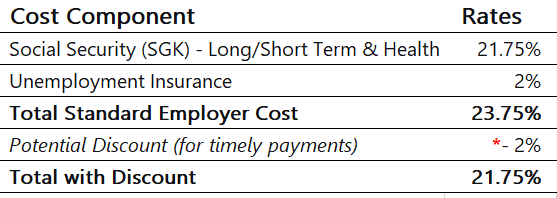
employer contribution rates in Turkey  

* If the employer pays contributions regularly without interruption, 2 points(5 points for producters) of the employer’s long-term insurance share can be paid by the state, effectively reducing the employer’s burden.
 

Employee Deductions

Employees also contribute 15% of their gross salary (14% social security, 1% unemployment insurance), which you must deduct and remit .

Income Tax and Stamp Tax

Turkey uses a progressive income tax rate, starting at 15% and rising to 40%. Employers must also withhold stamp tax at a rate of 0.759% on gross earnings .

Special Rules for Hiring Foreign Employees

If you plan to hire international talent, additional rules apply.

Work Permits

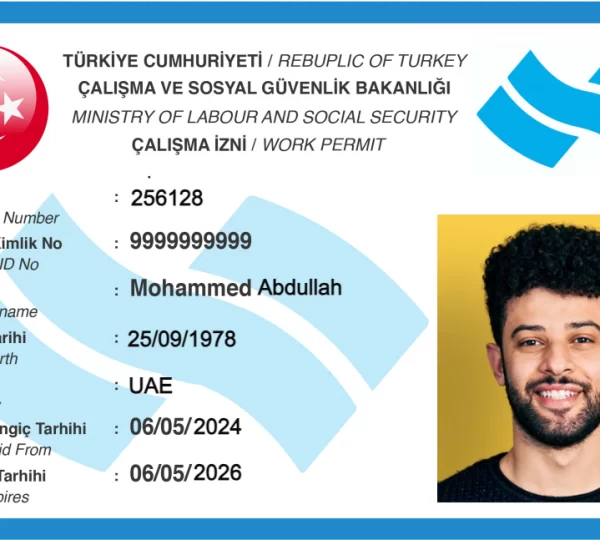
All foreigners need a work permit to be employed in Turkey. The application is submitted electronically by the employer .

  • Standard Work Permit: Granted for up to one year for the first application, with extensions possible (two years, then three) .

  • Turquoise Card: A long-term permit for highly skilled workers .

Key Eligibility Criteria for Sponsorship

To sponsor a foreign national, employers must meet strict criteria, including the “5:1 Rule”: the company must employ at least five Turkish nationals for each foreign employee . Financial thresholds also apply, such as a minimum paid-in capital of TRY 500,000 or annual exports of at least $150,000 .

Restricted Professions

Certain professions are reserved for Turkish citizens, including dentists, pharmacists, lawyers, notaries, and security guards .

Common Compliance Risks to Avoid

  • Employee Misclassification: Incorrectly treating an employee as an independent contractor to avoid taxes and benefits is a serious violation. Turkish courts look at factors like dependency, provision of materials, and who sets the working hours .

  • Incorrect Payroll Contributions: Mistakes in social security or tax calculations can lead to significant penalties. The system is complex, so accuracy is key .

  • Permanent Establishment (PE) Risk: Hiring employees in Turkey without a legal entity can inadvertently create a PE, subjecting your company to unexpected corporate tax liabilities .

Onboarding Best Practices in Turkey

Effective onboarding sets the stage for a successful working relationship. This includes registering the employee with the SGK before their first day, preparing a compliant Turkish contract, and introducing them to the team and company culture. Incorporating informal tea (“çay”) breaks is a great way to help new hires build social connections .
Navigating Turkish employment law is complex, with obligations scaling by employee count, frequent regulatory updates, and significant penalties for non-compliance.

Key Risks of Non-Compliance

  • Administrative fines: Increased by 25.49% for 2026 

  • Reclassification risks: Improper fixed-term contracts or contractor arrangements can trigger back-payments of severance, notice pay, and all social security contributions

  • Work permit violations: Employer liability for deportation costs and potential business disruption 

Areas Where Professional Support Adds Value

  1. Employment Contracts: Drafting Turkish-language compliant contracts with proper termination, non-compete, and confidentiality clauses 

  2. Workforce Compliance: Managing union relations, adapting international HR policies to Turkish law, and handling mass layoffs or restructuring 

  3. Incentive Applications: Ensuring correct application of SGK discounts and Teknopark benefits, avoiding common errors that lead to penalties 

  4. Expatriate and Immigration: Navigating work permit and residence permit processes efficiently, ensuring compliance with the 5:1 rule and capital requirements 

  5. Employment Disputes: Representation in litigation, arbitration, and mediation for terminations, workplace accidents, harassment claims, and discrimination matters 

Compliance Checklist for Employers

✔️ All employment contracts are in Turkish (or bilingual with Turkish prevailing)
✔️ Employee registered with SGK before starting work
✔️ Payroll processed through banks (5+ employees)
✔️ Disabled employee quota met (3% for 50+ employees)
✔️ OHS requirements satisfied based on workplace size and hazard class
✔️ Work permits obtained for foreign nationals through correct channel (e-Permit or e-Exemption)
✔️ Termination grounds properly documented in writing
✔️ Severance pay calculated correctly—and only paid when legally due

Banks may reject applications due to :

❌ Missing or incomplete documents
❌ No Turkish tax number
❌ No proof of address
❌ No Turkish phone number
❌ Unclear source of funds
❌ Unclear business activity description
❌ Sanction-sensitive sectors or high-risk nationalities
❌ Bank’s internal risk appetite changes

🔍 Most rejections occur due to unclear activity descriptions—not missing documents .

Contact Us Hiring Employees in Turkey

Hiring employees in Turkey offers access to a vibrant and skilled workforce, but success depends on a clear understanding of the legal framework—from crafting compliant employment contracts and managing payroll costs to adhering to termination rules and leveraging available incentives.

Whether you are setting up a new company, operating through a branch, or expanding your investment footprint in Turkey, building a compliant and efficient workforce is a key strategic priority. Managing the employee hiring process correctly — including employment contracts, social security registrations, tax obligations, and labor law compliance — is essential for ensuring operational continuity and avoiding regulatory risks.

At A&M Consulting Co., we support local and international companies throughout the employee recruitment and onboarding process in Turkey. As a licensed accounting and advisory firm registered with TURMOB (the Union of Chambers of Certified Public Accountants of Turkey) and ISMMMO (the Istanbul Chamber of Certified Public Accountants), we combine technical expertise with practical guidance to help businesses hire staff smoothly and in full compliance with Turkish regulations.

Our personnel employment support services include:

  • Structuring employment models and advising on suitable hiring options

  • Preparation of compliant employment contracts in line with Turkish Labour Law

  • Employee registration with the Social Security Institution (SGK)

  • Guidance on salary structuring, employment costs, and employer obligations

  • Support with work permit processes for foreign employees

  • Assistance with onboarding procedures and statutory notifications

  • Ongoing advisory on labor law compliance and HR-related obligations

  • Integration of employment processes with payroll and financial reporting systems

By working with A&M Consulting Co. for personnel employment support, companies can reduce legal risks, improve workforce planning, and establish compliant hiring practices. This allows management teams to focus on business growth while ensuring that employment processes are handled professionally within Turkey’s dynamic regulatory environment.

DISCOVER OUR SERVICES:

You can reach out to our experienced consultans via email or by filling out the Contact Form on our website’s contact page

FAQs About Hiring Employees in Turkey

Yes. A foreign company must first establish a legal presence such as a subsidiary, branch office, or use an Employer of Record (EOR) structure to legally employ staff in Turkey.

Yes. Employers must register employees with the Social Security Institution (SGK) before the employee’s first working day. Late registration may result in administrative fines.

While verbal agreements may be legally valid in some cases, a written employment contract is strongly recommended and is required for fixed-term contracts under **Turkish Labour Law No. 4857.

The legal maximum working time is 45 hours per week, typically divided into 5 or 6 working days.

Employers must:

  • Calculate and pay employee salaries

  • Withhold income tax

  • Pay social security premiums

  • Submit monthly payroll declarations

  • Maintain payroll records

The total employer cost is usually 25–30% higher than the gross salary, depending on social security incentives, benefits, and sector.

Yes. The probation period can be agreed in the employment contract and may last up to 2 months, extendable to 4 months through collective agreements.

Yes, but they must obtain a work permit before starting employment. The employer typically sponsors the work permit application.

Employees are entitled to:

  • 14 days after 1–5 years of service

  • 20 days after 5–15 years

  • 26 days after 15 years

Additional rules apply for employees under 18 or over 50.

Yes. Employers must comply with **Occupational Health and Safety Law No. 6331, which may require appointing safety specialists and conducting risk assessments.

Yes. Many companies work with accounting and payroll service providers to manage hiring procedures, payroll processing, and regulatory compliance.

Share:
Facebook
WhatsApp
Twitter
LinkedIn
Email
Recent Posts
Follow us!