

Summarize this article with AI
Turkey has introduced a significant tax incentive for companies engaged in transit trade activities by reducing the effective corporate tax rate to 5% under certain conditions. The new regulation aims to strengthen Turkey’s position as a regional trade hub and encourage international companies to conduct global trading operations through Turkish entities.
For foreign investors, exporters, and international trading companies, this development creates an attractive opportunity to benefit from a substantially lower tax burden while leveraging Turkey’s strategic location between Europe, Asia, the Middle East, and Africa.
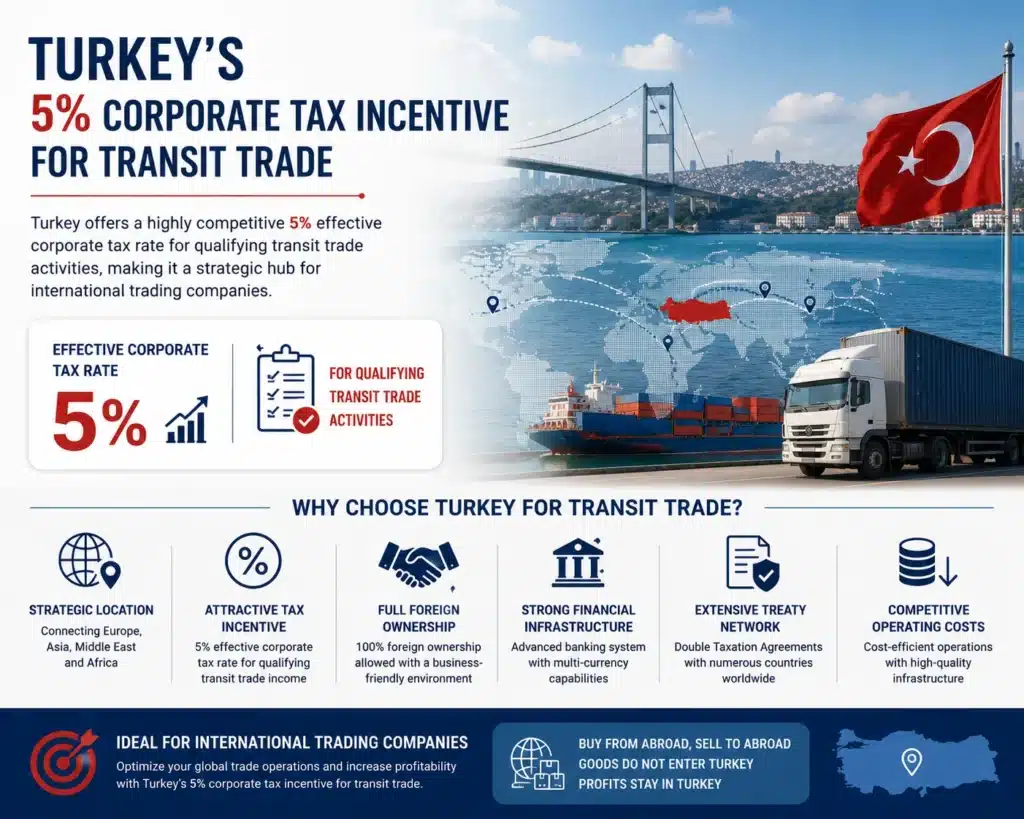
Transit trade in Turkey refers to an international trading activity where goods are purchased from one foreign country and sold to another foreign country without entering Turkey’s customs territory or domestic market.
In a typical transit trade transaction, a Turkish company acts as an intermediary between the supplier and the buyer. The goods are shipped directly from the exporting country to the importing country, while the commercial transaction, invoicing, and profit generation are managed through the Turkish company.
Example of Transit Trade
A company registered in Turkey purchases electronic products from a manufacturer in China and sells them to a customer in Germany.
Goods are shipped directly from China to Germany.
The products do not enter Turkey.
The Turkish company issues the sales invoice and earns the profit margin from the transaction.
This type of operation is considered transit trade under Turkish regulations.
The most important characteristic of transit trade is that the goods are shipped directly from the supplier’s country to the buyer’s country without entering Turkey’s customs territory.
Since the goods do not physically enter Turkey, import and export customs procedures in Turkey are generally not required. This reduces administrative burdens and simplifies international trade operations.
A Turkish company purchases goods from a foreign supplier and sells them to a foreign customer, earning a profit margin on the transaction while managing contracts, invoicing, and payments.
Payments for transit trade transactions are typically received and made through the Turkish company’s bank accounts, allowing profits to be recorded in Turkey.
Both the supplier and the customer are located outside Turkey. The Turkish company serves as the commercial intermediary between the two parties.
The products are not stored, processed, or distributed within Turkey. They are transported directly from the country of origin to the destination country.
Recent tax regulations provide significant incentives for qualifying transit trade income, including a reduced effective corporate tax rate under certain conditions, making Turkey an attractive jurisdiction for international trading companies.
Transit trade is particularly beneficial for:
Foreign investors can establish and fully own a Turkish company that conducts transit trade activities, without requiring a local shareholder.
Turkey’s location between Europe, Asia, the Middle East, and Africa makes it an ideal base for managing international trade flows across multiple regions.
One of the most important advantages of transit trade in Turkey is the availability of tax incentives for qualifying activities. Recent regulations have reduced the effective corporate tax rate to 5% for eligible transit trade income, creating substantial tax savings for international businesses.
This reduced tax burden can significantly improve profitability and enhance global competitiveness.
Turkey is uniquely positioned at the crossroads of Europe, Asia, the Middle East, and Africa. This strategic location allows companies to efficiently manage trade flows between major international markets.
Businesses operating through Turkey can access more than 1.5 billion consumers within a relatively short flight distance.
In transit trade transactions, goods are shipped directly from the supplier’s country to the buyer’s country without entering Turkey.
As a result:
Foreign investors can establish and fully own a Turkish company without the need for a local shareholder.
This provides international businesses with complete control over their operations while benefiting from Turkey’s business-friendly investment environment.
Turkey has a well-developed banking sector capable of supporting international trade operations.
Companies can benefit from:
These services facilitate smooth and efficient cross-border transactions.
Turkey has signed numerous Double Taxation Agreements (DTAs) with countries around the world.
These treaties may help businesses:
Compared to many European jurisdictions, Turkey offers relatively competitive costs for:
This allows companies to maintain efficient operations while controlling overhead expenses.
Turkey possesses a modern transportation infrastructure that supports international trade through:
These logistics capabilities facilitate efficient movement of goods between global markets.
Foreign investors can choose from various legal structures, including:
This flexibility allows businesses to select the most suitable structure for their commercial objectives and tax planning strategies.
A Turkish trading company can serve as a central hub for managing commercial activities across:
This regional reach makes Turkey an ideal location for multinational trading operations.
This incentive is designed to encourage international businesses to establish trading operations in Turkey and manage cross-border transactions through Turkish companies.
Previously, income from transit trade was subject to the standard corporate tax rate (currently 25%). Law No. 7582 amends the Corporate Tax Law (Article 10) to introduce a massive deduction
Here is the comparison of the new rates:
| Structure | Tax Deduction | Effective Corporate Tax Rate* | Based In |
| Standard Turkish Company | 95% Deduction | 5% | Mainland |
| IFC Participant Company | 100% Deduction | 0% | Istanbul Financial Center |
* The standard corporate tax rate is 25%
Traditionally, profits generated from transit trade activities were subject to the general corporate tax rules applicable in Turkey. With the introduction of the new incentive, eligible transit trade income may qualify for a significantly reduced effective tax burden.
The measure is expected to:
A lower corporate tax rate directly improves profitability for businesses engaged in international trading activities. Companies can retain a larger portion of their earnings while benefiting from Turkey’s strategic geographic location and developed business infrastructure.
For high-volume trading operations, the reduction to an effective 5% corporate tax rate can create a considerable competitive advantage.
This incentive is designed to position Istanbul as a leading regional and international financial hub, attracting global financial institutions, investment companies, fintech firms, and international service providers.
For businesses engaged in international trade, finance, treasury management, or cross-border commercial activities, the combination of Turkey’s 5% effective corporate tax rate for qualifying transit trade income and the 0% corporate tax advantage available for eligible activities in the Istanbul Financial Center creates a highly competitive tax environment.
As a result, international investors may find Turkey an increasingly attractive jurisdiction for establishing both trading and financial operations, benefiting from strategic market access and some of the most favorable tax incentives available in the region.
Note: The 0% corporate tax benefit in the Istanbul Financial Center applies only to qualifying activities and companies that meet the specific requirements set forth in the relevant legislation. Professional tax advice should be obtained to determine eligibility.
The incentive is particularly relevant for:
Foreign investors who establish a Turkish company may also be eligible to benefit from the incentive, provided they meet the applicable legal and tax requirements.
In addition to the reduced corporate tax rate, companies operating transit trade activities through Turkey may benefit from:
These advantages make Turkey an increasingly attractive jurisdiction for international trade and supply chain management.
Turkey’s reduced 5% effective corporate tax rate for qualifying transit trade activities presents a valuable opportunity for international trading companies. However, businesses must meet certain requirements to benefit from this incentive.
The company must engage in genuine transit trade transactions involving:
The transactions must satisfy the legal definition of transit trade under Turkish regulations.
To benefit from the incentive, the business must operate through a company incorporated and tax resident in Turkey, such as:
The company must be registered with the Turkish Trade Registry and Tax Office.
The tax incentive generally applies only to profits derived from qualifying transit trade activities. Income from other business operations may remain subject to the standard corporate tax rate.
Companies should retain sufficient documentation to support the nature of the transactions, including:
Proper documentation is essential in demonstrating eligibility during a tax audit.
Businesses must maintain accurate bookkeeping and fulfill all reporting obligations, including:
All payments related to transit trade activities should be conducted through the company’s official bank accounts to ensure transparency and traceability.
The company should have genuine business operations and management functions in Turkey. Tax authorities may evaluate whether the company has sufficient economic substance to support its activities.
Companies must comply with all applicable Turkish tax, commercial, foreign exchange, and anti-money laundering regulations to maintain eligibility for the incentive.
Whether you are an entrepreneur, trading company, or multinational corporation, setting up a Turkish entity can be an effective way to manage global trade activities.
Foreign investors typically establish one of the following legal entities:
The Limited Liability Company is the most popular structure for small and medium-sized businesses engaged in transit trade.
Key features include:
A Joint Stock Company may be more suitable for larger businesses and multinational groups.
Advantages include:
The company formation process requires the preparation of various documents, including:
Additional documents may be required depending on the ownership structure and business activities.
The company must be registered with the relevant Trade Registry Office.
Upon successful registration:
Following incorporation, the company must register with the Turkish Tax Office.
This process includes:
Proper tax registration is essential for companies intending to benefit from transit trade incentives.
A Turkish corporate bank account is generally required for:
Turkey’s banking system supports multiple currencies and international payment operations, making it well-suited for transit trade businesses.
All Turkish companies must maintain accounting records and comply with local tax regulations.
Key obligations include:
Professional accounting support is highly recommended to ensure compliance and maximize available tax benefits.
Once the company is established, it can engage in transit trade transactions by:
The goods do not need to enter Turkey, making transit trade an efficient and flexible international business model.
As discussed throughout this guide, understanding What Transit Trade in Turkey Is is the first step for businesses seeking to take advantage of this model. By facilitating transactions between foreign suppliers and foreign customers without goods entering Turkey, transit trade offers a flexible and efficient framework for international commerce.
The Advantages of Transit Trade in Turkey extend far beyond tax savings. Companies can benefit from a strategic geographic location connecting Europe, Asia, the Middle East, and Africa, as well as a modern banking system, competitive operating costs, and an extensive network of double taxation treaties.
These benefits help explain Why Turkey Is Becoming a Preferred Transit Trade Hub for multinational corporations, sourcing companies, and international traders looking for a reliable base to manage global operations.
For investors interested in entering the Turkish market, understanding How to Establish a Transit Trading Company in Turkey is essential. The incorporation process is relatively straightforward, with options for full foreign ownership and flexible corporate structures tailored to international business needs.
Finally, Establishing a Transit Trade Company in Turkey can provide long-term commercial and tax advantages for businesses involved in cross-border trade. With the introduction of the new 5% corporate tax incentive, Turkey has further enhanced its attractiveness as a destination for international trading activities.
For foreign investors, entrepreneurs, and multinational groups, now may be an ideal time to evaluate Turkey as a strategic base for transit trade operations and global business expansion.
A&M Consulting Co. is a specialized investment and business advisory firm, focused on helping foreign entrepreneurs, and international companies establish and scale service transit trade activities in Turkey.
We provide end-to-end solutions, including:
Our goal is to deliver cost-efficient, fully compliant, and scalable business solutions, enabling our clients to seamlessly enter the Turkish market while maximizing available tax advantages.
Whether you are an individual entrepreneur or a global company, we ensure that your operations in Turkey are strategically structured, legally compliant, and financially optimized from day one.
DISCOVER OUR SERVICES:
You can reach out to our experienced consultans via email or by filling out the Contact Form on our website’s contact page
Transit trade refers to the purchase of goods from one foreign country and their sale to another foreign country through a Turkish company, without the goods physically entering Turkey. The Turkish company manages the commercial transaction, invoicing, and profit generation.
The new incentive allows qualifying transit trade income to benefit from a significantly reduced effective corporate tax rate of 5%, helping companies lower their tax burden and increase profitability.
Turkey offers a strategic location between Europe, Asia, the Middle East, and Africa, combined with modern infrastructure, a strong banking system, foreign investment opportunities, and attractive tax incentives for international businesses.
Yes. Foreign investors can establish and fully own a Turkish company without requiring a local shareholder, making Turkey an attractive destination for international trading operations.
Transit trade is commonly used by:
No. One of the key features of transit trade is that the goods are shipped directly from the supplier’s country to the buyer’s country without entering Turkey.
The primary advantages include:
The process generally involves:
Foreign investors typically choose between:
The most suitable structure depends on the company’s size, investment plans, and operational needs.
The minimum capital requirement depends on the chosen company type and current Turkish corporate regulations. Professional advice should be obtained to determine the latest requirements.
Yes. Turkish banks generally offer multi-currency corporate accounts, allowing companies to conduct international transactions efficiently.
Yes. Turkey has an extensive network of Double Taxation Agreements (DTAs) that may help reduce international tax burdens and prevent double taxation.
Companies must maintain proper accounting records, invoices, contracts, shipping documents, and other supporting evidence demonstrating that transactions qualify as transit trade activities.
The incorporation process is generally completed within a few days to a few weeks, depending on the company structure, documentation, and administrative procedures.
Turkey combines tax efficiency, strategic market access, modern infrastructure, investor-friendly regulations, and strong international trade connections, making it one of the most attractive jurisdictions for managing global trading activities.
To qualify for the 5% tax incentive, a company must conduct eligible transit trade transactions through a Turkish tax-resident entity. The goods must be purchased from a foreign supplier and sold to a foreign customer without entering Turkey. Additionally, the company must maintain proper accounting records, retain supporting commercial documentation, comply with Turkish tax and reporting obligations, and ensure that the income claimed under the incentive is derived from qualifying transit trade activities. Failure to meet these requirements may result in the loss of the tax benefit.
No. Simply being located in the Istanbul Financial Center does not automatically grant access to the exemption. Companies must meet the legal requirements and conduct qualifying activities specified in the applicable regulations.
Qualifying activities generally include financial services provided to non-residents and services that generate export income in accordance with the relevant legal framework.


WhatsApp Us