

Summarize this article with AI
Changing a company’s registered office address in Turkey is a common corporate procedure that enables businesses to relocate their legal headquarters while maintaining the same legal identity. Whether your company is moving to a larger office, switching to a virtual office, relocating to another city, or optimizing operational costs, the address change must comply with the Turkish Commercial Code (TCC) and be registered with the relevant Trade Registry Office.
A registered office address is more than just a mailing location. It is the company’s official legal address recorded before the Trade Registry, Tax Office, Social Security Institution (SGK), MERSIS, banks, and other public authorities. Any change to this address must be properly documented and officially registered before it becomes legally effective.
Foreign investors frequently relocate their Turkish companies after incorporation. Typical reasons include moving to a more prestigious business district such as Maslak or Levent, changing accounting firms, leasing a virtual office, relocating operations, or consolidating multiple offices into one registered headquarters.
Although the procedure is relatively straightforward, errors in documentation, delays in Trade Registry filings, or failure to notify the relevant authorities may lead to administrative penalties and unnecessary delays.
This comprehensive guide explains everything foreign investors need to know about changing a registered office address in Turkey, including legal requirements, required documents, timelines, estimated costs, virtual office options, tax implications, and the complete step-by-step registration process.
A registered office address is the official legal address of a company recorded in the Turkish Trade Registry. It serves as the company’s legally recognized headquarters for receiving official correspondence, government notifications, legal notices, tax inspections, and court documents.
Every company incorporated in Turkey must maintain a valid registered office address throughout its existence. This address is recorded in:
The registered office address does not necessarily have to be the location where the company’s daily operations are carried out. Many businesses—particularly foreign-owned companies and technology startups—choose to operate remotely while maintaining a legally compliant registered office or virtual office.
The registered address represents the company’s official domicile under Turkish corporate law and serves as the primary contact point for all government authorities.
One of the most common questions asked by foreign investors is whether a registered office address and a virtual office are the same.
The answer is not always.
A registered office address is the official legal headquarters of the company recorded before the Trade Registry.
A virtual office is a commercial service offered by licensed office providers that may also be used as the company’s registered office, provided the lease agreement satisfies Turkish legal requirements.
A virtual office typically includes:
For many foreign entrepreneurs who do not require permanent physical office space, a virtual office provides an efficient and cost-effective solution while remaining fully compliant with Turkish legislation.
However, not every virtual office provider meets the legal standards required for Trade Registry registration. Therefore, businesses should ensure that the chosen provider offers addresses specifically approved for company registration purposes.
Companies relocate their registered office for various commercial, operational, and legal reasons. While some businesses move because of expansion, others relocate to reduce operating costs or improve their corporate image.
The most common reasons include:
As businesses grow, they often require larger office space or relocate closer to clients, suppliers, or transportation networks.
Many international companies prefer relocating their headquarters to well-known business districts such as Maslak, Levent, Ataşehir, or Kozyatağı to strengthen their corporate image.
A prestigious address enhances credibility when dealing with customers, banks, investors, and international business partners.
Many foreign-owned companies operate remotely and no longer require a dedicated physical office.
Changing the registered address to a licensed virtual office can significantly reduce rental and operational costs while maintaining full legal compliance.
Office rental costs vary considerably across Turkey.
Businesses often relocate to reduce expenses while maintaining an official registered office suitable for legal and tax purposes.
Companies may transfer their headquarters from one province to another due to:
Following mergers, acquisitions, shareholder changes, or organizational restructuring, companies frequently relocate their registered headquarters to align with new management or operational requirements.
Some companies move their registered office to the address of a new accounting or corporate services provider to centralize administrative processes.
Under the Turkish Commercial Code, almost every registered business entity has the legal right to change its registered office address.
The procedure applies equally to Turkish-owned and foreign-owned businesses.
The following entities may change their registered office:
The legal procedure varies slightly depending on the company’s legal structure, but the overall registration process remains substantially similar.
Yes.
Companies wholly or partially owned by foreign investors enjoy exactly the same rights as Turkish-owned companies regarding registered office address changes.
Turkish legislation does not impose any restrictions based on the nationality of shareholders or directors.
Foreign-owned companies may:
This makes Turkey one of the most investor-friendly jurisdictions for post-incorporation corporate changes.
A company’s registered office address in Turkey is governed primarily by the Turkish Commercial Code No. 6102 (TCC). Since the registered office is stated in the company’s Articles of Association (AoA), any change requires an amendment to the Articles of Association and registration with the competent Trade Registry Office.
The address change does not create a new legal entity. The company continues operating under the same:
The amendment only changes the company’s official legal headquarters.
Following the registration, the company must also update its address before the relevant governmental authorities and institutions to ensure full legal compliance.
The internal approval required depends on the legal structure of the company.
For a Limited Liability Company, the registered office address change is generally approved by the Shareholders’ General Assembly through a formal shareholders’ resolution.
The resolution should include:
For Joint Stock Companies, the address change is usually approved by the General Assembly.
However, if the Articles of Association authorize the Board of Directors to change the registered office within the same Trade Registry jurisdiction, the Board Resolution may be sufficient.
Each company’s Articles of Association should therefore be reviewed before initiating the process.
If a foreign company’s Turkish branch changes its registered office, the authorized representatives of the branch generally approve the amendment in accordance with the parent company’s authorization documents.
Additional foreign corporate documents may be required depending on the circumstances.
Changing a registered office address is a straightforward corporate procedure when all required documents are properly prepared.
Below is the complete process followed by most Turkish companies.
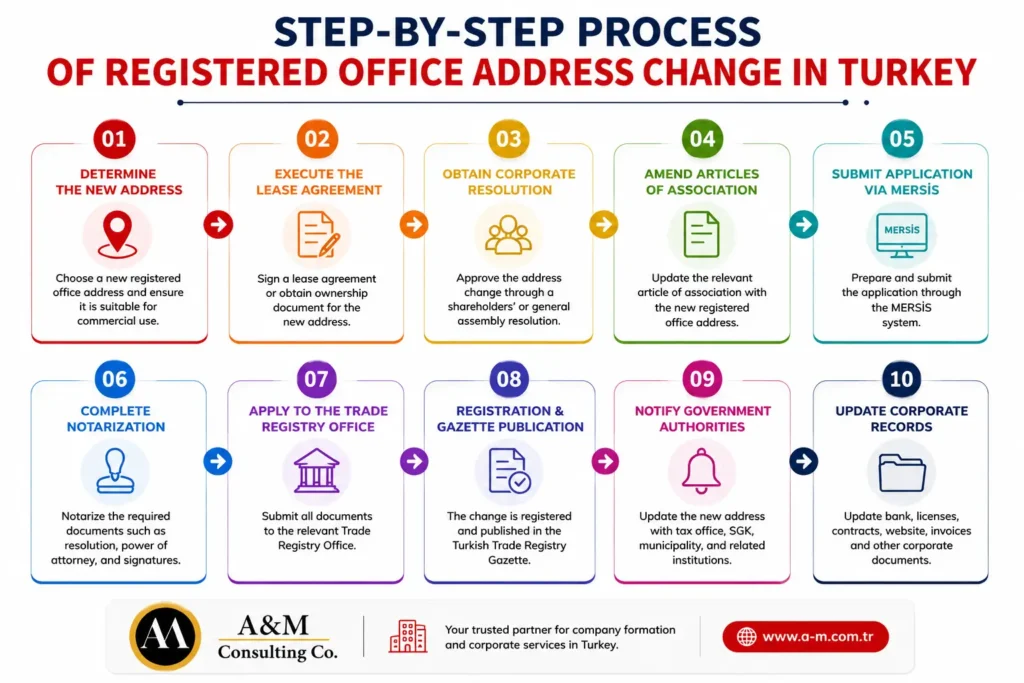
The first step is selecting the company’s new legal headquarters.
The new address should:
If the company intends to use a virtual office, the office provider should be authorized to lease registered office addresses.
Before filing the application, the company should obtain legal possession of the new premises.
This is generally evidenced by:
For virtual offices, the service agreement should clearly indicate that the address may be used as the company’s official registered office.
Because the company’s registered office address is specified in the Articles of Association, the relevant article must be amended.
The amendment typically includes:
This amendment will later be uploaded through the MERSIS system.
The shareholders or authorized corporate body approve the address change.
The corporate resolution authorizes:
The resolution must be signed by the authorized parties.
Depending on the circumstances, notarization may also be required.
Turkey’s MERSIS (Central Registration System) is the electronic platform through which all corporate amendments are processed.
The following information is entered into the system:
Once completed, MERSIS generates the Trade Registry application package.
Certain documents may require notarization before submission.
These may include:
If the documents are signed outside Turkey, they generally require:
The completed application file is submitted to the competent Trade Registry Office.
The application package generally consists of:
The Trade Registry examines the file for legal compliance before approving the amendment.
Once approved:
From this date onward, all invoices, contracts, official correspondence, company seals, and commercial documents should display the new registered office address.
After registration, the company should update its records with all relevant authorities.
These generally include:
Prompt notification helps avoid inconsistencies between official databases.
The final step is updating the company’s internal records and branding materials.
These include:
Maintaining consistent corporate records helps strengthen legal compliance and corporate identity.
Although documentation may vary depending on the company’s legal structure, the following documents are generally required:
For companies with foreign shareholders or directors, apostilled corporate documents and certified Turkish translations may also be required.
Yes.
Foreign investors who are unable to travel to Turkey can complete the entire registered office address change remotely by granting an apostilled or duly legalized Power of Attorney to an authorized representative.
Once the Power of Attorney has been notarized, apostilled (or legalized where applicable), and translated into Turkish by a sworn translator, the representative may complete the process on behalf of the company before:
This approach significantly reduces the time and costs associated with international travel while ensuring full compliance with Turkish corporate legislation.
The time required to complete a registered office address change depends on the company’s legal structure, the completeness of the required documentation, and the workload of the relevant Trade Registry Office.
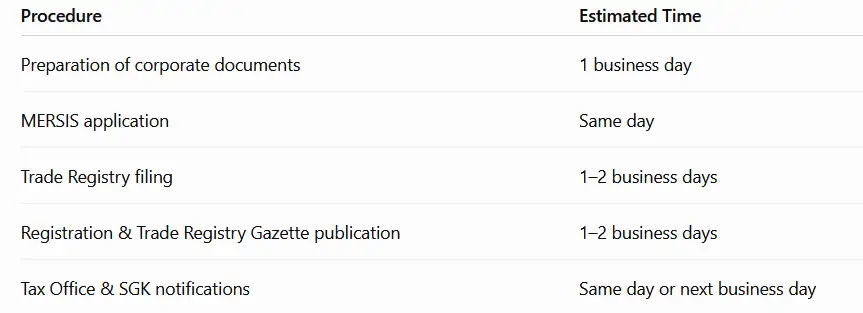
Under normal circumstances, the process can be completed within 3 to 5 business days once all required documents have been properly prepared and submitted.
A typical timeline is as follows:
Foreign investors using an apostilled Power of Attorney should also consider the time required for document legalization, international shipping, certified translation, and notarization.
The overall cost varies depending on several factors, including the company’s legal structure, whether foreign documents are involved, and whether a virtual office service is required.
The typical costs include:
| Service | Estimated Cost |
|---|---|
| Professional service fee | About EUR 1,000 – 1,500 + VAT |
| Registered / Virtual Office (Annual) | About EUR 500 – 5750 + VAT |
| Translation & Notarization (if required) | Approximately EUR 750 – 1,000 + VAT |
| Trade Registry Fees | Subject to official tariff |
| Government Fees | Depending on the transaction |
Official fees may vary depending on:
For this reason, obtaining a company-specific quotation before initiating the process is recommended.
Registering the new address with the Trade Registry is only one part of the process.
Following registration, the company should ensure that its records are updated before all relevant public institutions and business partners.
These may include:
Maintaining consistent information across all institutions helps prevent administrative issues and ensures uninterrupted business operations.
Yes.
Turkish legislation allows companies to use a virtual office as their registered office address, provided that the virtual office provider offers a legally compliant lease agreement suitable for Trade Registry registration.
A virtual office is particularly suitable for:
Typical virtual office services include:
Choosing a reputable provider is essential to ensure legal compliance and avoid registration issues.
Although the procedure is relatively straightforward, companies often encounter delays due to avoidable mistakes.
Some of the most common include:
Not every commercial address qualifies as a registered office. The lease agreement and zoning status should be verified before filing.
Some companies complete the Trade Registry registration but forget to notify the Tax Office, SGK, banks, or licensing authorities.
Any discrepancy between the MERSIS application and supporting documents may delay the registration process.
Improperly prepared shareholders’ or board resolutions are among the most common reasons for Trade Registry rejection.
Foreign corporate documents should be apostilled (or legalized where applicable), translated into Turkish, and notarized before submission.
Whether your company is relocating to a new office, switching to a virtual office, or expanding into a different city, obtaining professional assistance can significantly simplify the process.
At A&M Consulting, we help foreign investors and international businesses navigate every stage of the registered office address change process with efficiency, transparency, and full legal compliance.
If you are planning to change your company’s registered office address in Turkey, A&M Consulting is ready to assist you throughout the entire process.
Our experienced corporate consultants provide end-to-end support, including:
Contact our team today for a tailored quotation and professional guidance on your registered office address change in Turkey.
You can reach out to our experienced consultans via email or by filling out the Contact Form on our website’s contact page.
A registered office address is the official legal address of a company recorded with the Turkish Trade Registry. It is used for receiving official correspondence from government authorities, tax offices, courts, banks, and other institutions. Every company established in Turkey must maintain a valid registered office throughout its existence.
Yes. Companies with foreign shareholders or directors have the same rights as Turkish-owned companies. A registered office address can be changed at any time, provided the legal procedures under the Turkish Commercial Code are followed.
Yes. Foreign investors who are unable to travel to Turkey can authorize a representative through an apostilled or duly legalized Power of Attorney. The representative can complete all procedures before the Trade Registry, Tax Office, SGK, and other relevant authorities on the company’s behalf.
Once all required documents have been submitted, the process is generally completed within 3 to 5 business days. Processing times may vary depending on the workload of the relevant Trade Registry Office and the completeness of the documentation.
The required documents generally include:
No. The company’s Tax Identification Number (TIN) remains unchanged. The address change only updates the company’s official registered office.
No. The MERSIS number and Trade Registry number remain the same after the address change.
Yes. A company may relocate its registered office to another province. However, the transfer may involve coordination between the existing and the new Trade Registry Office, depending on the location.
Yes. A virtual office may serve as the company’s registered office, provided the service provider offers a legally compliant lease agreement acceptable to the Turkish Trade Registry.
Not necessarily. Many consulting firms, software companies, holding companies, and foreign-owned businesses legally operate using registered virtual office services.
Share:
Although documentation may vary depending on the company’s legal structure, the following documents are generally required:
For companies with foreign shareholders or directors, apostilled corporate documents and certified Turkish translations may also be required.


Follow us!
WhatsApp Us