

Changing a company director or manager in Turkey is a common corporate procedure that may become necessary due to business expansion, organizational restructuring, shareholder decisions, resignation, retirement, or changes in ownership. Whether your company is a Limited Liability Company (Ltd. Şti.) or a Joint Stock Company (A.Ş.), the appointment or replacement of the individuals authorized to represent the company must comply with Turkish corporate legislation and registration requirements.
For foreign investors, understanding the legal framework governing company management is particularly important. Turkish law distinguishes between company managers in limited liability companies and board members or directors in joint stock companies. Although the terminology differs, both roles are responsible for managing and legally representing the company.
Failure to complete the required legal procedures can create significant operational challenges. Banks may refuse to recognize newly appointed representatives, contracts may become invalid due to unauthorized signatures, and government authorities may reject applications if company records have not been updated properly.
Fortunately, changing a company director or manager in Turkey is generally a straightforward process when all required corporate resolutions, notarized documents, and Trade Registry filings are prepared correctly.
This comprehensive guide explains everything foreign investors need to know about changing a company director or manager in Turkey, including:
Whether you are replacing an existing manager, appointing a foreign director, restructuring your company’s management, or simply updating your corporate records, this guide will help you understand every stage of the process.
Before initiating any corporate amendment, it is essential to understand the distinction between a company director and a company manager under Turkish law.
Many international investors use the term director to describe the individual responsible for managing a company. However, under the Turkish Commercial Code, the terminology depends on the legal structure of the business.
In a Limited Liability Company, the company is managed by one or more Managers (Müdür).
The manager is responsible for:
A manager may be:
Turkish law permits limited liability companies to appoint one or more directors according to their articles of association, but requires that at least one shareholder be a director.
Joint Stock Companies operate under a different governance structure.
Instead of managers, they are administered by a Board of Directors, which may consist of one or more board members.
The Board of Directors is responsible for:
Representation authority may be granted to:

Although many foreign investors use the phrase “company director”, the legal documentation required by Turkish authorities differs depending on the company type.
For example:
| Company Type | Correct Legal Term |
|---|---|
| Limited Liability Company (Ltd. Şti.) | Company Manager |
| Joint Stock Company (A.Ş.) | Board Member / Director |
Understanding this distinction ensures that shareholder resolutions, Trade Registry applications, and company records are prepared accurately, reducing the risk of delays or rejection during the registration process.
One of the most common sources of confusion for foreign investors is the distinction between a company director and a company manager in Turkey. While these terms are often used interchangeably in everyday business language, Turkish corporate law assigns different meanings to each role depending on the company’s legal structure.
Understanding this distinction is essential because the appointment, dismissal, registration process, and corporate documentation vary according to whether the company is established as a Limited Liability Company (Ltd. Şti.) or a Joint Stock Company (A.Ş.).
Making changes using incorrect terminology may lead to delays during the Trade Registry application process or require amendments to corporate resolutions before registration can be completed.
Under the Turkish Commercial Code, a Limited Liability Company (Ltd. Şti.) is managed by one or more Managers (Müdürler).
The shareholders appoint the manager(s), who are responsible for both the daily administration and the legal representation of the company.
A company manager has authority to:
A company may appoint:
Unless otherwise restricted by the Articles of Association or shareholders’ resolutions, the appointed manager generally has broad authority to act on behalf of the company.
A Joint Stock Company (A.Ş.) follows a different corporate governance model.
Instead of appointing managers, the shareholders elect a Board of Directors, which is responsible for managing and representing the company.
The Board of Directors may consist of:
The Board determines how representation authority will be exercised.
For example:
Unlike a limited liability company, the authority of directors in a joint stock company is often determined by formal Board resolutions and internal governance rules.
Yes.
In fact, this is one of the most common structures for small and medium-sized companies in Turkey.
For example:
There is no legal requirement that a company manager must hold shares in the company unless the Articles of Association provide otherwise.
However, in the case of a Limited Liability Company (LLC), at least one of the shareholders must be appointed as a manager.
Yes.
Turkey permits foreign nationals to be appointed as:
There is generally no nationality requirement under the Turkish Commercial Code.
However, depending on the circumstances, additional practical considerations may arise, such as:
Being appointed as a company manager or director does not automatically grant the right to live or work in Turkey. Foreign nationals who intend to reside in Turkey or perform activities requiring work authorization may need to obtain the appropriate residence or work permit under the applicable immigration legislation.
One important distinction is that management authority and representation authority are not always identical.
For example, a company may appoint several managers, but only one manager may have authority to sign contracts individually.
Similarly, in a Joint Stock Company, the Board of Directors may restrict representation authority by requiring joint signatures or delegating signing authority to specific individuals.
For this reason, whenever a director or manager is changed, the shareholders should carefully review whether the company’s representation structure also needs to be amended.
Foreign investors often confuse the roles of Company Manager and Authorized Signatory.
These are separate legal concepts.
A Company Manager is responsible for the management and legal representation of the company.
An Authorized Signatory, on the other hand, is a person who has been granted authority to sign certain documents or conduct specific transactions on behalf of the company.
For example, a company may appoint:
Not every Authorized Signatory is a Company Manager, and not every Company Manager has unlimited signing authority.
Yes.
Turkish law allows Limited Liability Companies to appoint multiple managers.
Depending on the company’s Articles of Association, they may act:
For example:
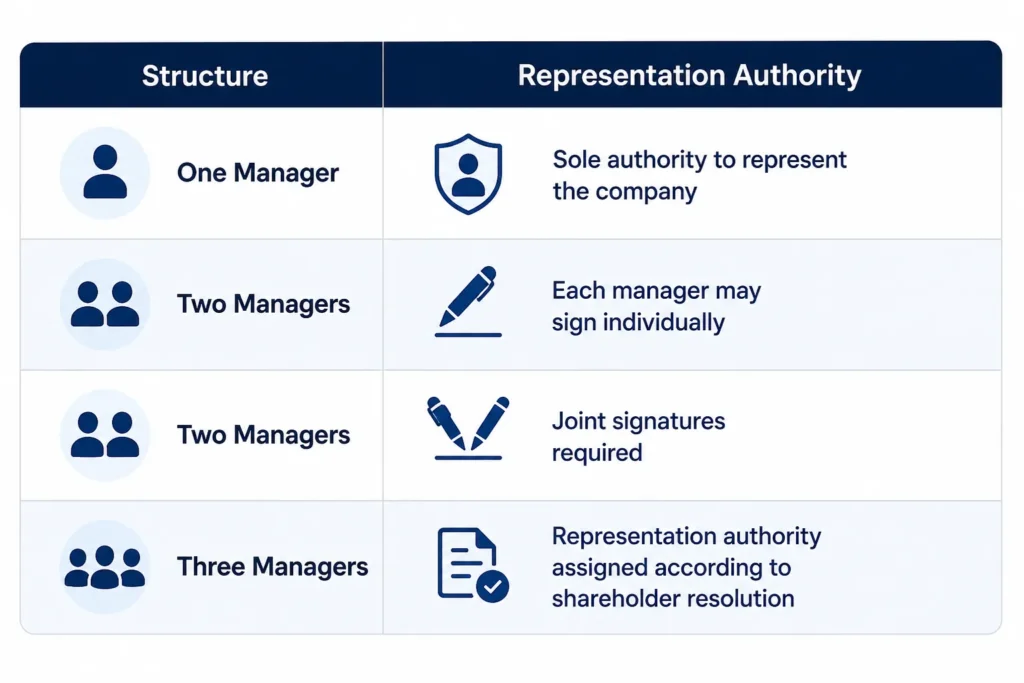
Understanding the distinction between a director and a manager is not merely a matter of terminology—it has direct legal and practical implications.
When preparing the necessary documentation for a corporate amendment, the correct legal role must be reflected in:
Using incorrect terminology or failing to update representation authority can result in delays, requests for additional documentation, or the rejection of the application by the relevant Trade Registry Office.
For this reason, foreign investors are advised to seek professional guidance before initiating any changes to the company’s management structure.
Changing a company director or manager in Turkey is governed primarily by the Turkish Commercial Code No. 6102 (TCC). The law sets out the rules for appointing, removing, replacing, and registering individuals who are authorized to manage and represent a company.
Although the process is generally straightforward, it must be carried out in accordance with the applicable legal requirements. Failure to comply with the Turkish Commercial Code or the relevant Trade Registry procedures may result in delays, rejected applications, or legal uncertainty regarding the company’s representation authority.
For foreign investors, understanding the legal framework is essential to ensure that corporate decisions are properly documented and legally effective.
The Turkish Commercial Code (TCC) is the principal legislation governing commercial companies in Turkey. It regulates:
Every company registered in Turkey must comply with the provisions of the Turkish Commercial Code, regardless of whether its shareholders are Turkish or foreign nationals.
Virtually every commercial company in Turkey may change its management structure during its lifetime.
The most common company types are:
The shareholders may appoint:
Management changes are generally approved through a Shareholders’ Resolution and become legally effective upon registration with the Trade Registry.
In Joint Stock Companies, shareholders or the General Assembly may:
Depending on the circumstances, additional Board resolutions may also be required.
Yes.
In most cases, the appointment or removal of a company manager or director requires a formal corporate decision.
For Limited Liability Companies, this usually takes the form of a Shareholders’ Resolution, which records the shareholders’ decision to:
For Joint Stock Companies, the relevant corporate body—typically the General Assembly or the Board of Directors, depending on the matter—must adopt the appropriate resolution in accordance with the Turkish Commercial Code and the company’s Articles of Association.
The resolution should clearly specify:
This is an important legal question.
Although shareholders may adopt a resolution on a particular date, the change generally becomes legally enforceable against third parties after it has been duly registered with the relevant Trade Registry Office and announced in the Turkish Trade Registry Gazette.
Until registration is completed:
For this reason, companies should complete the registration process as soon as possible after the shareholders approve the change.
Not necessarily.
Whether the company’s Articles of Association (AoA) must be amended depends on how the management provisions are drafted.
Each company’s constitutional documents should therefore be reviewed before preparing the corporate resolutions.
Under Turkish law, changes relating to company management must be registered with the relevant Trade Registry Office.
The registration process typically includes:
Only after these formalities have been completed will the new management information appear in the official commercial records.
Changing a company director or manager often requires updates beyond the Trade Registry.
Depending on the company’s activities, notifications may also be necessary to:
Promptly updating these records helps ensure uninterrupted business operations and avoids administrative complications.
One of the most important legal aspects of any management change is the definition of representation authority.
The company must determine:
These details are recorded during the registration process and reflected in the company’s official records.
Clearly defining representation authority minimizes legal risks and provides certainty for employees, customers, suppliers, banks, and government authorities.
Appointing a new director or manager is not the final step.
The company should also ensure that:
Maintaining accurate corporate records is an essential part of ongoing legal compliance in Turkey.
Foreign-owned companies should pay particular attention to documentation requirements.
Depending on the circumstances, additional documents may be required, such as:
Preparing these documents correctly before filing with the Trade Registry can significantly reduce processing times and prevent unnecessary delays.
Before changing a company director or manager in Turkey, companies should keep the following legal principles in mind:
Changing a company director or manager is a normal part of a company’s lifecycle. As businesses grow, attract new investors, restructure their operations, or adapt to changing market conditions, their management structure often needs to evolve accordingly.
Under Turkish law, shareholders generally have the authority to appoint new managers or directors, replace existing ones, or modify representation authority, provided that the necessary corporate procedures are followed.
Below are the most common reasons why companies operating in Turkey change their directors or managers.
One of the most frequent reasons for a management change is the voluntary resignation of the current director or manager.
A manager or board member may resign due to:
Once the resignation is accepted (where applicable), shareholders should appoint a replacement without unnecessary delay to ensure uninterrupted management and legal representation of the company.
If the resigning individual is the company’s sole authorized representative, a new representative should be appointed before business operations are affected.
Turkey continues to attract international investors across various industries, including manufacturing, technology, logistics, finance, renewable energy, and professional services.
When a foreign investor acquires shares in a Turkish company, it is common to revise the management structure by:
Foreign nationals may generally serve as company managers or board members, provided that the applicable legal and registration requirements are satisfied.
As companies expand, their governance structures often become more sophisticated.
Corporate restructuring may involve:
For example, a family-owned business may initially operate with a single shareholder-manager but later appoint professional executives as the company grows.
Changes in ownership frequently lead to changes in management.
Examples include:
New shareholders often wish to participate in management or appoint individuals they trust to oversee the company’s operations.
Following a share transfer, companies should review whether their management structure and representation authority remain appropriate.
As businesses mature, shareholders may seek to improve transparency, accountability, and decision-making by revising the company’s management structure.
Examples include:
These measures can strengthen internal controls and reduce operational risk.
Business growth often requires additional management resources.
Companies opening:
may appoint additional managers or directors to oversee specific operations.
Rather than relying on a single individual, shareholders may distribute responsibilities among multiple executives with clearly defined roles.
Sometimes the management team remains unchanged, but the company’s representation authority needs to be updated.
For example, shareholders may decide to:
These changes improve internal control while ensuring that corporate decisions are made appropriately.
International corporate groups frequently standardize their governance structures across multiple jurisdictions.
When a Turkish subsidiary becomes part of a multinational group, the parent company may require:
These changes help ensure consistency across the group’s international operations.
Following a merger or acquisition, changes to the management team are common.
The acquiring company may appoint:
Management changes often form part of the post-acquisition integration process and help align the acquired company with the buyer’s organizational structure.
In unfortunate circumstances, a company may need to appoint a replacement due to the death or permanent incapacity of a manager or board member.
Prompt action is particularly important if the individual held sole representation authority, as delays may affect:
Shareholders should initiate the appointment process as soon as practicable to maintain business continuity.
Shareholders may decide to replace a manager or director due to concerns about performance or strategic direction.
Reasons may include:
As long as the applicable legal procedures and the company’s constitutional documents are respected, shareholders generally have the authority to appoint new management.
Certain regulated industries—such as banking, insurance, financial services, healthcare, energy, and telecommunications—may be subject to sector-specific rules regarding company management.
Depending on the nature of the business, regulatory authorities may require companies to:
Companies operating in regulated sectors should ensure that any management changes comply with both the Turkish Commercial Code and the relevant industry regulations.
One of the most common questions asked by foreign investors is whether there are any nationality, residency, or ownership restrictions when appointing a company director or manager in Turkey.
The good news is that Turkish corporate law provides considerable flexibility. In most cases, companies are free to appoint the individual they consider most suitable, provided that the appointment complies with the Turkish Commercial Code, the company’s Articles of Association, and the applicable registration procedures.
This flexibility makes Turkey an attractive jurisdiction for international businesses, multinational groups, and foreign entrepreneurs establishing or expanding their operations.
Yes.
Foreign nationals may generally be appointed as:
There is no general requirement that a company manager or director must be a Turkish citizen.
As a result, many foreign-owned companies in Turkey appoint one of their overseas shareholders, regional executives, or international managers to oversee the Turkish entity.
However, foreign appointees should ensure that all required identification and registration documents are properly prepared before the appointment process begins.
In most cases, no.
A company manager or board member does not have to reside in Turkey simply because they have been appointed to that role.
Many Turkish companies are managed by individuals who live abroad and visit Turkey only when necessary for business purposes.
However, practical considerations should be taken into account. If the appointed individual will actively manage the business from within Turkey or carry out activities that require immigration authorization, the appropriate residence permit or work permit may be required under Turkish immigration legislation.
The appointment itself does not automatically grant the right to live or work in Turkey.
Not necessarily.
Turkish law generally allows both shareholders and non-shareholders to serve as company managers or board members.
This gives companies the flexibility to appoint:
This approach is particularly common among multinational groups that prefer to separate ownership from day-to-day management.
In certain circumstances, yes.
For Joint Stock Companies (A.Ş.), a legal entity may be appointed as a member of the Board of Directors. In such cases, the legal entity must designate a real person who will act on its behalf and exercise the rights and obligations arising from the appointment.
For Limited Liability Companies (Ltd. Şti.), management functions are generally carried out by natural persons. Companies should therefore review the Turkish Commercial Code and their Articles of Association before making an appointment involving a legal entity.
Professional advice is recommended where corporate shareholders are expected to participate directly in management.
Yes.
Turkish companies frequently appoint multiple individuals to share management responsibilities.
Examples include:
The shareholders may appoint:
The company may establish a Board of Directors consisting of:
The structure should reflect the company’s operational needs and governance objectives.
Absolutely.
There is no limit on how many times a company may change its directors or managers.
Companies regularly update their management due to:
Each appointment or removal should follow the applicable legal procedures and be registered with the Trade Registry where required.
Although document requirements vary depending on the specific circumstances, foreign directors or managers are commonly asked to provide:
Preparing these documents in advance helps streamline the registration process.
Accepting an appointment involves both authority and responsibility.
Depending on the company’s structure, the appointed individual may be responsible for:
Managers and directors are expected to perform their duties with due care and in the best interests of the company.
Before appointing a foreign manager or director, companies should consider the following practical points:
Early preparation reduces the likelihood of delays and facilitates a smooth transition.
When appointing a company director or manager in Turkey, remember the following:
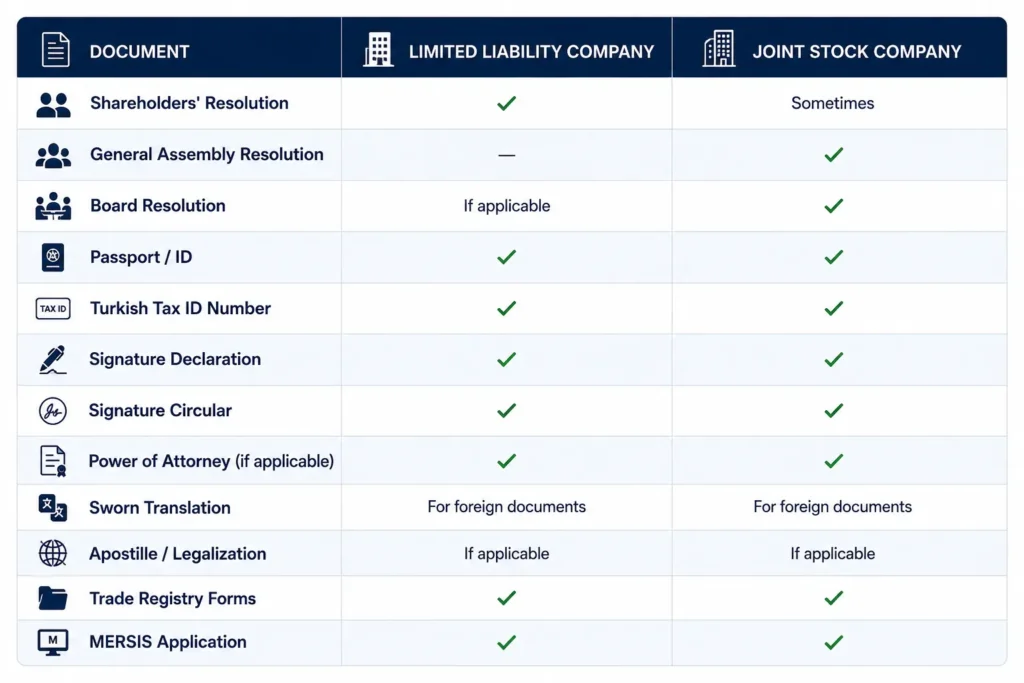
Changing a company director or manager in Turkey requires the preparation of several corporate and registration documents. The exact documentation depends on factors such as the company’s legal structure, the nationality of the incoming director or manager, whether the appointment is made in person or through a representative, and the specific requirements of the relevant Trade Registry Office.
Preparing all documents accurately before filing the application helps avoid delays, requests for additional information, and rejected registrations.
This section outlines the documents that are commonly required when changing a company director or manager in Turkey.
Although requirements may vary from case to case, companies are generally expected to prepare the following:
Each document serves a specific legal purpose and should be prepared carefully.
For a Limited Liability Company (Ltd. Şti.), the most important document is usually the Shareholders’ Resolution.
This resolution formally records the shareholders’ decision to:
The resolution should clearly identify:
Where required, the signatures of the shareholders must be notarized.
For Joint Stock Companies (A.Ş.), the required corporate document depends on the nature of the appointment.
Depending on the circumstances, the appointment may require:
The resolution should specify:
Companies should ensure that the resolution complies with both the Turkish Commercial Code and the Articles of Association.
The incoming director or manager must provide proof of identity.
For Turkish citizens:
For foreign nationals:
The Trade Registry may require a notarized copy or certified translation depending on the circumstances.
Companies should ensure that passports remain valid throughout the registration process.
Foreign nationals appointed as company managers or directors generally need to obtain a Turkish Tax Identification Number before the registration process can be completed.
This number is used by:
Obtaining a Turkish Tax Identification Number is usually a straightforward administrative procedure and should be completed before preparing the final application documents.
The newly appointed representative will usually need to update the company’s signing records.
Depending on the circumstances, this may include:
These documents enable banks, public authorities, and commercial counterparties to verify who is legally authorized to sign on behalf of the company.
If representation authority has changed, the previous signature circular should be updated promptly after registration.
Foreign shareholders are not always able to travel to Turkey to complete the registration process.
In such cases, they may authorize another individual—such as a lawyer or corporate service provider—to act on their behalf.
The Power of Attorney should clearly authorize the representative to:
If executed outside Turkey, the Power of Attorney generally needs to be:
Turkey’s central commercial registration system (MERSIS) is used during most corporate amendment procedures.
The application generally includes:
The electronic records submitted through MERSIS should match the physical documents filed with the Trade Registry.
The relevant Trade Registry Office requires standardized application forms as part of the registration process.
These forms typically include:
Incomplete or inconsistent application forms may delay the registration.
In some cases, the newly appointed manager or director may be required to formally accept the appointment.
The acceptance confirms that the individual:
Although the specific format may vary, companies should verify the current requirements before filing the application.
Documents issued outside Turkey are generally not accepted in their original language.
Common examples include:
These documents usually require translation into Turkish by a sworn translator before submission to the relevant authorities.
Foreign-issued documents often require authentication before they can be used in Turkey.
Depending on the country of origin, this may involve:
Companies should verify the applicable legalization procedure before arranging translations.
Failure to legalize foreign documents correctly is one of the most common causes of delays in corporate registration procedures.
Depending on the company’s circumstances, the Trade Registry or other authorities may request additional documentation, such as:
The documentation required will depend on the nature of the amendment and the company’s business activities.
Changing a company director or manager in Turkey involves more than simply appointing a new individual. The process includes a series of legal and administrative steps that must be completed in the correct order to ensure that the appointment is valid and recognized by public authorities, financial institutions, and third parties.
Although the exact procedure may vary depending on the company’s legal structure and specific circumstances, the following steps reflect the standard process followed by most Turkish companies.
Before preparing any corporate resolutions, the company’s Articles of Association (AoA) should be carefully reviewed.
This review helps determine:
Many unnecessary delays can be avoided by identifying these requirements at the outset.
Once the shareholders have decided to change the company’s management, they should confirm the details of the incoming appointee.
This includes verifying:
For foreign nationals, all supporting documents should be collected before moving to the next stage.
The company must prepare the appropriate corporate resolution.
Depending on the company type, this may include:
The resolution should clearly state:
The wording should be precise and consistent with the Turkish Commercial Code.
Before filing the application, all supporting documents should be assembled.
Typical documents include:
Preparing a complete application package significantly reduces the likelihood of requests for additional documentation.
Certain corporate documents and signatures may need to be notarized before submission.
Depending on the circumstances, notarization may apply to:
If documents are executed outside Turkey, additional legalization procedures—such as an Apostille or consular legalization—may be required before notarization can be completed in Turkey.
Turkey’s commercial registration system operates through MERSIS (Central Registration System).
Before visiting the Trade Registry Office, the relevant information must generally be entered into the MERSIS system.
This typically includes:
The electronic records must be consistent with the physical documentation that will be submitted.
Once all documents have been prepared, the application should be submitted to the competent Trade Registry Office.
The submission generally includes:
The Trade Registry reviews the documents to verify compliance with the Turkish Commercial Code and registration requirements.
If any inconsistencies are identified, the applicant may be asked to provide corrections or additional documentation before the registration can proceed.
Following approval by the Trade Registry Office, the appointment is officially registered.
The registration records:
Registration is one of the most important milestones in the process because it gives legal effect to the appointment with respect to third parties.
After registration, the change is typically published in the Turkish Trade Registry Gazette.
The publication serves as official public notice of the amendment.
This announcement enables:
to verify the company’s current management structure through the official commercial records.
Once registration has been completed, the company’s Signature Circular should be updated.
This document identifies the individuals authorized to sign on behalf of the company and is widely used by:
Failure to update the Signature Circular may result in practical difficulties when conducting business.
Although Trade Registry registration updates many official records, additional notifications may still be required.
Depending on the company’s activities, updates may need to be made with:
Timely notification helps ensure that all records remain consistent across different institutions.
Finally, companies should review and update their internal documentation.
This may include:
Maintaining accurate internal records is an important aspect of corporate governance and ongoing compliance.
Changing a company director or manager in Turkey is generally a straightforward corporate amendment when all required documents are prepared correctly. The process usually includes the preparation of corporate resolutions, notarization (where required), MERSIS registration, Trade Registry filing, publication in the Turkish Trade Registry Gazette, and post-registration updates with banks and other institutions.
Timeline: In straightforward cases, the procedure can often be completed within a few business days after all documents are ready. If foreign documents require apostille, legalization, or sworn translation, the overall timeline may be longer.
Trade Registry registration and publication fees
Notary fees for signatures, declarations, or powers of attorney
Sworn translation costs for foreign-language documents
Apostille or legalization expenses for documents issued abroad
Professional service fees for preparing and filing the application
The total cost varies depending on the company type, number of documents, notarization requirements, and whether foreign-issued documents must be legalized. Careful preparation and professional assistance can help reduce delays, avoid additional expenses, and ensure a smooth registration process.
Changing a company director or manager in Turkey is generally a straightforward corporate amendment when all required documents are prepared correctly. The process usually includes the preparation of corporate resolutions, notarization (where required), MERSIS registration, Trade Registry filing, publication in the Turkish Trade Registry Gazette, and post-registration updates with banks and other institutions.
Timeline: In straightforward cases, the procedure can often be completed within a few business days after all documents are ready. If foreign documents require apostille, legalization, or sworn translation, the overall timeline may be longer.
Main Cost Components:
Trade Registry registration and publication fees
Notary fees for signatures, declarations, or powers of attorney
Sworn translation costs for foreign-language documents
Apostille or legalization expenses for documents issued abroad
Professional service fees for preparing and filing the application
The total cost varies depending on the company type, number of documents, notarization requirements, and whether foreign-issued documents must be legalized. Careful preparation and professional assistance can help reduce delays, avoid additional expenses, and ensure a smooth registration process.
Changing a company director or manager in Turkey involves more than preparing a shareholders’ resolution. The process requires compliance with the Turkish Commercial Code, proper preparation of corporate documentation, Trade Registry filings, notarization procedures, and timely updates with banks and government authorities.
For foreign investors, navigating these legal and administrative requirements can be challenging—especially when documents are issued abroad or the company’s ownership structure involves multiple jurisdictions.
At A&M Consulting Co., we help international businesses complete the entire process efficiently, accurately, and in full compliance with Turkish corporate regulations.
We provide end-to-end support for companies that need to appoint, replace, or remove a company manager or board member in Turkey.
Our services include:
You can reach out to our experienced consultans via email or by filling out the Contact Form on our website’s contact page.
Yes.
Foreign nationals may generally be appointed as:
There is no general requirement that a manager or director must be a Turkish citizen. However, the individual must satisfy the applicable corporate registration requirements.
No.
Turkish law does not generally require company managers or board members to reside in Turkey.
Many foreign-owned companies appoint directors or managers who live abroad.
However, if the individual intends to work or reside in Turkey, they may need to obtain the appropriate residence permit or work permit under Turkish immigration legislation.
No.
A company manager or board member does not necessarily have to be a shareholder.
Companies may appoint:
This flexibility allows businesses to separate ownership from management.
Yes.
Both Limited Liability Companies and Joint Stock Companies may appoint multiple individuals to manage the company.
Representation authority may be structured so that managers or directors:
The structure should reflect the company’s operational and governance needs
In most cases, yes.
For Limited Liability Companies, the appointment or removal of a manager is generally approved by a Shareholders’ Resolution.
For Joint Stock Companies, the required resolution depends on the company’s governance structure and the provisions of the Turkish Commercial Code and the Articles of Association.
Yes.
To ensure legal certainty and public recognition, changes to company management should be registered with the relevant Trade Registry Office.
Following registration, the amendment is typically published in the Turkish Trade Registry Gazette.
Yes.
Foreign shareholders who cannot travel to Turkey may usually authorize a representative through a properly executed Power of Attorney.
If the Power of Attorney is signed abroad, it may need to be notarized, apostilled (or legalized), and translated into Turkish before it can be used in Turkey.
The processing time depends on several factors, including:
Applications supported by complete documentation are generally processed more efficiently.
Yes.
A company manager or director may resign in accordance with the applicable legal procedures.
After the resignation, shareholders should appoint a replacement if necessary to ensure uninterrupted management and representation of the company.
Not always.
Whether physical presence is required depends on the specific circumstances and the documents involved.
Where permitted, the process may be handled through authorized representatives acting under a valid Power of Attorney.
For foreign nationals, yes.
A Turkish Tax Identification Number is generally required for corporate registration procedures and interactions with public authorities.
It is advisable to obtain the Tax Identification Number before preparing the appointment documents.
In many cases, yes.
Documents issued outside Turkey often require:
Companies should verify the applicable authentication requirements based on the country where the documents were issued.
Yes.
Foreign-language documents submitted to Turkish authorities generally require a sworn Turkish translation.
Depending on the document, notarization may also be required.
Not always.
An amendment is only required if the company’s Articles of Association contain provisions that must be updated as part of the appointment.
Many management changes can be completed without amending the Articles.
Failure to register the appointment may create legal and practical problems.
For example:
Timely registration is therefore essential.
Yes.
In some cases, shareholders may simply modify the company’s representation authority.
For example, they may:
Such changes should also be properly documented and registered where required.
No.
Turkish law does not impose a limit on the number of appointments or removals.
Companies may update their management whenever necessary, provided that each change complies with the applicable legal procedures.
In certain circumstances, yes.
For Joint Stock Companies, a legal entity may serve as a member of the Board of Directors, provided that it designates a natural person to act on its behalf.
Companies should review the Turkish Commercial Code and their Articles of Association before making such an appointment.
Following registration, companies should promptly update:
Completing these post-registration updates helps ensure smooth business operations.
While straightforward cases may be manageable, professional assistance is highly recommended for foreign investors.
Experienced corporate advisors can assist with:
Professional support can reduce administrative burdens and minimize the risk of delays or rejected applications.
Share:


Follow us!
WhatsApp Us