
HR and Payroll Services in Turkey for Foreign Companies
HR and Payroll Services in Turkey
Managing human resources and payroll in Turkey requires more than simply calculating employee salaries. Employers must comply with a wide range of legal obligations, including labour law, social security regulations, payroll taxation, employee documentation, and statutory reporting requirements.
For foreign companies entering the Turkish market, understanding these requirements can be particularly challenging. Employment legislation, payroll calculations, tax filings, and Social Security Institution (SGK) procedures are governed by detailed regulations that require ongoing monitoring and accurate implementation.
Whether you are establishing a subsidiary, opening a branch office, or hiring employees through your Turkish company, maintaining full compliance with local employment and payroll legislation is essential for avoiding administrative penalties and ensuring smooth business operations.
For this reason, many international businesses choose to outsource their HR and payroll functions to experienced local professionals who understand the Turkish regulatory framework and can manage the entire process efficiently.
Why HR and Payroll Management Matters in Turkey
Human resources and payroll are closely connected but serve different purposes within an organisation.
Human resources (HR) focuses on managing the employee lifecycle, including recruitment support, employment contracts, personnel administration, leave management, workplace policies, and compliance with Turkish labour legislation.
Payroll management, on the other hand, involves calculating salaries, preparing payslips, managing tax withholdings, calculating social security contributions, submitting statutory declarations, and ensuring employees are paid accurately and on time.
Because these functions are closely linked, many businesses prefer an integrated HR and payroll solution rather than managing them separately.
HR and Payroll Challenges for Foreign Companies
Foreign investors often encounter practical challenges when employing staff in Turkey.
Some of the most common issues include:
- Understanding Turkish Labour Law requirements
- Registering employees with the Social Security Institution (SGK)
- Calculating payroll in accordance with Turkish legislation
- Managing income tax and social security contributions
- Preparing monthly payroll reports
- Complying with statutory filing deadlines
- Keeping pace with frequent legislative and regulatory changes
- Managing employee onboarding and termination procedures
- Maintaining legally required personnel records
Without local expertise, these responsibilities can become both time-consuming and administratively demanding.
Why Companies Outsource HR and Payroll Services
Outsourcing HR and payroll allows companies to focus on growing their business while experienced professionals manage the administrative and compliance aspects of employment.
Professional payroll outsourcing providers typically assist with:
- Payroll processing
- HR administration
- Social security registrations
- Tax compliance
- Employment documentation
- Payroll reporting
- Regulatory compliance
- Ongoing advisory services
For companies operating internationally, outsourcing also provides consistency across multiple jurisdictions while ensuring that local employment requirements are properly managed.
What You’ll Learn in This Guide
This comprehensive guide explains everything foreign investors and international employers need to know about HR and payroll services in Turkey, including:
- The Turkish payroll system
- HR services available for foreign companies
- Payroll outsourcing benefits
- Employer obligations
- Employee rights under Turkish labour law
- Payroll taxes and social security contributions
- Monthly payroll procedures
- Compliance requirements
- Common payroll mistakes
- Frequently asked questions
- How professional HR and payroll support can help your business remain compliant
Whether you are hiring your first employee in Turkey or managing a growing workforce, this guide will help you better understand the country’s HR and payroll framework and make informed business decisions.
What Are HR and Payroll Services?
HR and payroll services encompass the administrative, legal, and operational processes involved in managing a company’s workforce and fulfilling its employment-related obligations.
Although closely connected, Human Resources (HR) and Payroll serve different functions within an organisation. HR focuses on managing employees throughout their employment lifecycle, while payroll ensures that employees are paid accurately and that all statutory obligations are fulfilled.
For companies operating in Turkey, both functions must comply with Turkish Labour Law, Social Security Institution (SGK) regulations, tax legislation, and other applicable legal requirements.
As a result, many foreign investors choose to outsource both HR and payroll services to specialised providers who understand the local regulatory environment.
What Are Human Resources (HR) Services?
Human Resources (HR) refers to the management of a company’s workforce from recruitment through to the termination of employment.
HR services help businesses establish compliant employment practices while supporting effective workforce management.
Typical HR services include:
- Recruitment support
- Employment contract preparation
- Employee onboarding
- Personnel file management
- HR policy development
- Leave and attendance management
- Performance management support
- Disciplinary procedure guidance
- Employee termination support
- HR compliance advisory
A well-managed HR function helps businesses reduce employment risks while improving operational efficiency and employee satisfaction.
What Are Payroll Services?
Payroll services involve calculating employee salaries and ensuring that all employment-related financial and statutory obligations are met correctly and on time.
Payroll administration is much more than issuing monthly payslips. It includes the accurate calculation of salaries, statutory deductions, employer contributions, tax withholdings, and mandatory reporting to the relevant authorities.
Typical payroll services include:
- Monthly payroll calculations
- Payslip preparation
- Income tax calculations
- Social security (SGK) calculations
- Employer contribution calculations
- Payroll reporting
- Statutory declarations
- Year-end payroll procedures
- Payroll compliance reviews
- Ongoing payroll advisory
Accurate payroll processing is essential for maintaining legal compliance and avoiding penalties arising from reporting errors or incorrect salary calculations.
HR vs Payroll: What’s the Difference?
Although HR and payroll often work together, they perform different roles within an organisation.
| Human Resources (HR) | Payroll |
|---|---|
| Recruitment support | Salary calculations |
| Employment contracts | Payslip preparation |
| Employee onboarding | Income tax calculations |
| HR policies | Social security (SGK) calculations |
| Personnel file management | Employer contribution calculations |
| Performance management | Monthly payroll reporting |
| Leave administration | Statutory declarations |
| Employee relations | Payroll compliance |
While HR manages people, payroll manages the financial and statutory obligations arising from employment.
Why Are HR and Payroll Closely Connected?
Many HR decisions directly affect payroll calculations.
For example:
- Hiring a new employee requires SGK registration and payroll setup.
- Salary increases affect payroll calculations and tax withholdings.
- Overtime, bonuses, commissions, and allowances must be reflected accurately in payroll.
- Annual leave, sick leave, maternity leave, and unpaid leave can all influence payroll processing.
- Employee resignations or terminations require final payroll calculations and statutory compliance.
Because these functions are interdependent, many companies prefer to manage HR and payroll through a single service provider.
Why Accurate HR and Payroll Management Matters
Errors in HR administration or payroll processing can lead to unnecessary compliance risks, financial penalties, and employee dissatisfaction.
An effective HR and payroll function helps businesses:
- Maintain compliance with Turkish labour and tax legislation
- Ensure employees are paid accurately and on time
- Meet statutory reporting deadlines
- Reduce administrative workload
- Improve operational efficiency
- Minimise employment-related risks
- Protect confidential employee data
- Support sustainable business growth
For foreign companies operating in Turkey, working with experienced local professionals can significantly simplify these responsibilities while ensuring compliance with the country’s evolving regulatory framework.
Related Guides
You may also find the following resources helpful:
Who Needs HR and Payroll Services in Turkey?
Not every business has the same HR and payroll requirements. While some companies employ only a few people, others manage large workforces across multiple locations. Regardless of company size, employers in Turkey must comply with labour law, payroll regulations, tax legislation, and social security obligations.
Professional HR and payroll services are particularly valuable for businesses that require ongoing compliance support, accurate payroll processing, and efficient workforce administration.
Our HR and payroll solutions are suitable for a wide range of businesses operating in Turkey.
Foreign Investors
Foreign entrepreneurs establishing a company in Turkey often face unfamiliar employment regulations and payroll procedures. We help international investors navigate Turkish labour law, register employees with the Social Security Institution (SGK), manage payroll processing, and fulfil all statutory obligations.
Subsidiaries of International Companies
Multinational companies operating through a Turkish subsidiary require payroll processes that comply with both local legislation and global corporate standards. We provide reliable payroll administration and HR support while coordinating with international finance and HR teams.
Branch Offices and Representative Offices
Branch offices and representative offices employing staff in Turkey must comply with local employment regulations. Our team assists with employee onboarding, payroll administration, statutory reporting, and HR compliance.
Small and Medium-Sized Enterprises (SMEs)
Many SMEs do not maintain an in-house HR or payroll department. Outsourcing these functions provides access to experienced specialists while reducing administrative costs and ensuring ongoing compliance.
Startups and Fast-Growing Businesses
Rapidly growing businesses often experience frequent hiring, salary revisions, and organisational changes. Our scalable HR and payroll solutions support business growth without requiring additional internal administrative resources.
Manufacturing and Industrial Companies
Manufacturing businesses typically manage shift work, overtime, production bonuses, and large employee populations. We help ensure payroll accuracy while supporting compliance with Turkish employment legislation.
Technology and Software Companies
Technology companies often employ highly skilled professionals, remote employees, and international staff. We provide flexible HR and payroll solutions tailored to the needs of innovative businesses.
Companies Hiring Their First Employee
Hiring the first employee in Turkey involves several legal obligations, including employment contract preparation, SGK registration, payroll setup, and personnel file creation. Our team helps employers complete these requirements correctly from the outset.
Whether your business employs one person or several hundred employees, our HR and payroll specialists can provide tailored solutions that meet your operational and compliance requirements.
Why Foreign Companies Outsource HR and Payroll Services in Turkey
Expanding into a new market brings significant opportunities, but it also introduces legal, administrative, and operational responsibilities. For companies employing staff in Turkey, managing HR and payroll internally requires a thorough understanding of Turkish labour legislation, tax regulations, social security requirements, and statutory reporting obligations.
Rather than building an in-house HR and payroll department, many foreign companies choose to outsource these functions to experienced local professionals. Payroll outsourcing not only reduces administrative workload but also helps businesses remain compliant with constantly evolving legal and regulatory requirements.
Whether employing a single individual or managing a growing workforce, outsourcing HR and payroll enables companies to focus on their core business while experienced specialists manage employment-related compliance.
Ensuring Compliance with Turkish Legislation
Turkish employment legislation imposes various obligations on employers throughout the employment lifecycle.
These include:
- Preparing legally compliant employment contracts
- Registering employees with the Social Security Institution (SGK)
- Calculating salaries in accordance with applicable legislation
- Withholding and reporting payroll taxes
- Submitting monthly statutory declarations
- Maintaining mandatory personnel records
- Complying with termination procedures
- Keeping up with legislative amendments
Failure to comply with these obligations may result in administrative penalties, financial liabilities, or employment disputes.
Professional HR and payroll providers help businesses remain compliant by monitoring legislative developments and implementing regulatory changes promptly.
Reducing Administrative Workload
Managing payroll involves far more than calculating monthly salaries.
Each payroll cycle requires the collection and verification of payroll data, calculation of statutory deductions, preparation of payroll reports, submission of declarations, and maintenance of employee records.
As a company’s workforce grows, these administrative responsibilities become increasingly time-consuming.
Outsourcing allows management teams to concentrate on strategic business activities rather than routine administrative tasks.
Access to Local Expertise
Employment legislation in Turkey is subject to periodic amendments affecting payroll calculations, tax rules, social security contributions, minimum wage adjustments, and reporting requirements.
Foreign companies often find it challenging to monitor these changes while operating across multiple jurisdictions.
Working with experienced local HR and payroll professionals provides access to practical knowledge of Turkish legislation, administrative procedures, and regulatory expectations.
Improving Payroll Accuracy
Payroll errors can affect both employers and employees.
Incorrect salary calculations, inaccurate tax withholdings, delayed social security declarations, or payroll reporting mistakes may create unnecessary financial and operational risks.
A structured payroll process, supported by experienced professionals and quality control procedures, helps minimise these risks while ensuring employees receive accurate and timely payments.
Supporting Business Growth
As businesses expand, their HR and payroll requirements become more complex.
New employees, salary revisions, bonuses, annual leave, overtime, employee benefits, and organisational changes all increase the administrative workload.
Outsourced HR and payroll services provide the flexibility to support business growth without requiring companies to establish a larger internal HR or payroll department.
This scalability is particularly valuable for international businesses entering the Turkish market.
Protecting Confidential Employee Information
Payroll records contain highly confidential information, including salaries, tax details, banking information, and personal employee data.
Professional payroll providers typically implement secure procedures for processing, storing, and protecting payroll information in accordance with applicable data protection requirements.
Maintaining confidentiality is essential for both legal compliance and employee trust.
Cost-Effective Workforce Management
Establishing and maintaining an internal HR and payroll department may require significant investment in personnel, software, training, and ongoing compliance monitoring.
Outsourcing provides businesses with access to specialised expertise without the overhead associated with building a dedicated in-house team.
For many companies, this approach offers a cost-effective way to maintain high standards of compliance while benefiting from experienced local support.
A Single Point of Contact
Many foreign investors prefer working with a single professional firm that can coordinate HR administration, payroll processing, accounting, tax compliance, and other corporate services.
This integrated approach simplifies communication, improves operational efficiency, and helps ensure consistency across different compliance areas.
Instead of coordinating multiple service providers, businesses can manage their employment and statutory obligations through one experienced local partner.
Key Benefits of Outsourcing HR & Payroll Services
Outsourcing HR and payroll can help businesses:
- Ensure compliance with Turkish labour and payroll legislation
- Reduce administrative workload
- Improve payroll accuracy
- Meet statutory filing deadlines
- Access local HR and payroll expertise
- Protect confidential employee information
- Support business growth efficiently
- Minimise employment-related risks
- Streamline communication through a single service provider
For foreign companies establishing operations in Turkey, outsourcing HR and payroll is often a practical solution for maintaining compliance while focusing on long-term business development.
Turkish Payroll System Explained
Turkey has a structured payroll system governed by the Labour Law No. 4857, the Social Insurance and General Health Insurance Law No. 5510, the Income Tax Law, and other applicable legislation.
Every employer operating in Turkey is responsible for calculating employee salaries, withholding applicable taxes, paying social security contributions, preparing payroll records, and submitting statutory declarations within the prescribed deadlines.
Although payroll administration follows a monthly cycle, it involves multiple legal, financial, and administrative processes that begin before an employee starts work and continue throughout the employment relationship.
Understanding how the Turkish payroll system operates is essential for maintaining compliance and avoiding administrative penalties.
Overview of the Turkish Payroll Process
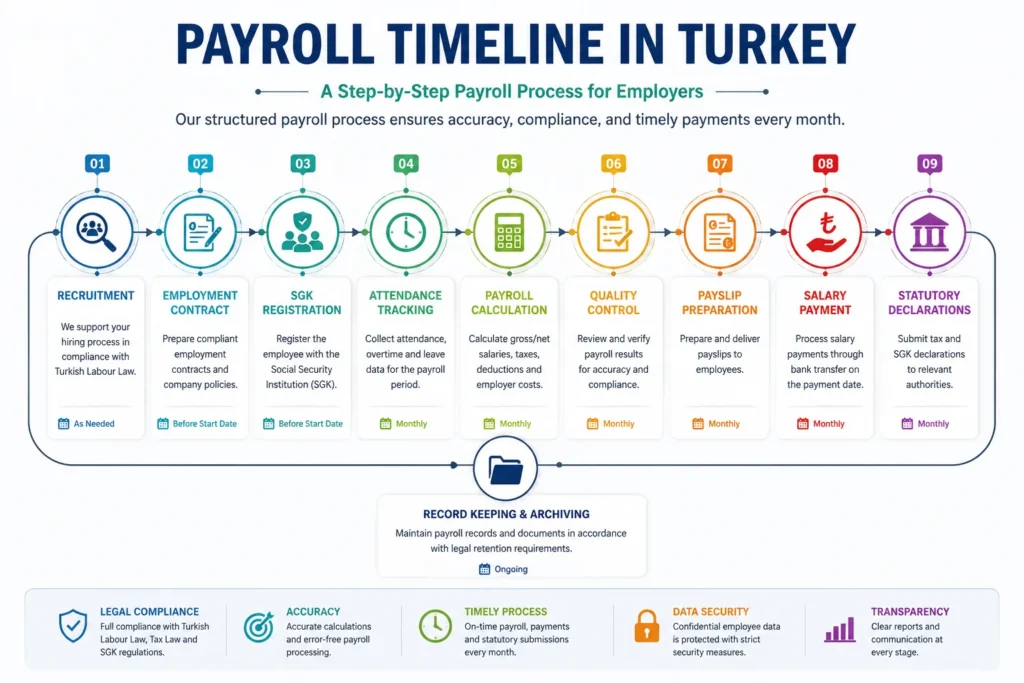
The payroll process in Turkey generally consists of several interconnected stages.
- Employee recruitment and employment contract
- Employee registration with the Social Security Institution (SGK)
- Collection of monthly payroll data
- Payroll calculation
- Internal payroll review and approval
- Payslip preparation
- Salary payment
- Submission of tax and social security declarations
- Payroll reporting and record keeping
Each stage must be completed accurately and within the applicable statutory deadlines.
Step 1 – Employment Contract
The payroll process begins before the employee’s first working day.
Employers should prepare an employment contract that complies with Turkish Labour Law and clearly defines:
- Position
- Salary
- Working hours
- Probation period (if applicable)
- Employee benefits
- Annual leave entitlement
- Notice periods
- Other employment conditions
A properly drafted employment contract forms the legal basis of the employment relationship.
Step 2 – Employee Registration with SGK
Before an employee starts work, the employer must complete the necessary registration procedures with the Social Security Institution (SGK).
Employee registration establishes the individual’s social security coverage and enables the employer to fulfil statutory reporting obligations.
Failure to register employees on time may result in administrative sanctions.
Step 3 – Collecting Payroll Information
At the end of each payroll period, employers collect all information affecting salary calculations.
Typical payroll inputs include:
- Base salary
- Attendance records
- Overtime
- Bonuses
- Commissions
- Allowances
- Annual leave
- Sick leave
- Unpaid leave
- Public holiday work
- Other payroll adjustments
Accurate payroll inputs are essential for correct salary calculations.
Step 4 – Payroll Calculation
After payroll information has been verified, employers calculate each employee’s monthly payroll.
Payroll calculations generally include:
- Gross salary
- Employee deductions
- Income tax withholding
- Social security contributions
- Employer contributions
- Net salary
Payroll calculations must comply with the applicable legislation and current statutory rates.
Step 5 – Payroll Review and Quality Control
Before payroll is finalised, all calculations should be reviewed to ensure their accuracy.
A quality control process typically includes:
- Verification of payroll inputs
- Review of salary calculations
- Confirmation of statutory deductions
- Validation of employee data
- Review of payroll reports
This additional review helps minimise payroll errors and supports compliance.
Step 6 – Payslip Preparation
Following approval, employers prepare individual payslips for employees.
Payslips generally include:
- Gross salary
- Statutory deductions
- Net salary
- Employer contributions
- Payroll period
- Other salary components
Payslips provide employees with a clear summary of their monthly remuneration.
Step 7 – Salary Payment
Once payroll has been finalised, salaries are paid to employees in accordance with the agreed payment schedule.
Employers should ensure that salary payments correspond to the approved payroll calculations and are supported by appropriate payment records.
Step 8 – Statutory Declarations
Payroll administration does not end with salary payments.
Employers must also complete various statutory reporting obligations, including:
- Social security declarations
- Payroll tax declarations
- Other employment-related filings required under Turkish legislation
Timely submission of these declarations is an essential component of payroll compliance.
Step 9 – Payroll Record Keeping
Employers should maintain payroll documentation and employment records for the periods required by Turkish legislation.
Typical records include:
- Employment contracts
- Payroll calculations
- Payslips
- Salary payment records
- Personnel files
- Statutory declarations
- Leave records
- Other employment documentation
Proper record keeping supports both legal compliance and future inspections.
Key Components of the Turkish Payroll System
An effective payroll process combines several interconnected compliance areas.
These typically include:
- Employment contracts
- Payroll administration
- Social security compliance
- Income tax withholding
- Personnel administration
- Employee records
- Payroll reporting
- Statutory declarations
- Record retention
Managing these components together helps employers maintain an efficient and compliant payroll function.
Why Professional Payroll Management Matters
Payroll administration requires ongoing attention to legislative developments, statutory deadlines, and employee-specific payroll data.
For foreign companies, outsourcing payroll to experienced professionals can help ensure accurate calculations, timely reporting, and continued compliance with Turkish employment, tax, and social security legislation.
A well-managed payroll process reduces administrative burdens while allowing businesses to focus on their core operations.
References
- Labour Law No. 4857
- Law No. 5510
- Income Tax Law
- Turkish Revenue Administration
- Social Security Institution (SGK)
Related Guides
To learn more about payroll compliance in Turkey, you may also find these guides useful:
Our HR and Payroll Services in Turkey
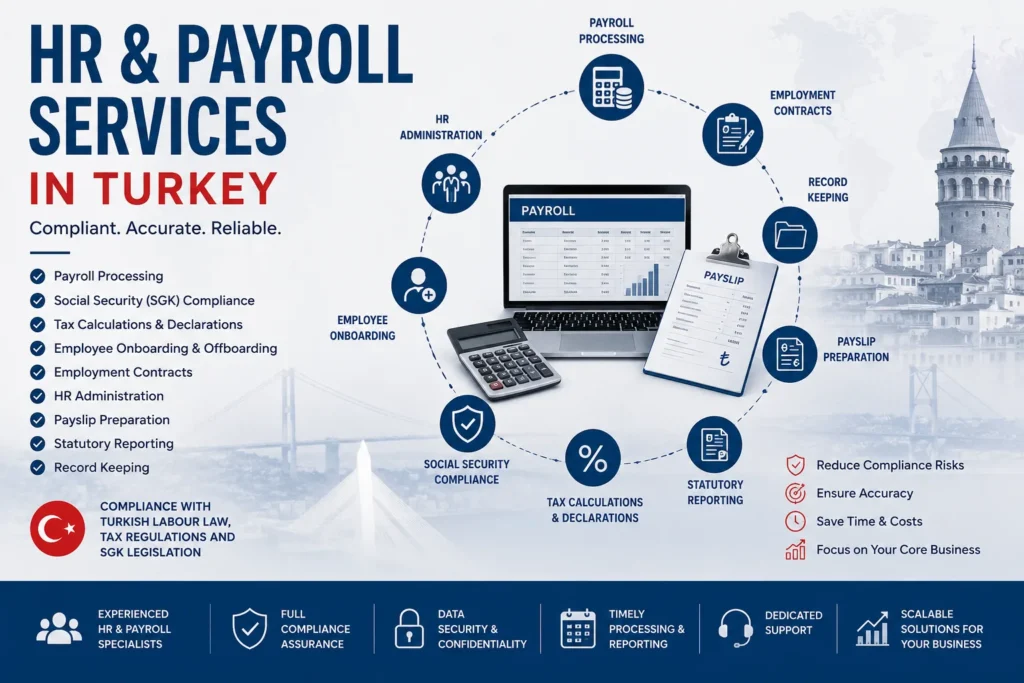
Managing payroll in Turkey requires more than simply calculating employee salaries. Employers must also comply with Turkish labour law, tax legislation, social security regulations, and various monthly reporting obligations.
At A&M Consulting Co., we provide comprehensive HR and payroll outsourcing services designed for foreign investors, multinational companies, and local businesses operating in Turkey.
Our payroll services include:
- Monthly payroll processing
- Payroll calculation and verification
- Payslip preparation
- Social Security Institution (SGK) compliance
- Income tax and payroll tax calculations
- Monthly statutory declarations
- Employee onboarding and offboarding support
- Employment contract preparation
- Personnel file management
- Annual leave tracking
- Overtime and attendance calculations
- Severance and notice compensation calculations
- Payroll reporting for management
- HR compliance consulting
- Coordination with Turkish authorities when required
By outsourcing your HR and payroll operations to experienced professionals, your business can reduce compliance risks, improve operational efficiency, and focus on its core activities.
Why Outsource HR and Payroll Services in Turkey?
Many international companies prefer outsourcing payroll because Turkish payroll legislation changes regularly and requires continuous monitoring.
Payroll outsourcing offers several advantages:
- Ensures compliance with Turkish labour and tax legislation
- Reduces administrative workload
- Minimises payroll errors
- Meets statutory filing deadlines
- Protects confidential employee information
- Provides access to local payroll specialists
- Supports business expansion in Turkey
- Improves payroll accuracy and reporting
For companies without an internal HR department, payroll outsourcing provides a cost-effective solution while maintaining full legal compliance.
Industries We Serve
Our HR and payroll services support companies across a wide range of industries, including:
- Information Technology (IT)
- Software Development
- Manufacturing
- E-commerce
- Logistics and Transportation
- Healthcare
- Pharmaceutical
- Construction
- Engineering
- Financial Services
- Representative Offices
- Branch Offices
- Regional Headquarters
- Startups and Scale-ups
- International Trading Companies
Whether you employ a single employee or hundreds of staff members, we can tailor our payroll solutions to meet your business requirements.
Why Choose A&M Consulting Co.?
Foreign investors require more than payroll calculations—they need a reliable local partner who understands Turkish employment legislation and international business practices.
Our team provides:
- English-speaking payroll specialists
- Dedicated payroll managers
- Transparent communication
- Timely payroll processing
- Compliance-focused payroll administration
- HR advisory services
- Tax and accounting integration
- Support during labour inspections
- Assistance with employee onboarding and termination procedures
We work closely with our clients to ensure payroll is processed accurately, confidentially, and in full compliance with Turkish legislation.
Contact Us for HR and Payroll Services in Turkey
Managing HR and payroll in Turkey involves far more than processing employee salaries. Employers must comply with Turkish labour legislation, tax regulations, social security requirements, and ongoing reporting obligations while ensuring that payroll is processed accurately and on time.
Whether you are establishing a new company, expanding your workforce, or managing an existing business, an effective HR and payroll system is essential for maintaining legal compliance and supporting sustainable business growth.
By partnering with experienced HR and payroll professionals, businesses can minimise compliance risks, reduce administrative burdens, improve payroll accuracy, and ensure that all statutory obligations are fulfilled in accordance with Turkish legislation.
At A&M Consulting Co., we provide comprehensive HR and payroll services tailored to the needs of foreign investors, multinational companies, and local businesses operating in Turkey. From employee onboarding and payroll processing to social security compliance, tax reporting, and HR advisory services, our team helps clients manage every stage of the employment lifecycle with confidence.
If you are looking for reliable HR and Payroll Services in Turkey, our specialists are ready to help your business remain compliant while allowing you to focus on your core operations.
Contact our team today to discuss your HR and payroll requirements and discover how our tailored outsourcing solutions can support your business in Turkey.
DISCOVER OUR OTHER SERVICES:
- Company Formation in Turkey
- Accounting & Bookeeping Services
- HR & Payroll Services
- Business Consultancy for Turkey
- Social Security Registration
- Virtual Office & Legal Address in Turkey
- Turkish Citizenship
- Turkey Work Visa
- Turkey Investment Visa
- Turkiye Tech Visa
- Establishment of Association in Turkey
- Foundation Registration in Turkey
- Company Winding Up in Turkey
You can reach out to our experienced consultans via email or by filling out the Contact Form on our website’s contact page
FAQs About HR and Payroll Services in Turkey
HR and payroll services include a range of administrative and compliance functions related to employee management. These services typically cover payroll processing, salary calculations, tax withholding, social security compliance, employment contracts, personnel file management, statutory reporting, and HR advisory.
Foreign companies often outsource payroll to ensure compliance with Turkish employment, tax, and social security regulations. Outsourcing also reduces administrative workload, minimises payroll errors, and allows businesses to focus on their core operations.
Payroll outsourcing services typically include:
- Monthly payroll calculations
- Payslip preparation
- Income tax calculations
- Social security calculations
- Payroll tax declarations
- SGK reporting
- Salary payment support
- Payroll reports
- Year-end payroll documentation
- Ongoing payroll compliance support
The exact scope may vary depending on the employer’s requirements.
Payroll is generally processed on a monthly basis. Employers calculate employee salaries, prepare payroll records, withhold applicable taxes, and submit the required statutory declarations each month.
Payroll calculations typically require:
- Employee salary information
- Attendance records
- Overtime hours
- Bonuses and commissions
- Annual leave
- Sick leave
- Public holiday work
- Other salary adjustments
Accurate payroll data helps ensure correct salary calculations and statutory compliance.
Outsourcing HR and payroll provides several advantages, including:
- Improved compliance
- Reduced administrative workload
- Greater payroll accuracy
- Timely statutory filings
- Lower operational risks
- Access to experienced payroll professionals
- Better reporting and documentation
- Increased efficiency
Yes.
Payroll service providers in Turkey regularly support wholly foreign-owned companies, multinational corporations, branch offices, liaison offices, and international investors operating in Turkey.
A&M Consulting Co. provides comprehensive HR and payroll services tailored to businesses operating in Turkey. Our team assists with payroll processing, employment documentation, social security compliance, tax reporting, employee onboarding and offboarding, HR advisory, and ongoing payroll administration, helping businesses meet their statutory obligations efficiently and accurately.
Yes. Every employer hiring personnel under an employment contract is required to comply with Turkish payroll regulations. Payroll administration includes salary calculations, tax withholding, social security contributions, statutory reporting, and payroll record keeping.
Payroll compliance refers to meeting all legal obligations related to employee compensation, including calculating salaries correctly, withholding taxes, paying social security contributions, maintaining payroll records, and submitting statutory declarations within the required deadlines.
Yes. Foreign-owned companies registered in Turkey may hire employees in accordance with Turkish Labour Law. Employers must complete employee registration, prepare employment contracts, process payroll, and fulfil all tax and social security obligations.
Yes. Payroll must generally be processed on a monthly basis. Employers are responsible for calculating salaries, preparing payroll records, paying employees, and completing monthly statutory filings.
Payroll administration typically requires documents and information such as:
- Employment contracts
- Employee identification details
- Salary information
- Attendance records
- Overtime records
- Leave information
- Bonus and commission details
- Bank account information
Employers must retain payroll and employment records for the periods prescribed by Turkish legislation. Proper record retention is important for tax audits, labour inspections, and potential legal disputes.
Yes. Many companies manage payroll remotely through outsourced payroll providers. Digital payroll systems allow employers to process payroll, review reports, and access payroll documentation securely from anywhere.
Incorrect payroll calculations may result in:
- Salary discrepancies
- Tax underpayments or overpayments
- Social security reporting errors
- Administrative penalties
- Employee disputes
- Additional correction procedures
Regular payroll reviews help minimise these risks.
A typical payslip includes:
- Gross salary
- Income tax withholding
- Social security deductions
- Employer contributions
- Net salary
- Payroll period
- Other salary components where applicable
Yes. Many payroll providers also offer HR support services, including employment contracts, personnel file management, onboarding, offboarding, leave administration, and HR compliance consulting.
Yes. HR outsourcing is often beneficial for small and medium-sized businesses that do not maintain an internal HR department. Outsourcing reduces administrative work while helping employers comply with employment legislation.
Payroll outsourcing offers several advantages, including:
- Reduced compliance risks
- Lower administrative costs
- Access to experienced payroll specialists
- Improved payroll accuracy
- Timely statutory reporting
- Greater operational efficiency
Payroll outsourcing fees vary depending on factors such as the number of employees, payroll complexity, reporting requirements, and additional HR services requested. Businesses should obtain a tailored quotation based on their specific needs.
Yes. Many payroll providers assist with employee onboarding by preparing employment contracts, completing SGK registration, establishing personnel files, and ensuring compliance before the employee’s first working day.
Yes. Payroll specialists can support employee termination procedures by calculating final salary payments, unused annual leave, severance pay where applicable, notice compensation, and completing the necessary statutory reporting.
Yes. Payroll providers typically prepare detailed monthly payroll reports that help employers monitor salary expenses, statutory contributions, tax liabilities, and overall payroll costs.
Yes. Payroll information contains sensitive employee data and should be handled confidentially. Professional payroll providers implement strict data protection procedures to safeguard payroll records and personal information.
A local payroll provider understands Turkish labour law, tax regulations, social security requirements, and reporting obligations. This local expertise helps foreign investors reduce compliance risks and manage payroll efficiently while operating in Turkey.
Still have questions?
Every business has unique HR and payroll requirements. Whether you need assistance with payroll processing, HR administration, employment contracts, SGK compliance, or payroll outsourcing in Turkey, our specialists are here to help.
Contact A&M Consulting Co. today for expert advice and tailored HR and payroll solutions that meet your business needs.

Certified Public Accountant