

Summarize this article with AI
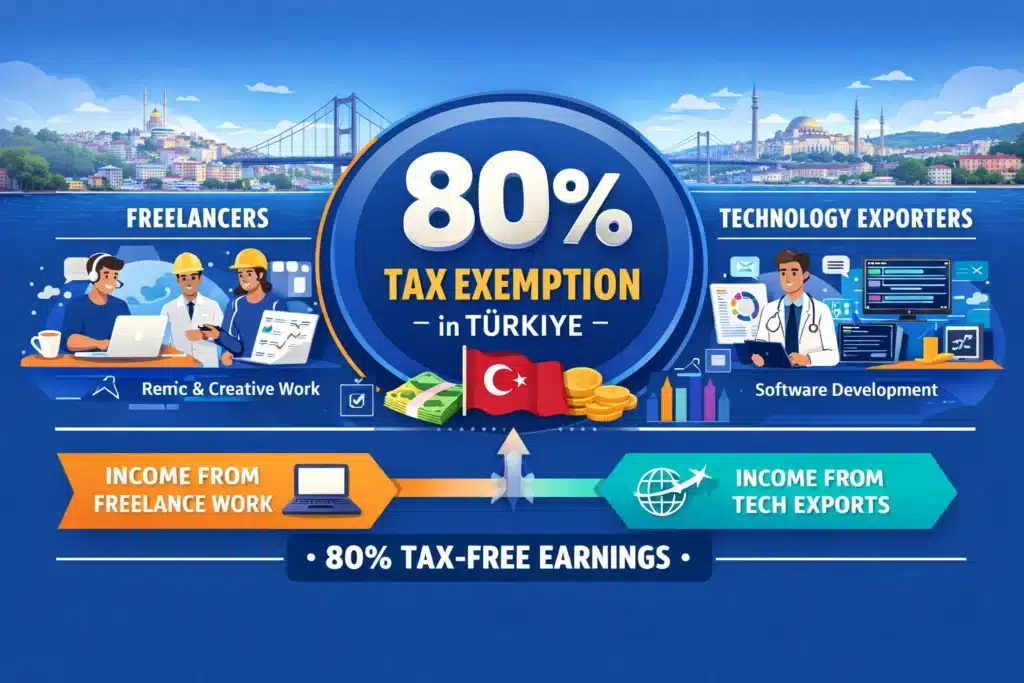
Turkey is actively positioning itself as a hub for digital exports, and to empower its skilled professionals, the government offers a powerful financial incentive. Freelancers and self-employed individuals who export specific technical services can benefit from a massive 80% exemption on their income tax.
This guide explains everything software developers, engineers, designers, architects, data analysts, and AI engineers in Turkey need to know to legally leverage this advantage, reduce their tax liability significantly, and become more competitive in the global marketplace.
This incentive is regulated under Article 10 of the Turkish Corporate Tax Law and Article 94 of the Turkish Income Tax Law. It applies to firms and self-employed individuals (natural persons, freelancers) who provide the following services directly to clients abroad:
Software Development: Website, mobile app, game, and enterprise software development.
Engineering Services: Software engineering, systems engineering, industrial design engineering.
Design Services: UI/UX design, graphic design, architectural modeling, digital illustration.
Data Science & Analytics: Data mining, data storage, data processing, data analysis, statistical analysis, machine learning model development.
Artificial Intelligence (AI) Engineering: Developing AI/ML algorithms, natural language processing, computer vision services.
R&D, quality control, technical drawing, medical reporting, call center services.and similar technical/professional services.
To benefit from this exemption, you must meet all of the following conditions:
Engage a Turkish CPA (SMMM): This is the most critical step. A knowledgeable CPA will ensure correct application and compliance.
Contract and Invoice: Sign a clear service agreement with your foreign client. Upon completion, issue a self-employment receipt or e-invoice in foreign currency.
Ensure Proper Payment Routing: Instruct your client to pay via international bank transfer directly to your Turkish bank account. Keep all bank proof.
Declaration and Filing: Your CPA will prepare your annual income tax return, declaring the foreign-sourced income and applying for the 80% exemption in the required fields and attachments.
Record Keeping: You are legally required to keep the contract, invoice, bank payment proofs, and tax return copies for 5 years.
Payment Method is Key: Payments received via crypto currencies (Bitcoin, etc.) or methods that don’t channel funds through a Turkish bank (e.g., PayPal balance) are NOT eligible for this exemption. The money must hit your Turkish bank account.
Vague Service Description: Avoid generic terms like “consulting” on your invoice. Use specific descriptions like “development of a machine learning model using Python.”
Timing of the Claim: The exemption must be claimed in the tax return for the year the income was earned. You cannot retroactively apply it for previous years.
SSI (Social Security – Bağ-Kur) Premiums: This is an income tax exemption only. Your SSI premium base is calculated on your gross income before this exemption. You will still pay Bağ-Kur premiums on the full amount.
This incentive is a cornerstone of Turkey’s strategy to boost digital service exports and is expected to remain in force. However, tax laws can be subject to minor changes. Always refer to the latest announcements from the Revenue Administration (Gelir İdaresi Başkanlığı) and maintain regular communication with your Turkish CPA.
For Turkish software developers, engineers, designers, and data scientists, the world is your marketplace. The 80% income tax exemption for exported services is a powerful tool designed to increase your net earnings and enhance your global competitiveness.
By ensuring proper documentation, banking, and tax filing with professional guidance, you can confidently leverage this significant financial advantage and scale your freelance career internationally.
A&M Consulting Co. is widely recognized for its expertise in this complex arena. We provide end-to-end advisory services for freelancers and businesses navigating the incentive system—from your Limited Liability or Sole Proprietorship company establishment to documentation, bookeeping and tax return submission, and ensuring post-approval compliance. Our goal is to secure the maximum available benefits for your venture within the Turkish incentive framework.
You can easily reach our experienced consultants via email or by filling out the contact form on our website.
DISCOVER OUR SERVICES:
You are eligible if you are a firm(like LLC) or self-employed individual (serbest meslek erbabı) in Turkey, paying income tax on your professional earnings, and you export specific technical or professional services to clients outside of Turkey. Eligible fields include software development, engineering, design, data analysis, and AI/ML engineering. Business owners (e.g., şahıs şirketi) are not eligible under this particular scheme.
Qualifying services are listed in the legislation and include:
Software and application development
Engineering, technical consulting, and design services
Data processing, analysis, and data science
Research & Development (R&D) activities
Architectural and industrial design
The payment for your services must be received in foreign currency (e.g., USD, EUR) into your Turkish bank account via an international wire transfer. Payments through PayPal balance, Wise balance, or cryptocurrency that do not pass through a Turkish bank do not qualify.
You must keep and provide to your accountant/tax advisor:
A signed service contract with your foreign client.
A self-employment receipt (serbest meslek makbuzu) or e-invoice issued in foreign currency.
The bank Swift/MT103 document proving the foreign currency entered your Turkish account.
Your annual income tax return where the exemption is declared.
You do not apply for a separate permit. You claim the exemption by declaring it in your annual income tax return (submitted the following year). Your Turkish CPA (SMMM) will fill out the necessary sections and schedules attached to the return to calculate the 80% deduction from your taxable income.
No. This is an income tax exemption only. Your monthly or quarterly SGK (Bağ-Kur) premiums are still calculated based on your total gross income before the 80% deduction. You cannot reduce your premium base with this exemption.
Yes, but the payment condition is critical. If the platform pays you by transferring funds directly to your Turkish bank account in foreign currency, you can qualify. If the funds are kept in a platform wallet (e.g., Upwork Balance) and you withdraw them later, ensure the final transfer is to your Turkish bank. Payments to a foreign PayPal account that you then spend without transferring to Turkey do not qualify.
There is no minimum or maximum income limit specified in the law. The 80% exemption applies to all qualifying foreign-sourced income reported in a given tax year.
This exemption applies only to income derived from qualified services provided to foreign clients. However, if you select the correct NACE code and submit your professional certificate, your domestic income will also be exempt from the 20% income tax if the tax authorities classify you as self-employed; otherwise, income from Turkish clients will be taxed according to standard income tax brackets without any exemption.
A&M Consulting Co. provides end-to-end advisory to ensure you correctly benefit from this incentive:
Eligibility Assessment: Confirming your professional status and service type qualify.
Documentation Guidance: Ensuring your contracts, invoices, and banking are set up correctly.
Tax Filing & Compliance: Accurately preparing and submitting your annual income tax return to claim the exemption.
Record-Keeping Audit: Helping you maintain the legally required documents for 5 years.
Integrated Incentive Advice: If your freelance work evolves into a larger project, we can guide you on broader incentives like Investment Incentive Certificates.
Recent Posts

WhatsApp Us