
VAT Registration in Turkey
VAT Registration in Turkey
Introduction
Value Added Tax (VAT), known as KDV (Katma Değer Vergisi) in Turkey, is one of the most important tax obligations for businesses operating in the country. Whether you are establishing a new company, expanding an existing business, importing goods, or providing taxable services, understanding the Turkish VAT registration process is essential for remaining compliant with local tax legislation.
Businesses that are required to register for VAT must obtain a VAT registration through the Turkish Tax Office before issuing VAT invoices and submitting periodic VAT returns. The registration process varies depending on whether the applicant is a Turkish company, a foreign investor, or a non-resident business with VAT obligations in Turkey.
Foreign entrepreneurs often assume that VAT registration is automatic upon company incorporation. While a Turkish company generally becomes a VAT taxpayer as part of its tax registration process, certain transactions, industries, and non-resident business models may require additional analysis to determine the correct VAT treatment.
In this comprehensive guide, we explain:
- Who must register for VAT in Turkey
- How the VAT registration process works
- Documents required for registration
- VAT registration for foreign companies
- Ongoing VAT compliance obligations
- Common mistakes businesses should avoid
Whether you are launching a new business or expanding your operations into Turkey, understanding VAT registration requirements from the outset can help you avoid penalties, invoicing errors, and unnecessary tax risks.
Key Takeaway
VAT registration is more than obtaining a tax number. Businesses must determine their VAT obligations, complete the appropriate registration procedures, issue compliant invoices, submit VAT returns on time, and maintain accurate accounting records to comply with Turkish tax legislation.
Related Services & Guides
Bu bölüm içinde doğal olarak aşağıdaki sayfalara bağlantı verin:
- Company Registration in Turkey → for businesses establishing a legal entity in Turkey.
- Company Formation in Turkey for Foreigners → for foreign investors entering the Turkish market.
- Online Company Registration in Turkey → for remote incorporation procedures.
- How to Get a Tax ID Number in Turkey → explaining the tax identification process before VAT registration.
- Tax in Turkey → providing an overview of the Turkish tax system
Who Needs VAT Registration in Turkey?
Not every individual or business operating in Turkey is required to register for Value Added Tax (VAT). Whether VAT registration is mandatory depends on the nature of the business activities, the legal structure of the taxpayer, and the applicable provisions of Turkish tax legislation.
In general, businesses that supply taxable goods or services in Turkey, import goods, or carry out other VAT-liable transactions must complete the appropriate VAT registration procedures before commencing taxable activities.
Foreign companies may also have VAT registration obligations, depending on how they conduct business in Turkey and the specific transactions involved.
Understanding whether VAT registration is required is an important first step in ensuring tax compliance and avoiding administrative penalties.
Turkish Companies
Companies incorporated in Turkey generally become VAT taxpayers as part of their tax registration process.
Businesses engaged in commercial, industrial, professional, or service activities are typically required to:
- Register with the Turkish Tax Office
- Obtain a Tax Identification Number
- Register for VAT
- Issue VAT-compliant invoices
- Submit periodic VAT returns
For most newly established companies, VAT registration forms part of the overall company registration process.
Foreign Companies
Foreign companies may also be required to register for VAT in Turkey in certain circumstances.
The applicable registration requirements depend on factors such as:
- The nature of the business activity
- Whether goods or services are supplied in Turkey
- Import or export activities
- Permanent establishment status
- Applicable tax treaties
- Turkish VAT legislation
Because every business model is different, foreign companies should assess their VAT obligations before commencing operations.
Importers and Exporters
Businesses importing goods into Turkey are generally subject to Turkish VAT rules.
Companies engaged in international trade should ensure that their VAT registration status aligns with customs procedures, invoicing requirements, and applicable reporting obligations.
Export transactions may also benefit from specific VAT rules and exemptions, provided the statutory conditions are satisfied.
Service Providers
Businesses providing taxable services within Turkey may also be required to register for VAT.
Examples include:
- Consultancy services
- IT and software services
- Marketing services
- Engineering services
- Construction services
- Professional services
The VAT treatment depends on the place of supply and the nature of the service provided.
E-commerce and Digital Businesses
Businesses selling products or providing digital services to customers in Turkey may also have VAT obligations.
Depending on the business model, VAT registration requirements may apply to:
- E-commerce companies
- Online marketplaces
- Digital service providers
- Software businesses
- Subscription platforms
Foreign digital businesses should carefully review Turkish VAT legislation before entering the market.
Who Typically Needs VAT Registration?
| Business Type | VAT Registration May Be Required |
|---|---|
| Turkish Limited Company | ✅ |
| Joint Stock Company | ✅ |
| Foreign Company Operating in Turkey | ✅ |
| Importer | ✅ |
| Exporter | Depending on the transaction |
| Service Provider | Usually |
| E-commerce Business | Depending on the business model |
| Digital Service Provider | Depending on the applicable VAT rules |
💡 Expert Tip
VAT registration requirements depend on the specific activities carried out by a business—not simply on whether the business is foreign or domestic. Before starting operations in Turkey, companies should assess their VAT obligations to ensure compliance from day one.
Related Services & Guides
To learn more about establishing and operating a business in Turkey, you may also find these resources helpful:
- Company Registration in Turkey – Learn how to establish a legal entity before registering for tax.
- Company Formation in Turkey for Foreigners – A practical guide for international investors.
- Online Company Registration in Turkey – Discover how to incorporate a Turkish company remotely.
- How to Get a Tax ID Number in Turkey – Understand the tax identification process required before VAT registration.
- Tax in Turkey – Explore the Turkish tax system, including VAT, corporate tax, and filing obligations.
- Accounting & Bookkeeping Services in Turkey – Learn how ongoing accounting support helps businesses remain VAT compliant.
Do You Need VAT Registration?
Starting a Business in Turkey
│
▼
Are You Supplying Taxable Goods or Services?
│
┌──────┴──────┐
│ │
Yes No
│ │
▼ ▼
VAT Registration May Be Required Review Other Tax Obligations
Types of VAT Registration in Turkey
VAT registration in Turkey is not a one-size-fits-all process. The registration procedure depends on the legal status of the taxpayer, the nature of the business activities, and the applicable provisions of Turkish tax legislation.
While most Turkish companies become VAT taxpayers during their tax registration process, foreign businesses and certain non-resident taxpayers may be subject to different registration requirements.
Understanding the available VAT registration categories helps businesses determine the correct compliance approach from the outset.
Standard VAT Registration
Standard VAT registration is the most common type of registration and generally applies to companies established in Turkey.
Following incorporation and tax registration, businesses are typically registered for VAT and become responsible for:
- Issuing VAT-compliant invoices
- Charging VAT on taxable supplies
- Filing periodic VAT returns
- Maintaining statutory accounting records
- Keeping VAT documentation in accordance with Turkish legislation
For most domestic businesses, VAT registration forms part of the initial company setup process.
VAT Registration for Foreign Companies
Foreign companies may also have VAT registration obligations in Turkey, depending on the nature of their activities.
Registration requirements are assessed based on factors such as:
- Commercial activities carried out in Turkey
- Import or export transactions
- Supply of taxable goods
- Provision of taxable services
- Permanent establishment status
- Applicable VAT legislation
Each business model should be reviewed individually to determine the appropriate VAT treatment.
VAT Registration for Importers and Exporters
Businesses involved in international trade may have additional VAT obligations.
Importers generally become liable for import VAT when goods enter Turkey, while exporters may benefit from specific VAT exemptions or refund mechanisms if statutory conditions are satisfied.
Proper customs documentation and VAT compliance are essential for international trade operations.
VAT Registration for Digital Service Providers
Businesses supplying digital services to Turkish customers should assess whether Turkish VAT obligations apply.
Depending on the business model, VAT considerations may arise for:
- Software providers
- SaaS businesses
- Streaming platforms
- Online education providers
- Digital marketplaces
- Subscription-based services
The applicable rules vary according to Turkish VAT legislation and the place of supply.
Sector-Specific VAT Registration Requirements
Certain industries may be subject to additional VAT procedures or industry-specific compliance requirements.
These sectors may include:
- Construction
- Manufacturing
- Logistics
- Healthcare
- Tourism
- E-commerce
- Financial services
- Technology companies
Businesses operating in regulated industries should obtain professional advice before commencing operations.
Comparison of VAT Registration Types
| Registration Type | Typical Applicant | VAT Registration |
|---|---|---|
| Standard VAT Registration | Turkish Companies | Required |
| Foreign Company Registration | Non-resident Businesses | Depends on Activities |
| Import VAT Registration | Importers | Required |
| Export-Related VAT | Exporters | Special VAT Rules Apply |
| Digital Services | Online Service Providers | Depends on Business Model |
| Industry-Specific Registration | Regulated Businesses | May Require Additional Compliance |
Choosing the Right VAT Registration
Selecting the appropriate VAT registration type depends on several factors, including:
- Business structure
- Type of business activities
- Residency status
- Import or export operations
- Digital services provided
- Industry regulations
- Expected commercial transactions
A proper assessment before commencing business activities can help avoid unnecessary registration issues and ensure compliance with Turkish tax legislation.
💡 Expert Tip
Many foreign investors assume that every business requires the same VAT registration process. In reality, the applicable registration procedure depends on the business model, industry, and the nature of taxable transactions. Obtaining professional advice before registration can help prevent costly compliance mistakes.
Related Services & Guides
To better understand VAT compliance and doing business in Turkey, you may also find these guides helpful:
- Company Registration in Turkey –Learn how businesses are established before completing tax registration.
- Online Company Registration in Turkey – Understand how foreign investors can incorporate a company remotely.
- Company Formation in Turkey for Foreigners – A complete guide for international entrepreneurs.
- How to Get a Tax ID Number in Turkey – Learn about obtaining a Turkish Tax Identification Number before VAT registration.
- Accounting & Bookkeeping Services in Turkey – Discover how ongoing accounting support ensures VAT compliance.
Step-by-Step VAT Registration Process in Turkey
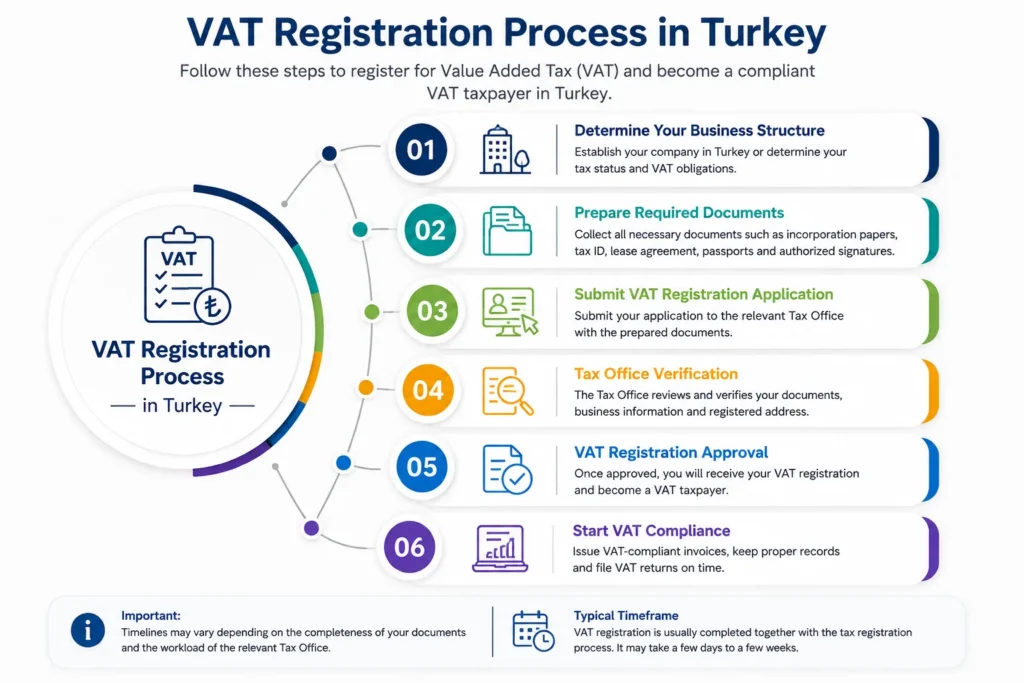
Registering for Value Added Tax (VAT) in Turkey is generally completed as part of the tax registration process for newly established companies. However, the exact procedure may vary depending on the legal structure of the business, the nature of its activities, and whether the applicant is a Turkish or foreign entity.
The following steps provide a general overview of the VAT registration process in Turkey.
Step 1 – Establish Your Business or Determine Your Tax Status
Before VAT registration can be completed, the applicant must first determine the appropriate legal and tax structure.
Depending on your circumstances, this may involve:
- Incorporating a Turkish company
- Registering a branch office
- Establishing a liaison office (where applicable)
- Assessing whether a foreign business has VAT registration obligations
- Obtaining a Turkish Tax Identification Number
Choosing the correct business structure is essential before proceeding with VAT registration.
Step 2 – Prepare the Required Documentation
The next step is to prepare the documents required by the Turkish Tax Office.
Depending on the applicant, these may include:
- Company incorporation documents
- Articles of Association
- Trade Registry records
- Tax Identification Number
- Passport copies (for foreign shareholders or directors)
- Signature declarations
- Lease agreement or registered office documentation
- Power of Attorney (if registration is handled by an authorized representative)
Additional documentation may be requested depending on the business activity.
Step 3 – Submit the VAT Registration Application
Once the required documentation has been prepared, the VAT registration application is submitted to the competent Turkish Tax Office.
During this stage, the tax authorities review the submitted information and verify the business details.
Where necessary, additional information or supporting documents may be requested before registration is finalized.
Step 4 – Tax Office Verification
Following the application, the Turkish Tax Office may conduct administrative checks to confirm the accuracy of the submitted information.
These procedures may include:
- Verification of the registered office address
- Review of incorporation documents
- Confirmation of business activities
- Verification of company representatives
The scope of the review depends on the characteristics of the business.
Step 5 – VAT Registration Approval
Once the registration process has been completed and the application is approved, the business becomes a registered VAT taxpayer.
The company can then:
- Issue VAT-compliant invoices
- Charge VAT on taxable transactions
- Submit VAT returns
- Maintain VAT records
- Fulfil ongoing tax compliance obligations
From this point onward, the business must comply with the reporting and record-keeping requirements established under Turkish tax legislation.
VAT Registration Process at a Glance
| Step | Description |
|---|---|
| 1 | Determine the appropriate business and tax structure |
| 2 | Prepare the required documentation |
| 3 | Submit the VAT registration application |
| 4 | Complete Tax Office verification procedures |
| 5 | Receive VAT registration approval and begin VAT compliance |
Typical Timeframe
Although processing times vary depending on the business structure and the completeness of the submitted documentation, VAT registration is generally completed together with the company’s tax registration process.
Delays may occur if additional documentation or clarification is requested by the Turkish Tax Office.
💡 Expert Tip
Preparing complete and accurate documentation before submitting the application can significantly reduce processing delays. Businesses should also ensure that their registered office information and corporate records are consistent across all official filings.
📋 VAT Registration Checklist
Before submitting your application, make sure you have:
✅ Company incorporation documents
✅ Tax Identification Number
✅ Registered office address
✅ Passport copies (if applicable)
✅ Power of Attorney (if applicable)
✅ Articles of Association
✅ Signature declarations
✅ Supporting business documents
Required Documents for VAT Registration in Turkey
Preparing the correct documentation is one of the most important steps in the VAT registration process. While the exact requirements may vary depending on the legal structure of the applicant and the nature of the business, the Turkish Tax Office generally requires a set of corporate, identification, and tax-related documents before processing a VAT registration application.
Submitting complete and accurate documentation helps avoid unnecessary delays and ensures that the registration process proceeds efficiently.
Documents Commonly Required
The following documents are commonly requested during the VAT registration process:
- Company Incorporation Documents
- Articles of Association
- Turkish Tax Identification Number (TIN)
- Trade Registry Gazette
- Signature Circular or Signature Declaration
- Registered Office Address Information
- Lease Agreement or Proof of Business Address
- Passport Copies of Foreign Shareholders or Directors (if applicable)
- Power of Attorney (if represented by an authorized advisor)
- Additional supporting documents requested by the Tax Office
The documentation requirements may differ depending on the applicant’s legal structure and business activities.
Additional Requirements for Foreign Investors
Foreign shareholders and directors may be asked to provide additional documentation during the registration process.
These documents may include:
- Notarized passport copies
- Certified Turkish translations
- Apostille or legalization (where applicable)
- Foreign corporate documents (for corporate shareholders)
- Board resolutions authorizing the incorporation or registration
- Power of Attorney for local representatives
Ensuring that foreign documents are properly legalized before submission can significantly reduce processing delays.
Why Accurate Documentation Matters
Incomplete or inconsistent documentation is one of the most common reasons for delays in VAT registration.
Businesses should ensure that:
- Company information is consistent across all official documents.
- Shareholder and director information matches incorporation records.
- The registered office address is correctly documented.
- Foreign documents have been translated and legalized where required.
Accurate documentation supports a smoother registration process and helps establish compliance from the outset.
Required Documents Checklist
| Document | Usually Required |
|---|---|
| Company Incorporation Documents | ✅ |
| Articles of Association | ✅ |
| Tax Identification Number | ✅ |
| Trade Registry Gazette | ✅ |
| Signature Declaration / Circular | ✅ |
| Registered Office Address | ✅ |
| Lease Agreement | Usually |
| Passport Copy (Foreign Individuals) | If Applicable |
| Corporate Documents (Foreign Companies) | If Applicable |
| Power of Attorney | If Applicable |
| Apostille / Legalization | Depending on Jurisdiction |
| Certified Turkish Translation | When Required |
💡 Expert Tip
Before submitting your VAT registration application, verify that all corporate documents, passport information, tax records, and registered office details are consistent. Even minor discrepancies may result in requests for additional information and delay the registration process.
Related Services & Guides
To better understand the company registration and tax compliance process in Turkey, you may also find these resources helpful:
- Company Registration in Turkey — Learn about establishing a Turkish company before completing tax registration.
- Company Formation in Turkey for Foreigners — A comprehensive guide for foreign entrepreneurs investing in Turkey.
- Online Company Registration in Turkey — Discover how to register a company remotely through a Power of Attorney.
- How to Get a Tax ID Number in Turkey — Understand the process of obtaining a Turkish Tax Identification Number.
- Accounting & Bookkeeping Services in Turkey — Learn how professional accounting services support VAT compliance.
- Tax in Turkey — Explore Turkey’s tax system, including VAT, corporate income tax, and filing obligations.
VAT Rates in Turkey
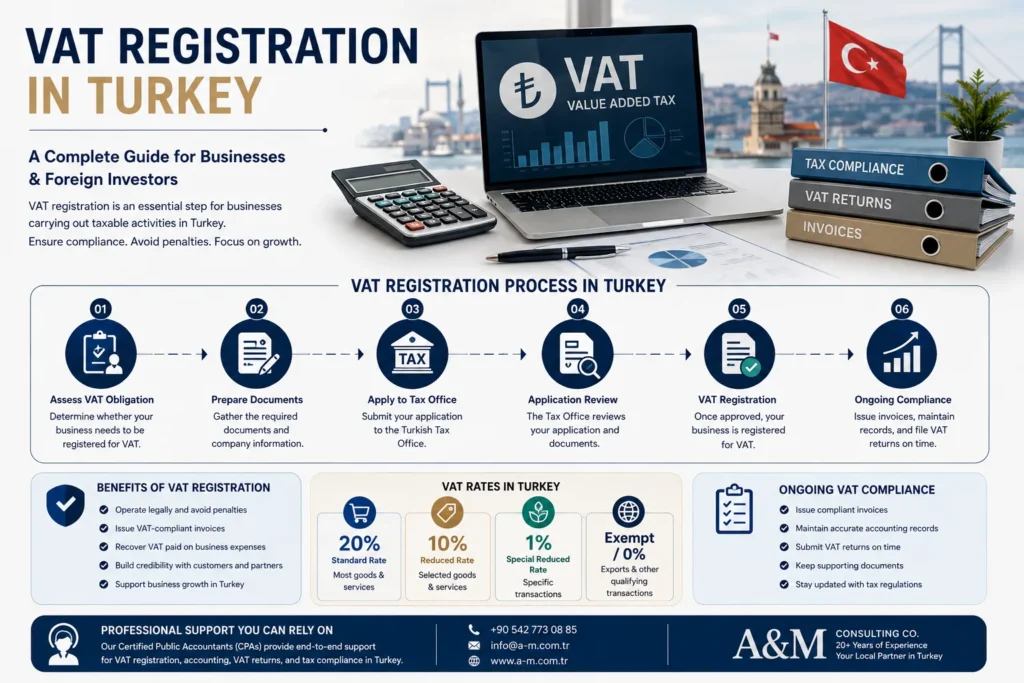
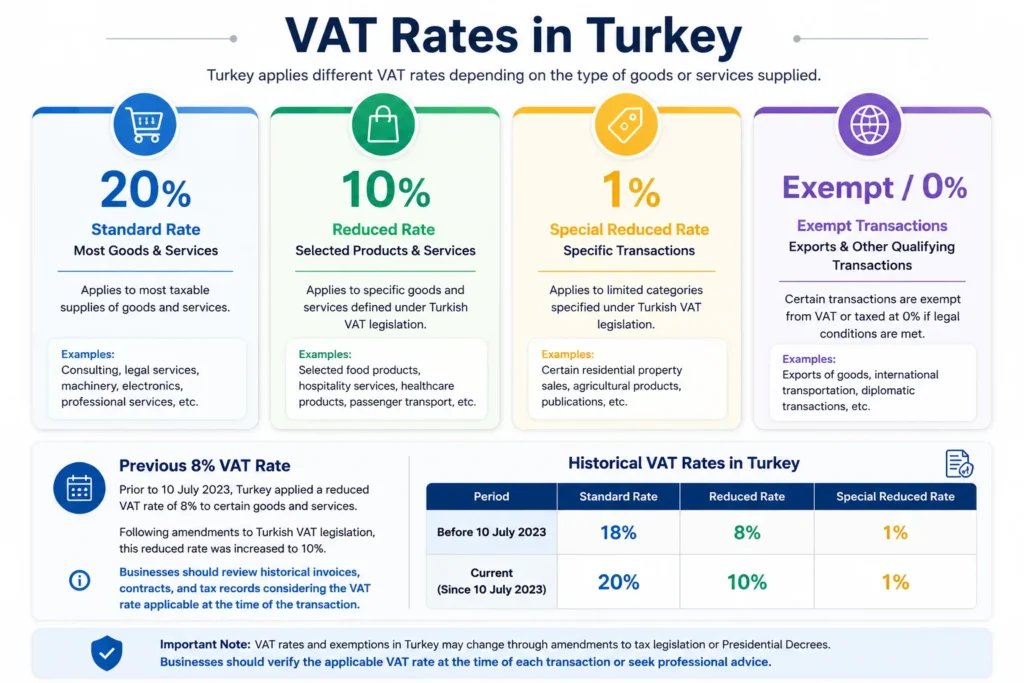
Turkey applies different VAT rates depending on the type of goods or services supplied. Understanding the applicable VAT rate is essential for issuing compliant invoices, calculating tax liabilities, and avoiding reporting errors.
The standard VAT rate applies to most commercial transactions, while reduced rates are available for specific categories of goods and services defined under Turkish VAT legislation.
Businesses should always verify the correct VAT treatment before issuing invoices, as applying the wrong VAT rate may result in tax assessments, penalties, and interest.
Standard VAT Rate
The standard VAT rate in Turkey is 20% and applies to most taxable supplies of goods and services.
Examples include:
- Professional consulting services
- Legal services
- Accounting services
- Machinery and equipment
- General commercial sales
- Most business-to-business transactions
Unless a reduced rate or exemption applies, businesses generally charge VAT at the standard rate.
Reduced VAT Rates
Certain goods and services benefit from reduced VAT rates.
10% VAT Rate
Examples may include:
- Selected food products
- Healthcare products
- Hospitality services
- Certain passenger transportation services
- Various goods and services specified by Presidential Decrees
1% VAT Rate
The lowest VAT rate generally applies to specific transactions identified under Turkish VAT legislation.
Examples may include:
- Certain residential property sales
- Selected agricultural products
- Specific publications and other qualifying goods
The availability of the reduced rate depends on the applicable legislation at the time of the transaction.
Previous 8% VAT Rate
Prior to 10 July 2023, Turkey applied a reduced VAT rate of 8% to certain goods and services.
Following amendments to Turkish VAT legislation, this reduced rate was increased to 10%. As a result, businesses should no longer assume that transactions previously subject to 8% VAT continue to qualify for the same rate.
When reviewing historical invoices, contracts, or tax records, it is important to consider the VAT rate that was applicable at the time of the transaction.
Historical VAT Rates
| Period | Standard Rate | Reduced Rate | Special Reduced Rate |
|---|---|---|---|
| Before 10 July 2023 | 18% | 8% | 1% |
| Current | 20% | 10% | 1% |
VAT rates are subject to amendments through Turkish tax legislation and Presidential Decrees. Businesses should always verify the applicable rate at the time of the transaction
VAT Exemptions
Not every transaction is subject to Turkish VAT.
Examples of VAT-exempt or VAT-relieved transactions may include:
- Certain export transactions
- International transportation
- Diplomatic transactions
- Certain financial services
- Specific investment incentive transactions
- Other exemptions provided under the Turkish VAT Law
The applicability of an exemption depends on the legal requirements being satisfied.
Which VAT Rate Applies?
Determining the correct VAT rate depends on several factors, including:
- Nature of the product or service
- Industry sector
- Customer location
- Import or export status
- Applicable exemptions
- Current Turkish VAT legislation
Because VAT legislation changes periodically, businesses should review the latest rules before invoicing customers.
Turkish VAT Rates Overview
| VAT Rate | Typical Application |
|---|---|
| 20% | Standard rate for most goods and services |
| 10% | Selected goods and services subject to reduced taxation |
| 1% | Limited categories specified under Turkish legislation |
| 0% | Certain exports and VAT-exempt transactions |
Common Sectors and Typical VAT Rates
| Business Activity | Typical VAT Treatment |
|---|---|
| Accounting & Consulting | 20% |
| Legal Services | 20% |
| Software Development | Usually 20% |
| Construction | Depends on the project |
| Hotel & Accommodation | Reduced rate may apply |
| Food Products | Depends on the product |
| Export of Goods | May qualify for VAT exemption |
| International Transportation | Special VAT rules may apply |
💡 Expert Tip
Applying the correct VAT rate is just as important as registering for VAT. Businesses should review every transaction individually, particularly when dealing with reduced-rate goods, international trade, or VAT-exempt supplies, to ensure full compliance with Turkish tax legislation.
Related Services & Guides
You may also find these resources helpful:
- Tax in Turkey— Understand the broader Turkish tax system, including corporate income tax and withholding tax.
- Accounting & Bookkeeping Services in Turkey — Learn how professional accounting support helps businesses apply the correct VAT treatment.
- Company Formation in Turkey for Foreigners — Discover how VAT registration forms part of the company formation process.
- Online Company Registration in Turkey — A guide to establishing a Turkish company remotely.
- Capital Gains Tax in Turkey — Learn how capital gains are taxed separately from VAT.
- How to Get a Tax ID Number in Turkey — Understand the importance of obtaining a Turkish Tax Identification Number before tax registration.
VAT Filing and Ongoing Compliance in Turkey
Obtaining a VAT registration is only the first step. Once registered, businesses must comply with ongoing VAT obligations established under Turkish tax legislation.
VAT-registered businesses are generally required to issue compliant invoices, maintain proper accounting records, file VAT returns within the statutory deadlines, and retain supporting documentation for tax purposes.
Failure to meet these obligations may result in administrative penalties, late payment interest, and additional tax assessments.
VAT Returns
Businesses registered for VAT are generally required to submit periodic VAT returns to the Turkish Tax Office.
VAT returns report:
- Output VAT collected on sales
- Input VAT paid on purchases
- VAT payable or refundable
- Other reportable VAT transactions
VAT returns must be prepared accurately using the company’s accounting records and supporting documentation.
Businesses should also understand the applicable filing deadlines, reporting requirements, correction procedures, and penalties for late submissions. For a detailed explanation of the filing process, see our VAT Return in Turkey guide.
Issuing VAT-Compliant Invoices
VAT-registered businesses must issue invoices that comply with Turkish tax legislation.
Invoices generally include:
- Supplier information
- Customer information
- Tax Identification Numbers
- Invoice date and number
- Description of goods or services
- VAT rate
- VAT amount
- Total invoice amount
Incorrect invoicing may create compliance issues during tax inspections.
Maintaining Accounting Records
Businesses must maintain complete accounting and bookkeeping records supporting their VAT returns.
Typical records include:
- Sales invoices
- Purchase invoices
- Bank statements
- Import and export documentation
- Expense records
- Inventory records
- Financial statements
Proper bookkeeping ensures that VAT calculations can be supported during a tax audit.
Electronic Tax Compliance
Many VAT obligations are fulfilled electronically through the Turkish Revenue Administration’s digital systems.
Depending on the business, companies may also be required to use:
- e-Invoice (e-Fatura)
- e-Archive Invoice (e-Arşiv)
- e-Ledger (e-Defter)
- Digital bookkeeping systems
Electronic compliance requirements vary depending on turnover thresholds and business activities.
VAT Audits
The Turkish Tax Office may review VAT records to verify compliance.
During a VAT audit, businesses may be requested to provide:
- Accounting records
- Tax returns
- Supporting invoices
- Bank documentation
- Import and export records
- Contracts and commercial documentation
Maintaining organized records significantly simplifies the audit process.
Ongoing VAT Compliance Checklist
| Compliance Requirement | Frequency |
|---|---|
| Issue VAT-compliant invoices | Ongoing |
| Maintain accounting records | Ongoing |
| Record purchase and sales invoices | Ongoing |
| Submit VAT returns | According to statutory filing periods |
| Retain supporting documentation | As required by legislation |
| Review VAT legislation updates | Regularly |
Common Compliance Challenges
Businesses frequently encounter difficulties with:
- Applying the correct VAT rate
- Late VAT return submissions
- Incomplete bookkeeping records
- Missing supporting documentation
- Incorrect invoice preparation
- Failure to comply with electronic reporting requirements
Establishing proper accounting procedures from the outset can help minimize these risks.
💡 Expert Tip
VAT compliance is an ongoing process—not a one-time registration. Businesses that maintain accurate accounting records, issue compliant invoices, and submit VAT returns on time are better positioned to avoid penalties and respond efficiently to tax audits.
Related Services & Guides
To learn more about tax compliance in Turkey, you may also find these resources helpful:
- VAT Return For Business in Turkey — Learn how VAT returns are prepared, filing deadlines, reporting obligations, and common compliance requirements.
- Accounting & Bookkeeping Services in Turkey — Learn how professional bookkeeping supports VAT compliance.
- Tax in Turkey — Explore corporate tax, withholding tax, and other key tax obligations.
- Company Registration in Turkey — Learn how tax compliance begins during company formation.
- Online Company Registration in Turkey — Discover how businesses can be established remotely.
- Capital Gains Tax in Turkey — Understand how capital gains taxation differs from VAT.
VAT Compliance Cycle
VAT Registration
│
▼
Issue VAT Invoices
│
▼
Maintain Accounting Records
│
▼
Prepare VAT Returns
│
▼
Submit Tax Declarations
│
▼
Keep Supporting Documents
│
▼
Ongoing Compliance
Common VAT Registration Mistakes to Avoid
Many businesses, particularly foreign investors entering the Turkish market for the first time, make avoidable mistakes during the VAT registration process. While some errors simply delay the registration, others may result in administrative penalties, additional tax liabilities, or ongoing compliance issues.
Understanding these common mistakes can help businesses complete the registration process more efficiently and remain compliant with Turkish VAT legislation.
VAT Registration Best Practice Checklist
| Best Practice | Benefit |
|---|---|
| Assess VAT obligations before starting business | Avoid incorrect registration |
| Prepare complete documentation | Reduce registration delays |
| Apply the correct VAT rate | Ensure compliant invoicing |
| Maintain accurate bookkeeping | Support VAT reporting |
| Submit VAT returns on time | Avoid penalties |
| Work with a Certified Public Accountant | Improve long-term compliance |
💡 Expert Tip
The majority of VAT compliance issues are caused by procedural errors rather than tax calculations. Establishing accurate accounting procedures and obtaining professional advice from the outset can significantly reduce compliance risks and administrative costs.
Related Services & Guides
To help you avoid common VAT compliance issues, you may also find these resources helpful:
- VAT Return For Business in Turkey — Learn about filing requirements, deadlines, corrections, and penalties.
- Accounting & Bookkeeping Services in Turkey — Discover how professional bookkeeping supports ongoing VAT compliance.
- Tax in Turkey — Explore the broader Turkish tax system and statutory obligations.
- Company Registration in Turkey — Understand how VAT registration fits into the company formation process.
- Online Company Registration in Turkey — Learn how foreign investors can establish a Turkish company remotely.
FAQs About VAT Registration in Turkey
Is VAT registration mandatory in Turkey?
VAT registration is generally mandatory for businesses carrying out taxable commercial activities in Turkey. Whether registration is required depends on the nature of the business, the transactions performed, and the applicable provisions of Turkish VAT legislation.
Can a foreign company register for VAT in Turkey?
Yes. Foreign companies may be required or permitted to register for VAT in Turkey depending on their business activities, taxable transactions, and the applicable legal framework. The registration requirements vary from case to case.
What documents are required for VAT registration?
The required documents typically include company incorporation documents, a Tax Identification Number, Trade Registry records, Articles of Association, registered office information, and identification documents. Foreign investors may also need certified translations, apostilles, or a Power of Attorney.
How long does VAT registration take in Turkey?
The processing time depends on the applicant’s circumstances and the completeness of the submitted documents. In many cases, VAT registration is completed together with the company’s tax registration process.
What is the standard VAT rate in Turkey?
The standard VAT rate is 20%. Reduced rates of 10% and 1% apply to certain goods and services specified under Turkish VAT legislation.
Do I need to submit VAT returns after registration?
Yes. Once registered, businesses are generally required to submit periodic VAT returns, maintain accounting records, and comply with the reporting obligations established by the Turkish Revenue Administration.
What happens if I fail to register for VAT?
Failure to register when required may result in administrative penalties, interest on unpaid taxes, and additional tax assessments. Businesses should evaluate their VAT obligations before commencing taxable activities.
Can I register for VAT remotely?
Yes. In many cases, foreign investors can complete the company formation and related tax registration procedures remotely by granting a Power of Attorney to an authorized representative in Turkey.
Is a Tax Identification Number required before VAT registration?
Yes. A Turkish Tax Identification Number (TIN) is generally required before a business can complete its VAT registration and fulfil other tax obligations.
Do I need a Certified Public Accountant (CPA) after VAT registration?
Although VAT registration is only the beginning of the compliance process, businesses typically benefit from working with a Certified Public Accountant (CPA) to manage bookkeeping, VAT returns, tax declarations, and ongoing compliance with Turkish tax legislation.
Can I recover VAT paid on business purchases?
Subject to the provisions of Turkish VAT legislation, businesses may generally deduct eligible input VAT incurred on business-related purchases against output VAT collected on taxable sales. The availability of VAT recovery depends on the nature of the transaction and compliance with documentation requirements.
Where can I get professional assistance with VAT registration in Turkey?
Professional support can help businesses complete the VAT registration process efficiently, prepare the required documentation, comply with filing obligations, and manage ongoing tax compliance. Working with experienced advisors can also reduce the risk of delays and administrative penalties.
Can a sole proprietor register for VAT in Turkey?
Yes. Sole proprietors carrying out taxable business activities may also have VAT registration obligations under Turkish tax legislation.
Is VAT registration required before issuing invoices?
Generally, businesses should complete the required tax and VAT registration procedures before issuing VAT-compliant invoices.
Can a company cancel its VAT registration?
Yes. Businesses that cease operations or no longer have VAT obligations may apply to deregister, subject to the applicable procedures and tax office requirements.
Does VAT registration automatically create corporate tax obligations?
No. Although VAT and corporate tax registrations are often completed together for companies, they are separate tax obligations governed by different legislation.
Are non-resident businesses subject to Turkish VAT?
Depending on the nature of their activities and the place of supply rules, non-resident businesses may have VAT obligations in Turkey.
What happens after VAT registration is approved?
After registration, businesses must issue compliant invoices, maintain accounting records, file VAT returns, and comply with all ongoing tax reporting obligations.
Can A&M Consulting Co. assist with VAT registration?
Yes. We assist local and international businesses with company formation, VAT registration, accounting, bookkeeping, VAT return preparation, and ongoing tax compliance in Turkey.
Where can I learn more about Turkish VAT and taxation?
You may also find these guides helpful:
- Tax in Turkey
- VAT Return in Turkey
- Accounting & Bookkeeping Services in Turkey
- Company Registration in Turkey
- Online Company Registration in Turkey
- Company Formation in Turkey for Foreigners
Still Have Questions About VAT Registration in Turkey?
Whether you are establishing a new company, expanding your business into Turkey, or assessing your VAT obligations as a foreign investor, obtaining the correct advice at the right time can save both time and unnecessary costs.
Our experienced Certified Public Accountants (CPAs) and tax advisors assist local and international businesses throughout the entire VAT registration process—from the initial assessment of VAT obligations to ongoing tax compliance and accounting support.
If you are unsure whether your business needs VAT registration or would like professional assistance with the application process, our team is ready to help.
How We Can Help
✔ VAT Registration in Turkey
✔ Tax Identification Number (TIN) Applications
✔ Company Registration for Foreign Investors
✔ VAT Return Preparation & Filing
✔ Accounting & Bookkeeping Services
✔ Tax Compliance & Advisory
✔ e-Invoice (e-Fatura) & e-Ledger (e-Defter) Support
✔ Ongoing CPA Services
Why Work With A&M Consulting Co.?
- Licensed Certified Public Accountants (CPAs)
- Registered with TÜRMOB and İSMMMO
- Extensive experience assisting foreign investors
- English-speaking professional team
- End-to-end company formation and tax compliance services
- Practical guidance tailored to Turkish legislation
Get Professional Assistance
Whether you need help registering for VAT, preparing VAT returns, or managing your ongoing tax obligations, A&M Consulting Co. provides reliable and practical support tailored to your business.
Contact us today to discuss your VAT registration requirements and ensure your business remains fully compliant with Turkish tax legislation.