

Summarize this article with AI
Establishing a company in Turkey offers significant opportunities for foreign investors.Turkey continues to be a magnetic hub for foreign investors, bridging Europe and Asia with its dynamic economy and young workforce with its strategic location, dynamic domestic market, and customs union access to the EU, Turkey remains an attractive jurisdiction for international business.
The company registration process in Turkey is governed by the Turkish Commercial Code and involves specific bureaucratic steps that differ significantly from common law countries like the UK or the US .
However, the excitement of market entry can quickly turn into costly delays if you are not prepared. However, many entrepreneurs make critical errors during the company formation process — mistakes that can lead to tax penalties, compliance risks, and operational inefficiencies.
To help you navigate this landscape, we have analyzed the latest legal guides and expert opinions to compile the most common mistakes made when setting up a company in Turkey—and, more importantly, how to avoid them.
One of the most frequent errors foreigners make is assuming that Turkish company registration is a fast, online process similar to filing in any other country. Even though a large part of the process involves online steps in reality, setting up a company in Turkey partcilarly foreigns involves formal, in-person steps, notarized documents, and interactions with multiple government agencies, including the Trade Registry, tax office, and notary public .
💡 The Fix: Hire a local consultant or plan for a timeline of 1–3 weeks and budget for professional translation and notary services Do not expect to click a button and be trading the next day.

A surprisingly common yet critical mistake is failing to strategically evaluate where your company should be physically and legally located. Turkey offers three distinct operating environments each with radically different tax regimes, operational restrictions, and strategic advantages.
Choosing incorrectly can mean the difference between paying 25% corporate tax or 0%, or between being able to sell locally or being restricted to exports .
Many investors register a standard mainland company out of convenience, only to realize later that they qualify for substantial R&D incentives or that their export-heavy business model would have been far more profitable in a Free Zone.
Mainland (Standard Company)
Best For: Businesses targeting the domestic Turkish market, local services, retail, and general trading .
Tax Regime: Standard corporate tax (currently 25%), standard VAT, and full social security liabilities.
Key Restriction: No special tax exemptions; full customs duties apply to imports/exports.
Regulatory Environment: Subject to all standard Turkish commercial and tax laws; full administrative requirements.
Free Zones (Serbest Bölgeler)
Best For: Export-oriented manufacturers, logistics hubs, warehousing, and companies focused on international trade . Turkey has 19 operational free zones strategically located near ports and airports .
Tax Regime:
100% exemption from corporate tax for manufacturers .
Exemption from VAT, customs duties, and stamp duty .
Income tax exemption on salaries for manufacturing employees (if exporting ≥85% of production) .
Unrestricted profit repatriation in foreign currency .
Key Restriction: Primarily designed for exports. Sales into the Turkish domestic market are permitted but trigger standard customs duties and VAT, eroding the tax advantage . Requires an Operating License from the Ministry of Trade .
Regulatory Environment: Streamlined administrative procedures; considered outside Turkey’s customs territory for trade purposes .
Technoparks (Technology Development Zones)
Best For: R&D companies, software developers, tech startups, and innovation-driven businesses .
Tax Regime:
Profits from R&D, software, and design activities exempt from income/corporate tax until December 31, 2028 .
Salaries of R&D and support staff exempt from income tax and stamp tax .
50% of employer’s SGK (social security) share covered by the state .
VAT exemption on software sales .
Key Restriction: Must conduct qualifying R&D or software activities. The new Tech Visa Program offers additional perks for qualifying tech entrepreneurs, including three-year work permits, free consultancy services, and access to incubation centers .
Regulatory Environment: Collaborative innovation ecosystem with access to universities and research centers; must operate within the physical technopark.
One of the most frequent mistakes is selecting an inappropriate legal structure.A critical decision that is often rushed is selecting the legal structure of the entity. Many foreign investors automatically choose a Limited Company without analysing:
While an LLC is suitable for most SMEs due to its no need cash capital and low capital requirement while esplishing and simpler management structure, it has restrictions on share transfers and cannot be publicly traded. A Joint Stock Company, while requiring higher capital, providing also the limited liability for non-managing shareholders offers more flexibility in issuing shares, attracting venture capital, and is the required structure for certain regulated sectors or if the company plans to go public in the future. Choosing incorrectly can complicate future investment rounds or expansion plans.
💡The Fix: Consult with a legal and financial advisor to weigh the pros and cons of LLCs vs. JSCs based on your long-term vision, including exit strategy, investment needs, and the nature of your business activities. Do not simply choose the cheapest or most common option without understanding the strategic implications.
Under the Turkish Commercial Code, the most common company types are:
Under the Turkish Commercial Code, foreign investors have four primary ways to establish a legal presence in Turkey. A fundamental and costly mistake is choosing the wrong one based on superficial research or by conflating terms like “subsidiary” and “branch.” Each structure serves a different purpose and comes with distinct legal, tax, and operational implications.
What it is: A newly formed Turkish legal entity with its own legal personality, separate from the foreign parent company. It can be established as either a Limited Liability Company (Ltd. Şti.) or a Joint Stock Company (A.Ş.).
Best For: Foreign entrepreneurs and startups entering the Turkish market without an existing foreign parent company, or investors seeking a clean, standalone structure.
Key Characteristics:
Full limited liability protection for shareholders.
Can engage in any commercial activity permitted by its articles of association.
Subject to all Turkish tax and commercial laws.
Shareholders can be foreign individuals or companies.
What it is: Legally, a subsidiary is identical to an “Independent Company” in structure—it will be registered as either an LLC or a JSC. The key difference is that a subsidiary is owned by a foreign parent company (or multiple companies/individuals). The parent company holds the shares.
Best For: Established foreign companies looking to expand into Turkey while maintaining control through share ownership.
Key Characteristics:
Requires additional documentation from the parent company (e.g., board resolution approving the investment, certificate of incorporation, all translated and notarized/apostilled).
The parent company enjoys limited liability (its risk is limited to its share capital contribution).
Often viewed as a long-term, committed market entry strategy.
What it is: An extension of the foreign parent company, not a separate legal entity. The branch operates under the parent company’s name and legal personality but is registered in Turkey.
Best For: Foreign companies that need a physical presence for specific activities like market research, quality control, or promoting the parent company’s products, but do not require a separate Turkish entity.
Key Characteristics:
No separate legal personality: The foreign parent company bears unlimited liability for all debts and obligations of the branch in Turkey.
Must appoint a resident branch manager with full authority.
Subject to Turkish tax laws on income generated in Turkey.
Cannot have its own shareholders; it is wholly dependent on the parent.
Often requires a higher minimum activity level than a liaison office.
What it is: A representative office that is strictly prohibited from engaging in any commercial activity. It cannot generate revenue, issue invoices, or import/export goods for sale.
Best For: Preliminary market research, feasibility studies, or promoting the parent company’s activities. It is often the first step before committing to a full investment.
Key Characteristics:
Requires special permission from the Ministry of Industry and Technology.
Must be fully funded by the foreign parent company (no revenue generation in Turkey).
Exempt from corporate and income tax, but not from VAT on local purchases.
Limited to a small number of expatriate and local staff.
Operating beyond its scope (e.g., signing contracts, making sales) leads to severe penalties, including forced closure and retroactive taxation.
Choosing the incorrect structure can have severe consequences:
Using a Liaison Office for Sales: This is the most common error. If a liaison office engages in commercial activities (e.g., signing sales contracts, invoicing), the tax authority will deem it a permanent establishment, retroactively assess corporate taxes on all its funding, and impose heavy fines. The office may also be shut down .
Choosing a Branch for High-Risk Activities: If your Turkish operation will engage in significant commercial contracts or face potential liabilities, using a branch exposes your entire parent company to those risks due to the unlimited liability structure. A subsidiary would limit this risk.
Overcomplicating with a Subsidiary for Simple Tasks: If you only need to conduct market research for a year, forming a full subsidiary with TRY 50,000 capital and full tax compliance is unnecessarily complex and costly. A liaison office is the correct, simpler path.
Misunderstanding “Independent” vs. “Subsidiary”: Some foreign entrepreneurs mistakenly believe they must form an “independent” company if they are the sole founder, even when their foreign company is the investor. In practice, the registration process for a subsidiary (parent company ownership) is well-established and offers the same liability protection.
💡The Fix: Before choosing a structure, answer these questions with your legal advisor:
Will the entity generate revenue in Turkey? If NO, consider a Liaison Office. If YES, you need a Subsidiary, Independent Company, or Branch.
Do you need to limit your parent company’s liability? If YES, choose a Subsidiary (LLC/JSC) . If you are willing to assume unlimited liability, a Branch is an option.
Is this a long-term, full-scale operation? If YES, a Subsidiary or Independent Company is appropriate. If it’s a temporary project, a Branch may suffice.
While most investors know there is a minimum capital requirement, the nuances of Turkish law regarding capital structure, payment, and usage are frequently misunderstood. A critical point of confusion—and one of the most common mistakes—is the difference in payment rules between company types.
As of 2026, the minimum share capital for a Limited Liability Company (LLC) is TRY 50,000, and for a Joint Stock Company (JSC) it is TRY 250,000. However, many investors make the mistake of setting the capital at the bare minimum without considering the company’s future needs. For example, a low capital base can hinder the ability to secure bank financing, bid on large tenders, or obtain certain commercial licenses that require a minimum shareholder’s equity.
A frequent misunderstanding involves the upfront cash payment. It is not required to pay any portion of the capital before registering an LLC. For an LLC, the capital must be committed, but you have 24 months from the date of incorporation to pay the full amount.
This is a major advantage of the LLC structure and differs significantly from the Joint Stock Company (JSC) rules, which do require 25% of the capital to be deposited in a blocked bank account before registration.
💡The Fix: Understand the rules for your specific company type. If forming an LLC, you do not need to worry about a pre-registration cash deposit, but you must have a plan to pay the full TRY 50,000 within two years. If forming a JSC, ensure 25% of the capital (TRY 62,500) is liquid and available to block in a Turkish bank account prior to finalizing registration.
Another common error is assuming that assets like machinery, vehicles, or intellectual property can be easily contributed as capital. While Turkish law allows for non-cash capital contributions, the process is rigorous:
Valuation: Every non-cash asset must be valued by a court-appointed expert to determine its fair market value.
Free Disposal: The asset must be freely disposable by the company and free of any liens or encumbrances.
Approval: The valuation report must be approved by the founding shareholders and the relevant government authority.
Attempting to contribute non-cash assets without proper valuation or with unclear ownership rights will stall the registration process.
💡The Fix: If you plan to contribute non-cash assets, budget significant extra time (weeks, not days) and legal fees for the expert valuation process. For speed and simplicity, cash capital is almost always preferable at the founding stage.
Foreign investors sometimes assume they can register the company’s capital in a foreign currency like USD or EUR. This is not permitted. The registered capital of a Turkish company must be expressed in Turkish Lira (TRY) . Attempting to file articles of association with foreign currency denominations will lead to immediate rejection.
💡The Fix: Ensure all official documentation, including the articles of association, state the capital amount in Turkish Lira. You can, of course, convert foreign currency to Lira for the deposit, but the registered amount must be in TRY.
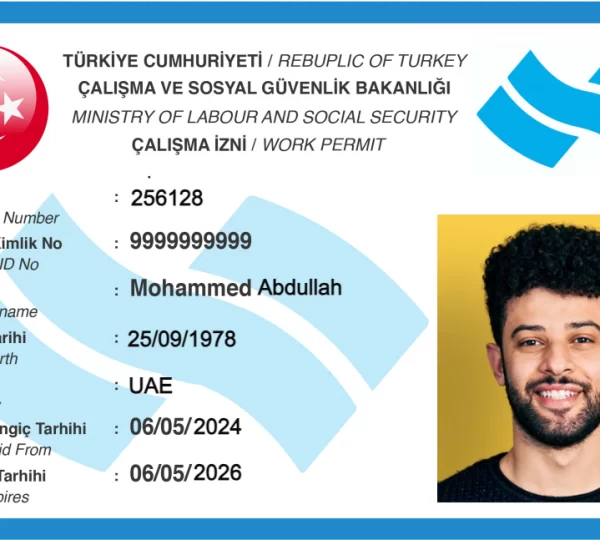
A frequently overlooked strategic point is that the minimum capital for company formation (TRY 50,000) is not the same as the capital required to qualify for a work permit. As of 2026, the Ministry of Labor requires a paid-in capital of at least TRY 500,000 to grant a work permit to a foreign shareholder. Many founders register with the minimum, only to discover later that they cannot legally manage their own company without meeting this higher threshold.
💡The Fix: If you plan to live in Turkey and hold a work permit as a company director, consider registering with a higher capital amount (e.g., TRY 500,000) from the outset to satisfy work permit requirements immediately.
All corporate documents—passports, articles of association, board resolutions—must be translated into Turkish by a sworn translator and notarized. If a foreign company is the shareholder, documents like the certificate of incorporation and board resolution approving the Turkish investment must be legalized (often with an Apostille) and then translated. Missing or incorrect notarization is a top reason for application rejection.
💡The Fix: Work with a bilingual CPA, lawyer or consultant who can oversee the translation and notarization process to ensure accuracy the first time.
Turkey has specific licensing requirements for regulated sectors such as finance, energy, education, health, and even certain retail operations. Establishing a company without securing the necessary sectoral permissions means you will have a legal entity that cannot legally operate.
💡The Fix: Conduct a sector-specific legal risk assessment early. Check if your business activity requires ministry approval or a special license before filing incorporation documents.
Obtaining the tax number for registration is just the first step. Once the company is live, you must register for VAT, withholding tax, e-ledger & e-invoice systems. Failure to file the correct declarations on time leads to “special irregularity fines as EUR 700 per decleration.”, failing to issue a required invoice can result in a fine of 10% of the transaction amount, but not less than eur 700 per document.
💡The Fix: Hire a qualified financial advisor or Turkish accountant immediately upon incorporation to handle tax calendars and e-Declaration systems.
Some businesses test the market by selling goods or services through e-commerce platforms without a registered Turkish entity. The Turkish Revenue Administration (GİB) uses data-mining to track bank transactions and e-commerce sales. If they detect “continuous and systematic” sales without registration, they will deem it an unregistered business activity.
Consequences: The tax authority can assess taxes on the entire discovered revenue, add tax loss penalties (up to three times the tax), and levy special irregularity fines. In cases of serious fraud, prison sentences of 18 months to 8 years apply under Article 359 of the Tax Procedure Law.
💡The Fix: Formalize your tax liability the moment you begin systematic commercial activity. If you have already started, use the “invitation to explain” (izaha davet) process to voluntarily comply and reduce penalties.
Registering a company in Turkey is a straightforward process when done correctly, but it leaves no room for shortcuts. The key to success lies in respecting the legal formalities, from accurate notarized translations and proper capital deposits to post-registration tax compliance. Crucially, savvy investors must look beyond the simple question of “LLC or JSC?” and consider the strategic implications of their entity choice (Independent, Subsidiary, Branch, or Liaison Office), their location (Free Zone or Technopark vs. Mainland), and their capital strategy.
Avoiding these common mistakes by engaging experienced local advisors, foreign investors can confidently unlock the vast potential of the Turkish market.
If you are planning to establish a company in Turkey and want a structured, compliant, and tax-efficient setup, professional advisory support from experienced corporate service providers is essential.
Whether you are establishing a new company, managing a branch, or expanding an existing investment, partnering with a qualified company registration service provider is a strategic move.
A properly structured business plan, the right corporate framework, the necessary licensing, and full post-incorporation local compliance directly determine the success of your project in Turkey.
As A&M Consulting Co., we are a trusted business consulting firm in Turkey, fully registered and accredited with TURMOB (Union of Chambers of Certified Public Accountants of Turkey) and ISMMMO (Istanbul Chamber of Certified Public Accountants). Our team combines technical expertise with a client-focused approach to deliver compliant company formation services in Turkey .
DISCOVER OUR SERVICES:
You can reach out to our experienced consultans via email or by filling out the Contact Form on our website’s contact page
While many assume it’s a 24-hour online process, the reality is that full registration typically takes 1 to 3 weeks. This includes obtaining a potential tax number, notarizing documents, depositing capital (if required), and final approval from the Trade Registry. Rushing the process often leads to document rejection and delays.
Generally, no. While some preliminary steps can be initiated remotely via power of attorney, the process requires physical presence or a legally authorized representative in Turkey. Foreign shareholders must also apply for a tax number in person at a Turkish tax office (or via a notarized power of attorney).
It is highly recommended. While not legally mandatory for all steps, a bilingual CPA, lawyer or consultant ensures your documents are correctly translated, notarized, and submitted. Mistakes in translation or procedure are the #1 reason for application rejection.
The minimum share capital is for a Limited Liability Company (Ltd. Şti.) TRY 50,000., for Joint Stock Company (A.Ş.) TRY 250,000.
No. This is a common misconception. For a limited liability company (LLC), you must pay the full capital within 24 months of the incorporation date. However, if you are establishing a joint-stock company (A.Ş.), you must deposit 25% of the capital before registration. The remainder must be paid within 24 months.
No. The registered capital of a Turkish company must be expressed in Turkish Lira (TRY) . All official documentation and the articles of association must reflect the amount in TRY.
Not automatically. The minimum capital for company formation (TRY 50,000) is separate from the capital required for a work permit. As of 2026, the Ministry of Labor generally requires a paid-in capital of at least TRY 500,000 to grant a work permit to a foreign shareholder. Plan accordingly if you intend to live in Turkey.
Yes, but it is complex. Non-cash capital (Ayni Sermaye) requires a court-appointed expert valuation, must be free of liens, and approved by authorities. This process adds significant time and cost. For speed, cash is almost always preferable at the founding stage.
LLC (Ltd. Şti.): Lower capital (TRY 50k), simpler management, suitable for SMEs. However, share transfers are restricted, and it cannot be publicly traded.
JSC (A.Ş.): Higher capital (TRY 250k), more flexible share issuance, easier to attract venture capital, and required for companies planning to go public or operate in certain regulated sectors
Subsidiary: A separate Turkish legal entity (LLC or JSC) owned by a foreign parent. The parent’s liability is limited to its capital contribution.
Branch: An extension of the foreign parent company, not a separate legal entity. The parent company has unlimited liability for all branch debts and obligations in Turkey.
Absolutely not. A Liaison Office is strictly prohibited from engaging in any commercial activity (sales, invoicing, importing/exporting for trade). Its purpose is limited to market research and promotion. Engaging in sales will result in severe tax penalties and forced closure.
If you are a foreign individual (not a company) investing alone, you will form an Independent Company (either an LLC or JSC). If your existing foreign company is the investor, you will form a Subsidiary. The registration process and liability protection are similar for both.
It depends on your business model:
Mainland: Best for targeting the domestic Turkish market.
Free Zone: Best for export-oriented manufacturing and logistics (0% corporate tax for manufacturers).
Technopark: Best for R&D, software, and tech startups (income tax exemptions for staff, profit exemptions).
Choosing the wrong location can cost you significant tax advantages.
This is a high-risk mistake. The Turkish Revenue Administration (GİB) tracks e-commerce and bank transactions. If they detect “continuous and systematic” sales without registration, they will deem it unregistered activity. Penalties can include back-taxes on all revenue, tax loss penalties (up to 3x the tax), and potential prison time for fraud under Article 359.
No. Registration is just the beginning. You must immediately register for VAT, withholding tax, and the e-invoice system. You must also register any employees with the Social Security Institution (SGK) before they start work. Post-incorporation compliance is where most new businesses face fines.
Yes, absolutely. Relying solely on the standard articles of association often leads to disputes. A clear shareholders’ agreement should outline profit distribution, decision-making authority, exit strategies, and dispute resolution mechanisms (e.g., ICC arbitration) to prevent deadlock.


WhatsApp Us