

Summarize this article with AI
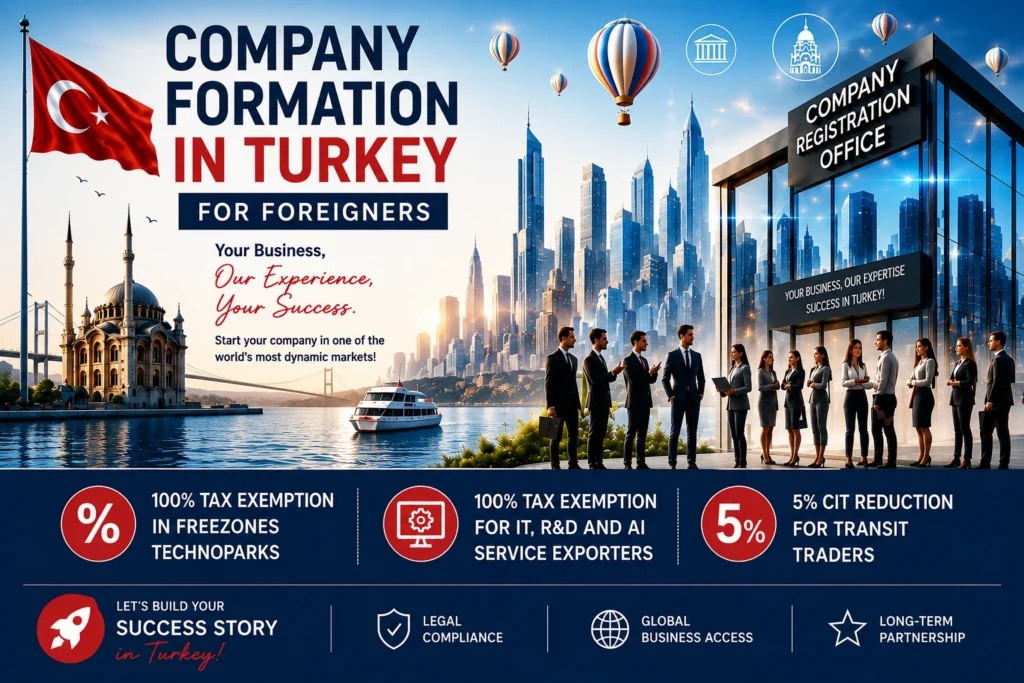
Türkiye has emerged as a highly attractive destination for foreign investors, thanks to its strategic location bridging Europe and Asia, a large domestic market, and an investor-friendly legal framework. Under the Foreign Direct Investment Law (No. 4875), foreign investors are granted equal treatment with domestic ones, enabling 100% foreign ownership of companies without a local partner requirement.
This guide provides a comprehensive overview of company formation in Türkiye for foreigners, covering legal structures, commercial areas, company types, step-by-step procedures, costs, and post-incorporation duties.
Türkiye has transformed into a dynamic hub for international business, attracting investors and entrepreneurs with its unique blend of strategic advantages. As of 2025, it stands as the world’s 17th-largest economy by nominal GDP and the 11th largest by purchasing-power parity . The country is actively implementing a “Powerhouse for Investment in the Türkiye Century” reform agenda, making it an opportune time for foreign businesses to enter the market.
Here are the key reasons why starting a business in Türkiye is a compelling proposition:
Türkiye’s unique location at the crossroads of Europe, Asia, and the Middle East is its most fundamental advantage. It serves as a natural gateway for accessing a vast market of over 1.5 billion people across Europe, the Balkans, the Caucasus, the Middle East, and North Africa . This strategic position is enhanced by a network of advanced logistics and integrated transport infrastructure, with roughly $300 billion invested in transportation infrastructure to support this connectivity . As global supply chains are reconfigured, Türkiye’s role as a central hub for production and distribution becomes increasingly valuable .
With a population exceeding 86.7 million and a median age of just 34.5, Türkiye offers a large and dynamic domestic market . This youthful population is tech-savvy and provides a robust and growing consumer base for a wide range of products and services. Furthermore, this demographic dividend translates into a strong and growing workforce and a rich talent pool, which is a key driver for foreign investors .
Türkiye’s startup scene is attracting increasing international attention, with founders from the US, Europe, and the Caucasus looking to Istanbul for investment, world-class talent, and a foothold in global markets . The ecosystem is supported by accessible support networks, world-class entrepreneurship centers like Terminal Istanbul, and a legal infrastructure that is aligning with international standards . This environment allows early-stage companies to scale quickly and leverage Türkiye as a launchpad for broader international expansion .
The Turkish legal framework is designed to be welcoming to foreign capital. Under the Foreign Direct Investments Law (No. 4875), foreign investors are granted equal treatment with domestic ones, enabling 100% foreign ownership of companies without a local partner requirement . This open approach has helped Türkiye attract nearly $300 billion in foreign direct investment over the past 23 years and host approximately 87,000 international companies .
In 2026, Türkiye introduced a landmark reform package with sweeping tax incentives to position itself as a premier global hub for multinational corporations and international investors . Key highlights include:
Attracting Regional Headquarters: A 20-year corporate tax exemption is available for companies that relocate their regional management headquarters to the Istanbul Financial Center (IFC), offering significant tax advantages on income generated from managing overseas operations .
Boosting Exports: The corporate tax rate for manufacturing exporters has been slashed to 9% (from the standard 25%), and other exporters will benefit from a reduced rate of 14% .
Incentivizing Transit Trade: Profits from transit trade will be 100% exempt from corporate tax for companies based in the IFC, with a 95% exemption for activities elsewhere in the country .
Attracting Global Talent: A new framework offers a 20-year income tax exemption on all foreign-earned income for highly qualified individuals and high-net-worth individuals who relocate their residency and capital to Türkiye .
Supporting Service Exports: The tax exemption for service exports has been expanded to 100%, targeting high-value sectors like software, engineering, and design .
Manufacturing and Agriculture: A reduced corporate tax rate of 12.5% has been introduced for manufacturing and agricultural production companies .
The company formation process in Türkiye is highly digitalized, making it efficient and accessible for foreign investors. Entrepreneurs can now:
Set up businesses remotely through a passport-based identity verification process .
Complete company incorporation fully online without a physical presence .
Benefit from virtual office services and automated accounting infrastructures to reduce operational costs .
The official incorporation process can be completed in less than a week following the submission of all necessary documentation .
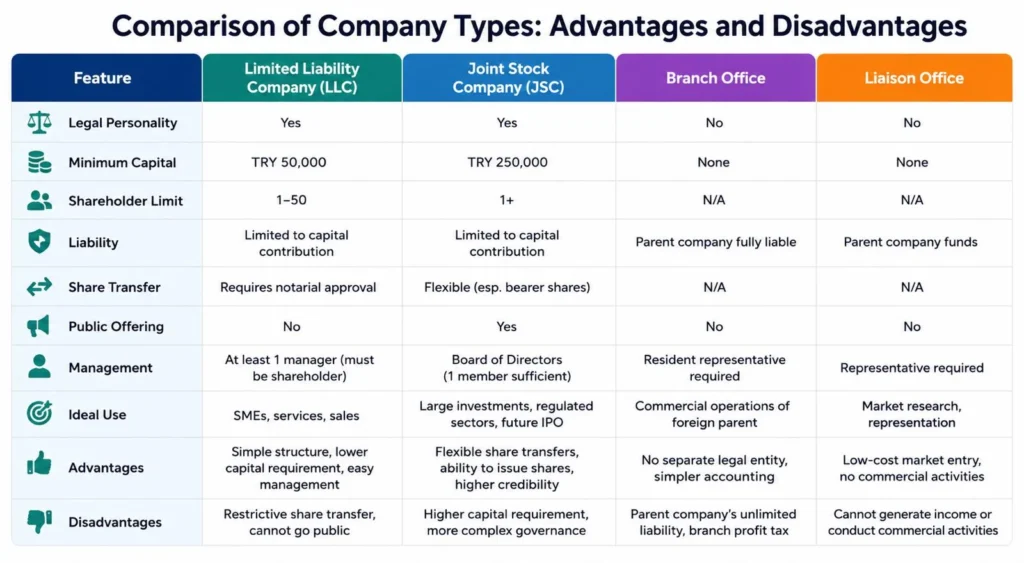
Foreign investors have several options for establishing a presence in Türkiye. The choice depends on the intended scale of operations, liability considerations, and long-term business goals.
The LLC is the most popular choice for foreign investors, particularly for small and medium-sized enterprises (SMEs). It is functionally similar to a German GmbH or a UK private limited company.
Legal Status: A legal entity separate from its shareholders.
Liability: Shareholders’ liability is limited to their capital commitments.
Minimum Capital: TRY 50,000.
Shareholders: 1 to 50 shareholders (individuals or corporate entities).
Management: At least one manager must be appointed, and at least one manager must be a shareholder. Managers do not need to be Turkish citizens or residents.
Share Transfer: Share transfers require notarial procedures and general assembly approval, making them less flexible.
Suitability: Ideal for SMEs, sales offices, service companies, and smaller-scale investments.
The JSC is preferred for larger investments, ventures planning to raise capital from the public, or those aiming for an eventual exit. It is comparable to a German AG or a UK PLC.
Legal Status: A legal entity.
Liability: Shareholders’ liability is limited to their capital contributions.
Minimum Capital: TRY 250,000 (or TRY 500,000 if adopting the registered capital system).
Shareholders: 1 or more shareholders, with no upper limit.
Management: A board of directors must be established (one board member is sufficient).
Share Transfer: Share transfers are more flexible, particularly for bearer shares, which can be transferred by endorsement and delivery without notary or registry filings.
Suitability: Best for large-scale investments, multi-shareholder structures, regulated sectors (e.g., banking, insurance), and businesses considering a public offering.
A branch office is an extension of a foreign parent company and does not have a separate legal personality.
Legal Status: Not an independent legal entity; the parent company is directly liable for all branch debts and obligations.
Capital Requirement: No minimum capital is legally required, though a working budget is advisable.
Activities: Can only conduct activities within the scope of the parent company’s business.
Taxation: Subject to corporate income tax in Türkiye. Profits transferred to the headquarters are subject to a 15% withholding tax, which may be reduced under Double Taxation Treaties.
Representation: Must appoint a fully authorised resident representative in Türkiye.
A liaison office is strictly for non-commercial activities and cannot engage in profit-making operations.
Activities: Market research, promotion, representation, communication, and coordination. It cannot issue invoices or conduct commercial transactions.
Permit: Requires a license from the Ministry of Industry and Technology, initially granted for up to 3 years and potentially extendable.
Funding: All expenses must be covered from abroad.
Suitability: Ideal for companies wishing to explore the Turkish market before making a more substantial investment.
There is no specific legislation governing joint ventures in Türkiye. They are generally structured as commercial companies (often JSCs) under the Turkish Commercial Code. Shareholders’ agreements are commonly used to define the relationship between parties and govern the joint venture’s maintenance. There are no nationality restrictions on shareholders or management rights, except in specific regulated sectors like media and aviation.
One of the most important decisions when establishing a company in Turkey is choosing the right commercial zone. The location of your business can significantly impact taxation, customs duties, operational flexibility, and eligibility for government incentives.
Türkiye offers three primary commercial zones with distinct tax advantages:
This encompasses the general economic area of Türkiye. Companies operating here are subject to standard corporate tax rates, VAT, and other applicable taxes.
These are specialised areas designed to foster R&D and high-technology investments. There are currently 101 Technoparks across Türkiye.
Key Advantages (until December 31, 2028):
Corporate Tax Exemption: Profits derived from software development, R&D, and design activities are exempt from income and corporate taxes.
VAT Exemption: Sales of application software produced exclusively in Technoparks are exempt from VAT.
Personal Income Tax Exemption: Remuneration for R&D, design, and support personnel is exempt from all taxes (support personnel limited to 10% of total R&D personnel).
Social Security Support: 50% of the employer’s share of social security premiums is covered by the government.
Stamp Duty & Customs Duty Exemption: Applicable documents and imported products within the scope of projects are exempt.
Free zones are areas deemed outside the Turkish customs territory, designed to boost export-focused investments. There are 19 Free Zones in Türkiye, strategically located near ports.
Key Advantages:
100% Exemption: From customs duties, corporate income tax (for manufacturing companies), VAT, special consumption tax, stamp duty, and real estate tax.
Unlimited Storage: Goods may remain in free zones for an unlimited period.
Profit Repatriation: Companies are free to transfer profits from free zones abroad without restrictions.
Income Tax Exemption: Exemption from income tax on employees’ wages for companies that export at least 85% of the FOB value of the goods they produce.
The company formation process in Türkiye is highly digitalised through the Central Registry Record System (MERSİS). If all documents are properly prepared, the official incorporation process can be completed within 3 to 7 business days.
The process follows a clear decision-making and execution flow, as illustrated below:
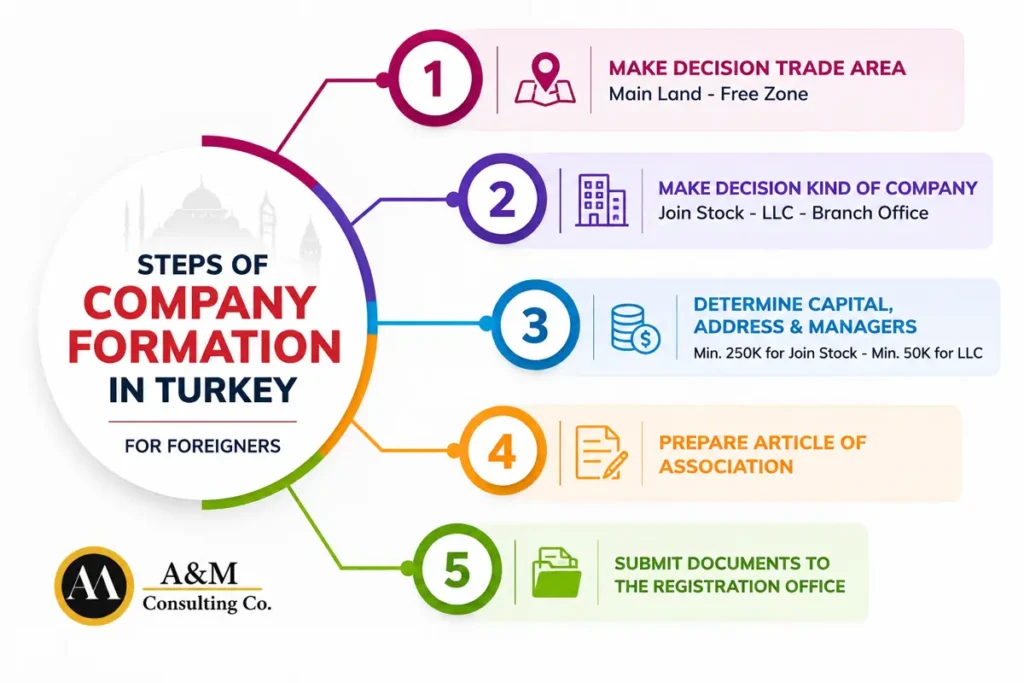
The first strategic decision is to determine where your business will operate. This choice has significant tax implications:
Main Land (Standard Commercial Zones): Companies are subject to standard corporate tax rates, VAT, and other applicable taxes.
Free Zones: Offer 100% exemption from customs duties, corporate income tax (for manufacturing companies), VAT, and stamp duty. Ideal for export-focused manufacturing and logistics businesses.
Technoparks (Technology Development Zones): While not explicitly listed in the flowchart, these are another key trade area for R&D and software companies, offering corporate tax and VAT exemptions.
Choose the legal structure that best suits your business goals, liability preferences, and scale:
Joint Stock Company (JSC – Anonim Şirket): Best for larger investments, regulated sectors, and companies considering a future public offering.
Limited Liability Company (LLC – Limited Şirket): The most popular choice for SMEs, offering a simple structure and limited liability.
Branch Office: An extension of a foreign parent company, suitable for establishing a commercial presence without creating a separate legal entity.
With the trade area and company type decided, the next step is to finalise the operational details:
Capital Requirements:
LLC: Minimum TRY 50,000 (payable within 24 months after registration).
JSC: Minimum TRY 250,000 (or TRY 500,000 if adopting the registered capital system; at least 25% must be deposited before registration).
Branch Office: No minimum capital legally required.
Registered Address: Secure a physical or virtual office address in Türkiye for official correspondence.
Managers/Directors:
LLC: At least one manager must be appointed, and at least one manager must be a shareholder (no Turkish residency requirement).
JSC: A board of directors must be established (one board member is sufficient).
The Articles of Association is the founding document of the company. It must include:
Company name and registered address
Business purpose and NACE codes (statistical classification of economic activities)
Share capital structure and payment schedule
Shareholder details and share distribution
Management and representation provisions
Fiscal year and audit provisions
This document must be prepared in Turkish and entered into the MERSİS system.
This is the final execution step where all preparations are formalised:
File with MERSİS: Enter the Articles of Association and all required information into the Central Registry Record System.
Deposit Capital (For JSC): Deposit at least 25% of the cash capital in a blocked bank account (for JSCs).
Pay Competition Authority Fee: Pay 0.04% of the company’s capital to the Turkish Competition Authority.
Submit to Trade Registry: Submit the MERSİS application and all supporting documents to the relevant Trade Registry Directorate.
Sign and Register: The founders sign the Articles of Association before the Trade Registry Directorate. The company acquires legal personality upon registration.
Issuance of Signature Circular: On the day of registration, signatories issue a signature circular before authorised Trade Registry personnel.
Certification of Legal Books: The Trade Registry Directorate certifies the company’s legal books (journal, ledger, inventory book, etc.) during the establishment process.
Publication: The establishment is announced in the Turkish Trade Registry Gazette.
Passport Copy: The first page, attested and translated into Turkish.
Proof of Address: A recent utility bill or bank statement (sometimes required).
Photograph: A professional headshot photo
Certificate of Activity/Good Standing: Issued by the relevant authority in the shareholder’s country, proving the company’s existence and current status. Must be apostilled and translated into Turkish.
Certificate of Registration: Official incorporation records, including a copy of the articles of association.
Board Resolution: A resolution from the shareholder company’s board authorising the establishment of the Turkish company and appointing the representative.
Signatory Circular: Proof of representation power for the authorised signatories of the shareholder company.
Note: All documents issued outside Türkiye must be apostilled (if the country is a party to the Hague Convention) or consular-legalised by the Turkish embassy or consulate in the country of origin. They must then be translated into Turkish by a sworn translator and notarised by a Turkish notary public.
Power of Attorney: Attested (notarised and apostilled/consular-legalised), authorising the representative to incorporate the company.
Office lease agreement(Physical or Virtual Office) or title deed
The exact costs vary based on the company type, share capital, and the volume of document legalisation and translation required. For a company with minimum capital, initial costs typically include:
| Cost Item | Estimated Cost (EUR) |
|---|---|
| Trade Registry Fees & Chamber Dues | Variable, based on capital and Article of Association: ~1,000 |
| Notary, Translation, and Apostille Costs | Variable, based on count of page and words: ~750 |
| Statutory Books and Incorporation Documents | Included in registry fees |
| Competition Authority Contribution | 0.04% of sha re capital: ~750 |
| Total Estimated Official Costs | €2,000 – €2,500 |
Note: This estimate covers official fees and excludes legal consultancy, accounting services, and bank charges.
Company registration is just the beginning. To operate legally and avoid penalties, foreign-invested companies must complete the following post-incorporation duties promptly.
The Trade Registry Directorate notifies the tax office ex officio. A tax officer will visit the company’s registered address to prepare a determination report, and at least one authorised signatory must be present. The company must then obtain its tax registration certificate from the local tax office.
The company must register with the Social Security Institution to obtain a workplace registration number. A separate application must be made for each employee before they start working.
It is mandatory to appoint a CPA to manage the company’s bookkeeping, tax declarations, payroll, and e-ledger and e-invoice enrolments. A CPA ensures compliance with the Tax Procedure Law and handles all financial and tax reporting.
4. Open a Corporate Bank Account
A corporate bank account is essential for business transactions, tax payments, and receiving payments. Bank compliance teams often require a clear business summary and a face-to-face meeting with a director.
5. Apply for E-Ledger, E-Invoice, and Fiscal Stamp
Türkiye has a mandatory e-Transformation system. Companies must apply to the Revenue Administration (GİB) to register for the e-Ledger (e-Defter) and e-Invoice (e-Fatura) systems. They must also procure a fiscal stamp for official documents.
6. Prepare a Signature Circular
The signature circular, issued at the Trade Registry Directorate on the day of registration, provides proof of signatory authority. While the 2021 amendment to the Turkish Commercial Code has, in principle, abolished the physical submission of signature declarations, foreign representatives may still need to execute one before a Turkish consulate or competent authority abroad.
7. Obtain a Company Stamp
A company stamp is required for official transactions, alongside signatures.
8. Apply for E-Notification (E-Tebligat)
Corporate income taxpayers are required to use the e-Notification system to receive official communications and documents electronically from the authorities. This registration must be completed within 15 days following the start of business.
9. Apply for Licenses & Permits
Depending on the business sector, additional permits or licences may be required. Examples include sectors like food, healthcare, energy, mining, and tourism.
E-TUYS Reporting: Foreign-invested companies must report shareholding and capital data annually via the E-TUYS system.
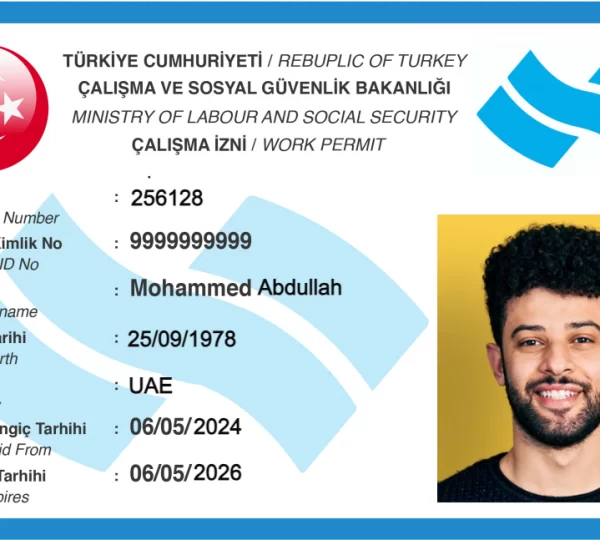
Work Permits: Foreign founders who intend to work for their Turkish company must obtain a work permit under the International Workforce Law No. 6735. Owning shares alone does not grant the right to work.
VERBIS Registration: Companies processing personal data may be required to register with the Data Controllers Registry Information System (VERBIS) under the Personal Data Protection Law (KVKK).
Disclaimer: This article provides general information and does not constitute legal or financial advice. Laws and regulations are subject to change. It is highly recommended to consult with a qualified legal and accounting professional in Türkiye for guidance specific to your situation.
Türkiye provides a comprehensive system of tax incentives to encourage investment, R&D, innovation, and exports. These incentives are designed to make Türkiye a regional hub for business and investment.
A 100% corporate tax exemption is available for income derived from service exports. This incentive is a powerful tool for companies in sectors such as software development, IT services, consultancy, and other professional services that serve clients abroad.
Companies operating in Technoparks enjoy a wide range of tax benefits until December 31, 2028 :
Corporate Tax Exemption: Profits derived from software development, R&D, and design activities are exempt from corporate income tax .
Personal Income Tax Exemption: The salaries of R&D, design, and support personnel are exempt from all taxes .
VAT Exemption: Sales of application software produced in Technoparks are exempt from VAT .
Social Security Support: 50% of the employer’s share of social security premiums is covered by the government .
Free Zones offer a tax-free environment to boost export-focused manufacturing :
100% Corporate Tax Exemption: For manufacturing companies .
100% Income Tax Exemption: For employees’ wages, provided that the company exports at least 85% of the FOB value of the goods it produces .
100% VAT and Customs Duty Exemption: For all operations within the zone .
The Turkish government is committed to supporting manufacturing. The corporate tax rate for manufacturing companies has been reduced to 12.5%, making it a highly competitive jurisdiction for industrial production . This incentive is part of the broader “Powerhouse for Investment in the Türkiye Century” program .
The Istanbul Financial Center (IFC) is Türkiye’s flagship project to create a regional financial hub, and the 2026 “Strong Investment Hub Program” has significantly expanded its tax advantages . The IFC is designed to compete with global centers like Singapore and Hong Kong .
| Incentive Type | Details |
|---|---|
| Transit Trade | 100% corporate tax exemption on profits from transit trade and overseas goods trading (increased from 50%) |
| Regional Management Centers | 100% corporate tax exemption for 20 years for qualifying companies relocating regional headquarters to the IFC (requires ≥80% revenue from abroad) |
| Financial Service Export | 100% deduction from corporate income tax base until 2031 (75% thereafter) |
| BSMV & Stamp Duty | 100% exemption from Banking and Insurance Transactions Tax (BSMV) and stamp duty for qualifying financial service export transactions |
| Personnel Income Tax | 60-80% income tax exemption for personnel with 5+ or 10+ years of international experience (subject to conditions) |
| Real Estate Leases | Exemption from charges and stamp duty for lease transactions within the IFC |
| Qualified Service Center Personnel | Income tax exemption on wages up to six times the gross minimum wage for staff in qualifying service centers within the IFC |
Turkey continues to attract foreign investors with its strategic location, competitive operating costs, large domestic market, and access to regional trade routes. As a bridge between Europe, Asia, and the Middle East, the country offers significant opportunities for entrepreneurs seeking international growth.
The Company Formation in Turkey for Foreigners process is designed to be accessible and efficient, allowing international investors to establish a legal presence with relatively straightforward procedures. Whether you are launching a startup, opening a subsidiary, or expanding an existing business, Turkey provides a favorable environment supported by modern corporate regulations and investment incentives.
However, successful market entry requires careful planning and full compliance with Turkish tax, accounting, labor, and corporate legislation. Working with experienced local advisors can help reduce risks, avoid delays, and ensure that all legal obligations are met from day one.
A&M Consulting Co. specializes in assisting foreign entrepreneurs and international companies throughout the entire company formation process in Turkey. From selecting the most suitable legal structure and preparing incorporation documents to tax registration, accounting, payroll, and ongoing compliance services, our team provides comprehensive support tailored to the needs of foreign investors.
Our mission is to simplify the business setup process, help clients benefit from available tax advantages and investment incentives, and provide practical, cost-effective solutions for entering the Turkish market with confidence.
If you are considering Company Formation in Turkey for Foreigners, our experts are ready to guide you through every stage of the investment journey and help you establish your business quickly, efficiently, and in full compliance with Turkish regulations.
DISCOVER OUR SERVICES:
You can reach out to our experienced consultans via email or by filling out the Contact Form on our website’s contact page.
Yes. Under the Foreign Direct Investment Law (No. 4875), foreigners may establish companies in Türkiye with 100% foreign shareholding and are granted equal treatment with Turkish nationals. No local partner is required, and no pre-approval is needed for incorporation outside a few regulated sectors such as defense, aviation, and broadcasting.
The most common structures for foreign investors are :
| Type | Minimum Capital | Best For |
|---|---|---|
| Limited Liability Company (LLC) | TRY 50,000 | SMEs, service companies, sales offices |
| Joint Stock Company (JSC) | TRY 250,000 (TRY 500,000 under registered capital system) | Large investments, multi-shareholder structures, future public offerings |
| Branch Office | None | Commercial operations of a foreign parent company |
| Liaison Office | None | Market research and representation (non-commercial activities only) |
The LLC is the most popular choice for small and medium-sized enterprises, while the JSC offers more flexibility for share transfers and is required in regulated sectors such as banking and insurance .
LLC: Minimum TRY 50,000. The capital can be paid within 24 months after registration .
JSC: Minimum TRY 250,000 (or TRY 500,000 if adopting the registered capital system). At least 25% of the cash capital must be deposited in a blocked bank account before registration; the remainder within 24 months .
Important: Companies incorporated under the old minimums must raise their capital to the new thresholds by 31 December 2026 or face dissolution.
Türkiye offers four main types of special investment zones, each designed to support different business activities. Choosing the right zone is a strategic decision that significantly impacts your tax position, operational costs, and overall business success.
1. Technology Development Zones (Technoparks)
Purpose: Support R&D, software, and high-tech activities.
Number: 101 zones (87 operational)
Ideal for: Software companies, AI firms, renewable energy, advanced manufacturing, research centers, engineering firms, tech startups
Key Advantages (until December 31, 2028):
100% corporate tax exemption on profits from software, R&D, and design activities
100% VAT exemption on software sales
100% personal income tax exemption for R&D, design, and support personnel
50% government coverage of employer’s social security premiums
Customs and stamp duty exemptions for R&D-related imports
2. Organized Industrial Zones (OIZs)
Purpose: Provide ready-to-use infrastructure and facilities for manufacturing.
Number: 392 zones across 81 provinces (hosting 67,000+ companies)
Ideal for: Manufacturing companies, automotive suppliers, machinery producers, electronics, textiles, food processing, chemicals
Key Advantages:
VAT exemption on land acquisitions
5-year real estate tax exemption from plant completion date
Low water, natural gas, and telecommunication costs
Exemption from municipality and solid waste taxes (if not using municipal services)
3. Free Zones (FZs)
Purpose: Boost export-focused investments. Physically in Türkiye but considered outside the customs area.
Number: 19 zones (strategically located near ports)
Ideal for: Export manufacturers, international traders, logistics companies, warehousing, assembly facilities
Key Advantages:
100% exemption from customs duties
100% corporate tax exemption for manufacturing companies
100% VAT, SCT, stamp duty, and real estate tax exemption
Unlimited storage period for goods
Unrestricted profit repatriation
100% income tax exemption on employee wages (for companies exporting ≥85% of production)
4. Industrial Zones (IZs)
Purpose: Support large-scale, technology-intensive integrated investments.
Number: 40 zones
Ideal for: Large-scale and tech-intensive investments, strategic sectors (petrochemicals, defense, space), companies requiring large land areas
Key Advantages:
Easement rights at 8-10 times more discounted rates compared to Treasury lands outside the zone
Accelerated and simplified bureaucratic processes
Eligibility for public investment financing from the Ministry of Industry and Technology
Streamlined application process through the Ministry or operator company.
For Individual Shareholders:
Passport Copy: The first page, attested and translated into Turkish.
Proof of Address: A recent utility bill or bank statement (sometimes required).
Photograph: A professional headshot photo
For Corporate Shareholders:
Certificate of Activity/Good Standing: Issued by the relevant authority in the shareholder’s country, proving the company’s existence and current status. Must be apostilled and translated into Turkish.
Certificate of Registration: Official incorporation records, including a copy of the articles of association.
Board Resolution: A resolution from the shareholder company’s board authorising the establishment of the Turkish company and appointing the representative.
Signatory Circular: Proof of representation power for the authorised signatories of the shareholder company.
Note: All documents issued outside Türkiye must be apostilled (if the country is a party to the Hague Convention) or consular-legalised by the Turkish embassy or consulate in the country of origin. They must then be translated into Turkish by a sworn translator and notarised by a Turkish notary public.
Other Mutual Documents:
Power of Attorney: Attested (notarised and apostilled/consular-legalised), authorising the representative to incorporate the company.
Office lease agreement(Physical or Virtual Office) or title deed
The official incorporation process can be completed in 1 to 3 business days after all documents are properly prepared and submitted through the MERSİS system . However, opening a corporate bank account can take an additional 1 to 2 days due to bank compliance procedures.
Official costs typically range from €2,000 to €2,500, depending on the company type, share capital, and volume of document legalisation required. Key cost items include :
Trade Registry fees and chamber dues
Notary, translation, and apostille costs
Competition Authority contribution (0.04% of share capital)
Statutory books and incorporation documents
Legal consultancy and accounting fees are additional and vary based on the service provider and complexity of the setup.
No. Company registration and personal immigration status are separate matters under Turkish law. You can own and register a Turkish company while living abroad, and no permit is required solely for shareholding .
However, if you intend to live in Türkiye and actively manage or work for the company, you must obtain a work permit .
After company registration, you must complete the following :
Tax registration with the local tax office
Social Security Institution (SGK) registration for workplace and employees
Appoint a CPA for bookkeeping and tax declarations
Open a corporate bank account
Apply for E-Ledger, E-Invoice, and fiscal stamp
Register for E-Notification (E-Tebligat)
Prepare the signature circular and company stamp
E-TUYS reporting for foreign-invested companies (annual and on changes)
Sector-specific licenses and permits (if applicable)
Yes. A subsidiary is a separate legal entity in Türkiye, owned partially or wholly by your foreign parent company. This structure offers limited liability, operational autonomy, and local market access . The subsidiary is established as an LLC or JSC with its own legal personality, and the parent company’s liability is limited to its investment.
Technoparks are ideal for software, R&D, and high-tech companies. Key incentives (valid until December 31, 2028) include:
100% corporate tax exemption on profits from software development and R&D activities
100% VAT exemption on software sales
100% personal income tax exemption for R&D, design, and support personnel
50% government coverage of the employer’s share of social security premiums
Customs duty exemption on imported products used for R&D projects
Share:


Follow us!
WhatsApp Us