

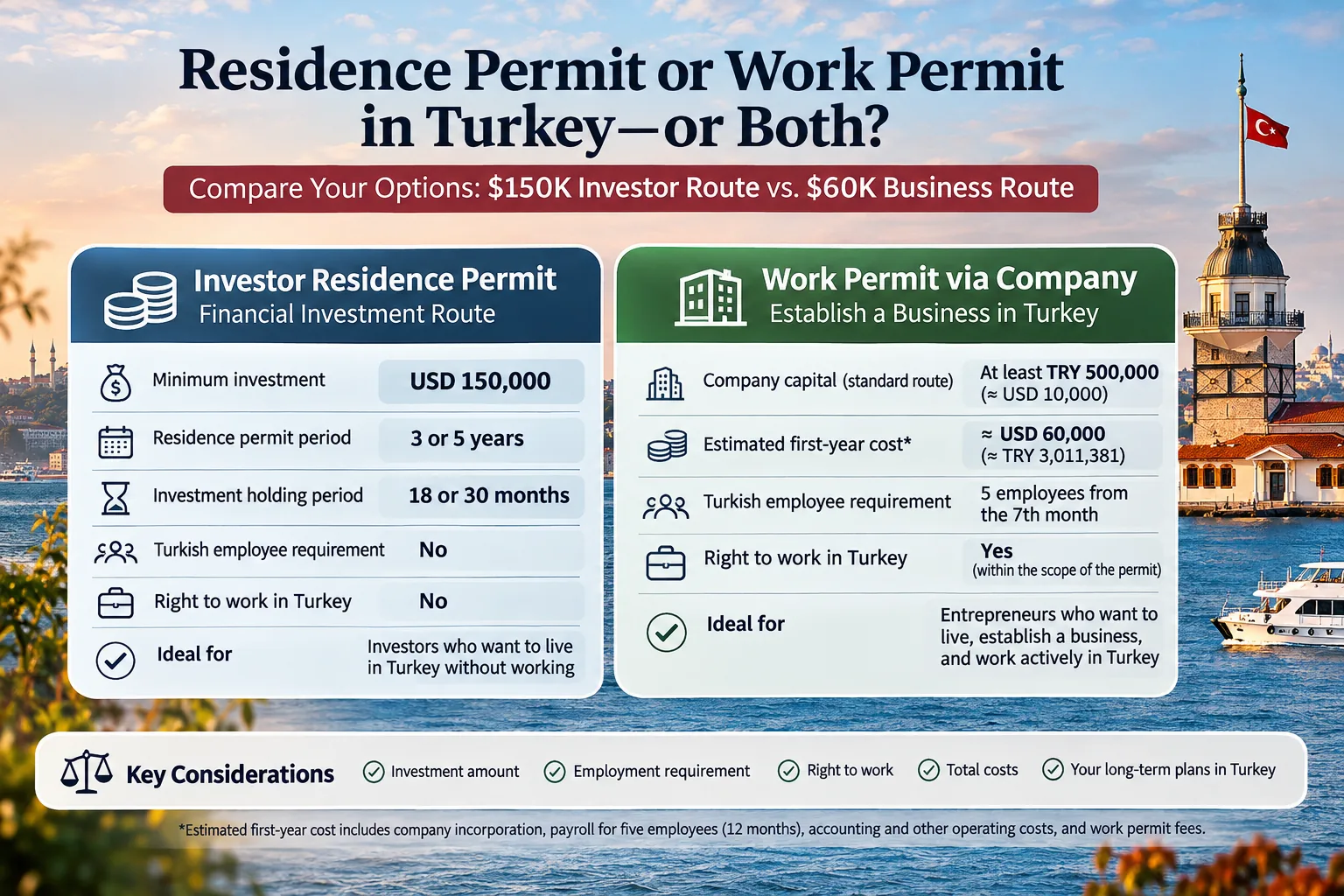
For foreign investors considering Turkey, the right route depends on whether the priority is residence, running a business, or both. An investment of $150,000 meets the investment threshold for a residence permit, while a budget of around $60,000 may cover setting up and operating a business and pursuing a work permit. A valid work permit also grants the right to reside in Turkey, subject to the applicable requirements. In this article we will compare the two options, their costs, and key requirements.
The first option is designed for individuals who wish to live in Turkey without working and can commit a substantial amount of their financial assets to an investment for a specified period. The second option may be more suitable for entrepreneurs who want to establish and actively manage a business in Turkey and generate income.
When considering only the investment amount, establishing a company requires significantly less capital. However, the paid-in capital required for a work permit, employment requirements, and payroll costs must also be taken into account.
For foreign entrepreneurs planning to conduct genuine commercial activities in Turkey, establishing a company and obtaining a work permit is often a more practical solution. Nevertheless, under the standard application route requiring the employment of five Turkish citizens, the total cost goes beyond the company’s capital alone.
A $150,000 investment may meet the investment threshold for a residence permit in Turkey. Alternatively, with an estimated budget of around $60,000, you may be able to establish a business and apply for a work permit. A valid work permit also grants the right to reside in Turkey. Approval is subject to the applicable legal requirements.
Residence permit: The investment threshold is $150,000.
Work permit: An estimated budget of around $60,000 may cover business establishment and related costs, including accounting fees.
Both: A valid work permit also grants the right to reside in Turkey.
Important: The $60,000 figure is an estimated business setup budget, not the work permit fee. Eligibility and approval depend on the applicable requirements.
|
Investment |
Residence permit duration |
Required investment holding period |
|---|---|---|
|
At least $150,000 |
3 years |
18 months |
|
At least $200,000 |
5 years |
30 months |
Eligible investment instruments include bank deposits in Turkey, government debt securities, certain real estate or venture capital investment funds, and eligible private pension plans. The investment and the required amount must be verified by the relevant institution.
This permit does not authorize the investor to work in Turkey. In addition, a residence permit issued under this scheme does not, by itself, provide the right to apply for Turkish Citizenship.
The opportunity to obtain residence rights in Turkey without establishing an active company
No requirement to employ five Turkish citizens
The investment may be released after the required holding period, subject to the applicable conditions
A suitable structure for individuals who wish to live in Turkey without working and rely on income from abroad
A substantial amount of capital must be committed to an investment for a specified period
An investor residence permit does not grant the right to work in Turkey
The investment’s return and value may be affected by market conditions
This option alone may not be sufficient for individuals who intend to conduct active business activities in Turkey
A work permit not only authorizes the holder to work in Turkey; as a general rule, it also serves in place of a residence permit. Therefore, entrepreneurs who intend to manage a company and actively work in Turkey may be able to rely on a work permit rather than applying for two separate permits.
However, establishing a company does not automatically entitle the foreign shareholder to a work permit. The Ministry evaluates applications based on the applicable financial adequacy, capital, employment, and salary criteria.
As of 2026, the standard assessment criteria include:
The company’s paid-in capital must be at least TRY 500,000.
The foreign shareholder’s capital contribution must be at least TRY 500,000.
The foreign shareholder must hold at least 20% of the company’s shares.
The company must hire minimum five Turkish citizens. This requirement may be deferred for the first six months of the initial incorporation. From the seventh month onward, the company must employ at least five Turkish citizens each month.
If the foreign shareholder’s capital contribution is $100,000 or more, the stated financial adequacy and employment criteria do not apply. This exemption does not guarantee that the work permit will be granted; other application requirements remain subject to assessment.
The statutory minimum capital is TRY 50,000 for a Limited Liability Company and TRY 250,000 for a Joint Stock Company. However, for a work permit application made on behalf of a company shareholder, the criteria above mean that paid-in company capital of TRY 500,000 and a foreign shareholder’s capital contribution of at least TRY 500,000 should be considered for both company types.
This amount is not an incorporation fee or a government charge; it is the company’s capital and may be used for business activities. However, the capital must be paid into the company’s bank account, and the payment must be supported by legally valid documentation.
The following comparison uses an illustrative exchange rate of USD 1 = TRY 50. USD equivalents will change as the exchange rate changes. The figures are estimates and should be reviewed against the applicable requirements and actual costs at the time of application.
|
Item |
Amount / Requirement |
|---|---|
|
Financial investment |
$150,000 |
|
Equivalent at TRY 50 per USD |
TRY 7,500,000 |
|
Required holding period for a 3-year permit |
18 months |
|
Nature of investment |
Qualifying investment held in an eligible financial instrument; not an incorporation expense |
The $150,000 is not a government fee or an expense that is necessarily consumed. The investor may release the investment after satisfying the applicable conditions and holding period. However, access to the capital is restricted during that period, and the investment may be exposed to market risk.
For this illustrative calculation, the estimated cost of incorporating a standard Turkish company, including government charges, is TRY 150,000. Actual costs may vary depending on the company structure and the services required.
Under the standard company-shareholder assessment criteria, the foreign shareholder’s capital contribution must be at least TRY 500,000. If the foreign investor owns 100% of the company, total paid-in capital of TRY 500,000 may meet this capital criterion. If the investor owns exactly 20%, the company’s total capital would need to be at least TRY 2,500,000 for the investor’s share to equal TRY 500,000.
For more information about company capital, please read our article, Share Capital in Turkey.
Important: The TRY 500,000 is company capital, not an incorporation expense or a government fee. It remains an asset of the company and may be used for business activities, subject to the applicable rules. The calculation below therefore excludes it from operating expenses, but it should be considered separately when planning the initial funding requirement.
For 2026, the estimated monthly employer cost of a minimum-wage employee in non-manufacturing sectors is TRY 40,214.03, assuming the applicable two-point social security premium reduction. The published employer cost without that reduction is TRY 40,874.63. Manufacturing-sector incentives differ.
|
Item |
Calculation |
Amount |
|---|---|---|
|
Monthly cost for five employees |
5 × TRY 40,214.03 |
TRY 201,070.15 |
|
Six-month cost |
TRY 201,070.15 × 6 |
TRY 1,206,420.90 |
|
Twelve-month cost |
TRY 201,070.15 × 12 |
TRY 2,412,841.80 |
Under the standard employment criterion described above, the five-Turkish-employee requirement begins in the seventh month of the initial work permit. Accordingly, the estimated payroll cost for the first six months in which the requirement applies is TRY 1.21 million. A full 12-month period of employment would cost approximately TRY 2.41 million.
This estimate assumes that all five employees are paid the minimum wage and that the two-point social security premium reduction applies. Actual payroll costs may be higher depending on salaries, sector, eligibility for incentives, and other employment-related costs.
|
Item |
Estimated annual cost |
|---|---|
|
Accounting and bookkeeping |
TRY 300,000 |
|
Electronic applications (e-ledger, e-invoice and company seal) |
TRY 50,000 |
|
Virtual office |
TRY 35,000 |
|
Other / contingency operating costs |
TRY 50,000 |
|
Total |
TRY 435,000 |
For a work permit valid for up to one year, the 2026 official work permit fee is TRY 12,574.90, and the work permit document fee is TRY 964. The combined official amount is TRY 13,538.90. This excludes any consultancy, translation, notarization, or other service costs.
|
Cost item |
Amount |
|---|---|
|
Company incorporation |
TRY 150,000.00 |
|
Five Turkish employees — 12 months |
TRY 2,412,841.80 |
|
Accounting and other operating costs |
TRY 435,000.00 |
|
Work permit and document fees |
TRY 13,538.90 |
|
Estimated total |
TRY 3,011,380.70 |
|
USD equivalent at TRY 50/USD |
$60,227.61 |
The estimated total is therefore approximately $60,000, excluding the company’s paid-in capital and any costs not listed above. The calculation uses 12 months of payroll; if only the six months from the seventh through the twelfth month are included, the estimated total would be lower.
|
Item |
$150,000 Investor Residence Permit |
$60,000 Business Investment |
|---|---|---|
|
Initial investment / capital |
$150,000 |
Under the standard application route, the foreign shareholder must hold at least TRY 500,000 in company capital |
|
Nature of the capital |
Committed to an eligible financial investment for a specified period |
Held as company capital and may be used for business activities |
|
Turkish employee requirement |
None |
Under the standard application route, five Turkish employees are required from the seventh month onward |
|
Right to work in Turkey |
Does not grant the right to work |
Grants the right to work within the scope of the work permit |
|
Right to reside in Turkey |
Yes |
Yes, while the work permit is valid |
|
Additional first-year costs |
Investment returns and potential market risk |
Payroll, accounting, office, incorporation, and permit costs |
|
Most suitable for |
Investors who want to live in Turkey without working |
Entrepreneurs and investors who want to live in Turkey, establish a business, and work actively |
The $150,000 investor residence permit may be more suitable for individuals who want to live in Turkey without working and can commit this amount to a financial investment. For foreign nationals who want to establish a business, manage a company, and generate income in Turkey, company incorporation and obtaining a work permit may be a more practical route.
The main advantage of the company route is that the capital can be used for business activities. Its main disadvantage is the payroll cost associated with employing five Turkish citizens. Therefore, the decision should not be based solely on comparing TRY 500,000 in company capital with a $150,000 financial investment.
Foreign individuals and legal entities are generally subject to the same company incorporation rules as domestic investors when establishing a company in Turkey. Incorporation procedures are carried out through MERSİS and the relevant Trade Registry Directorate.
For foreign entrepreneurs, the process generally involves the following steps:
1. Choose the company type: The most common options for foreign investors are a limited liability company and a joint stock company. The company’s business activities, ownership structure, and management model are determined.
2. Determine the company name and registered address: A registered address in Turkey must be established. Depending on the nature of the business, office or workplace requirements should also be assessed.
3. Prepare the foreign shareholder’s documents: The passport, its notarized Turkish translation, and the required identity and tax number procedures must be completed. Documents issued abroad may require an apostille or consular legalization.
4. Prepare the articles of association: The company’s business activities, capital, shareholders, and representation authorities are determined, and the articles of association are prepared through MERSİS.
5. Register with the Trade Registry: The required documents are submitted to the relevant Trade Registry Directorate, and the company is registered.
6. Complete tax registration: Tax registration, signature procedures, company books, and other relevant registrations are completed.
7. Complete banking and capital procedures: A company bank account is opened, and the paid-in capital requirement relevant to the work permit application is fulfilled. For a joint stock company, at least one-quarter of the subscribed capital must be deposited in a bank before incorporation.
8. Set up accounting and payroll systems: E-document applications, accounting, Social Security Institution (SGK), and payroll processes are established according to the company’s activities.
9. Obtain any required business licences: Depending on the sector, the company may need a specific operating licence or a standard business licence from the local municipality.
10. Apply for the work permit: Once the company has been established and the required documentation is ready, a work permit application can be submitted on behalf of the foreign shareholder.
For more information, see our article on Company Registration in Turkey.
A foreign national who holds a valid work permit in Turkey generally does not need to obtain a separate residence permit for the same period. Under Turkish law, a valid work permit serves as a residence permit, allowing its holder to reside in Turkey while the work permit remains valid.
This means that foreign entrepreneurs who establish a company and obtain a work permit may generally rely on that permit for both their right to work and their right to reside in Turkey. They should ensure that the work permit remains valid and comply with the applicable renewal and notification requirements.
An investor residence permit, on the other hand, does not authorize its holder to work in Turkey. If an investor later decides to actively work in or manage a business in Turkey, they must assess whether they need to obtain a work permit and meet the relevant application requirements.
In short: A valid work permit generally covers the holder’s residence rights in Turkey. An investor residence permit does not replace a work permit when the individual intends to work.
Foreign investors and entrepreneurs may be able to bring their eligible family members to Turkey, but the family’s residence status is assessed separately from the principal applicant’s permit.
A spouse and eligible dependent children may apply for a family residence permit if the relevant conditions are met. These may include requirements concerning the sponsor’s residence status, income, health insurance, address registration, and supporting documents. A family residence permit is not granted automatically when the principal applicant receives an investor residence permit or work permit.
A valid work permit generally serves as the holder’s residence permit, but it does not automatically provide residence rights to the holder’s spouse or children. Family members must apply for the appropriate residence status and satisfy the applicable requirements.
A family residence permit does not, by itself, authorize the spouse to work in Turkey. A spouse who intends to work must separately assess and obtain the required work authorization.
Before choosing an investment or business route, investors who plan to relocate with their family should consider the eligibility requirements and application process for each family member. The family’s circumstances and the principal applicant’s permit type may affect the available options.
Foreign investors should assess the legal, financial, and operational requirements of each route before committing funds. The following mistakes can lead to unexpected costs, delays, or problems with an application.
Establishing a company in Turkey does not automatically entitle a foreign shareholder to a work permit. The application is assessed separately, based on the applicable capital, shareholding, employment, and other requirements. Investors should review these criteria before incorporating a company in Turkey.
Company capital is not the same as an incorporation fee or a government charge. It remains an asset of the company and may be used for business activities, subject to applicable rules. Investors should also account separately for incorporation expenses, payroll, accounting, office costs, and permit fees.
Under the standard work permit assessment route described in this article, the company must employ at least five Turkish citizens from the seventh month onward. Investors should budget for the associated payroll and social security costs, rather than considering only the company’s initial capital or incorporation expenses.
The estimated $60,000 budget in this article is an illustrative first-year cost calculation, not a statutory investment threshold or work permit fee. Actual costs may vary depending on the company’s structure, payroll, operating expenses, exchange rates, and the requirements applicable at the time of application.
An investor residence permit does not, by itself, authorize the holder to work in Turkey. Foreign nationals who intend to work or actively manage a business should assess whether they need a work permit and ensure that they meet the relevant requirements.
Meeting a stated investment or company-capital threshold does not guarantee approval. Investors should verify the applicable investment instruments, holding period, company requirements, and supporting documentation before making financial commitments or submitting an application.
A&M Consulting Co. provides company formation, tax consultancy, accounting, payroll, and corporate compliance services to foreign investors and international businesses operating in Turkey. We help entrepreneurs assess their business setup options, understand the financial and regulatory requirements, and establish the operational framework needed to run a business in Turkey.
Our support covers the process from company incorporation and capital planning to work permit applications, accounting, payroll, and ongoing compliance.
Our services include:
Company Formation and Registration in Turkey: Assistance with establishing limited liability companies (Ltd. Şti.) and joint-stock companies (A.Ş.), including company structure, incorporation documents, Trade Registry procedures, and tax registration.
Work Permit Application Support: Guidance and application assistance for foreign company shareholders and managers seeking a work permit in Turkey, including review of applicable capital, employment, and other assessment criteria.
Capital and Investment Planning: Assistance with understanding company capital requirements, paid-in capital procedures, and the distinction between company capital, incorporation costs, and operating expenses.
Registered Address and Virtual Office: Support with arranging a registered business address in Turkey, subject to the company’s activities and applicable requirements.
Accounting and Tax Compliance: Ongoing accounting and bookkeeping services and tax consultancy in Turkey, including corporate tax, VAT, withholding tax, and statutory declarations.
HR, Payroll, and SGK Compliance: Outsourced HR and payroll services, including payroll calculations, employment documentation, social security (SGK) registration and compliance, and ongoing HR administration.
Electronic Tax Applications: Assistance with e-invoice, e-ledger, e-archive, e-signature, and other electronic systems required for the company’s operations.
Business Licence and Operational Compliance: Guidance on identifying sector-specific licensing requirements and relevant municipal or administrative procedures.
Ongoing Corporate Compliance: Support with statutory records, tax filings, accounting processes, and other recurring obligations after incorporation.
Whether you are considering a financial investment to obtain residence rights or planning to establish and actively operate a business in Turkey, A&M Consulting Co. can help you evaluate the relevant requirements, estimated costs, and practical steps for your chosen route.
With more than 20 years of professional experience, we provide practical accounting, tax, and business consultancy through English-language communication, financial reporting, and ongoing professional support. As a CPA-led advisory firm, we help international investors understand their obligations and manage the administrative and financial aspects of operating in Turkey.
Contact A&M Consulting Co. to discuss your company formation plans, work permit application, or ongoing business compliance requirements in Turkey.
An investor residence permit allows eligible foreign investors to reside in Turkey without working. A work permit authorizes a foreign national to work in Turkey and, as a general rule, also grants residence rights while it is valid.
Under the investor residence permit route discussed in this article, an investment of at least $150,000 may qualify for a three-year residence permit, subject to the applicable requirements and verification of the investment.
For the investment levels described in this article, the required holding period is 18 months for a three-year residence permit and 30 months for a five-year residence permit.
No. An investor residence permit does not grant the right to work in Turkey. Foreign nationals who intend to work or actively manage a business generally need a work permit.
A foreign company shareholder may apply for a work permit after completing the company establishment procedures. However, company registration alone does not guarantee approval. The application is assessed against the applicable capital, employment, and other requirements.
Under the standard criteria described in this article, the company’s paid-in capital must be at least TRY 500,000, and the foreign shareholder’s capital contribution must also be at least TRY 500,000. The foreign shareholder must hold at least 20% of the company’s shares.
Under the standard application route, the requirement to employ five Turkish citizens may be deferred during the first six months of the initial work permit. From the seventh month onward, the company must employ at least five Turkish citizens each month. Certain exemptions may apply, depending on the applicable criteria.
As a general rule, a valid work permit also serves as a residence permit in Turkey for the duration of its validity, subject to the applicable rules.
No. Company capital is an asset of the company and may be used for business activities, subject to applicable rules. It is separate from incorporation costs, payroll, accounting, and other operating expenses.
This article uses approximately $60,000 as an illustrative first-year budget for company incorporation, payroll for five employees, accounting and other operating costs, and work permit fees. Actual costs may vary depending on the business, salaries, exchange rate, and applicable requirements. The estimate excludes the company’s paid-in capital.
Company capital is not a government fee or an expense that is automatically consumed during incorporation. Once paid into the company, it may be used for legitimate business activities, subject to applicable legal and accounting requirements.
Company establishment and a work permit may be more suitable for an entrepreneur who intends to operate a business, manage a company, and work actively in Turkey. An investor residence permit may be more appropriate for someone who wants to reside in Turkey without working and can commit the required funds to an eligible investment.
No. Neither permit automatically grants Turkish citizenship. Any citizenship application must meet the separate legal requirements applicable to the relevant route.
A&M Consulting Co. provides support with company formation, work permit application procedures, accounting, payroll, tax compliance, and other business-related requirements in Turkey. The appropriate scope of support depends on the investor’s circumstances and the applicable requirements.

Certified Public Accountant (CPA)





WhatsApp Us