

Transferring shares in a Turkish company is a legal process that changes the ownership structure of the company and may have important corporate, tax, and regulatory consequences. The procedure differs depending on whether the company is a Limited Liability Company (LLC) or a Joint Stock Company (JSC).
For LLCs, the transfer generally involves a written share transfer agreement with notarized signatures, General Assembly approval, and registration with the relevant Trade Registry. JSC share transfers are generally more flexible, although the applicable requirements depend on the type of shares, the company’s Articles of Association, and any statutory restrictions.
For foreign investors, additional considerations may include Power of Attorney, notarization and apostille, Turkish translations, tax implications, beneficial ownership requirements, and sector-specific restrictions.
Whether you are acquiring shares in an existing Turkish company, transferring your shares to another shareholder, or restructuring your company’s ownership, understanding the applicable procedure before completing the transaction is essential.
Key Takeaways
✔ LLC and JSC share transfers follow different legal procedures in Türkiye.
✔ LLC share transfers generally require notarization and General Assembly approval.
✔ JSC share transfers are generally more flexible than LLC share transfers.
✔ Foreign individuals and companies can generally acquire shares in Turkish companies, subject to applicable restrictions.
✔ Tax consequences depend on the seller, share type, holding period, and transaction structure.
✔ Due diligence should be completed before acquiring shares in an existing Turkish company.
Share transfers in Türkiye are primarily governed by the Turkish Commercial Code (Law No. 6102), together with applicable tax legislation, the company’s Articles of Association, and relevant Trade Registry and corporate record requirements.
The legal framework differs depending on whether the company is a Limited Liability Company (LLC) or a Joint Stock Company (JSC).
The Turkish Commercial Code provides the principal legal framework for the transfer of shares in Turkish companies.
For LLCs, the relevant provisions primarily include Articles 595 and following, which regulate the transfer of company shares, written transfer agreements, notarization, General Assembly approval, and registration requirements.
For JSCs, share transfers are primarily regulated under the provisions concerning the transfer of registered and bearer shares, including the relevant provisions of the Turkish Commercial Code.
In addition to statutory requirements, the company’s Articles of Association (AoA) should always be reviewed before completing a share transfer.
Depending on the company type and applicable legislation, the Articles of Association may contain provisions concerning:
The role of the Trade Registry differs between LLCs and JSCs.
For an LLC, the share transfer generally needs to be registered with the relevant Trade Registry.
For a JSC, an ordinary share transfer generally does not require registration and announcement with the Trade Registry, although other corporate records and notifications may apply depending on the share type and transaction.
A share transfer may also be affected by Turkish income tax, corporate tax, VAT, stamp tax, and other applicable legislation.
Where the transaction involves a foreign investor, additional considerations may arise under foreign investment, tax treaty, beneficial ownership, AML/KYC, and sector-specific regulations.
The legal requirements should be determined before the share transfer agreement is signed. A transaction that does not comply with the applicable corporate formalities may create problems with ownership records, corporate approvals, registration, taxation, or the enforceability of the transaction.
Important: The applicable requirements may vary depending on the company’s legal structure, Articles of Association, share type, nationality of the parties, and transaction structure. A transaction-specific legal and tax assessment should therefore be completed before closing.
A share transfer in Turkey is the legal process through which ownership rights in a Turkish company are transferred from one shareholder to another person or entity. The transaction may involve an existing shareholder transferring part or all of their shares, or a new investor acquiring an ownership interest in the company.
The legal procedure depends primarily on the company’s legal structure. Limited Liability Companies (LLCs) and Joint Stock Companies (JSCs) are subject to different rules regarding documentation, approvals, registration, and transfer restrictions.
For a Turkish LLC, a share transfer generally requires a written share transfer agreement with notarized signatures. Unless the Articles of Association provide otherwise, the transfer is generally subject to General Assembly approval and must subsequently be registered with the Trade Registry.
JSC shares are generally more freely transferable. The specific procedure depends on whether the shares are registered or bearer shares, as well as the company’s Articles of Association and any applicable statutory restrictions.
Unlike an LLC share transfer, a JSC share transfer is generally not subject to Trade Registry registration and announcement, although certain corporate records and, where applicable, Central Securities Depository (MKK) notifications must be completed.
Foreign individuals and companies can generally acquire shares in Turkish companies. However, the transaction may require additional documentation and compliance procedures, including passport or corporate documents, Turkish tax identification, Power of Attorney, notarization, apostille and certified Turkish translations, depending on the parties and transaction structure.
Before completing a share acquisition, foreign investors should also review the company’s tax position, outstanding debts, litigation, employment liabilities, licenses, guarantees, and existing shareholder structure.
This distinction between LLC and JSC procedures is important because choosing the wrong procedure or failing to complete a required registration can affect the legal effectiveness of the transaction.
The transfer of shares in a Turkish Limited Liability Company (LLC) is subject to specific formal requirements under the Turkish Commercial Code. Compared with a Joint Stock Company (JSC), an LLC share transfer generally involves more corporate formalities and registration requirements.
The transfer must generally be documented through a written share transfer agreement with notarized signatures. The agreement should clearly identify the parties, the number or percentage of shares being transferred, the transfer price, and other relevant transaction terms.
Unless the company’s Articles of Association (AoA) provide otherwise, an LLC share transfer generally requires approval by the company’s General Assembly.
The General Assembly’s approval is an important step in completing the transfer and should be properly documented through a shareholder resolution.
Following the required corporate approval, the share transfer must generally be submitted to the relevant Trade Registry Directorate for registration.
The company’s registered shareholder information should be updated following completion of the registration process.
The company should also update its share ledger and corporate records to reflect the new ownership structure.
For transactions involving foreign shareholders, additional documentation may be required, such as passport copies, Turkish tax identification numbers, notarized documents, apostilles, certified Turkish translations, and a Power of Attorney where the transaction is completed through a representative.
Where General Assembly approval is required, the statutory rules also provide an important three-month period. If the General Assembly does not reject the transfer within the applicable period following notification, the transfer may be deemed approved under the Turkish Commercial Code.
Because the exact procedure can depend on the company’s Articles of Association, existing shareholder structure, and transaction documents, the LLC’s corporate records should be reviewed before the transfer is completed.
Share transfers in a Turkish Joint Stock Company (JSC) are generally more flexible than transfers in an LLC. In principle, shareholders may transfer their shares without requiring General Assembly approval, although restrictions may apply depending on the type of shares, the company’s Articles of Association, and applicable legislation.
For registered shares, the transfer is generally completed through the relevant transfer and endorsement procedures and recorded in the company’s share ledger.
The Articles of Association may contain certain restrictions on the transfer of registered shares, particularly where the law permits the company to limit or refuse transfers under specific circumstances.
Bearer shares are subject to different rules. Transfers generally require delivery of the share certificate, while the relevant ownership information must also be reflected in the applicable records.
For bearer shares, notification to the Central Securities Depository (MKK) may also be required. Therefore, the parties should verify that the relevant MKK procedures have been completed before considering the transfer fully effective against the company and third parties.
Unlike an LLC, a JSC share transfer generally does not require General Assembly approval.
However, the company’s Articles of Association and the type of shares involved should always be reviewed before completing the transaction.
As a general rule, a JSC share transfer does not need to be registered and announced with the Trade Registry merely because the shares have changed hands.
This is one of the key differences between JSC and LLC share transfers.
Although Trade Registry registration is generally not required for an ordinary JSC share transfer, the company’s share ledger and other relevant corporate records should be updated to reflect the new shareholder structure.
For transactions involving foreign investors, additional requirements may apply, including notarized or apostilled corporate documents, certified Turkish translations, tax identification, and Power of Attorney arrangements.
Although both LLCs and JSCs allow ownership interests to be transferred, the legal procedures and formalities can differ significantly. The following comparison provides a practical overview of the main differences.
| Feature | Limited Liability Company (LLC) | Joint Stock Company (JSC) |
|---|---|---|
| Share Transfer Agreement | Generally required in writing | Depends on the type of shares |
| Notarization | Generally required | Generally not required for ordinary share transfers |
| General Assembly Approval | Generally required unless the Articles of Association provide otherwise | Generally not required |
| Trade Registry Registration | Generally required | Generally not required for ordinary transfers |
| Share Ledger | Must be updated | Must be updated |
| Transfer Restrictions | More significant | Generally more flexible |
| Bearer Shares | Not permitted | Permitted subject to applicable rules |
| MKK Notification | Not applicable | Relevant for bearer shares |
| Foreign Investor Acquisition | Generally possible | Generally possible |
| Power of Attorney | Can be used where properly executed | Can be used where properly executed |
In general, JSC shares are more freely transferable than LLC shares. This can make a JSC structure more suitable where shareholders expect frequent ownership changes, investment transactions, or future transfers.
An LLC may involve more formalities because of the requirement for notarized documentation, General Assembly approval, and Trade Registry registration.
However, the Articles of Association, share type, shareholder structure, and specific transaction circumstances should always be reviewed before a transfer is completed.
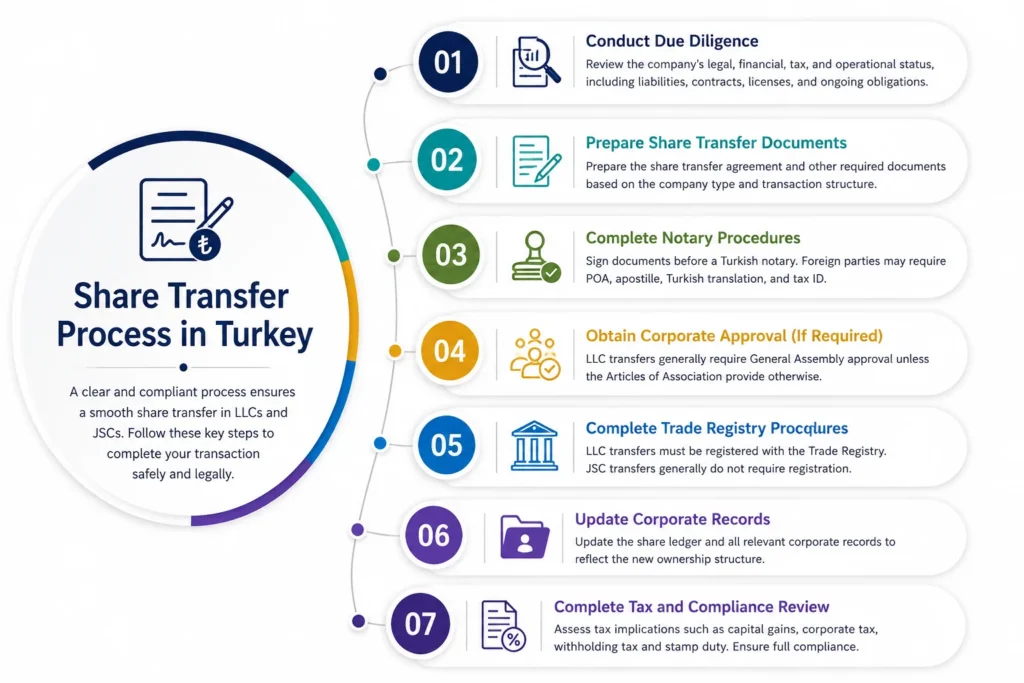
The share transfer process depends on whether the transaction involves an LLC or JSC, but the transaction should generally begin with legal and financial due diligence before any ownership change is completed.
Before acquiring shares, review the company’s:
This is particularly important when acquiring shares in an existing Turkish company, because the buyer acquires an ownership interest in the company together with its existing legal and financial position.
The required documents depend on the company type and transaction structure.
For an LLC, this generally includes a written share transfer agreement with notarized signatures and the required corporate approval.
For a JSC, the documentation depends on whether the shares are registered or bearer shares and whether any contractual or statutory transfer restrictions apply.
Where notarization is legally required, the parties must complete the relevant procedures before a Turkish notary.
Foreign parties may need additional documentation, including:
For an LLC, General Assembly approval is generally required unless the Articles of Association provide otherwise.
For a JSC, General Assembly approval is generally not required for an ordinary share transfer, subject to applicable restrictions.
For an LLC, the approved transfer is generally submitted to the relevant Trade Registry Directorate for registration.
An ordinary JSC share transfer generally does not require registration and announcement with the Trade Registry.
Following completion of the transaction, the company’s share ledger and relevant corporate records should be updated to reflect the new ownership structure.
The parties should assess the transaction’s potential tax consequences, including capital gains, corporate tax, withholding tax, stamp tax, and any applicable double taxation agreement.
The exact tax treatment depends on the parties, share type, holding period, transaction value, and other circumstances.
A&M Consulting Co. can coordinate the share transfer process from due diligence and document preparation through notary, Trade Registry, tax, and corporate record procedures.
The documents required for a share transfer in Turkey depend on the company’s legal structure, the type of shares being transferred, and whether the parties are Turkish or foreign individuals or entities.
A typical Limited Liability Company (LLC) share transfer may require:
For a Joint Stock Company (JSC), the required documentation may include:
Foreign individuals and companies may need additional documents to complete a share acquisition or transfer in Türkiye, including:
The exact documentation should be determined before the transaction begins, particularly where a foreign shareholder, corporate shareholder, or representative is involved. Missing or incorrectly prepared documents can delay notarization, corporate approval, or Trade Registry procedures.
Important: Document requirements can vary depending on the company structure, Articles of Association, share type, transaction structure, and nationality of the parties. A transaction-specific document checklist should therefore be prepared before proceeding.
A share transfer in Türkiye may have tax consequences for both the seller and, in certain circumstances, the buyer. The applicable tax treatment depends on factors such as the legal status of the seller, the type of shares, the holding period, the transfer price, and whether the transaction involves a Turkish or foreign shareholder.
Where shares are sold by an individual, any taxable capital gain should be assessed according to the applicable Turkish income tax rules.
The tax treatment can differ depending on whether the shares are held in an LLC or JSC, the nature of the shares, and how long they have been held.
If the seller is a company or other corporate entity, the gain arising from the share transfer may be subject to corporate tax, subject to applicable exemptions, deductions, and the specific circumstances of the transaction.
Foreign investors should assess the Turkish tax consequences before completing a share transfer. The seller’s country of residence, the applicable Double Taxation Agreement (DTA), the nature of the shares, and the underlying assets of the Turkish company may affect the final tax position.
Depending on the structure and documentation of the transaction, stamp tax, notary fees, Trade Registry fees, and other administrative costs may arise.
These costs should be reviewed before signing the share transfer documents so that the parties have a clear understanding of the total transaction cost.
A share transfer is not automatically subject to VAT simply because consideration is paid for the shares. The VAT treatment depends on the nature of the shares, the seller, and the specific transaction.
For this reason, the VAT position should be assessed on a transaction-by-transaction basis rather than assuming that every share transfer is taxable or exempt.
Tax treatment can become more complex when a non-resident individual or foreign company sells shares in a Turkish company. Before completing the transaction, it is advisable to review:
Tax treatment should be determined before the share transfer is completed. A&M Consulting Co. can review the transaction structure and assess the applicable Turkish tax and compliance requirements for Turkish and foreign shareholders.
Foreign individuals and companies can generally acquire and transfer shares in Turkish companies, allowing them to enter an existing business without establishing a new company from scratch. However, foreign investors may face additional documentation, tax, banking, and compliance requirements depending on the transaction structure.
A foreign investor may acquire shares from an existing shareholder rather than subscribing to newly issued shares. This can provide a faster way to obtain an ownership interest in an established Turkish company.
Before completing the transaction, the investor should review the company’s:
Foreign individuals may generally need:
Foreign corporate shareholders may additionally need corporate registry documents, articles of association, authorized signatory documents, and a corporate resolution approving the transaction.
Although foreign ownership is permitted in many sectors, certain regulated industries may be subject to specific foreign investment restrictions, licensing requirements, or regulatory approvals.
The applicable rules should therefore be checked before signing the share transfer agreement, particularly for businesses operating in regulated sectors.
A foreign investor does not necessarily need to be physically present in Türkiye for every stage of a share transfer. Depending on the transaction, a properly prepared Power of Attorney (POA) may allow an authorized representative to complete certain procedures on the investor’s behalf.
Foreign-issued documents may need to be apostilled or otherwise legalized and translated into Turkish before they can be used in Türkiye.
A foreign company may also acquire shares in a Turkish company. In such cases, additional corporate documentation and verification of the foreign company’s authority to enter into the transaction will generally be required.
The exact requirements depend on the jurisdiction of the foreign company, its corporate structure, the transaction documents, and the Turkish company’s legal structure.
For foreign investors, a share transfer should be treated as both an ownership transaction and a due-diligence exercise. Reviewing the company’s financial, tax, legal, and regulatory position before closing can help identify liabilities that may otherwise remain with the company after the ownership change.
Following an ownership change, foreign shareholders may also need assistance with corporate bank account opening in Turkey and related banking compliance.
Acquiring shares in an existing Turkish company means becoming a shareholder of the company with its existing legal, financial, tax, and operational position. For this reason, due diligence should be completed before signing the share transfer agreement or making the purchase payment.
Review the company’s:
The buyer should also verify:
Existing employment obligations should not be overlooked. The review may include:
The buyer should confirm that the seller is legally entitled to transfer the shares and that there are no undisclosed shareholders, pledges, usufruct rights, restrictions, or other third-party claims affecting the shares.
A share acquisition is different from simply purchasing individual company assets. The company itself continues to exist after the transfer, together with its existing rights and obligations.
Therefore, discovering an undisclosed tax liability, debt, lawsuit, employment claim, or regulatory problem after closing may create significant risks for the new shareholder.
A&M Consulting Co. can coordinate financial, tax, corporate, and compliance due diligence before a share acquisition in Türkiye, helping foreign investors evaluate the company before completing the transaction.
Yes. In many cases, foreign individuals and companies can complete a Turkish company share transfer without being physically present in Türkiye, provided that the required documents and Power of Attorney arrangements are properly prepared.
The exact procedure depends on whether the transaction involves an LLC or JSC, the nationality and legal status of the parties, and whether any additional corporate or regulatory approvals are required.
A foreign shareholder can authorize a representative in Türkiye through a properly prepared Power of Attorney (POA).
The authorized representative may, depending on the scope of the POA:
If the Power of Attorney or other corporate documents are issued abroad, they may need to be:
For foreign corporate shareholders, additional evidence of the company’s legal existence and the authority of the signatory may also be required.
Not necessarily. A properly structured Power of Attorney can significantly simplify the process for foreign investors who cannot travel to Türkiye.
However, not every transaction can automatically be completed remotely. The required documents, corporate approvals, notary procedures, and Trade Registry requirements should be confirmed before the transaction begins.
A&M Consulting Co. can coordinate share transfer procedures in Türkiye on behalf of foreign investors through a properly authorized representative, including document preparation, notarization, corporate approvals, Trade Registry procedures, and related compliance.
The time required to complete a share transfer in Turkey depends on the company type, transaction structure, document readiness, and whether corporate approval or Trade Registry procedures are required.
For a straightforward transaction with complete documentation:
The transaction may take longer when:
A straightforward transaction may be completed within several business days when all documents are properly prepared and no additional approval or due-diligence issues arise.
However, it is not advisable to guarantee a fixed completion period before reviewing the company and transaction structure.
A&M Consulting Co. can review your transaction in advance and provide a practical timeline based on the company type, shareholders, documentation, and required procedures.
As of 1 January 2026, newly established companies in Türkiye are subject to mandatory electronic record-keeping under the Electronic Commercial Books System (ETDS) for certain corporate books, including the Share Ledger and General Assembly Meeting and Negotiation Book.
This development is particularly relevant to companies completing ownership changes or establishing a new shareholder structure.
The share ledger records the company’s shareholders and their ownership interests. Following a share transfer, the company’s records must accurately reflect the new shareholder structure.
For companies subject to ETDS requirements, the relevant records are maintained electronically through the prescribed system.
When completing a share transfer, the company’s corporate records should be reviewed and updated consistently with the transaction documents.
This helps ensure that:
The ETDS requirement represents an important change in Turkish corporate record-keeping and should be considered when establishing a new company or restructuring an existing company’s ownership.
A&M Consulting Co. can assist with reviewing and updating the relevant corporate records as part of a Turkish company share transfer, including coordination of the required corporate and compliance procedures.
Transferring shares in a Turkish company involves more than preparing a share transfer agreement. Depending on the transaction, the process may require due diligence, notarization, General Assembly approval, Trade Registry procedures, tax assessment, corporate record updates, and additional documentation for foreign shareholders.
A&M Consulting Co. provides end-to-end support for both LLC and JSC share transfers in Türkiye, helping local and international investors complete the transaction in accordance with applicable Turkish corporate and tax requirements.
We can coordinate the transaction remotely where a properly executed Power of Attorney is available, reducing the need for foreign shareholders to travel to Türkiye for every stage of the process.
Our team can also coordinate the share transfer with the company’s accounting, tax, banking, and ongoing compliance requirements.
Whether you are acquiring shares in an existing Turkish company, transferring your ownership to another shareholder, or restructuring your company’s ownership, A&M Consulting Co. can manage the relevant procedures from start to completion.
Yes. Foreign individuals and companies can generally acquire shares in Turkish companies, subject to applicable sector-specific restrictions and regulatory requirements.
Yes. Foreign shareholders can generally transfer their shares to another individual or legal entity, provided that the applicable corporate and legal procedures are completed.
For an LLC share transfer, the share transfer agreement generally requires notarized signatures. JSC share transfers are subject to different formalities depending on the type of shares and transaction structure.
Generally, yes. Unless the company’s Articles of Association provide otherwise, an LLC share transfer requires General Assembly approval.
Generally, no. JSC shares are more freely transferable, although restrictions may apply under the Articles of Association or applicable legislation.
For an LLC, the share transfer generally needs to be registered with the relevant Trade Registry. An ordinary JSC share transfer generally does not require Trade Registry registration and announcement.
Yes. In many cases, foreign shareholders can authorize a representative in Türkiye through a properly prepared Power of Attorney to complete the relevant procedures.
Yes. A properly drafted and executed Power of Attorney can allow an authorized representative to handle relevant notary, corporate, Trade Registry, and administrative procedures.
The documents depend on the company type and transaction. They may include a share transfer agreement, General Assembly resolution, identification documents, corporate documents, share records, Power of Attorney, and Trade Registry documents.
Foreign-issued documents may need to be apostilled or legalized and translated into Turkish before they can be used in Türkiye. The exact requirements depend on the document and issuing country.
A straightforward transaction with complete documentation may be completed within several business days. The actual timeline depends on the company structure, required approvals, document preparation, and Trade Registry procedures.
A share transfer may have tax consequences. The applicable treatment depends on factors including the seller’s legal status, share type, holding period, transaction value, and tax residency.
Not automatically. The VAT treatment depends on the nature of the shares, the seller, and the specific transaction structure.
Yes. Before acquiring an existing Turkish company, it is advisable to review its tax liabilities, debts, SGK obligations, litigation, contracts, licences, bank liabilities, assets, and corporate records.
Yes. Acquiring shares in an existing Turkish company can provide an alternative to establishing a new entity. However, comprehensive due diligence should be completed before the transaction.
Foreign ownership is generally permitted in many sectors, but certain regulated industries may have specific ownership restrictions, licensing requirements, or regulatory approval requirements.
The company itself continues to exist after the share transfer. Therefore, its existing rights, obligations, debts, contracts, and liabilities generally remain with the company unless otherwise provided by law or the relevant contractual arrangements.
Yes. A foreign legal entity can generally acquire shares in a Turkish company, subject to the applicable corporate documentation, tax, regulatory, and sector-specific requirements.
Not necessarily. Where the transaction can legally be completed through an authorized representative, a properly prepared Power of Attorney may allow the foreign shareholder to complete the relevant procedures remotely.
Yes. A&M Consulting Co. can assist with due diligence, document preparation, notarization, General Assembly procedures, Trade Registry applications, foreign shareholder documentation, tax assessment, and corporate record updates.
Share transfers in Turkey can involve different legal, tax, and corporate requirements depending on the company structure and transaction.
If you are unsure about the required documents, General Assembly approval, Trade Registry procedures, taxation, or how to complete the transfer as a foreign investor, our team can help.
Have a specific question about your share transfer? Contact A&M Consulting Co. for professional guidance based on your transaction.
Planning to acquire, sell, or transfer shares in a Turkish company?
A&M Consulting Co. provides end-to-end support for LLC and JSC share transfers, helping Turkish and foreign investors manage the legal, corporate, tax, and administrative procedures involved in the transaction.
Whether you are acquiring an existing Turkish company, restructuring your ownership, or transferring shares to a foreign investor, our team can coordinate the process from due diligence and document preparation through completion of the share transfer and corporate record updates.
Contact A&M Consulting Co. to discuss your transaction and receive guidance based on your company’s structure and specific circumstances.
Abdullah Mercanlı is the Co-Founder of A&M Consulting Co. and has more than 20 years of professional experience in accounting, taxation, finance, payroll, and social security. He supports international businesses and foreign investors with tax compliance, company formation, and business operations in Turkey.
Registered member of ISMMMO · Registration No. 50555



WhatsApp Us