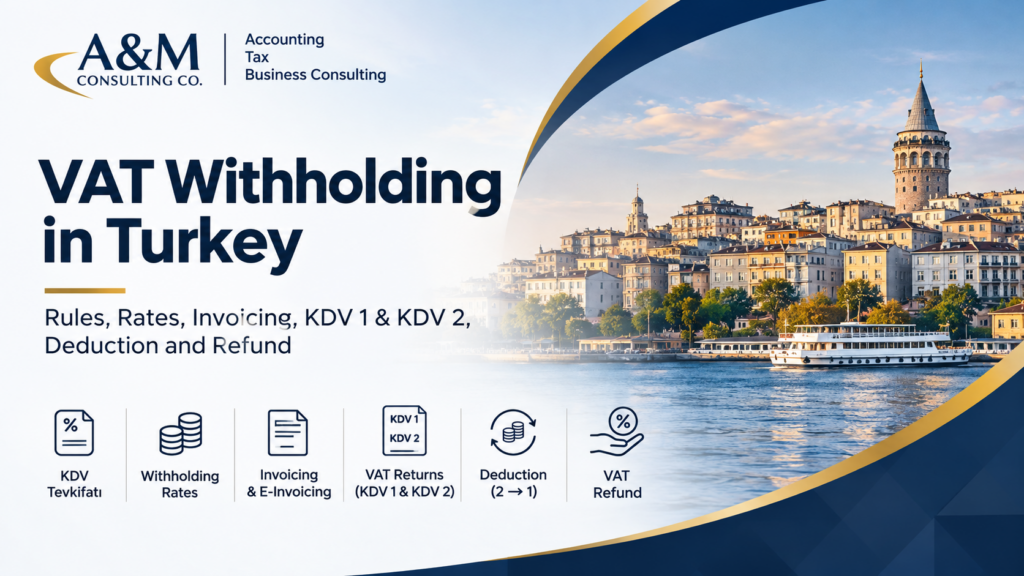
VAT Withholding in Turkey
VAT Withholding in Turkey: Rules, Rates and Tax Compliance
VAT withholding in Turkey (known as KDV Tevkifatı in Turkish) is a tax collection mechanism under which the responsibility for declaring and paying all or part of the Value Added Tax (VAT) arising from certain taxable transactions is transferred from the supplier to the purchaser or service recipient.
The legal basis for VAT withholding in Turkey is established under Article 9 of Turkish VAT Law No. 3065, which authorizes the Ministry of Treasury and Finance to designate parties involved in taxable transactions as responsible for declaring and paying VAT in order to secure tax collection. The detailed rules governing full and partial VAT withholding, including the relevant transactions, responsible parties and applicable withholding ratios, are set out in the VAT General Implementation Communiqué, particularly Sections I/C-2.1.2 and I/C-2.1.3.
Under the standard VAT system, the supplier is responsible for charging VAT on the invoice, collecting it from the customer, and declaring the tax to the Turkish tax authorities through its VAT return.
However, under the VAT withholding mechanism, this responsibility is shared between the supplier and the recipient, or transferred entirely to the recipient, depending on the nature of the transaction and the applicable withholding rules.
In practice, the recipient withholds the relevant portion of the VAT from the payment due to the supplier and declares and pays that amount directly to the Turkish tax office as a responsible party. The supplier remains responsible for declaring the portion of VAT that has not been withheld, where applicable.
The primary purpose of VAT withholding is to secure VAT collection, strengthen tax compliance, reduce tax evasion risks and ensure that VAT liabilities arising from certain transactions are properly reported and paid to the tax authorities.
VAT withholding is particularly relevant to businesses operating in sectors such as construction, engineering, consulting, transportation, maintenance and repair, labour procurement, catering and various other commercial services.
How Does VAT Withholding Work?
Under the Turkish VAT withholding system, the process generally involves the following steps:
The supplier issues an invoice: The supplier issues an invoice showing the taxable transaction, the applicable VAT rate, the calculated VAT amount and the relevant withholding ratio.
The recipient withholds the applicable VAT: The recipient deducts the withholding portion of the VAT from the amount payable to the supplier.
The recipient declares and pays the withheld VAT: The withheld amount is declared to the Turkish tax office through VAT Return No. 2 (KDV 2 Beyannamesi) and paid within the applicable statutory deadline.
The supplier declares the remaining VAT: Where partial VAT withholding applies, the supplier declares the non-withheld portion through VAT Return No. 1 (KDV 1 Beyannamesi).
The applicable procedure depends on whether the transaction falls within the scope of full or partial VAT withholding.
It is important to note that VAT withholding does not reduce the applicable VAT rate or the total VAT calculated on the transaction. It changes the party responsible for declaring and paying the relevant portion of the tax.
Businesses operating in Turkey must therefore assess the nature of each transaction, the status of the parties involved and the applicable provisions of Turkish VAT legislation before issuing or processing an invoice subject to withholding.
VAT withholding is one of the mechanisms within the Turkish VAT system. To understand how it interacts with standard VAT rates, VAT returns, reverse charge procedures and other tax obligations, see our comprehensive guide to VAT in Turkey.
Full and Partial VAT Withholding in Turkey
Under Turkish VAT legislation, VAT withholding is divided into two main categories: Full VAT Withholding (Tam Tevkifat) and Partial VAT Withholding (Kısmi Tevkifat).
The distinction between these two mechanisms depends on the proportion of VAT that the purchaser or service recipient is required to withhold and declare to the Turkish tax authorities.
While full withholding transfers the entire VAT declaration and payment responsibility to the recipient, partial withholding divides this responsibility between the supplier and the recipient.
Both mechanisms are regulated under the VAT General Implementation Communiqué and must be applied in accordance with the specific conditions established for each transaction.
Full VAT Withholding (Tam Tevkifat)
Full VAT withholding applies when the entire VAT calculated on a taxable transaction must be withheld by the recipient and declared to the Turkish tax authorities under the recipient’s tax responsibility.
Under this mechanism, the supplier does not collect the VAT amount from the customer. Instead, the recipient assumes responsibility for declaring and paying 100% of the calculated VAT through VAT Return No. 2 (KDV 2 Beyannamesi).
Full VAT withholding is particularly relevant in the following situations:
Services received from non-resident suppliers: Where a service is supplied by a person or company that does not have a residence, business establishment, legal headquarters or business centre in Turkey, and the service is subject to Turkish VAT because it is used or consumed in Turkey, the recipient may be required to account for the entire VAT under the reverse charge mechanism.
Specific transactions designated under Turkish VAT legislation: Certain domestic transactions are also subject to full withholding where the conditions prescribed by the VAT General Implementation Communiqué are met.
For example, consider a Turkish company purchasing consulting services from a foreign company with no business establishment in Turkey. If the service is subject to Turkish VAT because it is used in Turkey, the Turkish company is generally responsible for calculating, declaring and paying the entire VAT.
It is important to distinguish between services supplied by non-resident businesses and services supplied by Turkish VAT-registered businesses. The applicable VAT treatment depends on the supplier’s status, the nature of the service and the place where the service is used or consumed.
Partial VAT Withholding (Kısmi Tevkifat)
Partial VAT withholding applies when only a specified portion of the VAT calculated on a transaction is withheld by the recipient. The remaining portion is declared by the supplier through its own VAT return.
Unlike full withholding, partial withholding does not transfer the entire VAT liability to the purchaser.
The VAT General Implementation Communiqué identifies the specific goods and services subject to partial withholding and determines the applicable withholding ratios for each category.
Common examples of transactions that may fall within the scope of partial VAT withholding include:
Construction works and related engineering, architectural and surveying services.
Consultancy, inspection, planning and project services.
Maintenance, repair and modification services for machinery, equipment and vehicles.
Labour supply services.
Catering and event organisation services.
Private security and protection services.
Cleaning and environmental maintenance services.
Transportation services.
Printing and publishing services.
Certain deliveries of metal products, scrap materials and recyclable goods.
The application of VAT withholding depends not only on the type of transaction but also on whether the purchaser falls within the category of recipients designated under the relevant provisions of Turkish VAT legislation.
For this reason, businesses should verify both the nature of the transaction and the purchaser’s status before applying a withholding ratio.
Key Differences Between Full and Partial VAT Withholding
The following table summarises the main differences between the two withholding mechanisms:
| Criteria | Full VAT Withholding | Partial VAT Withholding |
|---|---|---|
| Withholding ratio | 10/10 (100%) | Specified partial ratio |
| VAT declared by recipient | Entire VAT amount | Withheld portion |
| VAT declared by supplier | No VAT remains to be declared for the withheld amount | Non-withheld portion |
| Recipient’s VAT return | VAT Return No. 2 | VAT Return No. 2 |
| Supplier’s VAT return | No corresponding VAT amount remains to be declared | VAT Return No. 1 |
| Application | Transactions specifically designated under the legislation | Specified goods and services subject to withholding |
Important: VAT withholding cannot be applied solely based on an agreement between the supplier and the purchaser. The transaction must fall within the scope of the relevant provisions of Turkish VAT legislation. The parties must also comply with the applicable conditions and reporting requirements.
Full and Partial VAT Withholding in Turkey
Under Turkish VAT legislation, VAT withholding is divided into two main categories: Full VAT Withholding (Tam Tevkifat) and Partial VAT Withholding (Kısmi Tevkifat).
The distinction between these two mechanisms depends on the proportion of VAT that the purchaser or service recipient is required to withhold and declare to the Turkish tax authorities.
While full withholding transfers the entire VAT declaration and payment responsibility to the recipient, partial withholding divides this responsibility between the supplier and the recipient.
Both mechanisms are regulated under the VAT General Implementation Communiqué and must be applied in accordance with the specific conditions established for each transaction.
Full VAT Withholding (Tam Tevkifat)
Full VAT withholding applies when the entire VAT calculated on a taxable transaction must be withheld by the recipient and declared to the Turkish tax authorities under the recipient’s tax responsibility.
Under this mechanism, the supplier does not collect the VAT amount from the customer. Instead, the recipient assumes responsibility for declaring and paying 100% of the calculated VAT through VAT Return No. 2 (KDV 2 Beyannamesi).
Full VAT withholding is particularly relevant in the following situations:
Services received from non-resident suppliers: Where a service is supplied by a person or company that does not have a residence, business establishment, legal headquarters or business centre in Turkey, and the service is subject to Turkish VAT because it is used or consumed in Turkey, the recipient may be required to account for the entire VAT under the reverse charge mechanism.
Specific transactions designated under Turkish VAT legislation: Certain domestic transactions are also subject to full withholding where the conditions prescribed by the VAT General Implementation Communiqué are met.
For example, consider a Turkish company purchasing consulting services from a foreign company with no business establishment in Turkey. If the service is subject to Turkish VAT because it is used in Turkey, the Turkish company is generally responsible for calculating, declaring and paying the entire VAT.
It is important to distinguish between services supplied by non-resident businesses and services supplied by Turkish VAT-registered businesses. The applicable VAT treatment depends on the supplier’s status, the nature of the service and the place where the service is used or consumed.
Partial VAT Withholding (Kısmi Tevkifat)
Partial VAT withholding applies when only a specified portion of the VAT calculated on a transaction is withheld by the recipient. The remaining portion is declared by the supplier through its own VAT return.
Unlike full withholding, partial withholding does not transfer the entire VAT liability to the purchaser.
The VAT General Implementation Communiqué identifies the specific goods and services subject to partial withholding and determines the applicable withholding ratios for each category.
Common examples of transactions that may fall within the scope of partial VAT withholding include:
Construction works and related engineering, architectural and surveying services.
Consultancy, inspection, planning and project services.
Maintenance, repair and modification services for machinery, equipment and vehicles.
Labour supply services.
Catering and event organisation services.
Private security and protection services.
Cleaning and environmental maintenance services.
Transportation services.
Printing and publishing services.
Certain deliveries of metal products, scrap materials and recyclable goods.
The application of VAT withholding depends not only on the type of transaction but also on whether the purchaser falls within the category of recipients designated under the relevant provisions of Turkish VAT legislation.
For this reason, businesses should verify both the nature of the transaction and the purchaser’s status before applying a withholding ratio.
Key Differences Between Full and Partial VAT Withholding
The following table summarises the main differences between the two withholding mechanisms:
| Criteria | Full VAT Withholding | Partial VAT Withholding |
|---|---|---|
| Withholding ratio | 10/10 (100%) | Specified partial ratio |
| VAT declared by recipient | Entire VAT amount | Withheld portion |
| VAT declared by supplier | No VAT remains to be declared for the withheld amount | Non-withheld portion |
| Recipient’s VAT return | VAT Return No. 2 | VAT Return No. 2 |
| Supplier’s VAT return | No corresponding VAT amount remains to be declared | VAT Return No. 1 |
| Application | Transactions specifically designated under the legislation | Specified goods and services subject to withholding |
Important: VAT withholding cannot be applied solely based on an agreement between the supplier and the purchaser. The transaction must fall within the scope of the relevant provisions of Turkish VAT legislation. The parties must also comply with the applicable conditions and reporting requirements.
Transactions Subject to VAT Withholding in Turkey
Under Turkish VAT legislation, VAT withholding applies only to specific goods deliveries and services identified in the VAT General Implementation Communiqué. The application of withholding depends on the nature of the transaction, the status of the supplier and, in many cases, the legal status of the purchaser.
Not every commercial transaction or service provided in Turkey is subject to VAT withholding. Businesses must therefore determine whether a transaction falls within the legally prescribed categories before applying a withholding ratio.
The transactions subject to partial VAT withholding are principally classified into two groups: services subject to withholding and goods deliveries subject to withholding.
Services Subject to VAT Withholding
The VAT General Implementation Communiqué identifies several service categories for which partial VAT withholding may apply.
The principal categories include the following:
1. Construction Works and Related Engineering Services
Construction works and services performed in connection with construction projects may be subject to VAT withholding.
This category includes qualifying construction activities as well as related engineering, architectural, surveying and project services, provided that the relevant statutory conditions are satisfied.
The scope of withholding depends on the nature of the work, the contractual arrangement and the status of the recipient.
2. Consultancy, Inspection, Planning and Project Services
Certain professional and technical services are subject to VAT withholding, including:
Consultancy services.
Engineering and architectural project services.
Technical inspection and supervision.
Planning and project development services.
Similar professional services falling within the scope of the Communiqué.
The classification of the service is important because not every professional or consultancy service automatically qualifies for withholding.
3. Maintenance, Repair and Modification Services
Maintenance, repair, modification and similar services relating to machinery, equipment, fixed assets and vehicles may be subject to VAT withholding.
These services are particularly relevant to manufacturing companies, industrial facilities, logistics businesses and commercial enterprises that outsource technical maintenance activities.
4. Labour Supply Services
Labour supply services are subject to specific VAT withholding rules.
This category generally covers arrangements in which personnel are supplied to another business to perform work under the recipient’s operational direction and supervision.
The distinction between labour supply and an independently performed service is important. A contract described as outsourcing or consultancy does not automatically determine its VAT treatment. The actual nature of the arrangement must be assessed.
5. Catering and Meal Services
Certain catering and meal services provided to businesses and other designated recipients fall within the scope of VAT withholding.
The application of withholding depends on the nature of the service and the recipient’s status under the Communiqué.
6. Private Security and Protection Services
Services involving private security, guarding and protection activities may be subject to VAT withholding when the relevant statutory conditions are met.
These rules are particularly relevant to companies outsourcing security services for offices, commercial buildings, factories and other facilities.
7. Cleaning and Environmental Maintenance Services
Cleaning services and specified environmental or garden maintenance services may also be subject to partial VAT withholding.
Examples include:
Cleaning of offices and commercial buildings.
Cleaning of industrial facilities.
Specified environmental maintenance services.
Garden and landscape maintenance services.
The applicable withholding treatment depends on the precise service category and the recipient’s qualification.
8. Transportation Services
Certain transportation services, including specified passenger shuttle transportation and road freight transportation services, are subject to VAT withholding.
Businesses purchasing transportation services should assess the nature of the transportation activity, the contractual arrangement and the applicable statutory conditions.
9. Printing and Publishing Services
Specified printing and publishing services may be subject to VAT withholding.
These rules may apply to qualifying printing activities, including the production of printed materials and similar services falling within the scope of the Communiqué.
10. Advertising and Commercial Promotion Services
Certain advertising services are also included within the VAT withholding framework.
Businesses purchasing advertising services should distinguish between the relevant advertising service categories and other services such as advertising space, digital platform subscriptions, software services and services supplied by non-resident providers. Their VAT treatment may differ depending on the underlying transaction.
Goods Deliveries Subject to VAT Withholding
In addition to services, certain goods deliveries are subject to partial VAT withholding under Turkish legislation.
These provisions primarily concern specific raw materials, industrial products, recyclable materials and goods traded in sectors where VAT collection risks require additional controls.
The principal categories include:
1. Scrap and Waste Materials
Certain deliveries of scrap and waste materials are subject to VAT withholding.
These may include specified scrap and waste materials derived from:
Iron and steel.
Copper and aluminium.
Plastic and rubber.
Paper and cardboard.
Glass.
The VAT treatment depends on the statutory definition of the goods and whether the relevant VAT exemption or withholding provisions apply.
2. Metal Products
Certain deliveries of metal products are subject to withholding, including specified products made from copper, zinc, aluminium, lead and iron or steel.
The applicable rules may differ depending on whether the goods are supplied by an importer or original producer, or through subsequent commercial transactions.
3. Agricultural and Animal-Origin Products
Specified deliveries of agricultural and animal-origin products, including cotton, wool, mohair, raw hides and leather, may fall within the scope of VAT withholding.
The supplier’s tax status and the applicable VAT exemption provisions must also be considered when determining the correct treatment.
4. Timber and Forestry Products
Certain deliveries of timber and forestry products are subject to VAT withholding under the conditions specified in the VAT General Implementation Communiqué.
Why the Nature of the Transaction Matters
Correctly identifying the nature of a transaction is essential when determining whether VAT withholding applies.
For example, a company purchasing engineering services as part of a construction project may be subject to different withholding rules depending on whether the service constitutes an integral part of the construction work or represents a separate consultancy or project service.
Similarly, an agreement involving the provision of personnel may constitute a labour supply service rather than an independently performed outsourced service.
Businesses should therefore evaluate the actual commercial substance of each transaction rather than relying exclusively on invoice descriptions, contract titles or accounting classifications.
The relevant provisions of the VAT General Implementation Communiqué, particularly Sections I/C-2.1.3.2 and I/C-2.1.3.3, should be consulted to determine the applicable withholding requirements.
Transactions Excluded from VAT Withholding
Not every transaction involving goods or services listed in the Communiqué is automatically subject to withholding.
Certain transactions may fall outside the withholding mechanism because of statutory exemptions, specific exclusions or the legal status of the parties.
For example:
Transactions exempt from VAT under the relevant provisions of Turkish VAT Law generally do not give rise to VAT withholding because no VAT is calculated.
Certain deliveries made by original producers or importers may be excluded from specific goods-withholding provisions.
Transactions below the applicable statutory threshold may not require partial withholding.
Certain transactions between parties that do not meet the recipient conditions specified in the Communiqué may fall outside the relevant withholding rules.
Accordingly, determining the correct VAT treatment requires an assessment of the transaction type, the supplier’s status, the purchaser’s status and any applicable exemptions or exceptions.
Businesses operating in Turkey should review these conditions before processing invoices to ensure that VAT withholding is applied correctly and consistently.
Who Is Required to Apply VAT Withholding in Turkey?
Under Turkish VAT legislation, the obligation to apply VAT withholding depends on the type of transaction and the legal status of the purchaser or service recipient.
Not every business registered for VAT in Turkey is automatically required to apply withholding to every purchase. The VAT General Implementation Communiqué distinguishes between specifically designated purchasers and other VAT-taxable businesses, depending on the category of goods or services involved.
Understanding this distinction is essential for businesses to determine whether they must withhold VAT when purchasing goods or services.
Designated Purchasers (Belirlenmiş Alıcılar)
Certain public institutions, organisations and businesses are classified as designated purchasers under the Turkish VAT General Implementation Communiqué.
These entities are required to apply VAT withholding to specified transactions when the relevant statutory conditions are satisfied.
Designated purchasers generally include:
Public administrations and public institutions.
Provincial special administrations and municipalities.
Universities and other public organisations.
State economic enterprises.
Banks and insurance companies.
Publicly established organisations and other entities specifically listed in the Communiqué.
Certain public and private organisations operating under special statutory arrangements.
The complete list and applicable conditions are set out in Section I/C-2.1.3.1 of the VAT General Implementation Communiqué.
Being classified as a designated purchaser does not mean that an organisation must withhold VAT on every purchase. The withholding obligation applies only to transactions covered by the relevant provisions.
Other VAT-Registered Businesses
Certain partial VAT withholding transactions are not restricted to designated purchasers.
Depending on the transaction category, other businesses and entities registered for VAT in Turkey may also be required to apply withholding when purchasing specified goods or services.
For example, certain consultancy, labour supply, maintenance and repair services may be subject to withholding when supplied to qualifying VAT-taxable businesses, even if those businesses are not public institutions or designated purchasers.
Therefore, the purchaser must examine the specific transaction category rather than assume that VAT withholding applies only to public institutions.
Are Foreign-Owned Companies Required to Apply VAT Withholding?
Yes. Companies established in Turkey with foreign shareholders are generally subject to the same Turkish VAT legislation as domestically owned companies.
Foreign ownership does not, by itself, create an exemption from VAT withholding obligations.
A Turkish company with foreign shareholders may therefore be required to apply VAT withholding when purchasing goods or services falling within the scope of the relevant provisions.
For example, a Turkish subsidiary of an international group purchasing qualifying consultancy, construction or labour supply services may have to withhold the applicable portion of VAT and declare it through VAT Return No. 2.
Similarly, a Turkish company purchasing services from a non-resident foreign supplier may be required to account for the entire VAT under the reverse charge mechanism if the service is subject to Turkish VAT.
Responsibilities of the Purchaser and Supplier
Both parties involved in a transaction subject to VAT withholding have specific tax and invoicing responsibilities.
Purchaser’s responsibilities:
Determine whether the transaction is subject to VAT withholding.
Verify the applicable withholding ratio.
Ensure that the invoice reflects the correct VAT and withholding amounts.
Declare the withheld VAT through VAT Return No. 2.
Pay the declared VAT within the applicable statutory deadline.
Maintain the relevant accounting records and supporting documents.
Supplier’s responsibilities:
Determine the correct VAT treatment of the transaction.
Issue an invoice in accordance with Turkish invoicing requirements.
Apply the relevant withholding ratio where applicable.
Declare the non-withheld portion of VAT through VAT Return No. 1 in partial withholding transactions.
Maintain supporting documentation and accounting records.
Failure to fulfil these responsibilities may result in tax assessments, tax loss penalties, late payment interest and other consequences under Turkish tax legislation.
Key Considerations for Businesses Operating in Turkey
Businesses should establish appropriate internal tax compliance procedures to identify transactions subject to VAT withholding.
In particular, finance and accounting departments should verify the following before processing supplier invoices:
Whether the transaction falls within a category subject to VAT withholding.
Whether the purchaser qualifies as a designated purchaser or another qualifying VAT-taxable recipient.
Whether the applicable transaction threshold has been exceeded.
Which withholding ratio applies.
Whether the transaction is subject to full or partial withholding.
Whether the supplier’s invoice and VAT return treatment are consistent with the applicable legislation.
A systematic review of these factors helps businesses avoid incorrect VAT treatment and potential tax compliance risks.
VAT Withholding Thresholds and Application Conditions in Turkey
Under Turkish VAT legislation, partial VAT withholding is subject to a minimum transaction threshold. This threshold determines whether a transaction falling within the scope of partial VAT withholding must be processed with withholding or invoiced under the standard VAT procedure.
The applicable threshold is linked to the annual invoice issuance limit determined under Article 232 of Tax Procedure Law No. 213 (Vergi Usul Kanunu).
VAT Withholding Threshold for 2026
For 2026, the applicable threshold for partial VAT withholding is TRY 12,000, including VAT.
Accordingly:
If the VAT-inclusive amount of an individual transaction does not exceed TRY 12,000, partial VAT withholding is not required.
If the VAT-inclusive amount exceeds TRY 12,000, the applicable withholding ratio must be applied to the entire VAT amount calculated on the transaction.
The threshold is not applied separately to the taxable base and the VAT amount. The total transaction value, including VAT, is taken into consideration.
The threshold applies to partial VAT withholding transactions. It should not be confused with the rules governing full VAT withholding, which are subject to separate provisions.
How Is the Threshold Applied?
The following examples illustrate how the threshold works in practice.
Transaction (Including VAT) | VAT Withholding Requirement |
|---|---|
TRY 8,000 | No withholding |
TRY 12,000 | No withholding |
TRY 12,001 | Withholding applies to the entire VAT amount |
TRY 25,000 | Withholding applies to the entire VAT amount |
TRY 100,000 | Withholding applies to the entire VAT amount |
For example, assume that a Turkish company purchases a consulting service for TRY 10,500 plus 20% VAT.
The total invoice amount is TRY 12,600, exceeding the TRY 12,000 threshold applicable in 2026.
If the transaction is subject to a 9/10 VAT withholding ratio and the purchaser meets the relevant withholding conditions, the purchaser must withhold 90% of the calculated VAT.
Importantly, withholding is calculated on the entire VAT amount, not merely on the portion exceeding the threshold.
Can a Transaction Be Divided into Multiple Invoices to Avoid VAT Withholding?
No. Turkish VAT legislation does not allow businesses to divide a transaction artificially to avoid VAT withholding obligations.
Where a single transaction exceeds the applicable threshold, its total value must be considered, even if the supplier issues multiple invoices or documents.
For example, if a service contract has a total value of TRY 50,000 excluding VAT, the supplier cannot avoid withholding by issuing five separate invoices of TRY 10,000 each for the same transaction.
If the tax authorities determine that invoices have been artificially divided to circumvent the withholding requirement, they may assess the transaction as a whole and apply the relevant tax provisions.
Businesses should therefore distinguish between genuinely separate commercial transactions and instalments or invoice divisions relating to a single underlying transaction.
Transactions Exempt from VAT Withholding
Certain transactions are excluded from VAT withholding under Turkish legislation.
For example:
Transactions exempt from VAT under the relevant provisions of Law No. 3065 generally do not give rise to VAT withholding because no VAT is calculated.
Deliveries made under the VAT exemption provisions of Article 11/1-c and Provisional Article 17 are excluded from withholding.
Certain transactions carried out by designated purchasers are subject to specific exclusions under the VAT General Implementation Communiqué.
These exclusions must be evaluated according to the legal nature of the transaction and the applicable provisions.
Annual Changes to the VAT Withholding Threshold
Because the partial VAT withholding threshold is linked to the annual invoice issuance limit under Article 232 of Tax Procedure Law No. 213, it may change from one calendar year to another.
Businesses operating in Turkey should therefore review the applicable threshold annually when updating their accounting procedures, invoicing systems and tax compliance controls.
The 2026 threshold of TRY 12,000 is based on the invoice issuance limit announced under Tax Procedure Law General Communiqué No. 588, published on 31 December 2025.
How to Calculate VAT Withholding in Turkey? (Practical Examples)
Calculating VAT withholding in Turkey requires identifying the applicable VAT rate and withholding ratio for the transaction. The withholding ratio is applied to the total VAT amount calculated on the taxable transaction, rather than directly to the invoice’s net value.
Under the Turkish VAT system, the supplier calculates VAT on the transaction value and shows the relevant withholding ratio and amount on the invoice. The purchaser deducts the withheld portion from the amount payable to the supplier and declares it to the tax authorities through VAT Return No. 2 (KDV 2 Beyannamesi).
The remaining VAT, where applicable, is collected by the supplier and declared through VAT Return No. 1 (KDV 1 Beyannamesi).
The following examples illustrate how VAT withholding is calculated in practice.
Example of 5/10 VAT Withholding
Assume that a Turkish company purchases a service subject to a 5/10 VAT withholding ratio.
The service value is TRY 100,000, excluding VAT, and the applicable VAT rate is 20%.
Description | Amount |
|---|---|
Service value (excluding VAT) | TRY 100,000 |
VAT rate | 20% |
Calculated VAT | TRY 20,000 |
Total invoice amount | TRY 120,000 |
VAT withholding ratio | 5/10 |
VAT withheld by purchaser | TRY 10,000 |
VAT collected by supplier | TRY 10,000 |
Total amount payable to supplier | TRY 110,000 |
In this example, the purchaser withholds TRY 10,000, representing 50% of the calculated VAT, and declares this amount through VAT Return No. 2.
The supplier collects the remaining TRY 10,000 in VAT and declares it through VAT Return No. 1.
Example of 7/10 VAT Withholding
Assume that a company purchases a qualifying maintenance and repair service subject to a 7/10 VAT withholding ratio.
The service value is TRY 100,000, excluding VAT, and the applicable VAT rate is 20%.
Description | Amount |
|---|---|
Service value (excluding VAT) | TRY 100,000 |
VAT rate | 20% |
Calculated VAT | TRY 20,000 |
Total invoice amount | TRY 120,000 |
VAT withholding ratio | 7/10 |
VAT withheld by purchaser | TRY 14,000 |
VAT collected by supplier | TRY 6,000 |
Total amount payable to supplier | TRY 106,000 |
Here, the purchaser is responsible for declaring and paying TRY 14,000 to the Turkish tax authorities, while the supplier collects the remaining TRY 6,000 in VAT.
Example of 9/10 VAT Withholding
Certain consultancy, labour supply, cleaning and other specified services may be subject to a 9/10 VAT withholding ratio when the applicable statutory conditions are met.
Assume that a company purchases a qualifying service for TRY 100,000, excluding VAT, with a VAT rate of 20%.
Description | Amount |
|---|---|
Service value (excluding VAT) | TRY 100,000 |
VAT rate | 20% |
Calculated VAT | TRY 20,000 |
Total invoice amount | TRY 120,000 |
VAT withholding ratio | 9/10 |
VAT withheld by purchaser | TRY 18,000 |
VAT collected by supplier | TRY 2,000 |
Total amount payable to supplier | TRY 102,000 |
In this case, the purchaser declares TRY 18,000 through VAT Return No. 2, while the supplier declares the remaining TRY 2,000 through VAT Return No. 1.
Example of Full VAT Withholding (10/10)
Under full VAT withholding, the entire VAT amount is declared and paid by the recipient.
For example, assume that a Turkish company receives consulting services from a foreign supplier that has no business establishment in Turkey. The service is subject to Turkish VAT because it is used in Turkey.
The service value is TRY 100,000, and the applicable VAT rate is 20%.
Description | Amount |
|---|---|
Service value | TRY 100,000 |
VAT rate | 20% |
Calculated VAT | TRY 20,000 |
VAT withholding ratio | 10/10 |
VAT declared by recipient | TRY 20,000 |
VAT payable to supplier | TRY 100,000 |
The Turkish recipient declares the entire TRY 20,000 VAT amount through VAT Return No. 2. No VAT amount is collected by the foreign supplier under this reverse charge mechanism.
General Formula for Calculating VAT Withholding
Businesses can use the following formulas to calculate VAT withholding:
Calculated VAT: Taxable transaction value × Applicable VAT rate
Withheld VAT: Calculated VAT × Withholding ratio
VAT collected by supplier: Calculated VAT − Withheld VAT
Amount payable to supplier: Taxable transaction value + VAT collected by supplier
These calculations help businesses determine the correct payment amount and distinguish between the VAT payable to the supplier and the VAT payable to the tax authorities.
Important Considerations When Calculating VAT Withholding
When calculating VAT withholding in Turkey, businesses should pay attention to the following points:
The correct VAT rate must be determined according to the nature of the goods or services.
The applicable withholding ratio must be verified under the VAT General Implementation Communiqué.
The withholding ratio is applied to the calculated VAT amount, not the taxable transaction value.
The applicable transaction threshold must be checked before applying partial VAT withholding.
Both the purchaser and supplier must ensure that their VAT returns accurately reflect the transaction.
The invoice must separately indicate the calculated VAT, withholding ratio, withheld VAT amount and remaining amount payable.
Correct VAT withholding calculations are essential for maintaining accurate accounting records, preventing tax reporting discrepancies and ensuring compliance with Turkish VAT regulations.
Legal basis: Article 9 of VAT Law No. 3065 and Sections I/C-2.1.2 and I/C-2.1.3 of the VAT General Implementation Communiqué. The invoice presentation requirements are also addressed in Section I/C-2.1.3.4.2.
VAT Withholding Invoices and E-Invoicing Requirements in Turkey
Businesses subject to VAT withholding in Turkey must comply with specific invoicing requirements when issuing invoices for transactions falling within the scope of the withholding mechanism.
A VAT withholding invoice must clearly identify the taxable transaction, the calculated VAT, the applicable withholding ratio, the amount of VAT withheld by the purchaser and the remaining amount payable to the supplier.
These requirements apply to both paper invoices and electronic invoices, including e-Invoices (e-Fatura) and e-Archive Invoices (e-Arşiv Fatura), where applicable.
Information Required on a VAT Withholding Invoice
Under the VAT General Implementation Communiqué, invoices issued for transactions subject to VAT withholding must separately indicate the following information:
Transaction value excluding VAT.
Calculated VAT amount.
Applicable VAT withholding ratio.
VAT amount to be withheld and declared by the purchaser.
Total invoice amount, including VAT before withholding.
Remaining amount payable to the supplier after withholding.
The invoice must clearly show the amount payable after deducting the withheld VAT.
These details enable both parties to record the transaction correctly and ensure consistency between their accounting records and VAT returns.
Example of a VAT Withholding Invoice
Consider a service transaction subject to 20% VAT and a 7/10 withholding ratio.
The service value is TRY 100,000, excluding VAT.
The invoice should contain the following information:
| Invoice Description | Amount |
|---|---|
| Transaction value | TRY 100,000 |
| Calculated VAT (20%) | TRY 20,000 |
| VAT withholding ratio | 7/10 |
| VAT withheld by purchaser | TRY 14,000 |
| Total invoice amount including VAT | TRY 120,000 |
| Amount payable to supplier | TRY 106,000 |
In this example, the supplier receives TRY 106,000, while the purchaser is responsible for declaring and paying TRY 14,000 through VAT Return No. 2.
The supplier must declare the remaining TRY 6,000 VAT through VAT Return No. 1.
VAT Withholding Codes in E-Invoices
Businesses using the Turkish e-Invoice system must select the appropriate VAT withholding transaction code when issuing invoices subject to withholding.
The Turkish Revenue Administration (Gelir İdaresi Başkanlığı – GİB) provides specific transaction codes for different categories of VAT withholding.
These codes identify the nature of the transaction and help ensure that the correct withholding treatment is reflected in the electronic invoice.
The selected code must correspond to the actual goods delivery or service provided and the applicable provisions of the VAT General Implementation Communiqué.
Using an incorrect withholding code may result in inconsistencies between the electronic invoice, the accounting records and the VAT returns submitted by the parties.
Businesses should therefore verify the relevant transaction code against the latest UBL-TR code lists published by the Turkish Revenue Administration.
E-Invoice, E-Archive Invoice & E-Self-Employment Receipt Requirements
VAT withholding may apply to transactions documented through different invoicing methods, depending on the taxpayer’s electronic invoicing obligations.
The principal document types include:
E-Invoice (e-Fatura): Electronic invoices exchanged between businesses registered in the Turkish e-Invoice system.
E-Archive Invoice (e-Arşiv Fatura): Electronic invoices issued in accordance with the e-Archive system requirements.
- E-Self-Employment Receipt (e-Serbest Meslek Makbuzu): An electronic document issued by self-employed professionals to document income earned from their professional activities. Depending on the nature of the service and the applicable VAT withholding provisions, VAT withholding may also apply to transactions documented through an e-Self-Employment Receipt.
For more information about the issuance, tax treatment and legal requirements of self-employment receipts, please read our guide on Self-Employment Receipt in Turkey.
When issuing an electronic invoice subject to withholding, the supplier must select the relevant invoice type and withholding code and ensure that the invoice contains all mandatory tax information.
The electronic invoice must reflect the actual transaction and the correct VAT withholding ratio.
Businesses operating in Turkey should also ensure that their electronic invoicing systems and tax applications are properly configured in accordance with the requirements of the Turkish Revenue Administration (GİB). For further information about e-Invoice, e-Archive, e-Ledger and other digital tax applications, please refer to our guide on Electronic Tax Applications in Turkey.
Incorrect or Missing VAT Withholding Invoices
Errors in VAT withholding invoices may create tax compliance problems for both the supplier and the purchaser.
Common invoicing errors include:
Applying an incorrect withholding ratio.
Selecting an incorrect withholding transaction code.
Failing to indicate the withheld VAT amount separately.
Showing an incorrect amount payable to the supplier.
Issuing a standard VAT invoice instead of a withholding invoice.
Recording the transaction incorrectly in the accounting system.
Where an invoice contains incorrect information, the necessary correction or cancellation procedures must be carried out in accordance with the applicable Turkish tax and electronic invoicing rules.
The parties should also review whether any adjustments to their VAT returns are necessary.
Accounting Records and Internal Controls
Businesses operating in Turkey should establish appropriate accounting controls to ensure that VAT withholding invoices are processed correctly.
In particular, finance and accounting departments should verify that:
The invoice relates to a transaction subject to VAT withholding.
The applicable withholding ratio and transaction code are correct.
The VAT amount and withheld portion are calculated accurately.
The supplier payment reflects the correct amount after withholding.
The withheld VAT is recorded as a tax liability payable by the purchaser.
The transaction is reported correctly in the relevant VAT returns.
Proper accounting records and tax compliance controls are essential for businesses operating in Turkey. To ensure accurate bookkeeping, financial reporting and compliance with Turkish tax regulations, explore our Accounting and Bookkeeping Services in Turkey.
VAT Return No. 1 (VAT-1) and VAT Return No. 2 (VAT-2)
VAT withholding in Turkey requires both the supplier and the purchaser to fulfil specific VAT declaration obligations. The applicable reporting procedure depends on whether the transaction is subject to full or partial VAT withholding.
The Turkish tax system uses two main VAT returns for these transactions:
VAT Return No. 1 (VAT-1): Used by VAT-registered businesses to declare VAT arising from their taxable sales and claim eligible input VAT deductions.
VAT Return No. 2 (VAT-2): Used by parties responsible for declaring VAT under the reverse charge mechanism and partial VAT withholding rules.
Understanding the relationship between these two returns is essential for businesses to maintain accurate tax records and comply with Turkish VAT reporting requirements.
VAT-1 – Supplier’s Declaration Obligations
VAT-1 is the standard VAT return submitted by VAT-registered businesses in Turkey.
Under partial VAT withholding, the supplier must declare the portion of VAT that has not been withheld by the purchaser.
For example, if a service is subject to a 7/10 withholding ratio, the supplier declares the remaining 3/10 of the calculated VAT through VAT-2
The supplier must ensure that:
The taxable transaction is properly recorded in its accounting records.
The invoice reflects the correct VAT rate and withholding ratio.
The non-withheld VAT amount is correctly reported.
The transaction is reflected in the relevant VAT return.
In full VAT withholding transactions, the entire VAT amount is declared by the recipient through VAT Return No. 2 rather than collected and declared by the supplier.
VAT-2 – Purchaser’s Declaration Obligations
VAT-2 is used by businesses and other parties designated as tax-responsible persons to declare VAT that they are required to withhold or account for under Turkish VAT legislation.
The return is particularly relevant in two situations:
1. Partial VAT Withholding
Where a transaction is subject to partial withholding, the purchaser declares the withheld portion of the calculated VAT through VAT-2
For example, if the total VAT on a service invoice is TRY 20,000 and the applicable withholding ratio is 7/10, the purchaser must declare TRY 14,000 through VAT-2.
2. Full VAT Withholding and Reverse Charge Transactions
Where full VAT withholding applies, the recipient declares the entire VAT amount through VAT-2.
This is particularly important for services received from foreign suppliers that do not have a residence, business establishment, legal headquarters or business centre in Turkey, where the services are subject to Turkish VAT because they are used or consumed in Turkey.
VAT-2 must be completed and submitted in accordance with the applicable statutory requirements. The VAT declared under this return must be paid to the tax authorities within the relevant deadline.
VAT Return Filing and Payment Deadlines
VAT returns in Turkey are generally submitted on a monthly basis.
The applicable filing and payment deadlines are as follows:
| VAT Return | Filing Deadline | Payment Deadline |
|---|---|---|
| VAT Return No. 1 (VAT-1) | 28th of the following month | 28th of the following month |
| VAT Return No. 2 (VAT-2) | 25th of the following month | 25th of the following month |
For example, VAT relating to transactions carried out in October must generally be reported and paid by the applicable November deadlines.
These deadlines reflect the extensions granted by the Turkish Revenue Administration under the relevant Tax Procedure Law circulars. Businesses should also check the official tax calendar for any deadline adjustments arising from public holidays or specific extensions.
Can the Purchaser Deduct VAT Declared Through VAT-2?
Yes. Under Article 29 of VAT Law No. 3065 and the relevant provisions of the VAT General Implementation Communiqué, VAT declared and paid by the purchaser through VAT-2 may generally be deducted through VAT-1, provided that the purchaser is entitled to deduct input VAT and the relevant goods or services are used in transactions giving rise to a deduction right.
However, the timing of the deduction is particularly important.
For VAT periods beginning in January 2024, the general rule is that VAT declared through VAT-2 can be deducted in the VAT-1 relating to the period in which the VAT is paid.
There is also a specific exception: where the purchaser submits and pays VAT-2 within the statutory deadlines and before submitting VAT-1 for the same tax period, the withheld VAT may be deducted in VAT-1 for that same period.
If the VAT declared through VAT-2 is paid late, the deduction is generally available in the VAT-1 for the period in which payment is actually made. Where payment is partial, deduction is available only for the amount paid.
Example:
A Turkish company purchases a service subject to 9/10 VAT withholding in October 2026.
The total VAT calculated on the invoice is TRY 20,000, of which TRY 18,000 is withheld by the purchaser.
If the purchaser declares and pays the TRY 18,000 through VAT-2 within the statutory deadline and before filing its October VAT-1, it may generally deduct the amount in its October VAT-1.
If the purchaser pays the VAT in November 2026 after the statutory deadline, the deduction is generally available in its November VAT-1.
The deduction is subject to the general input VAT deduction requirements under Turkish VAT legislation.
Deduction of the Non-Withheld VAT Portion
In partial VAT withholding transactions, the purchaser may also deduct the portion of VAT that is not withheld and is effectively borne through the supplier’s invoice.
This portion is generally deductible in the VAT-1 relating to the period in which the invoice or equivalent document is recorded in the statutory books, provided that the applicable deduction requirements are satisfied.
However, the deduction must not be postponed beyond the calendar year following the year in which the transaction took place.
This rule is separate from the deduction mechanism applicable to the portion declared through VAT-2.
Key Compliance Considerations
Businesses applying VAT withholding should ensure that their accounting records and tax declarations are consistent.
The following controls are particularly important:
VAT-1 and VAT-2 must reflect the correct portions of the transaction.
The purchaser must declare the withheld VAT through VAT-2.
The withheld VAT must be paid within the applicable statutory deadline.
The supplier must report the non-withheld VAT through VAT-1 in partial withholding transactions.
The purchaser must apply the correct timing rules when deducting VAT through VAT-1.
Invoices, accounting records and VAT returns must be reconciled to avoid discrepancies.
Failure to comply with VAT declaration and payment requirements may result in tax assessments, penalties and late payment charges under Turkish tax legislation.
VAT Refund Entitlement Arising from VAT Withholding
VAT withholding in Turkey may give rise to a VAT refund entitlement for the supplier, particularly in transactions subject to partial VAT withholding.
Under the Turkish VAT system, the supplier collects only the non-withheld portion of the VAT from the purchaser, while the withheld portion is declared and paid by the purchaser directly to the tax authorities.
As a result, the supplier may accumulate deductible input VAT that cannot be fully offset against the VAT collected on its sales. In such circumstances, the VAT withholding mechanism may create a right to claim a refund, subject to the conditions and procedures established under Turkish VAT legislation.
The rules governing refunds arising from VAT withholding are set out in Section I/C-2.1.5 of the VAT General Implementation Communiqué.
When Does VAT Withholding Create a Refund Entitlement?
A supplier may become entitled to claim a VAT refund when VAT has been withheld by the purchaser on transactions falling within the scope of partial VAT withholding.
The refund mechanism is particularly relevant to businesses that regularly provide services or deliver goods subject to VAT withholding.
For example, a company providing consultancy services subject to a 9/10 withholding ratio may collect only 10% of the calculated VAT from its customer. The remaining 90% is withheld and declared by the purchaser.
If the supplier has accumulated deductible input VAT that cannot be fully offset against its output VAT, the withheld VAT may become refundable, subject to the applicable statutory conditions.
It is important to note that the refund is calculated based on the VAT withheld from the relevant transactions, not simply on the total input VAT incurred by the supplier.
Conditions for Claiming a VAT Refund Arising from Withholding
Under the VAT General Implementation Communiqué, the following conditions generally apply to refund claims arising from partial VAT withholding:
Supplier’s VAT declaration: The supplier must declare the non-withheld portion of VAT through VAT Return No. 1 (KDV 1).
Purchaser’s VAT declaration: The purchaser must submit VAT Return No. 2 (KDV 2) declaring the withheld VAT.
Payment of withheld VAT: The VAT declared and assessed by the purchaser through VAT Return No. 2 must generally have been paid to the tax authorities.
Refund reporting: The supplier must report the relevant transactions and refund amount in the applicable VAT return and its supporting schedules.
Supporting documentation: The supplier must submit the required refund application and supporting documents in accordance with the applicable administrative procedures.
A specific exception applies to transactions carried out with public administrations within the general budget. In these cases, approval of the relevant progress payment (hakediş) by the authorised spending officer is required, and separate declaration and payment conditions are not sought.
The refund amount cannot exceed the VAT withheld by the purchaser on the relevant transactions.
Methods of Obtaining a VAT Refund
VAT refunds arising from partial withholding may generally be requested through two methods:
A. Offset Against Tax and Social Security Liabilities (Mahsuben İade)
The supplier may request that its VAT refund entitlement be offset against eligible tax liabilities and social security premium debts.
Depending on the applicable rules, the offset may cover:
Corporate income tax liabilities.
VAT liabilities.
Other eligible tax debts.
Social Security Institution (SGK) premium liabilities and related amounts.
The scope of eligible liabilities and the documentation requirements are determined under the VAT General Implementation Communiqué.
B. Cash VAT Refund (Nakden İade)
Alternatively, the supplier may request payment of the eligible VAT refund directly to its bank account.
Cash refund applications are subject to the applicable administrative review and documentation requirements. Depending on the transaction category and refund amount, the tax authorities may require a tax inspection report, a Certified Public Accountant (YMM) VAT Refund Certification Report or other forms of assurance, such as a tax guarantee.
The applicable procedures and monetary limits differ according to the type of transaction giving rise to the refund.
Documentation Required for VAT Refund Applications
Businesses claiming VAT refunds arising from withholding must submit the relevant application documents and supporting records.
Depending on the nature of the transaction and the applicable refund procedure, these may include:
Standard VAT refund application petition.
VAT return containing the refund claim.
Deductible VAT list for the relevant tax period.
Sales invoice list showing transactions subject to VAT withholding.
Relevant VAT Return No. 2 information and payment records.
Supporting invoices, contracts and other transaction documentation.
YMM VAT Refund Certification Report, tax inspection report or guarantee, where required.
The required documents and submission procedures are determined by the Turkish Revenue Administration (GİB).
Important Considerations for Businesses
Businesses should carefully monitor VAT withholding transactions to identify potential refund entitlements and avoid losing the opportunity to recover eligible VAT amounts.
In particular, finance and accounting departments should ensure that:
VAT withholding transactions are correctly recorded.
Supplier and purchaser VAT declarations are consistent.
Withheld VAT is properly tracked by transaction and tax period.
VAT Return No. 1 and VAT Return No. 2 records are reconciled.
Refund claims are prepared within the applicable statutory time limits.
Supporting documents are complete and consistent with the accounting records.
Proper management of VAT withholding refunds can improve cash flow and prevent VAT balances from accumulating unnecessarily.
For a broader explanation of different VAT refund mechanisms in Turkey, including export-related refunds, reduced-rate VAT refunds and refund application procedures, please refer to our dedicated guide: VAT Refund in Turkey.
Common VAT Withholding Mistakes and Tax Compliance Risks in Turkey
VAT withholding in Turkey involves specific invoicing, accounting and tax reporting requirements. Errors in determining the applicable withholding ratio, identifying the responsible party or declaring the withheld VAT may result in tax discrepancies and additional liabilities.
Businesses operating in Turkey, particularly foreign-owned companies and international groups, should establish appropriate procedures to ensure that VAT withholding is correctly applied to their transactions.
The following are some of the most common mistakes encountered in VAT withholding practices.
Applying the Wrong VAT Withholding Ratio
One of the most common errors is applying an incorrect withholding ratio to a transaction.
Different goods and services are subject to different withholding ratios under the VAT General Implementation Communiqué. Applying a ratio intended for another transaction category may result in an incorrect tax declaration.
For example, consultancy services, construction works, transportation services and labour supply services may be subject to different withholding ratios and application conditions.
Businesses should therefore identify the actual nature of the transaction before determining the applicable ratio.
Failing to Apply VAT Withholding When Required
Another common mistake occurs when a purchaser processes an invoice under the standard VAT procedure even though the transaction is subject to withholding.
This may happen when:
The accounting department is unfamiliar with the relevant withholding rules.
The supplier issues an invoice without the appropriate withholding information.
The purchaser incorrectly assumes that withholding applies only to public institutions.
The transaction is incorrectly classified in the accounting system.
The purchaser must independently verify whether the transaction is subject to withholding. The supplier’s invoice format or description does not remove the purchaser’s statutory responsibility.
Incorrect Classification of Goods and Services
The withholding treatment of a transaction depends on its actual commercial substance, not merely the description written on the invoice.
For example, a personnel outsourcing arrangement may constitute a labour supply service, while another arrangement involving external personnel may represent an independently performed service.
Similarly, engineering and consultancy services connected with construction projects may be subject to different rules depending on the contractual structure and the actual scope of work.
Incorrect classification may lead to the application of an inappropriate withholding ratio or failure to apply withholding altogether.
Errors in VAT Return-1 and VAT Return-2
VAT withholding requires coordination between the supplier’s and purchaser’s tax declarations.
Common reporting errors include:
The purchaser failing to declare withheld VAT through VAT – 2.
The supplier declaring the full VAT amount instead of the non-withheld portion.
Differences between invoice amounts and declared VAT amounts.
Incorrect reporting periods.
Failure to reconcile VAT-1 and VAT-2 records.
These discrepancies may create difficulties during tax audits and refund assessments.
Both parties should ensure that their VAT declarations accurately reflect the same underlying transaction.
Deducting Withheld VAT in the Wrong Tax Period
The timing of input VAT deduction is another important compliance issue.
VAT declared through VAT Return No. 2 is generally deductible through VAT Return No. 1 in the period in which the relevant tax is paid, subject to the specific exception for timely declaration and payment before filing VAT Return No. 1 for the same period.
Claiming the deduction before satisfying the applicable conditions may result in an incorrect VAT deduction and potential tax exposure.
Finance departments should therefore monitor both the declaration and payment dates of VAT Return No. 2 before recording the corresponding input VAT deduction.
Incorrect or Incomplete Invoices
Invoices subject to VAT withholding must contain the relevant tax information, including the applicable VAT rate, withholding ratio and withheld VAT amount.
Common invoice-related mistakes include:
Missing withholding information.
Incorrect withholding codes in e-Invoices.
Incorrect VAT calculations.
Incorrect supplier payment amounts.
Using an ordinary invoice format without the required withholding details.
Businesses should verify the accuracy of invoices before recording them in their accounting systems and processing supplier payments.
Missing VAT Declaration and Payment Deadlines
Late submission or payment of VAT-2 may result in tax penalties and late payment interest.
Businesses should maintain a tax compliance calendar to monitor:
Monthly VAT Return No. 1 deadlines.
Monthly VAT Return No. 2 deadlines.
VAT payment deadlines.
VAT deduction periods.
Supporting documentation and reconciliation requirements.
Meeting these deadlines is particularly important for companies with a high volume of withholding transactions.
Failure to Identify VAT Refund Entitlements
Businesses subject to partial VAT withholding may accumulate significant amounts of withheld VAT.
Failure to monitor these amounts may result in missed opportunities to claim eligible VAT refunds or offset the relevant amounts against other tax liabilities.
Companies should periodically review their withholding transactions and assess whether they have a refund entitlement under the applicable provisions of Turkish VAT legislation.
Lack of Internal Tax Compliance Procedures
Companies with frequent VAT withholding transactions should establish internal controls covering purchasing, invoicing, accounting and tax reporting.
Effective procedures should include:
Reviewing supplier contracts and transaction classifications.
Identifying transactions subject to VAT withholding.
Verifying the applicable withholding ratios and thresholds.
Checking invoices before payment.
Reconciling VAT Return No. 1 and VAT Return No. 2.
Monitoring VAT payment and deduction periods.
Reviewing potential VAT refund entitlements.
Implementing these controls helps businesses reduce tax compliance risks, avoid unnecessary financial exposure and maintain accurate financial reporting.
Consequences of Non-Compliance with VAT Withholding Rules
Failure to comply with Turkish VAT withholding requirements may result in additional tax assessments and administrative consequences.
Depending on the nature of the violation, potential consequences may include:
Assessment of unpaid or under-declared VAT.
Tax loss penalties under Tax Procedure Law No. 213.
Late payment interest.
Special irregularity penalties for certain invoicing and documentation violations.
Additional tax audit and compliance procedures.
The specific consequences depend on the circumstances of the transaction, the nature of the violation and the applicable provisions of Turkish tax legislation.
Businesses should therefore treat VAT withholding as an integral part of their tax compliance and accounting procedures rather than merely an invoicing requirement.
VAT Withholding for Foreign-Owned Companies Operating in Turkey
Foreign-owned companies established in Turkey are generally subject to the same VAT legislation and withholding requirements as companies owned by Turkish shareholders.
Foreign ownership does not create a separate VAT withholding regime or an automatic exemption from Turkish tax obligations.
Companies operating in Turkey must therefore assess their domestic purchases, service agreements and cross-border transactions to determine whether VAT withholding or reverse charge VAT applies.
This is particularly important for international groups, subsidiaries, branches and businesses receiving services from foreign suppliers.
VAT Withholding Obligations of Foreign-Owned Turkish Companies
A company incorporated in Turkey with foreign shareholders is generally treated as a Turkish resident company for VAT purposes.
Accordingly, it may be required to apply VAT withholding when purchasing goods or services falling within the scope of the VAT General Implementation Communiqué.
For example, a Turkish subsidiary of an international group purchasing qualifying consultancy, construction, maintenance or labour supply services from a domestic supplier may be required to withhold the applicable portion of VAT.
The applicable withholding ratio depends on the nature of the transaction, the purchaser’s status and the conditions established under Turkish VAT legislation.
Foreign shareholders, foreign directors or international ownership structures do not, by themselves, change these requirements.
Services Purchased from Foreign Suppliers
One of the most important VAT issues for international businesses operating in Turkey concerns services purchased from suppliers located outside Turkey.
Under Article 9 of Turkish VAT Law No. 3065, where a service is supplied by a person or company that does not have a residence, business establishment, legal headquarters or business centre in Turkey, and the service is subject to Turkish VAT because it is used in Turkey, the recipient may be responsible for declaring and paying the VAT.
This mechanism is commonly referred to as reverse charge VAT.
Examples of services that may require reverse charge VAT treatment include:
International management and consultancy services.
Software development and IT services.
Marketing and advertising services.
Technical support and professional services.
Management and administrative services.
Certain licensing and intellectual property services.
The VAT treatment must be assessed according to the actual nature of the service, the place of use or benefit, and any applicable exemptions or special provisions.
Importantly, the fact that a supplier issues an invoice without Turkish VAT does not automatically mean that the transaction is outside the scope of Turkish VAT.
Intra-Group Services and Management Fees
International groups frequently provide management, administrative, financial, technical and consultancy services between their affiliated companies.
For example, a foreign parent company may charge its Turkish subsidiary for:
Regional management services.
Financial and accounting support.
Human resources management.
IT infrastructure and technical support.
Business development and strategic consultancy.
Administrative and operational services.
Where these services are supplied by a non-resident company and are subject to Turkish VAT because they are used in Turkey, the Turkish recipient may be required to declare VAT under the reverse charge mechanism.
In addition to VAT, businesses should consider transfer pricing requirements, the deductibility of the relevant expenses and any applicable double taxation treaty provisions.
The contractual description alone does not determine the VAT treatment. The actual service provided, its commercial substance and the place where it is used must be examined.
Domestic VAT Withholding and Cross-Border Reverse Charge: Key Differences
Foreign-owned companies should distinguish between domestic partial VAT withholding and reverse charge VAT on services received from non-resident suppliers.
| Criteria | Domestic Partial VAT Withholding | Cross-Border Reverse Charge |
|---|---|---|
| Supplier | Generally a domestic supplier | Non-resident supplier without a Turkish establishment |
| VAT treatment | VAT is shared between supplier and purchaser | Entire Turkish VAT is generally accounted for by the recipient |
| Withholding | Specified partial ratio | Generally 10/10 |
| Purchaser’s declaration | VAT Return No. 2 | VAT Return No. 2 |
| Supplier’s declaration | Remaining VAT through VAT Return No. 1 | No Turkish VAT declaration by the foreign supplier solely for this transaction, subject to applicable rules |
Although both mechanisms may require the recipient to declare VAT through VAT Return No. 2, their legal basis and application conditions are different.
VAT Compliance for Foreign Investors and International Groups
Foreign-owned businesses operating in Turkey should establish appropriate procedures to manage VAT withholding and reverse charge obligations.
In particular, companies should:
Review domestic supplier invoices for transactions subject to VAT withholding.
Identify services purchased from non-resident suppliers.
Determine whether foreign services are subject to Turkish VAT.
Distinguish between domestic partial withholding and full reverse charge VAT.
Ensure that VAT Return No. 1 and VAT Return No. 2 are submitted correctly.
Maintain appropriate contracts, invoices and supporting documentation.
Review input VAT deduction eligibility and applicable payment requirements.
Proper VAT management is essential for foreign investors seeking to maintain tax compliance, manage cash flow and avoid unexpected tax liabilities in Turkey.
Professional accounting and tax advisory support can help international companies assess their transactions, apply the correct VAT treatment and maintain compliance with Turkish tax legislation.
Businesses commencing taxable activities in Turkey should also ensure that their VAT registration and tax compliance obligations are properly established. For further information, see our guide to VAT Registration in Turkey.
How Can A&M Consulting Co. Help with VAT Withholding in Turkey?
A&M Consulting Co. provides comprehensive accounting, tax and business consultancy services to local and international companies operating in Turkey. We help businesses understand and fulfil their VAT obligations, including VAT withholding (KDV tevkifatı), VAT return procedures and related tax compliance requirements.
Our services cover the full scope of accounting and tax compliance, from company establishment and tax registration to ongoing financial reporting, VAT declarations and statutory obligations.
Our services include:
VAT Withholding Consultancy: Guidance on full and partial VAT withholding, applicable withholding rates, transaction classification, invoicing requirements and the responsibilities of suppliers and purchasers under Turkish VAT legislation.
VAT Registration and Compliance: Assistance with VAT registration in Turkey, VAT return preparation, input VAT deductions, tax exemptions and ongoing VAT compliance.
VAT Returns and Tax Declarations: Preparation and review of VAT Return No. 1 (KDV 1) and VAT Return No. 2 (KDV 2), including reconciliation of withheld VAT amounts and related accounting records.
VAT Refund Consultancy: Assistance with assessing VAT refund entitlements arising from withholding and other eligible transactions, preparing supporting documentation and managing refund applications. For further information, see our guide to VAT Refund in Turkey for Businesses.
Accounting and Bookkeeping: Accounting and bookkeeping services in Turkey, including statutory accounting records, invoice processing, VAT reconciliations, financial statements and periodic reporting.
Tax Consultancy and Compliance: Tax consultancy services covering corporate income tax, personal income tax, VAT, withholding tax (stopaj), tax declarations and other applicable tax obligations.
Electronic Tax Applications: Support with electronic tax systems and documentation, including e-Fatura, e-Arşiv Fatura, e-Defter and other applicable digital tax applications. Learn more about Electronic Tax Applications in Turkey.
Company Formation and Business Registration: Assistance with company registration in Turkey, including limited liability companies (Ltd. Şti.), joint-stock companies (A.Ş.) and sole proprietorships, together with post-establishment tax and administrative procedures.
HR, Payroll and Social Security Services: Outsourced HR and payroll services, including payroll calculations, employment documentation, social security declarations and SGK compliance.
Whether you are a Turkish company, a foreign-owned business, or an international enterprise conducting taxable transactions in Turkey, A&M Consulting Co. can help you manage VAT withholding obligations and maintain compliance with Turkish tax legislation.
With more than 20 years of professional experience, we provide practical tax and accounting support to international clients through English-language communication, financial reporting and ongoing consultancy.
Contact A&M Consulting Co. to discuss your VAT withholding, VAT declarations, accounting, tax compliance or other business requirements in Turkey.
FAQs About VAT Withholding in Turkey
VAT withholding (KDV tevkifatı) is a tax collection mechanism under which the purchaser is responsible for declaring and paying all or part of the VAT on certain transactions directly to the Turkish tax authorities. Depending on the transaction, either full or partial VAT withholding may apply.
Under full VAT withholding (10/10), the purchaser declares and pays the entire VAT amount. Under partial VAT withholding, the purchaser pays only the applicable portion of the VAT, while the supplier declares the remaining portion through its VAT return.
VAT withholding applies to specific goods and services designated under the VAT General Implementation Communiqué. Examples include certain construction services, consultancy, labour supply, cleaning, transportation and deliveries of specified metals and raw materials. The applicable rules depend on the transaction type and the status of the parties.
For partial VAT withholding, the purchaser declares the withheld portion through VAT Return No. 2 (KDV 2), while the supplier declares the remaining VAT through VAT Return No. 1 (KDV 1). Under full withholding, the purchaser is responsible for declaring and paying the entire VAT amount.
VAT withholding rates vary according to the type of goods or services and the applicable statutory classification. Common ratios include 2/10, 3/10, 4/10, 5/10, 7/10, 9/10 and 10/10. Businesses should verify the applicable ratio against the current VAT General Implementation Communiqué before issuing or processing an invoice.
A minimum threshold applies to certain partial VAT withholding transactions. The threshold is linked to the applicable invoice issuance limit under Turkish tax legislation and may be revised annually. The threshold generally does not apply to transactions subject to full VAT withholding. Businesses should check the current year’s limit before applying the rules.
VAT Return No. 2 is the declaration used by purchasers to report VAT withheld under the Turkish VAT withholding system. The purchaser is responsible for declaring and paying the withheld amount within the applicable statutory deadlines.
Yes. Subject to the statutory conditions, a purchaser may deduct VAT declared and paid through VAT Return No. 2 in its VAT Return No. 1. The timing of the deduction depends on the applicable declaration and payment requirements.
Yes. VAT declared and paid by the purchaser through VAT Return No. 2 (KDV 2) may generally be deducted through VAT Return No. 1 (KDV 1), provided that the statutory conditions are satisfied.
As a general rule, the deduction is available in the VAT return period in which the VAT declared under KDV 2 is paid. However, where KDV 2 is submitted and paid within its statutory filing and payment deadline, the deduction may be claimed in KDV 1 for the corresponding taxation period, subject to the applicable rules.
Businesses should ensure that the KDV 2 declaration, payment records and KDV 1 deduction are properly reconciled to avoid discrepancies in their VAT accounts.
Certain services supplied by non-resident providers may be subject to full VAT withholding in Turkey when the services are considered supplied or utilised in Turkey under the applicable VAT rules. However, the VAT treatment depends on the nature of the service, place-of-supply rules, exemptions and other relevant circumstances.
Yes. Foreign-owned companies established in Turkey are generally subject to the same VAT withholding rules as domestically owned companies. Their obligations depend on the nature of their transactions and whether they qualify as purchasers required to apply withholding under Turkish VAT legislation.
In certain circumstances, a supplier may become entitled to a VAT refund when VAT withheld by purchasers cannot be fully offset against its deductible VAT. Refund eligibility, documentation and application procedures depend on the applicable transaction and statutory requirements. For more information, see our guide to VAT Refund in Turkey for Businesses.
Incorrect VAT withholding may result in additional tax assessments, tax loss penalties, late payment interest and other tax-related consequences. Both suppliers and purchasers should ensure that the transaction is correctly classified, the applicable withholding ratio is used and the relevant VAT returns are filed accurately and on time.
Depending on the nature of the transaction and the taxpayer’s status, relevant electronic documents may include e-Fatura, e-Arşiv Fatura and e-Serbest Meslek Makbuzu (e-SMM). The applicable document must contain the required VAT and withholding information and comply with Turkish electronic invoicing regulations.
VAT withholding is calculated by applying the relevant withholding ratio to the VAT amount shown on the invoice, not to the net transaction value. For example, if a service is invoiced at TRY 100,000 plus 20% VAT, the total VAT is TRY 20,000. If the applicable withholding ratio is 5/10, the purchaser withholds TRY 10,000 and pays the remaining TRY 10,000 VAT portion to the supplier.
VAT withholding is calculated on the VAT amount, provided that the transaction is subject to VAT withholding. The applicable ratio determines how much of the calculated VAT is declared and paid by the purchaser. The net service or goods value is not multiplied directly by the withholding ratio.
No. VAT withholding does not automatically apply to every invoice issued in Turkey. It is applicable only to transactions specifically designated under the VAT General Implementation Communiqué and where the relevant conditions concerning the transaction and the parties are satisfied.
A VAT withholding invoice should include the normal mandatory invoice information, together with the applicable VAT rate, VAT amount, withholding ratio and the amount of VAT subject to withholding. The relevant withholding transaction or service classification should also be correctly identified in accordance with the applicable electronic invoicing rules.
An invoice issued with an incorrect VAT withholding ratio may require correction or cancellation and reissuance, depending on the circumstances and the applicable invoicing procedures. The supplier and purchaser should also review whether their VAT returns need to be corrected to reflect the proper tax treatment.
If the purchaser fails to declare or pay VAT that it was legally required to withhold, the tax authorities may assess the unpaid tax and impose applicable tax loss penalties and late payment interest. The purchaser should review and correct its VAT Return No. 2 (KDV 2) obligations as necessary.
Yes. Certain self-employment services may fall within the scope of VAT withholding, depending on the nature of the service, the applicable statutory provisions and the status of the parties. Where the transaction is documented through an e-Self-Employment Receipt (e-SMM), the relevant VAT and withholding requirements must also be considered.
Transactions between related companies are not automatically exempt from VAT withholding. If a transaction falls within a category designated for withholding and the applicable conditions are met, VAT withholding may apply even when the supplier and purchaser belong to the same corporate group. The transaction must also be assessed separately for transfer pricing and other relevant tax considerations.

About the Author
Abdullah Mercanlı, Certified Public Accountant (SMMM)
Abdullah Mercanlı is the Co-Founder of A&M Consulting Co. and has more than 20 years of professional experience in accounting, taxation, finance, payroll, and social security. He supports international businesses and foreign investors with tax compliance, company formation, and business operations in Turkey.
Registered member of ISMMMO · Registration No. 50555