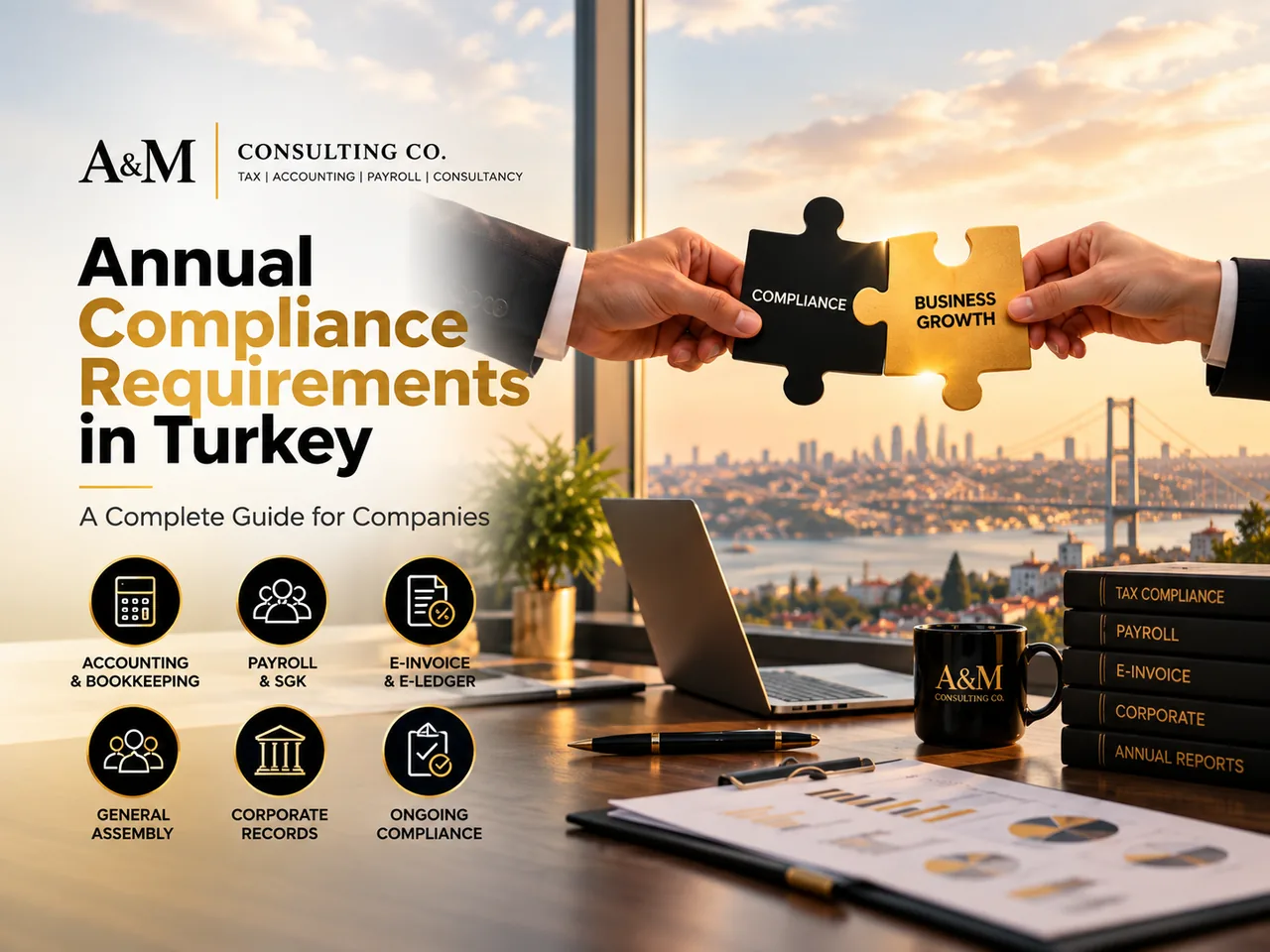

Annual Compliance Requirements in Turkey cover the tax, accounting, payroll, electronic invoicing, financial and corporate obligations that companies must review and fulfill each year. Company compliance does not end after incorporation; businesses operating in Turkey must continue to meet ongoing statutory requirements throughout the financial year and at the beginning of each new year.
For foreign-owned companies, annual compliance may involve corporate income tax returns, temporary tax payments, VAT and withholding tax filings, accounting and bookkeeping, e-Invoice and e-Ledger requirements, annual payroll adjustments, financial position reviews, general assembly procedures, trade registry obligations and company records.
The scope of these obligations can vary depending on the company’s legal structure, business activities, employees, accounting system and tax status. A proper annual compliance review helps companies identify outstanding obligations, update their systems for the new financial year and determine whether any corporate or financial action is required.
In this guide, we explain the main annual compliance requirements for companies in Turkey, with particular attention to the obligations that foreign investors and foreign-owned companies should consider.
Companies operating in Turkey are subject to various tax compliance obligations throughout the financial year. In addition to periodic tax returns and payments, companies should complete an annual review of their tax position and ensure that all required declarations and payments have been properly completed.
The main tax compliance areas include corporate income tax, temporary tax, VAT and withholding tax. The applicable obligations may vary depending on the company’s activities, tax status and transactions.
Companies subject to corporate income tax must file an annual corporate income tax return for the relevant accounting period. The annual tax calculation determines the company’s final corporate income tax liability based on its taxable income for the year.
Importantly, temporary taxes paid during the year are offset against the corporate income tax calculated in the annual return. This means that taxes already paid during the year are taken into account when determining the company’s final tax liability.
For more information about corporate taxation, see our guide to Corporate Income Tax in Turkey.
Companies may be required to calculate and pay temporary corporate income tax during the year based on their interim financial results. These payments are subsequently taken into account when preparing the annual corporate income tax return.
Therefore, the annual tax compliance process should include a reconciliation of temporary tax calculations and payments with the final annual corporate income tax liability.
Companies must also ensure that their VAT and withholding tax obligations have been properly reported and paid throughout the year. As part of the annual compliance review, businesses should check whether all relevant tax returns have been filed and whether any outstanding tax liabilities remain.
Companies can review the specific requirements in our guides on VAT in Turkey and Withholding Tax in Turkey.
For foreign-owned companies, maintaining accurate accounting records and coordinating tax reporting with an experienced Accounting Firm in Turkey can help ensure that annual and periodic tax compliance obligations are properly managed.

Annual accounting and bookkeeping are an essential part of Annual Compliance Requirements in Turkey. Companies should ensure that their accounting records are complete, accurate and properly maintained throughout the financial year, while also completing the necessary year-end accounting procedures.
At the end of each financial year, companies should review their accounting records, reconcile relevant accounts and prepare the financial information required for tax reporting and other statutory obligations.
The annual accounting review may include:
For companies that operate in Turkey, professional accounting and bookkeeping services in Turkey can help ensure that accounting records and year-end procedures are properly completed.
Companies should also review their financial statements and statutory accounting records at the end of the financial year. The financial position shown in the accounting records is particularly important because it can also help identify issues such as accumulated losses, insufficient equity or the potential need for a capital increase.
For foreign-owned companies, this annual review is also an opportunity to assess whether the company’s accounting, tax and financial reporting processes remain compliant with Turkish requirements.
The year-end accounting process should then continue into the new financial year, including the necessary accounting system and electronic ledger preparations.
The beginning of a new financial year requires companies in Turkey to review and update their accounting systems and electronic accounting processes. This is an important part of Annual Compliance Requirements in Turkey, particularly for companies using electronic accounting and bookkeeping systems.
At the beginning of each new year, companies should review their accounting setup and ensure that the new accounting period is correctly opened in their accounting system. This includes checking the company’s accounting records, opening balances and the configuration required for the new financial year.
The new-year accounting process may include:
Companies using electronic tax applications should also review their e-Invoice (e-Fatura), e-Archive and e-Ledger (e-Defter) processes at the beginning of the new financial year.
This may include:
For more information, see our guide to Electronic Tax Applications in Turkey.
Payroll compliance is another important part of Annual Compliance Requirements in Turkey. At the beginning of each calendar year, companies should review and update their payroll systems and employee salary parameters to reflect changes applicable to the new year.
These adjustments are particularly important when there are changes to the minimum wage, tax exemptions, payroll parameters or social security calculations.
At the beginning of the new year, companies should review employee salary calculations and ensure that the applicable minimum wage and other statutory payroll parameters have been correctly reflected in the payroll system.
Depending on the company’s payroll structure, the annual review may include:
Companies should also review the tax exemptions and other payroll-related parameters applicable to employees in the new year.
Where applicable, these changes need to be reflected in payroll calculations so that income tax, social security contributions and other payroll-related amounts are calculated correctly.
At the beginning of a new calendar year, annual payroll and tax calculation parameters are reset for the new period. Employee payroll records and relevant annual calculation bases should therefore be reviewed and correctly configured for the new year.
For businesses employing employees in Turkey, professional Payroll Services in Turkey can help ensure that annual payroll adjustments and ongoing payroll compliance are properly managed.
Foreign companies employing staff in Turkey can also benefit from specialized HR and Payroll Services in Turkey for Foreign Companies.
As part of Annual Compliance Requirements in Turkey, companies should not only review their tax and accounting obligations but also assess their overall financial position. This review can help identify whether the company’s working capital, equity and share capital remain sufficient for its ongoing operations.
Companies should periodically assess their working capital and liquidity position to determine whether they have sufficient resources to meet their short-term financial obligations.
The review may include:
Year-end financial statements should also be reviewed for accumulated losses and capital loss. Significant losses may reduce the company’s equity and create a need for further corporate action.
Companies should assess whether their financial position requires measures such as a capital increase, restructuring of the capital structure or other appropriate corporate measures.
For companies considering an increase in their share capital, see our guide to Capital Increase in Turkey.
Companies should also assess whether accumulated losses and liabilities have significantly weakened their financial position. Where appropriate, the company’s assets, liabilities and equity position should be reviewed to determine whether there are concerns regarding over-indebtedness or the company’s ability to continue meeting its obligations.
For foreign-owned companies, this annual financial review is particularly useful because it allows shareholders and managers to identify potential capital or financial issues before they require more significant corporate action.
The annual general assembly is an important part of the corporate compliance process for companies in Turkey. In addition to reviewing the company’s financial statements and previous year’s activities, shareholders may need to consider and approve various corporate matters depending on the company’s circumstances.
The annual general assembly can therefore serve not only as a statutory corporate meeting but also as an opportunity to review whether changes to the company’s management, registered information or capital structure are required.
Where necessary, shareholders may decide to appoint a new company manager or replace an existing manager. The relevant corporate decision and subsequent registration requirements should be completed in accordance with the company’s legal structure and applicable Turkish regulations.
For detailed information about the procedure, see our guide to Company Manager Change in Turkey.
Depending on the company’s structure and the requirements of its shareholders, foreign investors may consider using a Nominee Director or Nominee Shareholder arrangement.
A Nominee Director may be appointed to fulfill a management or representation role within the company, while a Nominee Shareholder may hold shares on behalf of the beneficial owner under a contractual arrangement. These structures require careful consideration of the parties’ legal responsibilities, beneficial ownership and applicable compliance requirements.
For more information, see our guides on Nominee Director Services in Turkey and Nominee Shareholder Services in Turkey.
A company may also need to change its registered office address. Where such a change is approved, the necessary corporate, trade registry and tax records should be updated accordingly.
See our detailed guide to Company Address Change in Turkey.
Shareholders may also decide to change the company’s legal name. Such a change requires the appropriate corporate decision and registration procedures.
For more information, see our guide to Company Name Change in Turkey.
Where the company’s financial position requires additional capital, shareholders may consider a capital increase. Other corporate decisions may also be placed on the agenda depending on the company’s activities and circumstances.
For a broader overview of corporate amendments and changes, see our guide to Corporate Changes in Turkey.
Companies operating in Turkey should also review their Trade Registry and Chamber of Commerce obligations as part of their annual compliance process. Corporate information should remain accurate and up to date, and companies should ensure that applicable registration and membership obligations are properly maintained.
Companies should review whether their registered corporate information remains accurate, particularly following any changes during the year. Depending on the circumstances, changes involving the company’s management, registered address, company name, capital or shareholders may require registration with the Trade Registry.
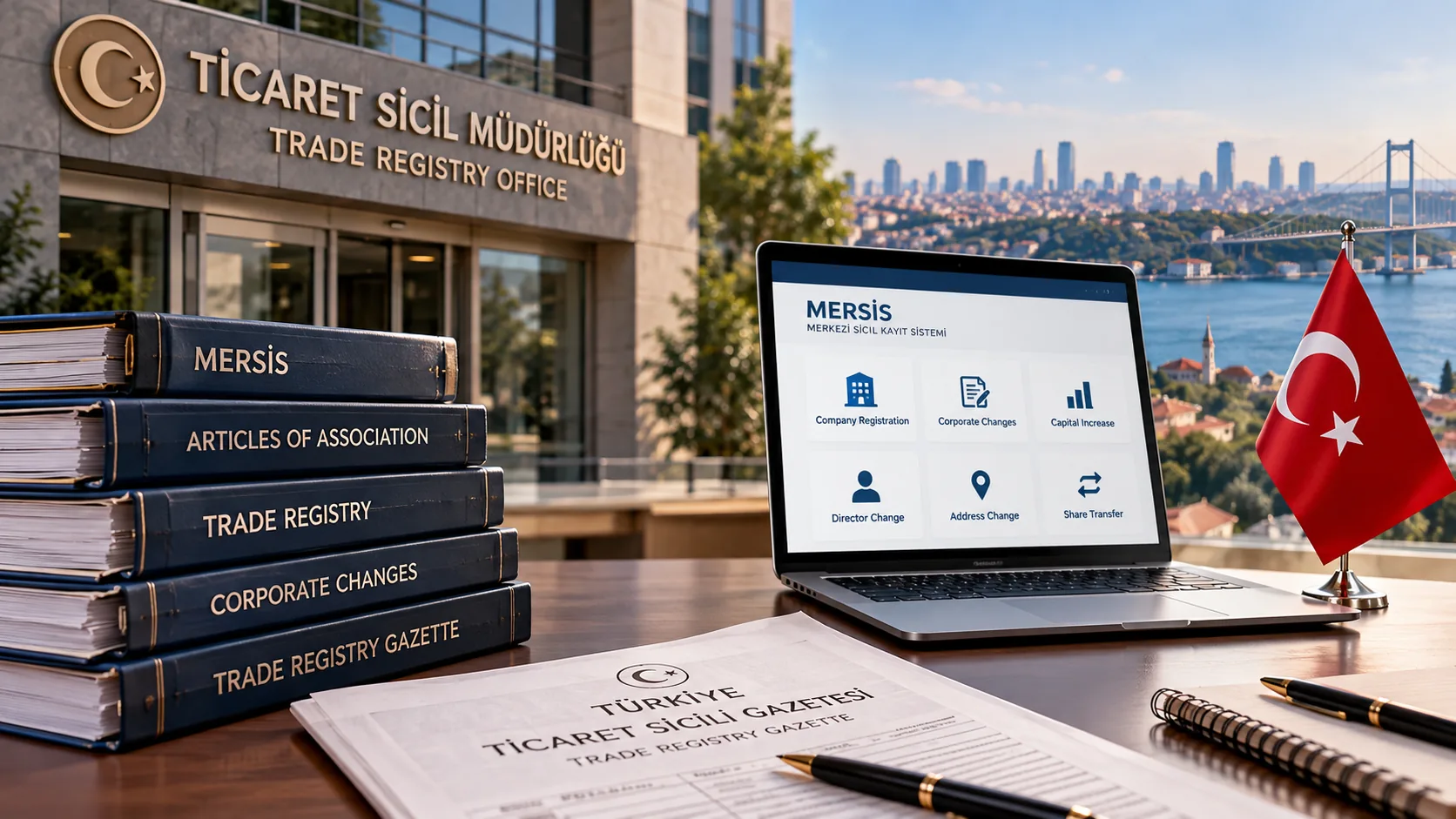
For more information about the Turkish Trade Registry and its role in corporate registration and changes, see our guide to Trade Registry in Turkey.
Companies registered with a Chamber of Commerce should also ensure that their annual membership dues and other applicable chamber obligations are reviewed and paid on time.
Companies should keep their chamber records and contact information up to date and check whether any outstanding dues or other obligations remain.
As part of the annual compliance review, companies can also compare their records across the Trade Registry, Chamber of Commerce, tax administration and accounting systems. This helps identify inconsistencies in information such as:
Where a corporate change has occurred, the relevant registrations and records should be updated accordingly. For a broader overview, see our guide to Corporate Changes in Turkey.
Companies in Turkey should also review the status of their corporate books as part of their annual compliance procedures. In particular, companies should ensure that their General Assembly Decision Book and Share Ledger are properly maintained and, where required, duly notarized.
Companies should ensure that decisions taken by the general assembly are properly recorded in the General Assembly Decision Book. The book should be maintained in accordance with the applicable requirements, and the relevant notarization procedures should be completed where required.
The Share Ledger is another important corporate record, particularly for companies with shareholders and shareholding changes. Companies should ensure that the share ledger is properly maintained and that the required notarization procedures are completed.
The annual compliance review should therefore include checking the status of these corporate books and ensuring that they are ready for the company’s ongoing corporate activities and future general assembly decisions.
Foreign-owned companies in Turkey are subject to the same core statutory compliance framework as other Turkish companies, but they may also need to consider additional requirements arising from their foreign ownership, international transactions and cross-border operations.
An annual compliance review should therefore cover not only tax and accounting obligations but also the company’s corporate structure, management, shareholders, payroll, financial position and official registrations.
Foreign investors should review, among other matters:
Foreign-owned companies should also ensure that information held by the Trade Registry, tax administration, accounting system and corporate records remains consistent. Changes in management, shareholders, registered address, company name or capital may require additional corporate and registration procedures.
For businesses established or operated by international investors, working with an experienced Accounting Firm in Turkey can help coordinate the company’s annual accounting, tax and corporate compliance requirements.
As part of the annual corporate tax compliance process in Turkey, companies may be required to submit a Beneficial Ownership Declaration (Gerçek Kullanıcı Bildirimi) together with their annual corporate income tax return.
The declaration provides information about the individuals who ultimately own or control the company and forms part of the company’s annual tax compliance obligations.
Companies should ensure that the beneficial ownership information is accurate, complete and up to date when submitting the annual declaration. Any changes in ownership or control during the year should also be reviewed to ensure that the information reported to the Turkish tax authorities is consistent with the company’s corporate records.
For foreign-owned companies, this review is particularly important because the declared beneficial ownership information should be consistent with the company’s shareholder structure, Share Ledger and other corporate records.
Annual compliance is not limited to tax and accounting obligations. Companies should also review whether their corporate information and official records remain accurate throughout the year.
Changes in the company’s managers, shareholders, registered office address, company name, share capital or other corporate information may require corporate resolutions and, where applicable, registration or notification to the relevant authorities.
Companies should therefore ensure that information recorded in their corporate books, Share Ledger, Trade Registry records, tax records and accounting systems remains consistent.
For foreign-owned companies, this review is particularly important when there have been changes in the ownership or management structure during the year.
Where a corporate change is required, companies can refer to our detailed guide on Corporate Changes in Turkey for information about the relevant procedures and requirements.
Failing to properly manage annual compliance requirements can result in missed filing deadlines, tax liabilities, inaccurate corporate records and other compliance risks. For foreign-owned companies, maintaining accurate and up-to-date records is particularly important because information may need to remain consistent across the company’s accounting records, tax filings, corporate books and official registrations.
A structured annual compliance review allows companies to identify outstanding obligations, update accounting and payroll systems for the new financial year, review their financial position and determine whether any corporate action is required.
By reviewing tax, accounting, payroll, e-Invoice, e-Ledger, financial and corporate obligations together, foreign companies can maintain their operations in Turkey in an organized and compliant manner.
A&M Consulting Co. provides accounting, tax, payroll and corporate compliance services for foreign-owned companies operating in Turkey.
Managing annual tax, accounting, payroll and corporate compliance requirements can be complex, particularly for foreign-owned companies operating in Turkey. A&M Consulting Co. provides comprehensive professional support to help international businesses meet their ongoing compliance obligations and maintain accurate corporate and financial records.
Our services include accounting and bookkeeping, tax compliance, payroll and SGK, e-Invoice and e-Ledger applications, corporate tax returns, general assembly procedures, corporate changes and other ongoing compliance services in Turkey.
With extensive experience working with foreign investors and international companies, A&M Consulting provides practical, coordinated support throughout the year—not only when annual filing deadlines approach.
Contact A&M Consulting today to discuss your company’s annual compliance, accounting, tax or payroll requirements in Turkey and find the right support for your business.
Annual compliance requirements include corporate income tax, temporary tax, VAT and withholding tax compliance, accounting and bookkeeping, e-Invoice and e-Ledger procedures, annual payroll adjustments, financial and capital reviews, General Assembly procedures, corporate records and Chamber of Commerce obligations.
Companies may need to file an annual corporate income tax return as well as periodic VAT, withholding tax and temporary tax returns, depending on their activities and tax status. Companies should also review their tax records and outstanding liabilities as part of their annual compliance process.
Yes. Temporary corporate income taxes paid during the relevant financial year are generally offset against the corporate income tax calculated in the annual corporate income tax return. The annual tax calculation therefore takes previously paid temporary taxes into account when determining the remaining tax liability.
Yes. Companies should review and update their payroll systems at the beginning of each calendar year. Changes to the minimum wage, salary parameters, tax exemptions and social security parameters may require adjustments to employee payroll calculations and records.
Companies should open the new accounting period, review opening balances and accounting parameters, and ensure that their accounting systems are correctly configured. Companies subject to e-Ledger requirements should also review their e-Ledger setup and related electronic record-keeping processes for the new financial year.
Companies should review their financial position, including working capital, accumulated losses, equity and share capital. Where losses have significantly reduced the company’s equity or its financial position requires additional funding, the company may need to consider a capital increase or other appropriate corporate measures.
Companies are generally required to hold their relevant annual General Assembly in accordance with the applicable rules for their legal structure. The General Assembly can review the company’s financial statements and activities and, where necessary, make decisions concerning management, capital and other corporate matters.
Yes, where the relevant matter falls within the authority of the General Assembly, shareholders may make decisions concerning matters such as the appointment or replacement of company managers, changes to the registered office address, company name and capital. Additional Trade Registry procedures may be required after the decision.
A Beneficial Ownership Declaration (Gerçek Kullanıcı Bildirimi) provides information about the individuals who ultimately own or control a company. Where applicable, companies are required to provide this information as part of their annual tax compliance process, including with the annual corporate income tax return.
Foreign-owned companies are generally subject to the same core Turkish tax, accounting, payroll and corporate compliance requirements as other Turkish companies. However, they should pay particular attention to the consistency of their shareholder, beneficial ownership, management, tax and Trade Registry records, especially where there are cross-border transactions or changes in ownership or management.
Companies registered with a Chamber of Commerce generally have annual membership dues and other applicable chamber obligations. Companies should review their chamber records and ensure that applicable dues are paid on time.
Companies should properly maintain their required corporate books, including the General Assembly Decision Book and Share Ledger. The applicable notarization requirements should also be reviewed to ensure that these corporate records are properly maintained and ready for future corporate decisions.
Every company has different tax, accounting, payroll and corporate compliance requirements depending on its activities, legal structure and financial position. If you have questions about your company’s annual compliance obligations in Turkey, A&M Consulting Co. can help.
Contact our team to discuss your company’s specific requirements and receive professional guidance on accounting, tax, payroll and corporate compliance in Turkey.

Certified Public Accountant (CPA)

WhatsApp Us