

Summarize this article with AI
Expanding your business into Turkey presents significant opportunities, but it also brings a range of legal, financial, and tax compliance responsibilities. Whether you are establishing a new company, opening a branch office, hiring employees, or investing in the Turkish market, working with a professional Turkish Accounting Firm is one of the most important decisions you will make.
Turkey has a well-established regulatory framework governing accounting, taxation, payroll, and corporate compliance. Businesses are required to maintain statutory accounting records, submit periodic tax returns, comply with Social Security (SGK) obligations, prepare financial statements, and fulfil numerous reporting requirements throughout the year. Failure to comply with these obligations may result in financial penalties, interest charges, and unnecessary administrative risks.
For foreign investors, navigating these requirements can be particularly challenging. Language barriers, unfamiliar legislation, digital tax systems, and continuously changing regulations make local professional support essential. A qualified Accounting Firm in Turkey helps businesses remain compliant while allowing management to focus on growth rather than administration.
Beyond traditional bookkeeping, modern accounting firms provide a broad range of business support services. Depending on your company’s needs, these may include tax advisory, payroll processing, financial reporting, company formation, employer registration, work permit support, VAT compliance, electronic tax applications, and ongoing corporate advisory services. Working with a single professional advisor simplifies communication and ensures that every aspect of your Turkish operations is managed consistently.
It is equally important to understand that accounting services in Turkey are not an unregulated profession. Professional accounting and tax advisory services are provided by licensed Certified Public Accountants (CPAs) who operate under strict professional and ethical standards established by Turkish law. Choosing a licensed CPA-led accounting firm provides greater confidence that your business complies with all applicable legislation and reporting requirements.
In this comprehensive guide, you will learn:
Whether you are planning to establish your first company in Turkey or are looking to replace your existing accounting provider, this guide will help you understand how a professional Turkish Accounting Firm can support your business, reduce compliance risks, and contribute to your long-term success in the Turkish market.
A Turkish Accounting Firm is a professional advisory firm that provides accounting, bookkeeping, tax compliance, payroll, financial reporting, and corporate advisory services to businesses operating in Turkey.
While many foreign investors initially assume that accounting simply involves recording financial transactions, the role of an accounting firm in Turkey is considerably broader. Businesses are required to comply with numerous legal, tax, labour, and Social Security obligations throughout the year, making professional accounting support an essential part of operating successfully in the Turkish market.
A professional accounting firm acts as a long-term business partner, helping companies maintain accurate financial records, meet statutory filing deadlines, comply with Turkish tax legislation, and navigate complex regulatory requirements.
For foreign-owned businesses, an experienced Turkish Accounting Firm also serves as a local advisor, assisting management in understanding Turkish business practices, communicating with public authorities, and ensuring compliance with continuously evolving legislation.
Although service offerings vary between firms, a professional Turkish Accounting Firm typically provides a comprehensive range of accounting and business support services, including:
Rather than working with multiple service providers, many foreign investors prefer a single accounting firm capable of managing these interconnected responsibilities under one roof.
One of the most common misconceptions is that accounting firms simply record invoices and prepare tax returns.
In reality, a modern Turkish Accounting Firm plays a much broader advisory role by helping businesses:
This proactive approach allows business owners and management teams to focus on growth while leaving complex compliance matters to experienced professionals.
Accounting services in Turkey are provided by licensed Certified Public Accountants (CPAs) who are authorized to perform statutory accounting and tax-related services under Turkish legislation.
Unlike many jurisdictions where bookkeeping may be carried out without professional licensing, accounting and tax compliance in Turkey are closely regulated professions.
For this reason, businesses should ensure that their accounting provider is managed by licensed professionals who possess the necessary qualifications, experience, and legal authority to provide accounting services.
To learn more about the qualifications, responsibilities, and legal authority of Certified Public Accountants in Turkey, read our comprehensive guide:
Turkish CPA: Everything Foreign Investors Need to Know.
Your accounting firm is more than a compliance service provider—it is one of your company’s most important business advisors.
The right accounting partner helps you:
For foreign companies entering the Turkish market, choosing an experienced Turkish Accounting Firm can significantly reduce operational complexity while providing confidence that all legal and financial obligations are being managed professionally.
Professional Insight: A Turkish Accounting Firm should not be viewed solely as an external bookkeeper. The best firms act as strategic business partners, combining expertise in accounting, taxation, payroll, labour law, and corporate compliance to help businesses operate efficiently and confidently in Turkey.
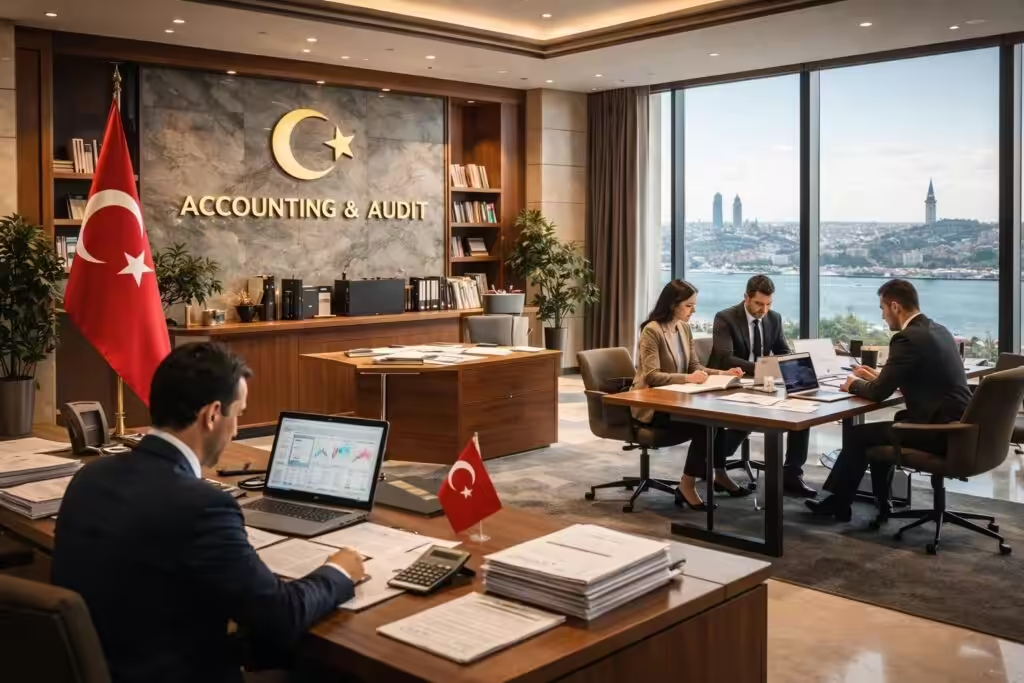
Turkey offers significant opportunities for foreign investors thanks to its strategic location, large domestic market, skilled workforce, and growing economy. However, establishing and operating a business in Turkey also requires compliance with a comprehensive legal and tax framework.
Unlike in many countries, accounting in Turkey extends far beyond bookkeeping. Companies are subject to ongoing tax filings, Social Security (SGK) reporting, electronic accounting systems, corporate compliance requirements, and frequent legislative updates. As a result, foreign businesses often find that partnering with an experienced Turkish Accounting Firm is essential for operating efficiently and remaining fully compliant.
Turkish companies must comply with numerous regulations issued by various public authorities, including the Ministry of Treasury and Finance, the Revenue Administration, the Social Security Institution (SGK), and the Ministry of Trade.
These regulations govern areas such as:
Keeping up with these obligations requires continuous monitoring of legislative changes and administrative practices.
A professional Turkish Accounting Firm helps businesses navigate this regulatory environment while reducing the risk of non-compliance.
One of the biggest challenges for foreign investors is understanding local administrative procedures.
Although many government systems are becoming more digital, most official correspondence, tax notifications, and administrative documentation are prepared in Turkish.
An experienced accounting firm acts as your local business partner by helping you:
This local support allows international management teams to make informed decisions without being hindered by language barriers.
Every company operating in Turkey has ongoing tax obligations.
Depending on the nature of the business, companies may need to submit:
Missing filing deadlines or submitting inaccurate declarations may result in administrative penalties, late payment interest, and unnecessary tax disputes.
Working with a professional accounting firm helps ensure these obligations are fulfilled accurately and on time.
Hiring employees in Turkey creates additional responsibilities beyond ordinary accounting.
Employers must comply with:
Many accounting firms provide integrated payroll and HR support, enabling employers to manage workforce compliance through a single professional advisor.
Learn more: For a detailed explanation of payroll outsourcing and employer obligations, read our guides:
Turkey has rapidly digitalized its tax administration over the past decade.
Many businesses are required to use electronic systems such as:
Understanding which electronic applications apply to your business—and implementing them correctly—is an important part of remaining compliant.
An experienced accounting firm can assist with both the initial setup and ongoing management of these digital obligations.
A modern accounting firm provides much more than compliance services.
Experienced accountants regularly advise clients on:
This advisory role helps business owners make informed decisions while minimizing financial and regulatory risks.
Managing accounting and compliance internally requires significant time, expertise, and resources.
By outsourcing accounting services, foreign companies can:
For many international businesses, outsourcing accounting is both a practical and cost-effective solution.
Foreign investors often underestimate the complexity of operating in a new jurisdiction.
A trusted Turkish Accounting Firm not only manages accounting records but also helps businesses understand local regulations, anticipate compliance risks, and establish efficient financial processes from the very beginning.
Rather than reacting to problems after they arise, professional accounting support enables businesses to prevent issues before they occur.
Professional Insight: For foreign companies, an accounting firm is often the first long-term business partner in Turkey. Beyond bookkeeping, a qualified accounting firm helps businesses navigate tax legislation, employer obligations, digital government systems, and corporate compliance—allowing management to focus on strategic growth rather than administrative complexity.
Every company operating in Turkey, regardless of its size or industry, must comply with a range of accounting, tax, and corporate reporting obligations established under the Turkish Commercial Code (TCC) and the Tax Procedure Law (TPL).
These obligations begin immediately after incorporation and continue throughout the life of the company. Failure to maintain proper accounting records or submit statutory declarations on time may result in administrative penalties, late payment interest, tax assessments, and compliance risks.
Partnering with an experienced Turkish Accounting Firm helps businesses understand these obligations, meet statutory deadlines, and remain fully compliant with Turkish legislation.
Companies in Turkey are legally required to maintain accurate accounting records that reflect all commercial and financial transactions.
These records form the basis for:
Accounting records must be prepared in accordance with Turkish legislation and retained for the legally prescribed retention period.
Proper bookkeeping is the foundation of corporate compliance.
A Turkish Accounting Firm is responsible for recording transactions such as:
Accurate bookkeeping ensures that financial statements and tax returns are prepared correctly.
Companies operating in Turkey are required to submit various tax declarations throughout the year.
Depending on the company’s activities, these may include:
Each declaration has specific filing and payment deadlines that must be monitored carefully.
Missing deadlines may result in administrative fines and late payment interest.
In addition to tax compliance, companies must prepare financial reports that accurately reflect their financial position.
These reports may include:
Reliable financial reporting supports both statutory compliance and better business decision-making.
Companies employing staff have additional accounting responsibilities.
These include:
Many accounting firms provide integrated payroll services, allowing employers to manage accounting and payroll through a single provider.
Turkey has become one of the most digitalized tax administrations in Europe.
Many businesses are required to register for and use electronic government systems, including:
Determining which electronic systems apply to your business depends on factors such as turnover, industry, legal status, and regulatory requirements.
A professional Turkish Accounting Firm can manage both the initial registration process and the ongoing administration of these digital systems.
Companies incorporated in Turkey are also required to maintain certain statutory books prescribed by the Turkish Commercial Code.
Depending on the legal structure of the company, these may include:
These books must be maintained in accordance with Turkish legislation and may be subject to notarization or electronic bookkeeping requirements.
Accounting responsibilities extend beyond monthly bookkeeping and tax filings.
Throughout the year, companies may also need to complete various corporate compliance procedures, including:
Working with a single accounting firm helps ensure these obligations are coordinated efficiently and completed on time.
The accounting obligations imposed on Turkish companies are extensive and continue throughout the company’s lifecycle.
Attempting to manage these responsibilities without professional guidance increases the risk of:
A professional Turkish Accounting Firm helps businesses establish reliable accounting processes, maintain accurate financial records, and meet all statutory obligations efficiently.
Professional Insight: Accounting compliance in Turkey is an ongoing process rather than a once-a-year obligation. Businesses are expected to maintain accurate books, submit periodic tax declarations, comply with digital reporting requirements, and meet numerous statutory deadlines throughout the year. Working with an experienced Turkish Accounting Firm helps ensure these responsibilities are managed proactively rather than reactively.
A modern Turkish Accounting Firm offers far more than bookkeeping and tax return preparation. Today’s businesses require comprehensive financial, tax, payroll, and corporate advisory services that support every stage of their operations.
Whether you are establishing a new company, hiring employees, expanding your business, or managing ongoing compliance, a professional accounting firm can provide the expertise needed to keep your business compliant while reducing administrative burdens.
Below are the core services typically offered by a licensed Turkish Accounting Firm.
Accurate bookkeeping forms the foundation of every successful business.
Professional bookkeeping services typically include:
Maintaining accurate accounting records ensures reliable financial reporting and helps businesses comply with Turkish accounting and tax legislation.
One of the primary responsibilities of an accounting firm is ensuring that all statutory tax obligations are fulfilled accurately and on time.
Typical tax compliance services include:
Professional tax compliance minimizes the risk of penalties, interest charges, and reporting errors.
Payroll is one of the most important services provided by accounting firms in Turkey.
Payroll services generally include:
For many foreign investors, outsourcing payroll alongside accounting creates a more efficient and integrated compliance process.
Many accounting firms assist foreign investors from the very beginning of their business journey.
Company formation services may include:
Professional guidance during incorporation helps businesses avoid unnecessary delays and ensures compliance from day one.
Related Guides:
Beyond statutory compliance, experienced accounting firms provide ongoing advisory services to help businesses make informed financial decisions.
These services may include:
Strategic accounting advice enables business owners to improve financial performance while remaining compliant with Turkish legislation.
Reliable financial reporting is essential for management, shareholders, banks, and investors.
Accounting firms can prepare:
These reports support better decision-making and provide a clear overview of business performance.
Turkey has implemented one of the most advanced digital tax systems in the region.
Accounting firms assist businesses with:
Professional support ensures businesses meet their electronic reporting obligations efficiently.
Foreign-owned businesses frequently require assistance with employment-related procedures.
Many accounting firms also provide support for:
Providing these services through one advisory firm simplifies administration and improves coordination.
Related Guides:
Corporate compliance extends beyond accounting and taxation.
Accounting firms often assist with:
Managing these procedures through one trusted advisor helps businesses remain fully compliant throughout their lifecycle.
One of the greatest advantages of working with a full-service Turkish Accounting Firm is having access to multiple professional services through a single provider.
Instead of coordinating separately with accountants, payroll specialists, HR consultants, tax advisors, and corporate lawyers, businesses can centralize their compliance requirements under one experienced advisory firm.
This integrated approach improves communication, increases efficiency, and reduces the risk of inconsistent advice across different service providers.
As your business grows, so do your compliance obligations.
Choosing an accounting firm that offers a complete range of services allows your business to scale more efficiently while maintaining compliance with Turkish legislation.
Rather than solving isolated accounting issues, a professional Turkish Accounting Firm provides long-term strategic support across accounting, taxation, payroll, HR, and corporate compliance—helping businesses operate confidently in Turkey.
Professional Insight: The best accounting firms don’t simply prepare tax returns—they become long-term business advisors. By integrating bookkeeping, payroll, tax, corporate compliance, and strategic advisory services, they help businesses reduce risk, improve efficiency, and build a strong foundation for sustainable growth in Turkey.
When choosing a Turkish Accounting Firm, one of the most important factors to consider is whether the firm is managed by licensed Certified Public Accountants (CPAs).
Unlike in some countries where bookkeeping services may be offered by individuals without formal professional qualifications, accounting and tax advisory services in Turkey are regulated professions. Companies are therefore strongly encouraged to work with licensed professionals who possess the legal authority, technical expertise, and ethical responsibility required to manage statutory accounting and tax compliance.
For foreign investors unfamiliar with the Turkish regulatory environment, working with a licensed CPA provides additional confidence that accounting records, tax filings, payroll, and corporate compliance obligations are handled professionally and in accordance with Turkish legislation.
The accounting profession in Turkey is governed by Law No. 3568, which regulates the qualifications, professional responsibilities, and ethical standards of Certified Public Accountants.
Licensed professionals are required to meet strict educational, professional, and ethical requirements before obtaining the authority to provide accounting and tax advisory services.
This regulatory framework helps ensure that businesses receive professional services that comply with current legislation and accepted accounting standards.
Licensed Turkish CPAs are members of professional organizations that regulate and oversee the accounting profession.
The two most important institutions are:
These organizations establish professional and ethical standards, support continuing professional education, and help ensure that members comply with the legal and professional obligations of the accounting profession.
For businesses, working with a CPA firm registered with these organizations provides an additional level of confidence and accountability.
Many foreign investors mistakenly believe that accounting is limited to recording invoices and preparing tax returns.
In reality, licensed Turkish CPAs provide much broader professional support, including:
As legislation evolves, licensed CPAs also help businesses understand new legal requirements and implement the necessary changes promptly.
Foreign-owned companies often face additional challenges when operating in Turkey, including unfamiliar legislation, language barriers, and complex administrative procedures.
A CPA-led accounting firm can provide valuable support by:
This combination of technical expertise and local knowledge enables foreign businesses to operate with greater confidence and reduced compliance risk.
Accounting, taxation, payroll, and corporate compliance are closely connected.
A change in payroll may affect tax liabilities. A capital increase may require accounting adjustments. A work permit application may depend on payroll records and financial reporting.
Working with a CPA-led accounting firm ensures that these interconnected areas are managed consistently rather than separately.
Instead of dealing with multiple advisors, businesses benefit from a coordinated approach that improves efficiency and reduces the risk of errors.
At A&M Consulting Co., we are proud to operate as a licensed Turkish Certified Public Accountant (CPA) firm registered with both TURMOB (the Union of Chambers of Certified Public Accountants of Turkey) and ISMMMO (the Istanbul Chamber of Certified Public Accountants).
Our firm combines more than 20 years of professional experience with a practical understanding of the challenges faced by foreign investors doing business in Turkey.
Beyond accounting and bookkeeping, we provide integrated services including:
This integrated approach allows our clients to work with a single, trusted advisor throughout every stage of their business journey in Turkey.
If you would like to understand the qualifications, legal responsibilities, and authority of Certified Public Accountants in Turkey, we recommend reading our comprehensive guide:
👉 Turkish CPA: Everything Foreign Investors Need to Know
Choosing an accounting firm is about more than comparing service fees.
You are selecting a long-term advisor who will be responsible for supporting your company’s financial compliance, tax obligations, payroll processes, and regulatory reporting.
By working with a licensed Turkish CPA firm, you gain:
For international companies, these qualities provide peace of mind and allow management to focus on growing the business rather than managing complex administrative requirements.
Professional Insight: While many firms advertise accounting services, not all operate under the same professional framework. Choosing a licensed Turkish CPA firm registered with TURMOB and ISMMMO ensures your business is supported by professionals who are legally authorized, professionally regulated, and committed to maintaining the highest standards of accounting, taxation, and corporate compliance.
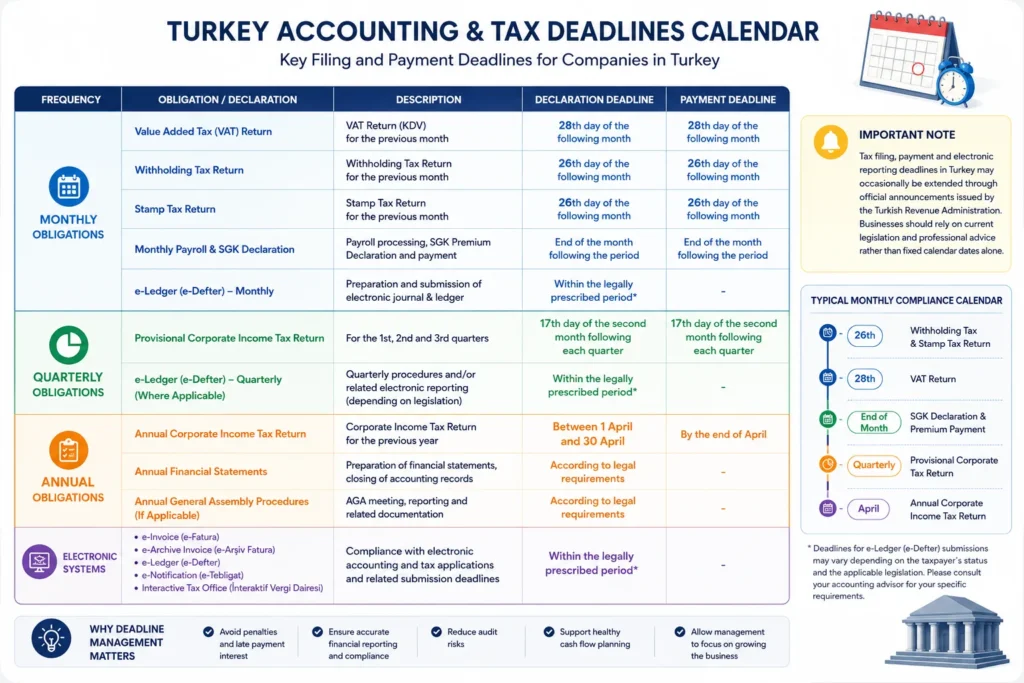
One of the biggest challenges for both local and foreign-owned companies in Turkey is keeping track of the numerous accounting, tax, payroll, and statutory reporting deadlines throughout the year.
Unlike jurisdictions where tax reporting may be limited to annual filings, Turkish companies are subject to continuous monthly, quarterly, and annual compliance obligations. Missing a filing or payment deadline may result in administrative penalties, late payment interest, and unnecessary correspondence with the Turkish tax authorities.
A professional Turkish Accounting Firm continuously monitors these deadlines, prepares the required declarations, and ensures that all statutory obligations are fulfilled accurately and on time.
Most accounting and payroll responsibilities in Turkey are performed on a monthly basis.
Depending on the company’s activities, businesses may be required to:
Consistent monthly bookkeeping is essential for accurate financial reporting and timely tax compliance.
Companies subject to VAT must submit their monthly VAT Return.
Businesses required to withhold taxes must submit a monthly Withholding Tax Return.
Stamp Tax is generally declared together with other monthly tax obligations.
Employers are responsible for completing monthly payroll procedures, including:
These obligations are generally completed by the end of the month following the relevant payroll period.
For a detailed explanation of payroll compliance, see our guides:
Companies subject to the e-Ledger (e-Defter) system must generate their electronic Journal Book and General Ledger each month.
Depending on the applicable legislation, these records must be digitally signed and submitted to the Turkish Revenue Administration within the legally prescribed deadlines.
Managing e-Ledger files correctly is an important part of maintaining digital accounting compliance in Turkey.
In addition to monthly reporting, companies must also comply with several periodic obligations.
Corporate taxpayers are generally required to submit a Provisional Corporate Income Tax Return for the first three quarters of each fiscal year.
This system allows corporate income tax to be paid progressively throughout the year.
At the end of each financial year, companies must complete several important accounting and corporate compliance procedures.
These typically include:
Maintaining accurate accounting records throughout the year significantly simplifies these annual procedures.
Corporate taxpayers must submit an Annual Corporate Income Tax Return covering the previous financial year.
Many companies are also required to comply with Turkey’s electronic accounting and tax systems, including:
Each application has its own reporting requirements and submission deadlines. A professional Turkish Accounting Firm ensures these electronic obligations are monitored and completed correctly.
Missing statutory deadlines can have serious financial and administrative consequences, including:
Rather than reacting after a deadline has been missed, businesses should adopt a proactive compliance strategy supported by experienced accounting professionals.
A professional Turkish Accounting Firm continuously monitors legislative updates, filing calendars, payment deadlines, and electronic reporting obligations, helping businesses remain compliant throughout the year while minimizing operational risks.
Important Note: Tax filing, payment, and electronic reporting deadlines in Turkey may occasionally be extended through official announcements issued by the Turkish Revenue Administration. Businesses should therefore rely on current legislation and professional advice rather than fixed calendar dates alone.
Professional Insight: Accounting compliance in Turkey is a continuous process rather than a year-end exercise. Successful businesses maintain accurate bookkeeping, submit declarations on time, monitor electronic reporting obligations, and work closely with their accounting firm throughout the year. This proactive approach reduces compliance risks, improves financial reporting, and allows management to focus on growing the business with confidence.
Choosing the right Turkish Accounting Firm is one of the most important decisions a company will make after entering the Turkish market.
Your accounting firm will not only prepare tax returns and maintain bookkeeping records but will also play a key role in ensuring legal compliance, supporting business decisions, communicating with government authorities, and helping your company adapt to regulatory changes.
For foreign investors, selecting the right accounting partner can significantly reduce operational risks while providing valuable local expertise throughout every stage of the business lifecycle.
The following factors should be carefully considered before appointing an accounting firm in Turkey.
The first and most important consideration is ensuring that the accounting firm is managed by licensed Certified Public Accountants (CPAs) who are legally authorized to provide accounting and tax services in Turkey.
Working with a CPA-led firm provides confidence that your accounting records, tax filings, payroll, and statutory reporting obligations are handled in accordance with Turkish legislation.
Related Guide:
Turkish CPA: Everything Foreign Investors Need to Know
Accounting requirements are often more complex for international businesses.
A firm experienced in working with foreign investors will understand issues such as:
Choosing a firm that regularly supports international clients helps avoid misunderstandings and unnecessary delays.
As your business grows, your compliance requirements will also increase.
Instead of working with multiple service providers, many businesses prefer an accounting firm capable of providing:
A single point of contact simplifies communication and improves operational efficiency.
Different industries are subject to different accounting and regulatory requirements.
For example:
Each industry may have unique tax treatments, reporting requirements, incentive programs, or licensing obligations.
Working with an accounting firm that understands your industry can help prevent costly compliance mistakes.
For many foreign investors, communication is just as important as technical expertise.
Your accounting firm should be able to explain:
in clear and professional English.
Regular communication helps management make informed decisions without language barriers.
Modern accounting firms should utilize digital tools that improve efficiency and transparency.
Look for firms experienced with:
Technology-driven firms typically respond faster and provide more efficient client service.
Professional accounting services should be supported by clear engagement terms and transparent pricing.
Before signing an agreement, businesses should understand:
Clear pricing helps avoid misunderstandings and supports long-term business planning.
The best accounting firms do more than prepare tax returns after the end of the month.
They proactively:
This proactive approach helps businesses solve problems before they become costly.
An accounting firm should not be viewed as an external service provider but as a long-term business partner.
As your company expands, your accounting advisor should be able to support:
Choosing the right partner from the beginning can save significant time and resources in the future.
Price is naturally an important consideration, but it should never be the only factor.
A qualified Turkish Accounting Firm contributes to the long-term success of your business by helping you:
The right accounting partner becomes an extension of your management team, providing reliable guidance as your business evolves.
Professional Insight: The most valuable accounting firms are not those that simply submit tax returns—they are those that help businesses anticipate challenges, navigate regulatory changes, and build sustainable operations. For foreign investors, choosing an experienced, CPA-led accounting firm can make the difference between merely complying with Turkish regulations and confidently growing a successful business.
Selecting the right accounting partner is about more than outsourcing bookkeeping. International businesses need an advisor who understands Turkish legislation, communicates effectively in English, and can coordinate accounting, tax, payroll, and corporate compliance under one roof.
At A&M Consulting Co., we support entrepreneurs, SMEs, multinational companies, and international investors throughout every stage of doing business in Turkey.
As a licensed Turkish Certified Public Accountant (CPA) firm, we combine technical expertise with practical business experience to help companies remain compliant while focusing on growth.
A&M Consulting Co. is a licensed CPA firm registered with:
This means our services are provided by professionals who are legally authorized to perform accounting, tax compliance, and financial advisory services in accordance with Turkish legislation.
For foreign investors, this provides confidence that statutory obligations are managed by qualified professionals operating under established professional and ethical standards.
Foreign companies often need more than accounting.
Instead of coordinating multiple service providers, our clients benefit from an integrated service model covering:
Having a single point of contact simplifies communication, improves efficiency, and ensures consistency across all compliance matters.
Our primary focus is assisting international companies entering and operating in the Turkish market.
We regularly work with clients from Europe, the Middle East, North America, and Asia across a wide range of industries, including:
Because we understand the challenges faced by foreign-owned businesses, we provide practical guidance that goes beyond statutory compliance.
Effective communication is essential when managing an international business.
Our team provides professional support in English, enabling shareholders, finance teams, and company directors to clearly understand:
We believe that accounting advice should be understandable, practical, and aligned with your business objectives.
Our objective is not simply to prepare tax returns after the end of each month.
We work proactively by:
This proactive approach enables businesses to reduce compliance risks while improving operational efficiency.
We utilize modern digital accounting processes to streamline communication and document management.
Our services include support for:
By leveraging digital systems, we help clients manage their accounting obligations more efficiently and with greater transparency.
We believe that an accounting firm should contribute to the overall success of a business—not simply fulfil statutory filing obligations.
Our role is to help clients:
Whether you are establishing your first company in Turkey or managing an established operation, our goal is to become a trusted long-term advisor throughout your business journey.
Professional Insight: At A&M Consulting Co., we believe successful accounting is built on three principles: technical expertise, proactive communication, and long-term partnership. By combining licensed CPA services with practical business consultancy, we help international companies operate confidently and compliantly in Turkey.
Choosing the right Turkish Accounting Firm is about far more than meeting statutory obligations. It is about building a long-term partnership with professionals who understand your business, anticipate regulatory changes, and help you operate confidently in an evolving legal and tax environment.
From company formation and bookkeeping to payroll, tax compliance, financial reporting, and corporate advisory, professional accounting support plays a critical role in the success of every business operating in Turkey.
For foreign investors, this support is even more valuable. Language barriers, unfamiliar regulations, digital tax systems, and ongoing compliance requirements can quickly become challenging without experienced local guidance. Working with a licensed CPA firm helps businesses reduce risks, remain compliant, and focus on their long-term growth rather than administrative complexities.
Whether you are planning to establish a new company, expand your existing operations, or simply look for a more reliable accounting partner, selecting an experienced Turkish Accounting Firm is an investment in your company’s future.
At A&M Consulting Co., we provide integrated accounting, tax, payroll, HR, and corporate compliance services for local and international businesses operating in Turkey.
As a licensed Turkish CPA firm registered with TURMOB and ISMMMO, we combine technical expertise with practical business experience to deliver reliable, compliant, and business-focused solutions.
Our services include:
Whether you are entering the Turkish market for the first time or seeking a trusted accounting partner for your existing business, our team is ready to assist you every step of the way.
Contact A&M Consulting Co. today to discuss your accounting and compliance needs in Turkey and discover how our experienced team can support your business growth.
To learn more about doing business in Turkey, you may also find these guides helpful:
You can reach out to our experienced consultans via email or by filling out the Contact Form on our website’s contact page.
Yes. Every company established in Turkey is required to maintain statutory accounting records and comply with Turkish tax legislation. While the law does not explicitly require outsourcing these services, in practice companies work with licensed Turkish Certified Public Accountants (CPAs) who are legally authorized to manage accounting and tax compliance.
A Turkish Accounting Firm typically provides:
Many firms also assist foreign investors throughout the entire business lifecycle.
Absolutely.
Foreign-owned companies operating in Turkey are subject to the same accounting and tax regulations as locally owned businesses. An experienced Turkish Accounting Firm can help international investors navigate Turkish legislation, communicate with government authorities, and ensure ongoing compliance.
Working with a licensed Turkish Certified Public Accountant (CPA) is strongly recommended.
Licensed CPAs are authorized under Turkish law to provide accounting and tax services and are regulated by professional organizations such as TURMOB and regional CPA chambers, including ISMMMO in Istanbul.
Depending on their activities, companies may need to file:
The exact obligations depend on the company’s legal structure and business activities.
Turkey operates one of the most advanced digital tax infrastructures in Europe.
Depending on eligibility, companies may be required to use:
A Turkish Accounting Firm can assist with registration, implementation, and ongoing compliance for these systems.
Accounting fees vary depending on several factors, including:
Businesses should request a customized quotation based on their operational needs rather than selecting an accounting firm based solely on price.
Yes.
Many accounting firms offer integrated payroll services, including:
Combining accounting and payroll services under one provider improves efficiency and helps ensure consistent compliance.
When selecting an accounting partner, consider factors such as:
Choosing an experienced CPA-led firm can significantly reduce compliance risks and improve operational efficiency.
A&M Consulting Co. is a licensed Turkish CPA firm registered with TURMOB and ISMMMO, providing accounting, tax, payroll, HR, and corporate compliance services to local and international businesses.
With extensive experience supporting foreign investors, we offer a single point of contact for company formation, bookkeeping, tax compliance, payroll, work permits, financial reporting, and ongoing business advisory—helping businesses operate confidently and compliantly in Turkey.
Yes. Many CPA firms also provide work permit consultancy and assist employers with the accounting, payroll, and financial documentation required during work permit applications for foreign employees and company directors.
Yes. A professional Turkish Accounting Firm can help prepare accounting records, explain financial transactions, provide supporting documentation, and communicate with the tax authorities throughout the audit process.
Yes. Many firms assist foreign-owned businesses by preparing management reports, explaining Turkish accounting records, and coordinating with overseas parent companies, auditors, and finance departments to support international reporting requirements.
Outsourcing accounting services allows businesses to:
For many foreign investors, outsourcing accounting is a cost-effective and efficient way to manage their Turkish operations.


WhatsApp Us