

Establishing a company in Turkey offers foreign investors access to a large domestic market and a strategic business location connecting Europe, Asia and the Middle East. However, entering the Turkish market involves more than registering a legal entity. Investors must also consider corporate structure, tax registration, banking, accounting, employment, social security and any licences required for their intended business activities.
Choosing the right company formation service provider is therefore an important decision. While some providers focus primarily on incorporation procedures, others offer broader professional support covering financial compliance, corporate administration and ongoing business requirements. Understanding these differences can help foreign investors avoid unnecessary costs, administrative complications and compliance risks.
This guide explains how to choose a company formation provider in Turkey and examines the key requirements foreign investors should consider before and after incorporation. It covers the roles of CPA-led advisory firms, law firms and formation agents, as well as remote company establishment, banking, taxation, payroll, work permits, business licences, corporate changes and company liquidation. It also outlines what to look for when selecting a long-term professional advisory partner.
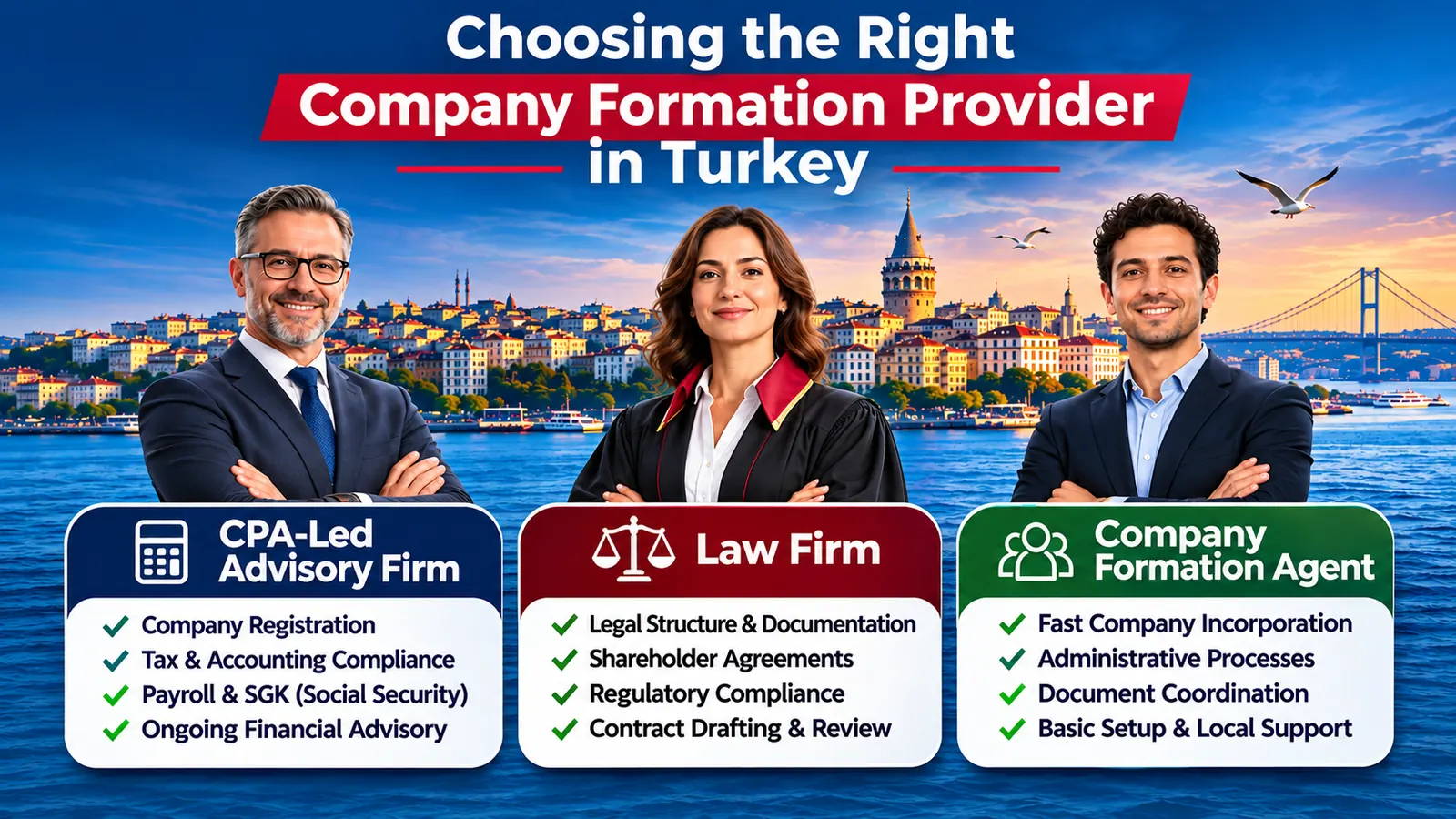
Foreign investors establishing a company in Turkey generally consider three types of professional providers: CPA-led advisory firms, law firms and company formation agents. The right choice depends on the company’s ownership structure, business activities and the level of professional support required after incorporation.
Which provider should you choose? CPA-led advisory firms are particularly suitable for ongoing accounting, taxation and financial compliance. Law firms are essential for complex legal matters and corporate structuring, while formation agents generally focus on administrative registration procedures.
CPA-led advisory firms focus on accounting, taxation, financial reporting and statutory compliance. Depending on their service scope, they may also coordinate company incorporation, tax registration, payroll, social security and work permit procedures.
Their main advantage is continuity: they can support the company’s financial and administrative obligations after incorporation. Learn more about the role of a Certified Public Accountant in Turkey.
Law firms specialise in corporate legal matters, including shareholder agreements, company structures, commercial contracts, corporate governance, mergers and acquisitions, and disputes.
They are particularly important for investments involving complex ownership arrangements or significant legal risks. Accounting, bookkeeping and payroll are generally handled by qualified accounting professionals.
Formation agents typically handle administrative incorporation procedures, document preparation and Trade Registry submissions. They may suit investors with straightforward registration needs who already have separate accounting and legal support.
Investors should confirm whether post-incorporation services are included in the quoted fee.
| Service | CPA-led firm | Law firm | Formation agent |
|---|---|---|---|
| Company incorporation | Yes | Yes | Yes |
| Accounting and bookkeeping | Core service | Usually external | Usually external |
| Tax compliance | Core service | Usually external | Limited |
| Payroll and SGK | Core service | Usually external | Varies |
| Corporate legal advice | Yes | Core service | Limited |
| Corporate amendments | Yes | Legal support | Varies |
For ongoing accounting and tax compliance: A CPA-led advisory firm.
For complex legal structuring and shareholder matters: A law firm.
For basic administrative registration: A company formation agent.
For comprehensive business support: Cooperation between a CPA-led advisory firm and a law firm.
The most appropriate arrangement depends on the company’s specific needs. For many foreign investors, combining financial and tax expertise with access to specialised legal advice provides a practical solution throughout the company’s lifecycle.
The best way to establish a company in Turkey is to choose a professional service provider that can support both incorporation and ongoing business requirements. Foreign investors should consider accounting, taxation, corporate banking, payroll, social security, work permits and sector-specific licences when selecting an advisor. The right choice depends on the company’s ownership structure, business activities and operational needs.
What Should Foreign Investors Know About Company Formation Services in Turkey?
Choosing a provider: CPA-led advisory firms, law firms and formation agents offer different professional services.
Company incorporation: Selecting the appropriate legal structure and completing Trade Registry procedures are the first steps.
Tax and accounting: Companies must meet applicable accounting, bookkeeping and tax compliance obligations.
Corporate banking: Opening a business bank account is subject to the bank’s own identification and compliance procedures.
Employment: Hiring staff involves payroll, employment documentation and social security registration.
Work permits and licences: Foreign nationals and businesses in regulated sectors may require additional authorisations.
Ongoing corporate administration: Capital increases, share transfers, management changes and liquidation may require further professional assistance.
Registering a company with the Turkish Trade Registry establishes the legal entity, but it does not automatically mean that the business is ready to commence all its commercial activities.
After incorporation, foreign-owned companies may need to complete several additional procedures:
Tax registration: Completing the applicable procedures with the Turkish tax administration.
Accounting setup: Establishing bookkeeping and statutory reporting arrangements.
Corporate banking: Opening a business bank account, subject to the bank’s approval.
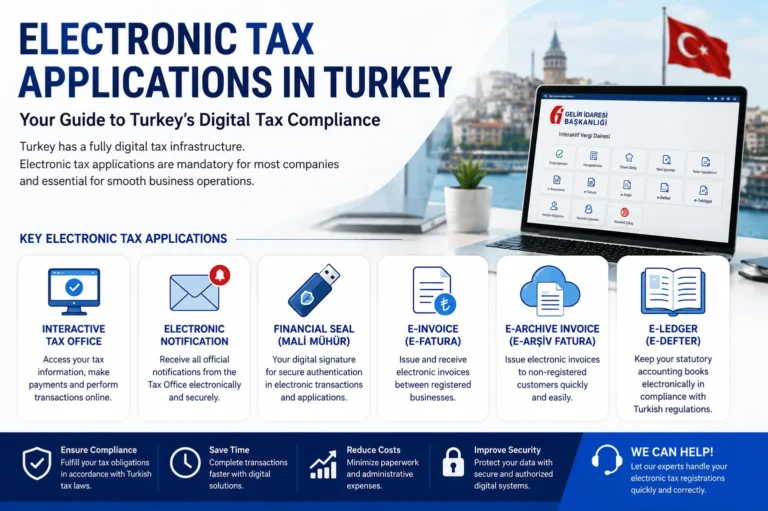
Electronic systems: Assessing applicable e-invoice, e-archive and e-ledger requirements.
Employment: Completing employer and employee registration procedures with the Social Security Institution (SGK).
Work permits: Obtaining the necessary authorisation for foreign nationals who intend to work in Turkey.
Business licences: Securing sector-specific permits where required.
The exact requirements depend on the company’s legal structure, business activities and employment plans. For example, a software company exporting services may have different operational requirements from a manufacturing business or a medical tourism provider.
These matters should be considered before incorporation whenever possible. The proposed business activity and ownership structure can influence both the establishment process and subsequent compliance obligations.
Investors can review the procedures involved in company registration in Turkey.
The key consideration is to plan not only for establishing the company, but also for making it operational and maintaining compliance.
Foreign investors do not necessarily need to travel to Turkey to establish a company. Depending on the circumstances, incorporation procedures can be carried out through an authorised representative acting under a properly executed Power of Attorney (PoA).
A foreign shareholder can appoint a representative in Turkey to handle specific incorporation procedures, including:
Preparing and submitting company registration documents.
Coordinating notarisation and document formalities.
Completing relevant MERSİS applications.
Submitting documents to the Trade Registry.
Following up on registration procedures.
A Power of Attorney issued abroad must meet the applicable formal requirements before it can be used in Turkey. Depending on the issuing country, this may involve notarisation, apostille certification or consular legalisation, followed by sworn translation and notarisation in Turkey where required.
The scope of authority is particularly important. A Power of Attorney prepared for company incorporation may not automatically cover banking transactions, tax procedures, employment matters or subsequent corporate changes.
Investors should therefore ensure that the document clearly identifies the procedures their representative is authorised to perform.
Further information about document requirements and legal formalities is available in our guide to Power of Attorney in Turkey.
Not necessarily. Although incorporation may be completed through representation, banks apply their own identification and customer due diligence procedures. Some may require shareholders or authorised representatives to attend in person.
Foreign investors should clarify these requirements before starting the process to avoid unnecessary travel and delays.
Opening a corporate bank account and completing tax registration are essential steps in preparing a newly established company for business operations in Turkey.
A Turkish company needs a suitable banking arrangement to receive customer payments, pay suppliers and employees, and manage its financial transactions.
Banks conduct their own Know Your Customer (KYC) and compliance assessments. They may request:
Company registration documents and articles of association.
Identification documents of shareholders and authorised signatories.
Information about beneficial owners and the source of funds.
Details of the company’s business activities and expected transactions.
Foreign shareholders and directors may face additional identification requirements. Some banks may request personal attendance.
Importantly, company incorporation does not guarantee bank account approval. Each bank makes its own decision based on its internal policies and compliance procedures.
Further information is available in our guide to business bank accounts in Turkey.
Following incorporation, the company must complete the applicable tax registration procedures with the Turkish Revenue Administration (GİB).
Depending on its activities, the company may be subject to corporate income tax, Value Added Tax (VAT/KDV), withholding tax and other statutory obligations.
Tax registration should be coordinated with the accounting setup to ensure that financial records, tax declarations and payment deadlines are properly managed from the beginning.
Investors can find further guidance on tax registration in Turkey and tax compliance for foreign companies.
Every company operating in Turkey must maintain appropriate accounting records and fulfil its applicable tax and statutory reporting obligations. These responsibilities continue throughout the company’s operations, regardless of its size or level of commercial activity.
Depending on its legal structure and activities, a company’s accounting responsibilities may include:
Recording sales, purchases, expenses and financial transactions.
Maintaining invoices and supporting documentation.
Managing statutory accounting books and records.
Reconciling bank transactions and monitoring receivables and payables.
Preparing financial statements and management reports.
Accurate bookkeeping is essential for monitoring the company’s financial position and supporting its tax declarations.
Turkish companies may have recurring obligations relating to corporate income tax, VAT (KDV), withholding tax and other applicable declarations.
Businesses may also be required to use electronic systems such as:
E-Invoice (e-Fatura): Electronic invoicing for transactions subject to the relevant requirements.
E-Archive (e-Arşiv): Electronic invoice arrangements applicable to qualifying transactions.
E-Ledger (e-Defter): Digital maintenance of statutory accounting books where required.
The applicability of these systems depends on the company’s activities, turnover and current legislation.
Foreign-owned businesses may also need English-language financial reports for overseas shareholders or head offices. These can include profit and loss statements, balance sheets, cash flow information and updates on Turkish tax liabilities.
Choosing an accounting provider with experience in international reporting can help management understand both its financial performance and local compliance responsibilities.
A&M Consulting Co. provides accounting and bookkeeping services in Turkey for foreign-owned businesses requiring ongoing accounting, tax and financial reporting support.
Hiring employees in Turkey creates additional legal, financial and administrative responsibilities for employers. Companies must comply with Turkish labour legislation and complete the required social security and payroll procedures.
Before employees commence work, employers must complete the applicable registration and notification procedures with the Social Security Institution (SGK).
Key responsibilities include:
Registering employees within the statutory deadlines.
Preparing employment contracts and personnel records.
Calculating social security contributions.
Submitting required monthly declarations.
Managing employee commencement and termination notifications.
Failure to fulfil these obligations may result in administrative penalties.
Payroll calculations in Turkey generally involve gross-to-net salary calculations, income tax and social security deductions, employer contributions and other applicable employment payments.
Employers must also manage working hours, annual leave, overtime and termination-related payments in accordance with the applicable labour legislation.
Foreign companies without an established local HR department may consider outsourcing payroll and employment administration. This can simplify local compliance and provide international management with clearer reporting on employment costs.
A&M Consulting Co. provides HR and payroll services in Turkey for foreign companies, including payroll administration and related employment procedures.
Further information about employer registration is available in our guide to social security registration in Turkey.
Registering a company in Turkey does not automatically authorise it to conduct every type of commercial activity. Certain businesses must obtain an operating licence, workplace opening and operating permit or sector-specific approval before commencing operations.
Requirements depend on the company’s actual activities, operating location and applicable regulatory framework. Additional authorisations may apply to businesses operating in sectors such as:
Healthcare and medical tourism.
Tourism and accommodation.
Financial and payment services.
Education.
Manufacturing and other regulated activities.
Depending on the activity, approvals may be issued by ministries, municipalities, regulatory agencies or other competent authorities.
Before starting operations, investors should establish:
Whether the proposed activity requires a specific licence.
Which authority is responsible for the approval.
Whether the business premises must meet particular conditions.
Whether qualified personnel or additional registrations are required.
Whether ongoing reporting or renewal obligations apply.
A company may be legally incorporated but still be unable to conduct certain regulated activities until the necessary approvals have been obtained. These requirements should therefore be assessed during the investment planning and company formation stages.
For further guidance, see our overview of business licence requirements in Turkey.
A company’s corporate structure may change as its business grows, attracts new investors or adapts to changing commercial requirements. Certain changes require formal shareholder or board resolutions, amendments to the articles of association and registration with the relevant Trade Registry.
Typical corporate amendments in Turkey include:
Changes in shareholders or ownership structure.
Appointment or removal of managers and directors.
Changes to the registered business address.
Amendments to the company’s articles of association.
Changes to registered business activities.
Updates to authorised representatives and signatories.
The required procedures depend on the company’s legal form and the nature of the proposed amendment. Limited liability companies (Ltd. Şti.) and joint-stock companies (A.Ş.) may have different approval and documentation requirements.
Corporate changes should also be reflected in the company’s relevant official records, including Trade Registry, tax administration and banking records where applicable.
Incomplete or inconsistent updates may create difficulties with banking transactions, official notifications and future corporate procedures.
Foreign investors should therefore coordinate corporate amendments with accounting, tax and legal specialists as necessary.
For a broader overview, see our guide to corporate changes in Turkey.
As a Turkish company develops, it may need additional capital or changes to its shareholder structure. Capital increases and share transfers are common corporate transactions, but both require compliance with the applicable company law and Trade Registry procedures.
A company may increase its registered capital to finance expansion, strengthen its financial position, meet investment requirements or accommodate new shareholders.
Depending on the company’s legal structure and the method of increase, the process may involve:
Shareholder or general assembly resolutions.
Amendments to the articles of association, where required.
Capital payment documentation.
Preparation of supporting corporate documents.
Registration with the relevant Trade Registry.
The procedures and capital payment requirements differ between limited liability companies (Ltd. Şti.) and joint-stock companies (A.Ş.).
Further information is available in our guide to capital increases in Turkey.
Share transfers may occur when an existing shareholder sells their interest, a new investor joins the company or shareholders reorganise their ownership structure.
The applicable formalities depend on the company’s legal form. Limited liability company share transfers generally involve different documentation and approval requirements from joint-stock company share transfers.
Investors should also consider valuation, contractual arrangements and potential tax consequences before completing a transaction.
For additional guidance, see our article on company share transfers in Turkey.
During its operations, a Turkish company may need to update its registered name, appoint new managers or directors, or relocate its registered office. These changes must be completed through the applicable corporate and Trade Registry procedures.
Typical changes include:
Company name change: Updating the registered trade name and, where required, amending the articles of association.
Manager or director change: Appointing or removing authorised managers, directors or company representatives.
Registered address change: Registering the company’s new official business address.
Depending on the nature of the amendment and the company’s legal structure, shareholder or general assembly resolutions, notarised documents and Trade Registry applications may be required.
Following registration, relevant changes should also be reflected in the company’s tax records, banking information and other applicable official registrations.
Keeping these records consistent helps prevent administrative difficulties and problems with banking transactions or official notifications.
The Turkish Trade Registry plays a central role in company incorporation and corporate administration. Certain corporate decisions and amendments must be registered and, where applicable, published in the Turkish Trade Registry Gazette.
Registration may be required for matters such as:
Company incorporation and amendments to the articles of association.
Appointment or removal of managers and directors.
Registered address and company name changes.
Capital increases and certain share-related transactions.
Changes to authorised representatives.
Depending on the transaction, the required documents may include shareholder or general assembly resolutions, notarised signatures, amended articles of association, identification documents and powers of attorney.
The documentation and approval procedures differ according to the company’s legal structure and the nature of the transaction. Incomplete or inconsistent applications may cause delays or additional administrative work.
Foreign investors should also ensure that corporate records remain consistent with relevant tax, banking and other official records.
For further information, see our guide to Trade Registry procedures in Turkey.
Foreign shareholders may decide to close their Turkish company because of changing business priorities, restructuring or the termination of commercial activities. However, simply stopping operations does not automatically terminate a company’s legal and tax obligations.
The liquidation of a Turkish company generally involves formal corporate decisions and registration procedures. Depending on the company’s legal structure and circumstances, the process may include:
Passing the required shareholder or general assembly resolution.
Appointing a liquidator where applicable.
Completing Trade Registry registration procedures.
Identifying outstanding assets, liabilities and creditor claims.
Preparing the required accounting records and financial statements.
Settling applicable tax and social security obligations.
Completing final liquidation and deregistration procedures.
Companies must continue to fulfil applicable accounting, tax and reporting obligations throughout the liquidation process. Outstanding employee, creditor and tax liabilities should also be addressed before the company can complete its closure.
The duration and complexity of liquidation depend on the company’s financial position, outstanding obligations, assets and corporate structure.
Foreign investors should therefore plan the closure process carefully and coordinate its legal, accounting and tax aspects.
Further information is available in our guide to company winding-up and liquidation in Turkey.
The cost and duration of establishing a company in Turkey depend on its legal structure, ownership arrangements, documentation and operational requirements. Foreign investors should distinguish between initial incorporation expenses and the ongoing costs of running the business.
Typical expenses may include:
Professional company formation and advisory fees.
Trade Registry and government charges.
Notary, translation and document legalisation costs.
Registered office or virtual office expenses.
Initial accounting and tax registration services.
Corporate banking and related administrative expenses.
Additional costs may arise from work permit applications, employee recruitment and sector-specific operating licences.
The incorporation process can be relatively straightforward when all required documents are prepared correctly. However, foreign document legalisation, shareholder arrangements, banking procedures and regulatory approvals may extend the overall timeline.
Investors should also distinguish between the time required to register a company and the time needed to make it fully operational.
A realistic establishment plan should therefore include separate milestones for incorporation, banking, tax registration, recruitment and licensing.
Before appointing a provider, investors should request a written quotation clearly identifying included services, third-party expenses, recurring fees and estimated timelines.
Establishing and operating a company in Turkey involves several interconnected responsibilities, including company administration, accounting, taxation, payroll, social security and regulatory compliance. Working with multiple providers for these matters can make communication difficult, increase administrative workload and create coordination gaps.
A single point of contact helps foreign investors manage these responsibilities more efficiently. Among professional service providers, CPA-led advisory firms are particularly well positioned to fulfil this role, thanks to their expertise in financial, accounting and tax matters and their ongoing involvement in a company’s statutory obligations.
A CPA-led advisory firm can support a company’s financial and administrative needs throughout its lifecycle, from incorporation to ongoing operations and eventual liquidation.
Depending on its service scope, this support may include:
Company formation and registration: Coordinating incorporation and initial administrative procedures.
Accounting and bookkeeping: Maintaining statutory records and monitoring financial transactions.
Tax compliance and advisory: Managing tax declarations, reporting obligations and tax-related matters.
Payroll and social security: Coordinating payroll, employment records and SGK procedures.
Corporate administration: Supporting Trade Registry procedures and corporate documentation.
Capital increases and share transfers: Coordinating the financial and administrative aspects of ownership and capital changes.
Management and corporate changes: Supporting director or manager changes, registered address updates and amendments to company details.
Company liquidation: Managing the accounting, tax and administrative aspects of winding-up procedures.
Financial reporting: Providing financial statements and management reports to overseas shareholders.
Investment incentives and business licences: Coordinating relevant applications and procedures with the competent authorities and specialist professionals.
Work permit coordination: Supporting the employer-related and administrative aspects of work permit applications.
Corporate banking support: Coordinating documentation and communication for business bank account applications.
CPA firms do not replace law firms or other regulated specialists. Complex legal structuring, shareholder agreements, litigation and specialised legal advice should be handled by qualified lawyers.
However, a CPA-led advisory firm can act as the central coordinator of a company’s financial and administrative matters, working with lawyers, banks and other specialists whenever necessary.
For foreign investors, this model offers continuity, clearer communication and a professional relationship that can support the business beyond its initial incorporation.
Choosing a company formation provider should not be based solely on the initial incorporation fee. Foreign investors should consider whether the provider can continue supporting the company as its operations, workforce and compliance requirements develop.
Before making a decision, consider the following factors:
Professional qualifications: Verify the provider’s professional credentials and relevant experience in Turkey.
International client experience: Look for experience working with foreign shareholders, overseas management teams and cross-border business structures.
Service scope: Check whether accounting, taxation, payroll, social security and corporate administration can be coordinated through one provider.
English-language communication: Ensure that reports, explanations and ongoing correspondence are available in a language your management team understands.
Transparent fees: Request a clear breakdown of professional fees, government charges and third-party costs.
Long-term support: Confirm that the provider can assist with future corporate changes, tax matters, employment requirements and other operational needs.
The right advisory partner should offer more than company registration. It should provide reliable professional support throughout the company’s lifecycle in Turkey.
A&M Consulting Co. provides comprehensive company formation, accounting, tax and business consultancy services to local and international investors establishing or operating businesses in Turkey. We support foreign entrepreneurs throughout the company formation process and help them manage the financial, tax and administrative responsibilities that follow incorporation.
Our services cover the full business lifecycle, from selecting the appropriate company structure and completing registration procedures to ongoing accounting, tax compliance, payroll and corporate administration.
Our services include:
Company Formation and Registration: Assistance with company registration in Turkey, including limited liability companies (Ltd. Şti.), joint-stock companies (A.Ş.) and other suitable business structures.
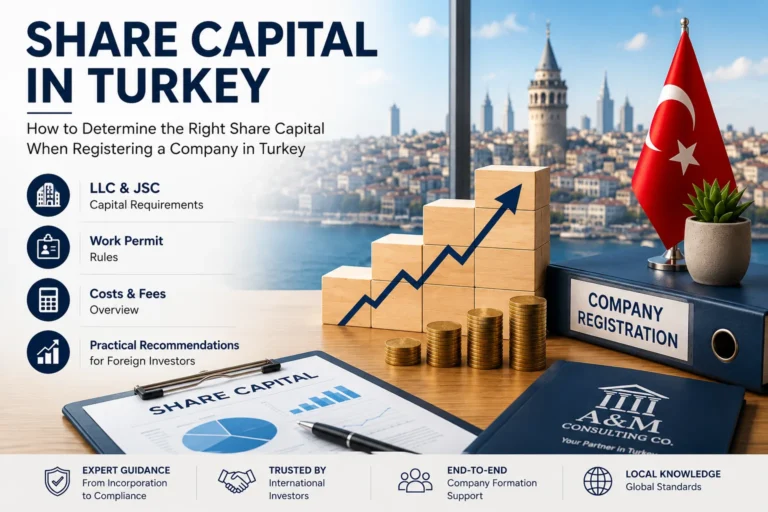
Corporate Structure and Establishment Advisory: Guidance on ownership structure, share capital, company management and incorporation requirements for foreign investors.
Power of Attorney and Remote Incorporation: Coordination of incorporation procedures for investors who cannot travel to Turkey, including documentation and Power of Attorney arrangements.
Tax Registration and Compliance: Assistance with tax registration in Turkey and ongoing corporate tax, VAT, withholding tax and statutory declaration obligations.
Accounting and Financial Reporting: Accounting and bookkeeping services, including statutory records, financial statements, tax reporting and management reports.
Electronic Tax Applications: Support with e-Fatura, e-Arşiv Fatura, e-Defter and other applicable electronic tax systems.
Corporate Banking Support: Assistance with documentation and coordination for business bank account applications, subject to each bank’s own compliance and approval procedures.
HR, Payroll and Social Security: Outsourced HR and payroll services, including payroll calculations, employment documentation and SGK compliance.
Work Permit Coordination: Administrative support for work permit applications involving foreign shareholders, directors and employees.
Business Licence Coordination: Assistance in identifying applicable licensing requirements and coordinating procedures with relevant authorities and specialist professionals.
Corporate Changes and Capital Transactions: Support with capital increases, share transfers, changes in company management, registered address updates and other corporate amendments.
Company Liquidation: Accounting, tax and administrative support throughout company winding-up procedures.
Whether you are an international entrepreneur planning to establish a new business, a foreign company entering the Turkish market or an existing investor seeking ongoing professional support, A&M Consulting Co. can help coordinate your company’s financial and administrative requirements in Turkey.
With more than 20 years of professional experience, we provide practical accounting, tax and business consultancy through English-language communication, financial reporting and ongoing professional support. As a CPA-led advisory firm, we aim to provide foreign investors with a reliable central point of contact throughout their company’s lifecycle.
Contact A&M Consulting Co. to discuss your company formation plans, accounting and tax requirements or ongoing business operations in Turkey.
It depends on your requirements. A CPA firm is generally focused on accounting, taxation, financial reporting and ongoing corporate compliance. A law firm focuses on legal structuring, contracts, shareholder agreements and other legal matters. Investors seeking both types of support may work with a CPA-led advisory firm that coordinates financial and administrative matters alongside qualified legal professionals.
A company formation agency typically focuses on incorporation procedures, document preparation and Trade Registry applications. A CPA firm can provide broader support, including company registration, accounting, tax compliance, payroll, social security and ongoing financial reporting. The actual scope of services depends on the provider.
Not every company incorporation requires both. An accountant or CPA-led advisory firm can coordinate incorporation and financial and tax procedures. A lawyer may be necessary for complex ownership structures, shareholder agreements, legal risk assessments or specialised corporate legal matters.
A CPA-led advisory firm can coordinate many aspects of company formation, including registration documentation, tax registration, accounting setup and post-incorporation compliance. However, legal services requiring a qualified lawyer and approvals requiring specialised professionals must be handled by the relevant authorised specialists.
Law firms primarily provide legal services. Accounting, bookkeeping, tax declarations, payroll and social security compliance generally fall within the scope of accounting and financial advisory professionals. Investors should clarify whether these services are provided directly or through separate professional providers.
The appropriate provider depends on the company’s ongoing needs. Businesses requiring regular accounting, tax, payroll and financial reporting support may benefit from a CPA-led advisory firm. Companies dealing with complex legal transactions may also require a dedicated law firm. These professional relationships can complement each other.
Investors should assess professional qualifications, experience with international clients, service scope, English-language communication, transparent fees and post-incorporation support. It is also important to understand who will handle accounting, taxation, payroll, banking coordination and future corporate changes.
Not necessarily. A low incorporation fee may cover only registration procedures and exclude tax registration, accounting setup, electronic tax applications and ongoing compliance. Investors should compare the complete service scope and potential additional costs rather than focusing only on the initial price.
For investors planning to operate in Turkey, ongoing support can be important. Accounting, tax compliance, payroll, social security, corporate changes and financial reporting continue after registration. A provider with a broader service scope can help coordinate these responsibilities.
Foreign-owned businesses may have additional requirements involving overseas shareholders, foreign documents, beneficial ownership information, international reporting and communication with headquarters abroad. Experience with international clients can help the advisory firm understand and coordinate these requirements more effectively.
No. CPA firms and lawyers have different professional responsibilities. A CPA firm can manage accounting, taxation, financial reporting and related administrative matters, while legal advice, litigation, legal representation and specialised legal drafting should be handled by qualified lawyers.
Yes. Some CPA-led advisory firms offer integrated services covering incorporation, accounting, tax compliance, payroll and social security. This arrangement can reduce the need to coordinate several separate providers. However, specialised legal and regulatory matters may still require external professionals.
These transactions involve corporate documentation, registration procedures and potentially significant tax and financial implications. A CPA-led advisory firm can coordinate their financial and administrative aspects, while legal drafting and specialised legal advice should be obtained from qualified lawyers where required.
Investors should check whether the professionals responsible for the services hold the relevant Turkish professional qualifications and are authorised to provide the services offered. They should also ask about experience with foreign-owned companies, English-language reporting and the specific responsibilities included in the engagement.
A single point of contact can simplify communication and coordination across accounting, taxation, payroll and corporate administration. A CPA-led advisory firm can monitor these interconnected financial and statutory responsibilities and coordinate with banks, lawyers and other specialists when necessary.
A&M Consulting Co. is a CPA-led business advisory firm providing company formation, accounting, tax compliance, payroll, social security and corporate administrative support. We also coordinate capital increases, share transfers, management changes, work permit procedures and company liquidation. Our English-language services help international investors manage their Turkish business requirements through a central professional contact.

Certified Public Accountant (CPA)



WhatsApp Us