
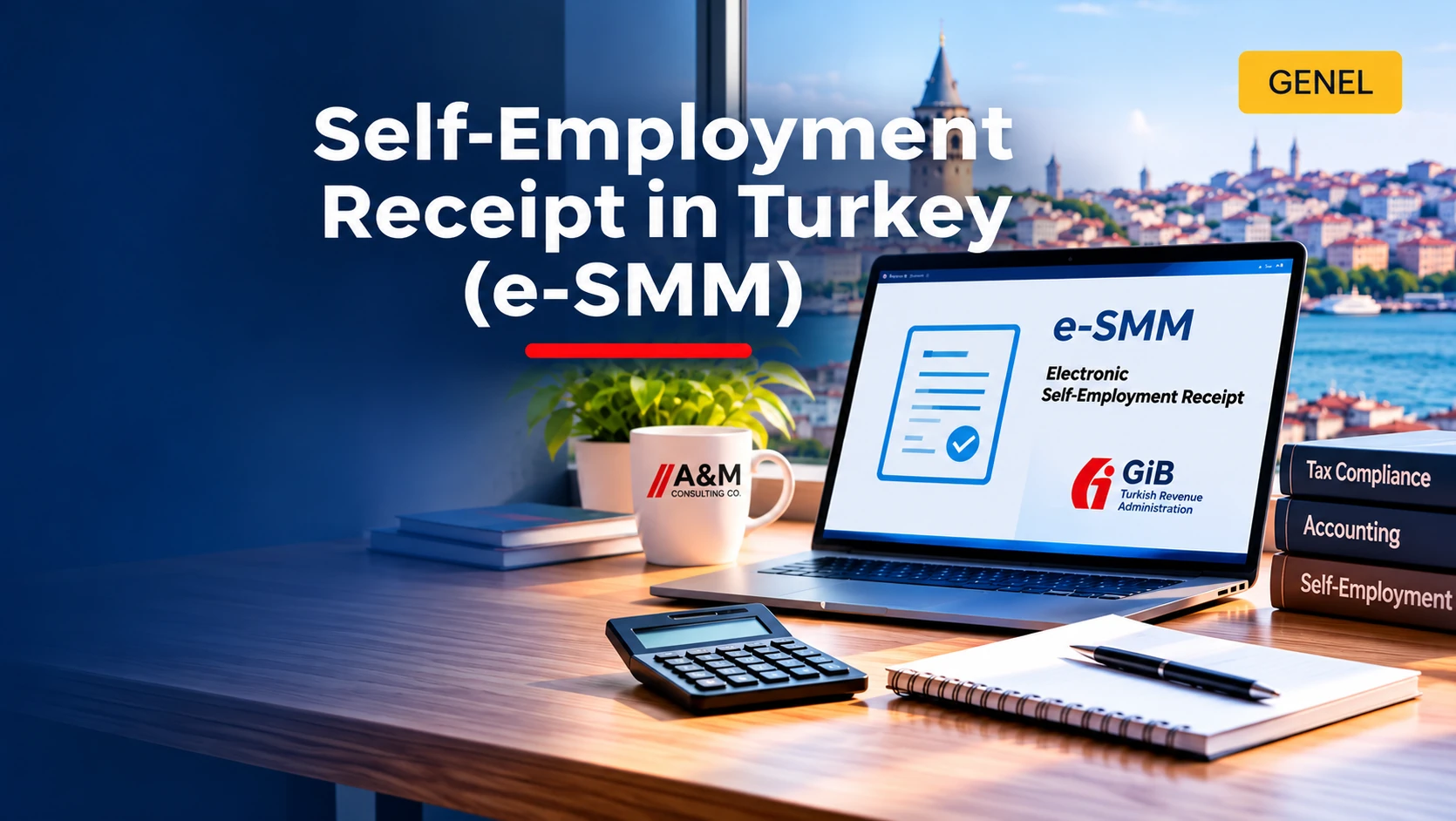
A Self-Employment Receipt (Serbest Meslek Makbuzu – SMM) is a type of invoice issued in Turkey by self-employed professionals to document payments received in return for their professional services. It is an official tax document used to record professional income and fulfil tax documentation obligations.
The legal basis for issuing Self-Employment Receipts is established under Article 236 of Tax Procedure Law No. 213. Meanwhile, Article 65 of Income Tax Law No. 193 defines self-employment activities and self-employment income.
Self-employed professionals in Turkey are generally required to issue a Self-Employment Receipt when collecting fees for their professional services. The electronic version, known as the Electronic Self-Employment Receipt (e-Serbest Meslek Makbuzu – e-SMM), is issued digitally through the electronic document system administered by the Turkish Revenue Administration (GİB).
Understanding the Self-Employment Receipt system is essential for independent professionals, businesses and foreign companies receiving professional services in Turkey. Particular attention must be paid to Value Added Tax (VAT), income tax withholding (stopaj) and electronic document obligations.
This guide explains the legal framework, issuance requirements and tax implications of Self-Employment Receipts in Turkey, including e-SMM procedures and how VAT and withholding tax are calculated.
Under Turkish tax legislation, individuals who regularly carry out self-employment activities on their own behalf and account are generally classified as self-employed professionals (serbest meslek erbabı) and are required to issue Self-Employment Receipts for payments received in connection with their professional activities.
Article 65 of Income Tax Law No. 193 defines self-employment activities as activities that primarily rely on personal labour, scientific or professional knowledge, or specialized expertise rather than capital. These activities must be performed independently, under the individual’s own responsibility and without being subject to an employer.
Article 66 of the same law further defines who is considered a self-employed professional. Accordingly, individuals who regularly perform qualifying professional activities are generally subject to the relevant self-employment tax and documentation requirements.
Depending on the nature of their activities and legal status, the following professionals may be required to issue Self-Employment Receipts in Turkey:
Lawyers and independent legal consultants
Certified public accountants and independent financial advisors
Doctors and independent healthcare professionals
Architects and engineers
Independent management and business consultants
Freelance teachers and trainers
Writers, artists and other creative professionals
Other individuals providing professional services independently
Article 236 of Tax Procedure Law No. 213 requires self-employed professionals to issue a Self-Employment Receipt for collections related to their professional activities and provide the document to their customers.
This obligation applies to professional service payments collected in the course of their self-employment activities. The receipt must document the relevant payment and applicable tax components.
Not necessarily. The tax treatment depends on the actual nature of the activity and the legal relationship between the service provider and the customer.
For example, an individual providing services independently under their own responsibility may be considered self-employed and required to issue a Self-Employment Receipt. However, where the relationship is legally an employment relationship, the payments are generally treated as employment income and documented through payroll rather than a Self-Employment Receipt.
Similarly, activities classified as commercial income rather than self-employment income may require the issuance of a commercial invoice instead.
Therefore, determining whether a professional must issue a Self-Employment Receipt requires an assessment of the nature of the activity, the way the services are performed and the applicable tax classification.
An Electronic Self-Employment Receipt (e-SMM) is the digital version of the traditional Self-Employment Receipt (SMM) used by self-employed professionals in Turkey. It is an official electronic tax document issued to record payments received for professional services.
The e-SMM system is regulated by the Turkish Revenue Administration (Gelir İdaresi Başkanlığı – GİB) under Tax Procedure Law No. 213 and the relevant General Communiqué on Tax Procedure Law, particularly Communiqué No. 509.
Yes. Self-employed professionals who are exempt from taxation are generally required to issue their Self-Employment Receipts electronically through the e-SMM system.
Under the applicable regulations, professionals who were already operating as of February 1, 2020, were required to transition to the e-SMM system by June 1, 2020. Those who commenced their activities on or after February 1, 2020, must register for the system by the end of the third month following the month in which they started their activities.
Consequently, e-SMM has become the standard method for issuing Self-Employment Receipts in Turkey.
Self-employed professionals can issue e-SMM documents through the following methods:
GİB Portal: The electronic application provided by the Turkish Revenue Administration.
Private Integrators: Authorized private service providers offering e-SMM software and electronic document services.
Direct Integration: Businesses with suitable technical infrastructure can integrate their own systems directly with the GİB platform.
Depending on the selected method, an electronic signature or financial seal may be required to authenticate the documents.
An e-SMM generally includes the following information:
Name, surname and tax identification details of the service provider
Name, surname or legal name and tax identification details of the customer
Date and unique serial number of the receipt
Description of the professional service
Gross service fee
Applicable VAT amount
Income tax withholding amount, where applicable
Total amount payable or collected
Electronic verification information, including a QR code where applicable
An e-SMM is created and stored electronically. It can be delivered to the customer electronically or, upon request, through a printed paper copy in accordance with the applicable procedures.
The self-employed professional must also retain the electronic document and make it available to the tax authorities when required.
Important: Issuing an e-SMM does not require the professional to register separately for the e-Invoice system merely because they use e-SMM. These are separate electronic document applications with different purposes and requirements.
In Turkey, a Self-Employment Receipt (Serbest Meslek Makbuzu – SMM) and a commercial invoice (Fatura) are two different types of tax documents used to record transactions and professional or commercial income.
The main difference is the nature of the activity performed by the service provider or seller. A Self-Employment Receipt is issued by self-employed professionals for their professional services, whereas a commercial invoice is generally issued by businesses and merchants for the sale of goods or the provision of services within the scope of their commercial activities.
Both documents are regulated under Tax Procedure Law No. 213:
Commercial Invoice: Articles 229–231 define the invoice and establish the rules for its issuance and required contents.
Self-Employment Receipt: Articles 236–237 regulate the obligation to issue a Self-Employment Receipt and specify its required contents.
Article 236 requires self-employed professionals to issue a Self-Employment Receipt for collections related to their professional activities and provide a copy to the customer.
| Criteria | Self-Employment Receipt (SMM) | Commercial Invoice (Fatura) |
|---|---|---|
| Issued by | Self-employed professionals | Merchants and businesses |
| Main purpose | Documenting income from independent professional activities | Documenting sales of goods and commercial services |
| Legal basis | VUK Articles 236–237 | VUK Articles 229–231 |
| Income classification | Self-employment income | Commercial income |
| VAT | Applied where the service is subject to VAT | Applied where the transaction is subject to VAT |
| Income tax withholding | Must apply depending on the customer and transaction | Generally not applicable to ordinary commercial sales |
| Electronic format | e-SMM | e-Invoice or e-Archive Invoice, where applicable |
As a general rule, a self-employed professional must issue a Self-Employment Receipt for income generated from their qualifying professional activities. A commercial invoice is not a substitute for an SMM merely because the professional or customer prefers to use an invoice.
The appropriate document depends on the legal and tax classification of the activity. If an individual’s activity is classified as commercial rather than self-employment activity, the relevant commercial invoicing rules apply.
Yes. A company in Turkey can receive a Self-Employment Receipt from an independent professional providing services within the scope of self-employment activities.
For example, when a Turkish company receives independent legal, accounting, engineering or consulting services from a self-employed professional, the professional generally issues an SMM or e-SMM rather than a commercial invoice.
The company must record the document in its accounting records and apply any relevant VAT deduction and income tax withholding rules, subject to the applicable legislation.
Therefore, the distinction between an SMM and a commercial invoice is determined primarily by the nature of the service provider’s activity and tax status, not simply by whether the customer is an individual or a company.
Self-employment services provided in Turkey are generally subject to Value Added Tax (VAT), known in Turkish as Katma Değer Vergisi (KDV). Therefore, self-employed professionals must calculate and declare VAT on their professional service fees when issuing a Self-Employment Receipt (SMM or e-SMM).
The general VAT rate in Turkey is 20%. However, certain professional services may qualify for reduced VAT rates or specific exemptions, depending on the nature of the service and the applicable legislation.
Unless a specific reduced rate or exemption applies, self-employed professionals must generally charge 20% VAT on their professional service fees.
VAT is calculated on the gross professional service fee before income tax withholding (stopaj). The applicable VAT amount is added to the service fee and shown separately on the Self-Employment Receipt.
For example, if a self-employed professional provides a consulting service for TRY 100,000, the calculation would be as follows, assuming the standard 20% VAT rate applies:
| Description | Amount (TRY) |
|---|---|
| Professional Service Fee | 100,000 |
| VAT (20%) | 20,000 |
| Total Amount | 120,000 |
If the customer is subject to income tax withholding, the withholding amount is calculated separately. It does not reduce the VAT taxable base.
The self-employed professional is responsible for calculating, declaring and paying the VAT arising from their professional activities.
The customer pays the VAT amount together with the service fee. Where applicable, the customer may also have an obligation to withhold income tax from the professional fee and remit it to the tax office on behalf of the service provider.
Businesses that meet the statutory requirements may generally deduct VAT shown on properly issued Self-Employment Receipts as input VAT, subject to the applicable VAT legislation.
The VAT treatment of professional services provided to foreign customers depends on the nature of the service, the customer’s status and where the service is utilized.
Certain services provided to customers abroad may qualify for the VAT exemption for services exported under Article 11/1-a and Article 12/2 of VAT Law No. 3065, provided that all statutory conditions are satisfied.
In particular, the service must be provided to a customer abroad and utilized abroad. Merely issuing a Self-Employment Receipt to a foreign customer or receiving payment in a foreign currency does not automatically qualify the service for VAT exemption.
An important point is that if the benefit of the service is utilized in Turkey, VAT must generally be charged, even if the customer is a foreign company or individual. For example, if a self-employed professional in Turkey provides consulting services to a foreign company but the results and benefits of those services are used in Turkey, the service will generally be subject to Turkish VAT.
The applicable VAT treatment should therefore be assessed based on the specific service and the relevant statutory conditions.
Income tax withholding (stopaj) is a tax deduction applied to certain payments made to self-employed professionals in Turkey. Under Article 94 of Income Tax Law No. 193, designated individuals and entities making payments for professional services are required to deduct income tax withholding from the professional fee and declare with WHT Tax Return then remit it to the tax office on behalf of the service provider.
Withholding tax is generally an advance payment of the self-employed professional’s income tax. The amount withheld is credited against the professional’s annual income tax liability, subject to the applicable tax rules.
The standard income tax withholding rate for payments made to self-employed professionals is generally 20%.
However, a reduced rate of 17% applies to certain self-employment activities falling within the scope of Article 18 of Income Tax Law No. 193, including qualifying literary, artistic and creative activities.
The applicable rates are as follows:
| Type of Professional Service | Withholding Tax Rate |
|---|---|
| General self-employment services | 20% |
| Qualifying activities under Article 18 of Income Tax Law | 17% |
The applicable rate depends on the nature of the professional activity and the relevant tax legislation.
The customer making the payment is responsible for deducting and remitting withholding tax when they fall within the categories of withholding agents specified under Article 94 of Income Tax Law No. 193.
These generally include:
Companies and commercial enterprises
Public institutions and government entities
Associations and foundations
Cooperatives
Certain self-employed professionals and other taxpayers required to withhold tax under the legislation
Where the customer is not legally required to withhold tax, the payment is generally made without income tax withholding. The professional remains responsible for declaring their income and fulfilling their own tax obligations.
Withholding tax is calculated on the gross professional service fee, excluding VAT. It is deducted from the amount payable to the self-employed professional.
For example, assume a consultant provides professional services worth TRY 100,000, subject to 20% VAT and 20% income tax withholding.
The calculation would be as follows:
| Description | Amount (TRY) |
|---|---|
| Gross Professional Service Fee | 100,000 |
| VAT (20%) | 20,000 |
| Income Tax Withholding (20%) | (20,000) |
| Net Amount Payable to the Professional | 100,000 |
In this example, the customer pays TRY 100,000 to the professional and remits TRY 20,000 in withholding tax to the tax office on the professional’s behalf. The total payment, including the VAT component, is TRY 120,000.
No. Income tax withholding and VAT are two separate tax components.
Withholding tax is calculated on the gross professional service fee, excluding VAT. VAT is calculated separately and added to the service fee.
The customer deducts the applicable withholding tax from the professional’s receivable and pays the VAT as part of the total amount due, subject to the applicable VAT rules.
No. Withholding tax is not automatically applied to every Self-Employment Receipt. Its application depends primarily on the customer’s legal status and whether the customer is classified as a withholding agent under Article 94 of Income Tax Law No. 193.
For example, when a Turkish company receives consulting services from an independent professional, it will generally be required to deduct 20% withholding tax from the professional fee. However, when the customer is an individual who is not required to withhold tax, the payment is generally made without this deduction.
Therefore, both the service provider’s activity and the customer’s tax status must be considered when determining the applicable withholding tax treatment.
Calculating a Self-Employment Receipt (SMM or e-SMM) in Turkey requires considering three main components: the gross professional service fee, Value Added Tax (VAT) and income tax withholding (stopaj), where applicable.
The withholding tax is calculated on the gross professional service fee, excluding VAT. VAT is then added to the service fee, while the applicable withholding tax is deducted from the amount payable to the self-employed professional.
The following examples illustrate how these amounts are calculated under the standard assumptions of 20% VAT and 20% income tax withholding.
Assume a self-employed consultant provides services to a Turkish company for a gross professional fee of TRY 100,000.
The customer is subject to income tax withholding at 20%, and the service is subject to the standard 20% VAT rate.
The calculation is as follows:
| Description | Calculation | Amount (TRY) |
|---|---|---|
| Gross Professional Service Fee | — | 100,000 |
| VAT (20%) | 100,000 × 20% | 20,000 |
| Income Tax Withholding (20%) | 100,000 × 20% | (20,000) |
| Net Amount Payable to the Professional | 100,000 + 20,000 − 20,000 | 100,000 |
In this example:
The self-employed professional receives TRY 100,000 from the customer.
The customer deducts TRY 20,000 as income tax withholding and remits it to the tax office.
The customer pays TRY 100,000 directly to the professional.
The professional accounts for the TRY 20,000 VAT in their VAT return, subject to the applicable rules.
The customer’s total financial obligation is TRY 120,000, consisting of TRY 100,000 paid to the professional and TRY 20,000 remitted as withholding tax.
In some professional service agreements, the parties agree on the amount the professional should receive after income tax withholding.
For example, assume a consultant and a Turkish company agree that the consultant must receive TRY 100,000 after 20% withholding tax.
In this case, the gross professional service fee must be calculated by adding back the withholding tax.
The calculation is as follows:
| Description | Calculation | Amount (TRY) |
|---|---|---|
| Agreed Net Professional Fee | — | 100,000 |
| Gross Professional Service Fee | 100,000 ÷ 80% | 125,000 |
| VAT (20%) | 125,000 × 20% | 25,000 |
| Income Tax Withholding (20%) | 125,000 × 20% | (25,000) |
| Amount Paid Directly to the Professional | 125,000 + 25,000 − 25,000 | 125,000 |
In this example, the professional receives TRY 125,000 directly, including TRY 25,000 VAT. The customer separately remits TRY 25,000 withholding tax to the tax office.
The customer’s total financial obligation is TRY 150,000.
Important: The agreed net professional fee of TRY 100,000 is the amount remaining after income tax withholding, excluding VAT. VAT is an additional amount and should not be treated as part of the professional’s income.
If the customer is not legally required to deduct income tax withholding, the payment is generally made without stopaj.
For example, assume a self-employed professional provides services worth TRY 100,000 to an individual customer who is not a withholding agent.
| Description | Amount (TRY) |
|---|---|
| Gross Professional Service Fee | 100,000 |
| VAT (20%) | 20,000 |
| Income Tax Withholding | 0 |
| Total Amount Payable | 120,000 |
In this case, the professional receives TRY 120,000 from the customer and remains responsible for fulfilling their applicable income tax obligations.
When calculating an SMM or e-SMM in Turkey, the following points should be considered:
VAT is calculated on the gross professional service fee.
Income tax withholding is calculated separately on the professional service fee, excluding VAT.
The withholding rate generally depends on the nature of the activity and the applicable legislation.
Whether withholding applies depends on the customer’s legal status and withholding obligations.
Where the parties agree on a net professional fee, the gross service fee must be calculated by taking the applicable withholding rate into account.
The actual calculation may differ depending on the nature of the professional activity, applicable VAT rate, withholding obligations and any relevant exemptions.
When a Self-Employment Receipt (SMM or e-SMM) is issued in Turkey, both the service provider and the customer may have tax obligations. However, their responsibilities differ depending on the type of tax.
The self-employed professional is generally responsible for declaring and paying VAT, while the customer may be required to deduct income tax withholding (stopaj) and remit it to the tax office.
For more information about income tax in Turkey, including applicable tax rates, tax brackets, deductible expenses, tax declarations and payment obligations, please refer to our comprehensive guide: Income Tax in Turkey.
The self-employed professional is responsible for calculating, declaring and paying the VAT arising from their professional services.
The VAT amount is added to the professional service fee and collected from the customer. The professional subsequently reports the VAT in their VAT return and pays any resulting tax liability to the tax office.
For example, if a professional provides consulting services worth TRY 100,000 and the applicable VAT rate is 20%, the customer is charged an additional TRY 20,000 in VAT.
The professional collects TRY 120,000 in total, including VAT, and accounts for the VAT in accordance with Turkish tax regulations.
When the customer is classified as a withholding agent under Article 94 of Income Tax Law No. 193, the customer is responsible for deducting the applicable income tax withholding from the gross professional service fee and declare it with WHT tax return then remitting it to the tax office.
The withholding amount is deducted from the payment otherwise payable to the professional. It represents an advance payment of the professional’s income tax rather than an additional tax charged on top of the agreed gross service fee.
For example, if the gross professional service fee is TRY 100,000 and the applicable withholding rate is 20%, the customer must deduct TRY 20,000 and pay this amount to the tax office on behalf of the professional.
The responsibilities can be summarized as follows:
| Tax Obligation | Self-Employed Professional | Customer |
|---|---|---|
| Issuing SMM or e-SMM | Responsible | Receives the document |
| Calculating VAT | Responsible | Pays VAT to the professional |
| Declaring VAT | Responsible | May deduct eligible input VAT |
| Deducting income tax withholding | No deduction from own payment | Responsible, where legally required |
| Remitting withholding tax | Not responsible for the customer’s deduction | Responsible |
| Declaring annual self-employment income | Responsible | Not responsible for the professional’s annual income tax return |
Yes. A business receiving a properly issued Self-Employment Receipt may generally deduct the VAT shown on the document as input VAT, provided that the statutory requirements for VAT deduction under VAT Law No. 3065 are satisfied.
The customer must record the document in its accounting records and comply with the applicable VAT deduction and reporting requirements.
Yes. Income tax withholding is generally an advance tax payment and does not automatically settle the professional’s entire annual income tax liability.
The self-employed professional must calculate their taxable self-employment income in accordance with the applicable rules and fulfil their annual income tax declaration obligations where required. Eligible withholding amounts are taken into account when determining the final income tax payable.
Therefore, VAT and income tax withholding serve different purposes: VAT is a transaction tax, whereas withholding tax is an advance collection of income tax.
Yes. Foreign companies can receive a Self-Employment Receipt (SMM or e-SMM) from self-employed professionals registered in Turkey when they purchase professional services from them.
For example, if a Turkish-based independent consultant, accountant, engineer or legal professional provides services to a company established abroad, the professional may issue an e-SMM to document the payment received for those services.
When issuing an e-SMM to a foreign customer, the self-employed professional must record the customer’s relevant identification and address information in accordance with the applicable electronic document requirements.
Depending on the customer’s legal status and the information available, the foreign company’s legal name, registered address and applicable foreign tax identification details may be included in the document.
The e-SMM must accurately reflect the professional service fee and the applicable tax treatment.
Not necessarily. The VAT treatment depends primarily on where the service is utilized.
If the service is provided to a foreign customer and its benefit is utilized outside Turkey, the transaction may qualify for the VAT exemption for exported services, provided that the conditions under Articles 11 and 12 of VAT Law No. 3065 are satisfied.
However, if the benefit of the service is utilized in Turkey, the service will generally remain subject to Turkish VAT, even if the customer is a foreign company.
Income tax withholding under Article 94 of Income Tax Law No. 193 generally applies to payments made by persons and entities designated as withholding agents under Turkish legislation.
A foreign company with no relevant withholding obligations in Turkey will generally not deduct Turkish income tax withholding merely because it receives an e-SMM from a Turkish professional.
However, where the foreign company has a presence or otherwise falls within the scope of Turkish withholding obligations, the applicable rules must be assessed based on its circumstances.
Foreign companies receiving an e-SMM from a Turkish professional should consider the following:
The legal and tax status of the service provider.
Whether the professional service qualifies for VAT exemption.
Whether the service is utilized in Turkey or abroad.
Whether any Turkish income tax withholding obligation applies.
The accounting and tax documentation requirements in the company’s country of residence.
The correct tax treatment should be determined based on the actual service, the parties’ legal status and the applicable Turkish tax legislation.
Yes. Foreign nationals may be able to register as self-employed professionals and issue Self-Employment Receipts (SMM or e-SMM) in Turkey, provided that they meet the applicable legal, tax registration and immigration requirements.
Foreign nationals who intend to carry out independent professional activities in Turkey must establish the appropriate tax status and fulfil the relevant registration obligations before commencing their activities.
Foreign nationals planning to operate as self-employed professionals in Turkey should consider the following requirements:
Legal right to work: Foreign nationals must have the appropriate legal authorization to perform independent professional activities in Turkey. Depending on their circumstances, a work permit or another applicable legal authorization may be required.
Tax registration: The individual must complete the necessary registration with the Turkish tax authorities.
Professional qualifications: Certain regulated professions may require specific qualifications, professional registration or recognition of foreign credentials in Turkey.
Electronic document registration: Eligible professionals must register for the e-SMM system and issue their receipts electronically in accordance with the applicable regulations.
Tax compliance: The individual must fulfil applicable VAT, income tax declaration and other statutory obligations.
Having a residence permit does not automatically grant a foreign national the right to work independently in Turkey.
Foreign nationals intending to provide professional services independently must assess their work authorization requirements under Turkish immigration and labour legislation. The applicable rules depend on their nationality, residence status, professional activity and legal circumstances.
For more information about work permit requirements, application procedures and eligibility conditions, please refer to our comprehensive guide: Work Permit in Turkey.
Once properly registered and legally authorized to carry out their professional activities, foreign self-employed professionals may issue e-SMM documents to eligible customers in Turkey and abroad.
The applicable VAT and income tax withholding treatment depends on the nature of the service, the customer’s status and where the service is utilized.
Foreign nationals planning to provide independent professional services in Turkey should therefore obtain tax and legal advice before starting their activities.
Self-employed professionals in Turkey are subject to several tax and accounting obligations arising from their professional activities. These obligations include income tax, Value Added Tax (VAT), electronic document issuance, bookkeeping and statutory tax declarations.
The applicable requirements depend on the nature and scale of the professional activity, the individual’s tax status and any relevant exemptions.
Self-employed professionals are generally subject to personal income tax on their net self-employment earnings.
Under Income Tax Law No. 193, taxable self-employment income is determined by deducting eligible business-related expenses from gross professional revenue in accordance with the applicable tax rules.
Turkey applies progressive income tax rates to individual income. The applicable tax rate depends on the individual’s total taxable income and the relevant tax brackets for the year.
Self-employed professionals must fulfil their annual income tax declaration obligations and pay the resulting tax liability within the statutory deadlines.
Self-employment services are generally subject to VAT unless a specific exemption or reduced rate applies.
Professionals must:
Calculate VAT on taxable professional services.
Issue the relevant SMM or e-SMM.
Submit periodic VAT returns.
Pay any resulting VAT liability within the applicable deadlines.
Eligible input VAT incurred on business-related purchases and expenses may generally be deducted from output VAT, subject to the requirements of VAT Law No. 3065.
For more information about please refer to our comprehensive guide: VAT Registration in Turkey, also VAT rates, exemptions, VAT returns and compliance requirements in Turkey, please refer to our comprehensive guide: VAT in Turkey.
Where payments are made by customers classified as withholding agents under Article 94 of Income Tax Law No. 193, the applicable income tax withholding must be deducted from the gross professional service fee.
The customer is responsible for declaring and remitting the withheld amount to the tax office. The professional can generally credit the withheld tax against their annual income tax liability, subject to the applicable rules.
For a more detailed explanation of income tax withholding (stopaj) in Turkey, including applicable withholding rates, calculation methods, payment obligations and tax compliance requirements, please refer to our comprehensive guide: Income Tax Withholding in Turkey.
Self-employed professionals subject to the e-SMM requirements must issue electronic receipts for collections arising from their professional activities.
They must also ensure that electronic documents are properly issued, delivered and retained in accordance with the Turkish Revenue Administration’s regulations.
Self-employed professionals must maintain the accounting records and supporting documentation required under Turkish tax legislation.
These records generally include:
Professional income and collection records.
Business-related expense documentation.
Issued Self-Employment Receipts.
Purchase invoices and other supporting documents.
VAT and withholding tax records.
Relevant bank and payment records.
Proper bookkeeping is essential for calculating taxable income, preparing tax returns and supporting the deductibility of eligible business expenses.
For professional assistance with bookkeeping, accounting records and tax compliance in Turkey, explore our Accounting and Bookkeeping Services in Turkey.
Self-employed individuals who fall within the scope of Article 4/1-b of Social Insurance and General Health Insurance Law No. 5510 may be required to register with the Social Security Institution (SGK) and pay their own social security contributions, commonly known as Bağ-Kur premiums.
The applicable registration and contribution requirements depend on the individual’s legal status and circumstances.
Self-employed professionals must submit the relevant tax declarations and make payments within the statutory deadlines.
Depending on their activities and tax status, these obligations may include:
Monthly VAT returns.
Annual personal income tax returns.
Provisional income tax returns, where applicable.
Withholding tax declarations, where the professional has relevant withholding obligations.
Social security declarations and premium payments, where applicable.
Failure to comply with tax filing, payment and documentation requirements may result in tax penalties, late payment interest and other legal consequences.
Important: The tax obligations of self-employed professionals in Turkey are not limited to issuing Self-Employment Receipts. Proper accounting, timely tax declarations, VAT compliance and social security registration must also be considered.
Self-employed professionals in Turkey are generally required to issue Electronic Self-Employment Receipts (e-SMM) for payments collected in connection with their professional activities. The process is managed through the electronic document system of the Turkish Revenue Administration (GİB).
Proper issuance, delivery and retention of e-SMM documents are essential for meeting tax documentation requirements and maintaining accurate accounting records.
Self-employed professionals can issue e-SMM documents through the following methods:
GİB Portal: Professionals can use the electronic document application provided by the Turkish Revenue Administration.
Private Integrators: Authorized private integration providers offer software solutions for issuing and managing e-SMM documents.
Direct Integration: Professionals with suitable technical infrastructure may use direct integration with the GİB system, subject to the applicable technical requirements.
After accessing the relevant system, the professional enters the customer information, service description, collection amount and applicable tax details. The document is then generated electronically with its unique identification and verification information.
Under Article 236 of Tax Procedure Law No. 213, a Self-Employment Receipt must be issued for collections related to professional activities.
The document must reflect the actual collection and the applicable tax components. Professionals should ensure that their e-SMM documents are issued in accordance with the statutory timing and electronic document requirements.
An e-SMM is an electronic document and can be delivered to the customer through electronic channels, such as email or other permitted delivery methods.
A printed copy may also be provided to the customer where requested, in accordance with the applicable procedures.
Self-employed professionals must retain their electronic documents and related accounting records in accordance with Turkish tax legislation.
Under the general retention rules of Tax Procedure Law No. 213, relevant tax documents and records must generally be preserved for five years, calculated from the beginning of the calendar year following the year to which they relate.
Electronic documents must remain accessible, readable and available for submission to the tax authorities when requested.
Failure to issue a Self-Employment Receipt or comply with the applicable electronic document requirements may result in tax penalties under Turkish tax legislation.
Professionals should therefore ensure that all collections arising from their self-employment activities are properly documented and that their e-SMM processes comply with the applicable rules.
A&M Consulting Co. provides comprehensive business, accounting and tax consultancy services to local and international businesses, entrepreneurs and self-employed professionals operating in Turkey.
Our services cover the entire business lifecycle, from company establishment and operational setup to ongoing accounting, tax, HR and payroll compliance.
Our services include:
Company Formation and Business Registration in Turkey: Assistance with establishing a limited liability company (Ltd. Şti.), a joint-stock company (A.Ş.) and Sole Proprietorship (şahıs işletmesi), including registration procedures and post-establishment formalities.
Work Permit Applications: Guidance and support for foreign business owners, investors and employees applying for work permits in Turkey.
Bank Account Opening Assistance: Support with corporate bank account opening procedures and coordination with Turkish banks.
Accounting and Bookkeeping: Maintaining statutory accounting records, preparing financial reports and managing ongoing accounting obligations.
Tax Consultancy and Compliance: Guidance on corporate and personal income tax, VAT, withholding tax (stopaj), tax returns and other tax obligations.
Self-Employment Receipt and e-SMM Services: Assistance with tax registration, e-SMM setup, issuance procedures and related tax compliance.
HR and Payroll Services: Outsourced human resources and payroll management, including payroll calculations, employment documentation, social security declarations and SGK compliance.
VAT Compliance: Support with VAT registration, VAT returns, input VAT deductions, exemptions and VAT refund procedures.
Social Security and Bağ-Kur: Assistance with social security registration and ongoing compliance obligations for employers and self-employed professionals.
Whether you are establishing a new business, working as an independent professional or managing an existing company in Turkey, A&M Consulting Co. can help you navigate the relevant legal, accounting, tax and administrative requirements.
With more than 20 years of professional experience, we provide practical support to international clients through English-language communication and reporting.
Contact A&M Consulting Co. to discuss your company formation, accounting, tax consultancy, work permit, banking, HR or payroll requirements in Turkey.
A Self-Employment Receipt (Serbest Meslek Makbuzu – SMM) is an official tax document issued by self-employed professionals in Turkey to record payments received for their professional services. It is a type of invoice regulated under Article 236 of Tax Procedure Law No. 213.
No. A Self-Employment Receipt and a commercial invoice are different tax documents in Turkey. An SMM is issued by self-employed professionals for their professional activities, whereas commercial invoices are generally issued by businesses for commercial transactions.
An e-SMM (Electronic Self-Employment Receipt) is the electronic version of the traditional Self-Employment Receipt. It is issued digitally through the electronic document system regulated by the Turkish Revenue Administration (GİB).
Individuals who carry out qualifying self-employment activities independently and collect fees for their professional services are generally required to issue Self-Employment Receipts. Examples include lawyers, accountants, engineers, doctors and independent consultants.
Yes. Self-employed professionals who are subject to the relevant requirements must issue their receipts electronically through the e-SMM system. Specific transition deadlines apply depending on when the professional commenced their activities.
The standard VAT rate in Turkey is 20%. However, certain professional services may qualify for reduced rates or exemptions depending on the nature of the service and applicable legislation.
Yes, where applicable. The general withholding tax rate for payments to self-employed professionals is 20%. Certain qualifying activities may be subject to a different rate. The obligation to deduct withholding tax depends on the customer’s legal status and the applicable tax legislation.
The self-employed professional is responsible for declaring and paying VAT. Where the customer is legally required to withhold income tax, the customer deducts the applicable withholding amount from the professional fee and remits it to the tax office.
Yes. A foreign company can receive an e-SMM from a self-employed professional registered in Turkey. The VAT treatment depends on the nature of the service and where its benefits are utilized.
Not automatically. Services provided to foreign customers may qualify for the VAT exemption for exported services if the statutory conditions are satisfied, including the requirement that the service is utilized outside Turkey. If the benefit of the service is utilized in Turkey, VAT will generally apply.
Yes, foreign nationals may be able to register as self-employed professionals and issue e-SMM documents in Turkey, provided they meet the applicable tax registration, professional qualification and work authorization requirements.
Yes. A person carrying out qualifying self-employment activities can generally register as an individual taxpayer without establishing a Limited Liability Company (Ltd. Şti.) or Joint Stock Company (A.Ş.). The individual must fulfil the applicable tax registration and other legal requirements.
Withholding tax is generally calculated on the gross professional service fee, excluding VAT. For example, if the service fee is TRY 100,000 and the applicable withholding rate is 20%, the withholding amount is TRY 20,000.
Yes. Businesses receiving a properly issued SMM or e-SMM may generally deduct the VAT shown on the document as input VAT, provided that the statutory requirements under VAT Law No. 3065 are satisfied.
Failure to issue a required Self-Employment Receipt or comply with electronic document obligations may result in tax penalties under Turkish tax legislation.
Self-employed individuals who fall within the scope of Article 4/1-b of Social Insurance and General Health Insurance Law No. 5510 may be required to register with the Social Security Institution (SGK) and pay Bağ-Kur social security contributions. The obligation depends on the individual’s legal and social security status.
Abdullah Mercanlı is the Co-Founder of A&M Consulting Co. and has more than 20 years of professional experience in accounting, taxation, finance, payroll, and social security. He supports international businesses and foreign investors with tax compliance, company formation, and business operations in Turkey.
Registered member of ISMMMO · Registration No. 50555



WhatsApp Us