

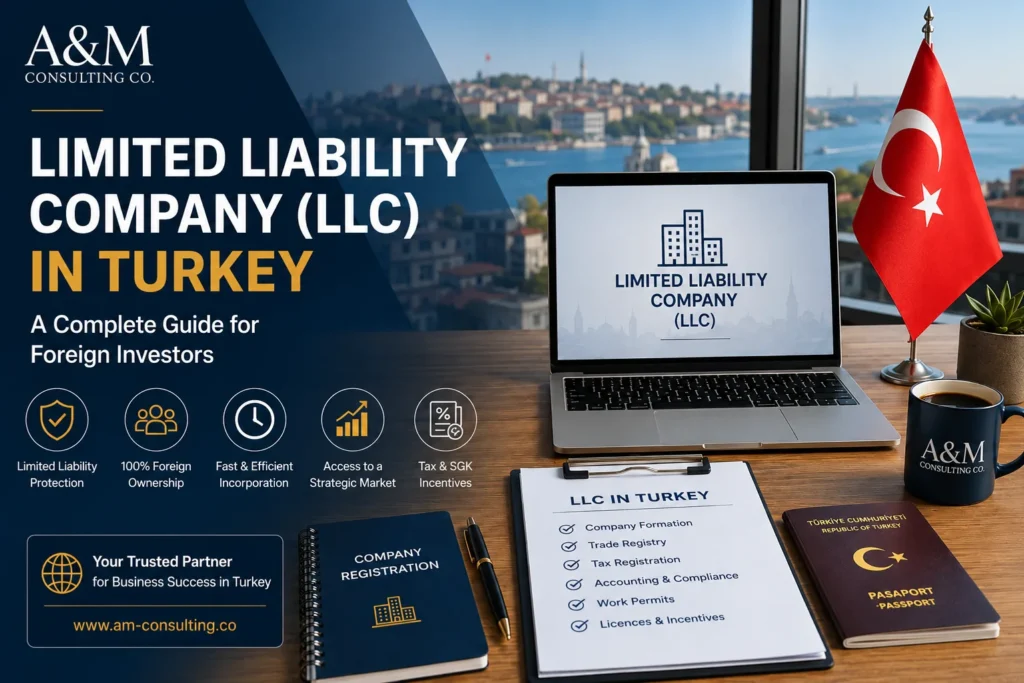
A Limited Liability Company (LLC), known in Turkey as a Limited Şirket (Ltd. Şti.), is one of the most common legal structures for businesses established by local and foreign investors. A Turkish LLC can generally be established with one or more shareholders, including foreign individuals and companies. The minimum share capital is TRY 50,000, and registration is completed through the relevant Trade Registry Office.
| Key Requirement | Details |
|---|---|
| Legal form | Limited Şirket (Ltd. Şti.) |
| Minimum capital | TRY 50,000 |
| Shareholders | 1–50 |
| Foreign ownership | Generally permitted |
| Registered address | Required |
| Registration authority | Trade Registry Office |
| Capital payment | Within 24 months after registration |
Turkey has become one of the most attractive investment destinations for international entrepreneurs thanks to its strategic location, large domestic market, skilled workforce, and business-friendly corporate legislation. Whether you are launching a startup, expanding an international business, or establishing a regional headquarters, choosing the right legal entity is one of the most important decisions you will make.
For most foreign investors, the Limited Liability Company (LLC)—known in Turkish as Limited Şirket (Ltd. Şti.)—is the preferred business structure. It combines operational flexibility with limited shareholder liability, allows 100% foreign ownership, and can be incorporated relatively quickly compared to many other jurisdictions.
However, incorporating an LLC in Turkey involves much more than registering a company name. Investors should understand the legal framework, share capital requirements, management structure, taxation, accounting obligations, payroll responsibilities, banking procedures, and ongoing compliance requirements before starting the incorporation process.
This comprehensive guide explains everything you need to know about establishing and operating a Limited Liability Company in Turkey, including:
Whether you are an entrepreneur, investor, freelancer, or multinational company entering the Turkish market, this guide will help you understand the legal and practical aspects of incorporating a Limited Liability Company (Ltd. Şti.) in Turkey.
Professional Insight: A Limited Liability Company is the most commonly established company type by foreign investors in Turkey because it offers a balance of legal protection, operational flexibility, and relatively straightforward compliance requirements. Nevertheless, selecting the appropriate corporate structure should always be based on your business model, investment objectives, and long-term growth plans rather than convenience alone.
By the end of this article, you will understand:
Before incorporating a company, you may also find these guides useful:
A Limited Liability Company (LLC)—known in Turkish as a Limited Şirket (Ltd. Şti.)—is one of the most common and widely used business entities in Turkey. It is governed by the Turkish Commercial Code (Law No. 6102) and is suitable for both domestic and foreign investors seeking a flexible and legally protected corporate structure.
An LLC is a separate legal entity, meaning that the company has its own legal personality independent of its shareholders. Once incorporated, it can own assets, enter into contracts, open bank accounts, employ staff, borrow funds, and conduct business in its own name.
Because of its relatively simple management structure, moderate capital requirements, and operational flexibility, the Turkish LLC has become the preferred company type for small and medium-sized enterprises (SMEs), international subsidiaries, technology companies, consulting firms, trading businesses, and many other commercial ventures.
One of the defining characteristics of a Turkish LLC is that it possesses its own legal identity.
After registration with the Turkish Trade Registry, the company becomes legally distinct from its shareholders. As a result, the company may:
This legal separation provides greater security for investors and allows the business to operate as an independent legal person.
As the name suggests, the principal advantage of a Limited Liability Company is that shareholders are generally liable only up to the amount of the capital they have committed to contribute to the company.
In other words, the personal assets of shareholders are generally protected from the company’s commercial obligations.
However, this protection is not absolute. Certain obligations—particularly those arising under tax, Social Security (SGK), and other public law legislation—may give rise to additional liabilities under specific legal circumstances.
Accordingly, while an LLC offers significant protection, shareholders and company managers should always ensure that the company complies with its statutory obligations.
A Turkish LLC may be incorporated by:
The company may have a minimum of one (1) and a maximum of fifty (50) shareholders.
Foreign individuals and foreign legal entities may own 100% of the shares, and there is generally no legal requirement for a Turkish shareholder to participate in the company.
This flexibility makes the LLC an attractive option for international investors who wish to establish a wholly foreign-owned business in Turkey.
Every Turkish Limited Liability Company must appoint at least one company manager (Müdür) who is responsible for managing and representing the company.
The manager may be:
Depending on the company’s governance structure, one or more managers may be appointed, with either individual or joint representation authority.
Learn more: See our guide on Nominee Director in Turkey to understand the legal responsibilities of company managers and foreign directors.
Turkish Limited Liability Companies are primarily regulated by:
Depending on the industry, additional licences or regulatory approvals may also be required before commencing operations.
A Limited Liability Company is suitable for a wide range of commercial activities, including:
For highly regulated sectors such as banking, insurance, financial services, or publicly listed companies, a Joint Stock Company (JSC) may be more appropriate.
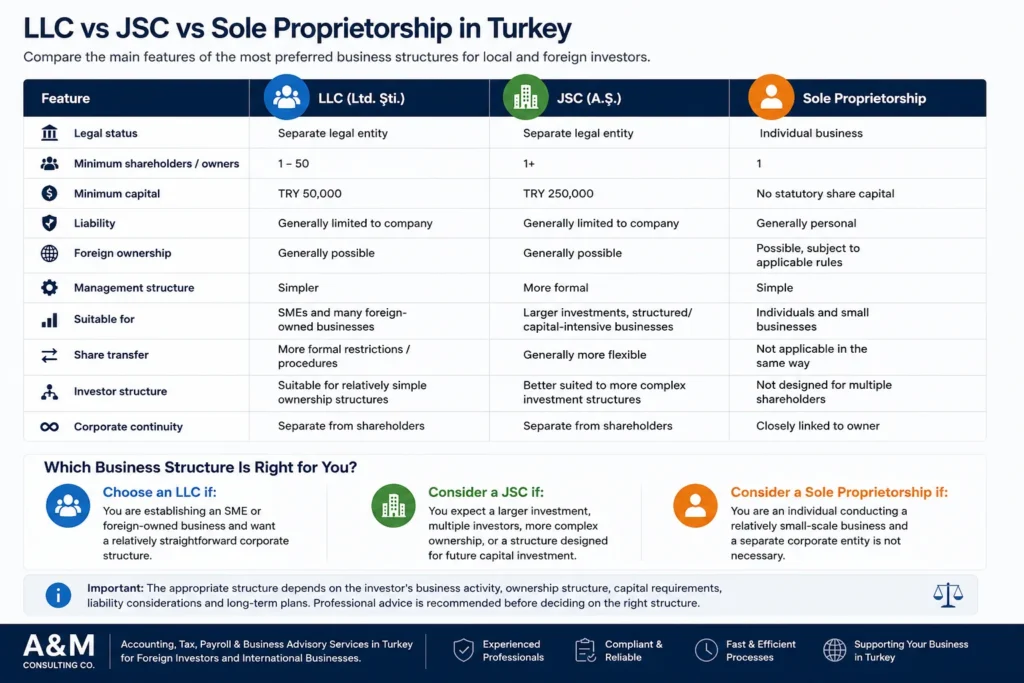
When establishing a business in Turkey, choosing the appropriate legal structure is an important decision. For many entrepreneurs and foreign investors, the main options to consider are a Limited Liability Company (LLC), Joint Stock Company (JSC), or sole proprietorship.
The right structure depends on factors such as the number of owners, investment size, liability considerations, management structure, financing plans and long-term business objectives.
| Feature | LLC (Ltd. Şti.) | JSC (A.Ş.) | Sole Proprietorship |
|---|---|---|---|
| Legal status | Separate legal entity | Separate legal entity | Individual business |
| Shareholders / owners | 1–50 | 1 or more | 1 |
| Minimum capital | TRY 50,000 | TRY 250,000 | No statutory share capital |
| Liability | Generally limited to the company, subject to statutory exceptions | Generally limited to the company, subject to statutory exceptions | Generally personal |
| Foreign ownership | Generally possible | Generally possible | Subject to applicable rules |
| Management | Manager or board of managers | Board of directors | Owner |
| Corporate structure | Relatively simple | More formal | Simple |
| Suitable for | SMEs and many foreign-owned businesses | Larger or more structured investments | Individuals and smaller businesses |
| Share transfer | Formal transfer and registration procedures apply | Generally more flexible | Not applicable in the same way |
| Corporate continuity | Separate from shareholders | Separate from shareholders | Closely connected to the owner |
Turkey’s Ministry of Trade identifies LLCs and JSCs as the two principal corporate forms, with LLCs allowing one to 50 shareholders and JSCs allowing one or more shareholders.
An LLC (Limited Şirket) may be appropriate if you are establishing a small or medium-sized business, including many foreign-owned businesses, and want a relatively straightforward corporate structure.
An LLC may be particularly suitable when:
The statutory minimum capital for a Turkish LLC is currently TRY 50,000. The entire subscribed capital may be paid within 24 months following registration.
A Joint Stock Company (A.Ş.) may be more appropriate for businesses expecting larger investments, multiple investors, more complex ownership structures or future capital investment.
A JSC may be worth considering when:
The statutory minimum capital for a JSC is currently TRY 250,000. Unlike an LLC, at least 25% of the subscribed cash capital generally needs to be paid before registration, with the remainder payable within the statutory period.
A sole proprietorship may be appropriate for an individual conducting a relatively small-scale business where establishing a separate corporate entity is not necessary.
It can be simpler to establish and operate than a corporate structure, but the business is closely connected to its owner and does not provide the same separate legal-entity structure as an LLC or JSC.
For foreign entrepreneurs, however, the suitability of a sole proprietorship should be evaluated carefully because immigration status, work authorization, business activity and other regulatory requirements may affect the available options.
Choose an LLC if you are establishing an SME or foreign-owned operating business and want a relatively straightforward corporate structure.
Consider a JSC if you expect a larger investment, multiple investors, more complex ownership or a structure designed for future capital investment.
Consider a sole proprietorship if you are an individual conducting a relatively small-scale business and a separate corporate entity is not necessary.
There is no single structure that is best for every investor. The appropriate choice depends on the business activity, ownership structure, capital requirements, liability considerations, financing plans and long-term objectives.
A&M Consulting Co. assists foreign investors and international businesses with company formation, accounting, tax, payroll, banking and ongoing corporate compliance in Turkey.
Our team can help you evaluate the practical requirements of different business structures and coordinate the relevant company registration and post-incorporation procedures.
Learn more about A&M Consulting Co. and our experience supporting foreign investors and international businesses in Turkey.
For most international investors, an LLC offers a more robust and scalable legal structure.
Professional Insight: The Turkish Limited Liability Company is designed to balance operational flexibility with legal protection. It is therefore the preferred corporate structure for the vast majority of foreign investors establishing a business in Turkey, particularly where the objective is to create a wholly owned subsidiary, trading company, consultancy, or technology business.
For many international entrepreneurs, selecting the appropriate legal structure is one of the first and most important decisions when entering the Turkish market.
Although Turkish law offers several business structures—including Joint Stock Companies (JSCs), Branch Offices, Liaison Offices, and Sole Proprietorships—the Limited Liability Company (Ltd. Şti.) remains the preferred option for the majority of foreign investors.
Its popularity stems from a combination of legal protection, operational flexibility, relatively straightforward compliance requirements, and suitability for businesses of almost every size.
Whether you are launching a startup, establishing a trading company, opening a regional office, or expanding an international business into Turkey, an LLC often provides the most practical balance between simplicity and corporate governance.
One of the greatest advantages of establishing an LLC in Turkey is that foreign individuals and foreign companies may own 100% of the company’s shares.
In most industries, there is no legal requirement to appoint a Turkish shareholder or local business partner.
This allows international investors to:
This level of ownership flexibility makes Turkey an attractive destination for international investment.
As discussed earlier, shareholders are generally liable only for the capital they have committed to contribute to the company.
This separation between the company’s assets and the shareholders’ personal assets reduces commercial risk and provides a higher degree of legal certainty when compared with business structures that do not offer limited liability.
For entrepreneurs planning long-term operations in Turkey, this protection is one of the primary reasons for choosing an LLC.
Provided that all required documentation has been prepared correctly, a Limited Liability Company can generally be incorporated within a relatively short period.
Modern electronic systems such as MERSIS, together with the centralised Trade Registry process, have significantly streamlined company formation procedures in recent years.
Working with experienced corporate advisers can further reduce delays by ensuring that all documentation complies with Turkish legal requirements from the outset.
Learn more: Our step-by-step registration guide later in this article explains the entire incorporation process in detail.
Unlike some corporate structures that require more complex governance arrangements, an LLC offers considerable flexibility in relation to management.
A company may appoint:
Representation authority may also be structured according to the company’s operational needs through individual or joint signature powers.
This flexibility allows investors to establish a governance model that reflects the size and complexity of their business.
The Turkish LLC is particularly well suited for:
For businesses that do not intend to raise capital through public offerings or require a highly complex corporate structure, an LLC often provides the most efficient legal framework.
Establishing an LLC enables foreign investors to operate as a locally registered Turkish company.
This allows the business to:
For many international companies, incorporating an LLC represents the first step toward establishing a permanent presence in the Turkish market.
A registered Turkish LLC is widely recognised by:
Operating through a properly incorporated legal entity generally enhances commercial credibility and facilitates day-to-day business operations.
Compared with many other jurisdictions, establishing and maintaining an LLC in Turkey is generally considered cost-effective.
While every company remains subject to accounting, tax, and compliance obligations, the LLC structure is designed to provide an efficient balance between legal protection and administrative requirements.
Businesses should nevertheless budget for ongoing professional services such as:
Professional Insight: For most foreign investors, the Turkish Limited Liability Company offers the optimal combination of ownership flexibility, limited liability, efficient management, and practical compliance requirements. Although every investment should be evaluated individually, an LLC is often the most suitable starting point for establishing a sustainable business presence in Turkey.
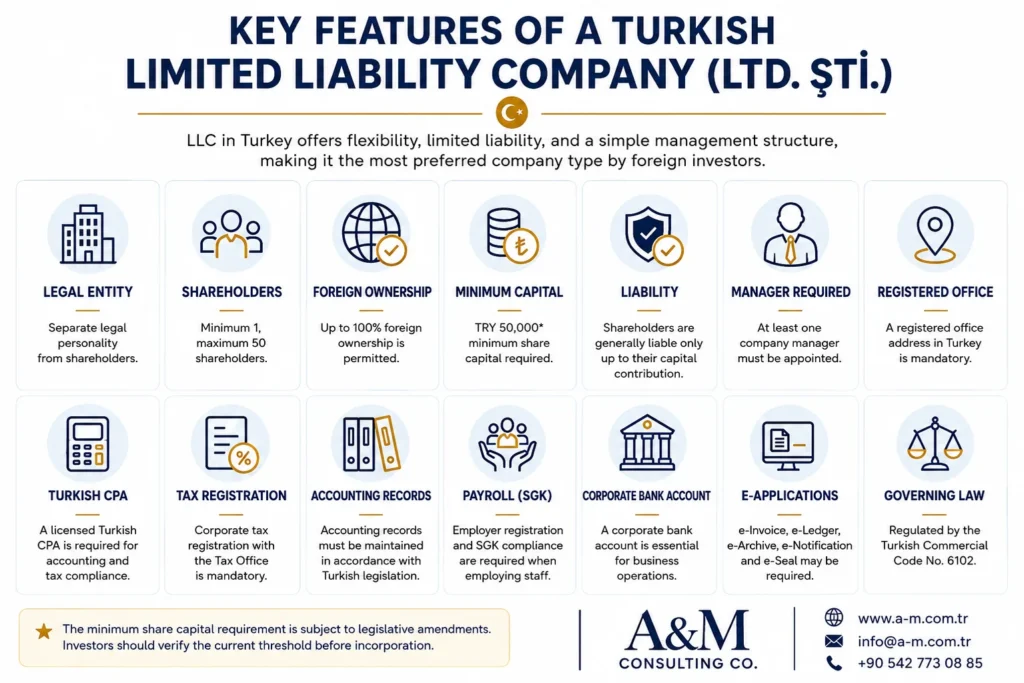
A Limited Liability Company (Ltd. Şti.) combines legal protection, operational flexibility, and relatively straightforward compliance requirements. These characteristics make it the most commonly incorporated company type for both Turkish entrepreneurs and foreign investors.
Before establishing a company, it is important to understand the key legal and operational features that distinguish an LLC from other business entities in Turkey.
Once registered with the Turkish Trade Registry, an LLC becomes an independent legal entity.
The company can:
This legal separation is one of the main reasons why investors choose an LLC over a sole proprietorship.
Turkish LLCs offer considerable flexibility regarding ownership.
An LLC may be established by:
Foreign investors may generally own 100% of the company’s shares, allowing complete control of the business without requiring a local partner.
Every Limited Liability Company must appoint at least one company manager (Müdür).
The manager is responsible for:
Managers may be shareholders or non-shareholders and may be Turkish citizens or foreign nationals, subject to the applicable legal and work permit requirements.
Related Guide: Nominee Director in Turkey
Every Turkish LLC must maintain a registered office address in Turkey.
This address serves as the company’s official correspondence address for:
Depending on the nature of the business, companies may use:
Related Guide: Changing a Company’s Registered Office Address in Turkey
All Turkish Limited Liability Companies are required to maintain accounting records and comply with Turkish tax legislation.
This generally includes:
Under Turkish legislation, companies are generally required to work with a licensed Certified Public Accountant (CPA) to fulfil their statutory accounting and tax obligations.
Related Guides:
An LLC is not required to employ staff immediately after incorporation.
However, once employees are hired, the company must comply with Turkish labour and Social Security legislation, including:
Related Guide: Payroll in Turkey
Although a company can be legally incorporated before opening a bank account, a corporate account is essential for conducting normal business operations.
It enables the company to:
Opening a corporate bank account is therefore one of the first practical steps following incorporation.
Related Guide: Opening a Corporate Bank Account in Turkey
Most companies are also required to use Turkey’s electronic tax systems.
Depending on the company’s activities and legal obligations, this may include:
These systems are administered by the Turkish Revenue Administration and form an essential part of corporate tax compliance.
Related Guide: Electronic Tax Applications in Turkey
Professional Insight: While a Turkish LLC is relatively straightforward to establish, maintaining compliance requires ongoing attention to accounting, taxation, payroll, corporate governance, and statutory reporting. Investors who understand these core features from the outset are better positioned to build a stable and compliant business in Turkey.
One of the main reasons why Turkey attracts international investors is its open investment environment. Turkish company law allows both domestic and foreign investors to establish and own a Limited Liability Company (Ltd. Şti.) under largely the same legal framework.
In most industries, foreign investors enjoy the same rights and obligations as Turkish citizens, making it possible to establish and operate a wholly foreign-owned company in Turkey.
Whether you are an individual entrepreneur, an overseas corporation, or a group of investors, Turkish legislation provides several ownership structures to suit different business needs.
Foreign nationals may establish a Turkish LLC in their own name.
There is generally no requirement to:
Most foreign entrepreneurs establish their Turkish company using only a valid passport and the required incorporation documents.
Depending on the circumstances, a Turkish Tax Identification Number (TIN) will also be required before the incorporation process can be completed.
Related Guide: How to Obtain a Turkish Tax Identification Number
A foreign legal entity may also become the shareholder of a Turkish Limited Liability Company.
This is a common structure for:
When the shareholder is a foreign company, additional corporate documentation—such as a Certificate of Incorporation, Certificate of Good Standing, Board Resolution, and Power of Attorney—may be required. Depending on the country of origin, these documents may also need to be apostilled or legalised, and officially translated into Turkish.
Turkish law permits the establishment of a single-member Limited Liability Company.
This means that one individual or one legal entity may own 100% of the company’s shares.
Single-shareholder LLCs have become particularly popular among:
The sole shareholder may also serve as the company’s manager, subject to the applicable legal requirements.
An LLC may also be established by two or more shareholders.
The company may have up to fifty (50) shareholders, who may consist of:
This flexibility enables investors to structure ownership according to their commercial and investment objectives.
Both Turkish and foreign legal entities may hold shares in a Turkish LLC.
This structure is commonly used where an international parent company wishes to establish a wholly owned Turkish subsidiary while maintaining centralised ownership and corporate governance.
Corporate shareholders enjoy the same rights as individual shareholders, subject to the company’s Articles of Association and Turkish corporate legislation.
No.
In most sectors, there is no legal requirement for a Turkish citizen or Turkish company to own shares in a Limited Liability Company.
Accordingly, foreign investors may generally establish a company with 100% foreign ownership and retain full control over its management and operations.
However, certain regulated industries—such as banking, insurance, financial services, energy, broadcasting, or aviation—may be subject to additional licensing or sector-specific ownership requirements.
Related Guide: Business Licenses and Permits in Turkey
Yes.
A foreign shareholder may also be appointed as the company’s Manager (Müdür).
However, depending on the company’s business activities and the applicable legislation, the appointment of a foreign manager may give rise to work permit and Social Security (SGK) obligations.
These requirements vary according to factors such as:
Related Guides:
Yes, in many cases.
Foreign investors who are unable to travel to Turkey may authorise a professional representative through a Power of Attorney (PoA) to complete much of the incorporation process on their behalf.
Depending on the scope of the authorisation, the representative may assist with:
Certain procedures—such as opening a corporate bank account—may still require the participation of shareholders or company managers, depending on the policies of the selected bank.
Turkish company law provides a highly flexible ownership framework that allows both individuals and companies to establish a Limited Liability Company.
Whether you are investing alone, forming a joint venture, or expanding an existing international business, a Turkish LLC can generally accommodate your preferred ownership structure while allowing up to 100% foreign ownership in most sectors.
Professional Insight: One of the key advantages of the Turkish LLC is its flexibility. Foreign investors are not required to appoint a local shareholder and may structure ownership through individuals, corporate entities, or a combination of both. With proper legal planning and documentation, establishing a wholly foreign-owned company in Turkey is a straightforward process for most international businesses.
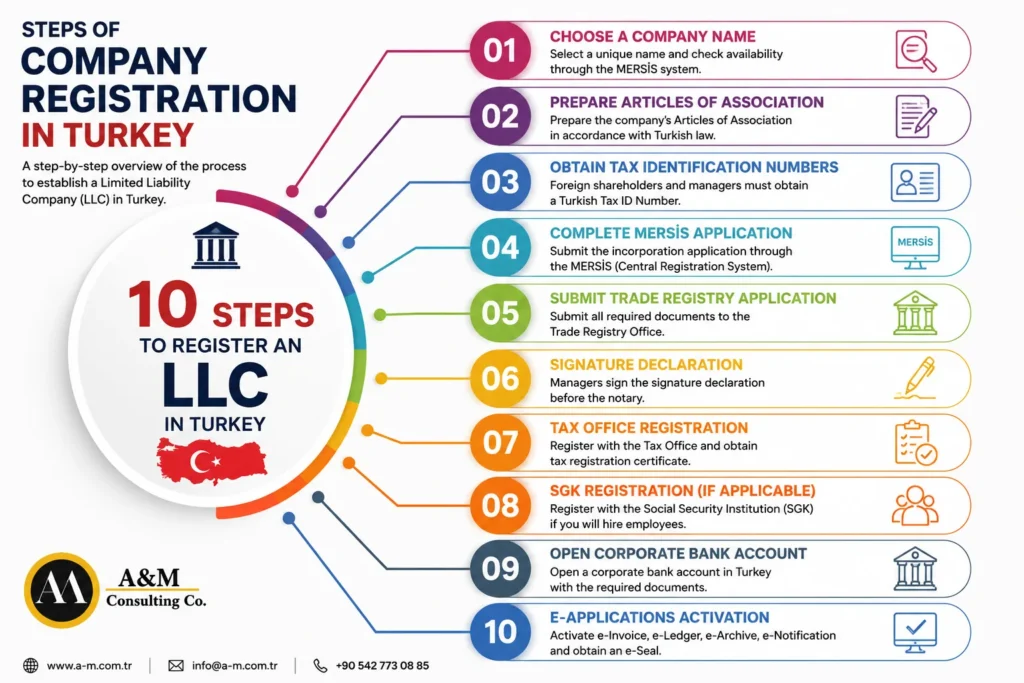
Establishing a Limited Liability Company (Ltd. Şti.) in Turkey is a structured legal process regulated by the Turkish Commercial Code and administered through the Trade Registry, the Turkish Revenue Administration, and other public institutions.
Although the registration procedure is relatively straightforward, careful preparation of the required documentation is essential to avoid delays.
Below is a step-by-step overview of the incorporation process.
The first step is selecting a unique company name.
Before incorporation, the proposed trade name should be checked through the MERSIS (Central Registration System) to ensure that it is available and complies with Turkish commercial naming regulations.
The company name must:
Choosing an appropriate company name at the beginning helps prevent unnecessary delays during the registration process.
The Articles of Association (AoA) establish the legal framework of the company.
The document generally includes:
Because this document defines the company’s legal structure, it should be carefully drafted to reflect the shareholders’ commercial objectives.
Foreign shareholders and foreign managers generally require a Turkish Tax Identification Number (TIN) before the incorporation process can be completed.
The TIN is required for various administrative procedures, including:
Related Guide: How to Obtain a Turkish Tax Identification Number
Turkey uses the Central Registration System (MERSIS) for company incorporations.
Through MERSIS, the incorporation application is prepared electronically, including:
Once completed, the application is submitted for Trade Registry review.
After the MERSIS application is finalised, the incorporation file is submitted to the relevant Trade Registry Office.
Depending on the company structure, the application generally includes:
Following approval, the company is officially incorporated and published in the Turkish Trade Registry Gazette.
The authorised company manager(s) must complete the required signature declarations.
These declarations identify the individuals authorised to represent the company before:
The scope of representation authority should correspond with the company’s internal governance arrangements.
Following incorporation, the company must complete its registration with the Turkish Tax Office.
This process generally includes:
Depending on the circumstances, additional verification procedures may be carried out by the tax authorities.
Related Guide: Tax Registration in Turkey
An LLC is not automatically required to register as an employer immediately after incorporation.
However, if the company intends to hire employees, it must complete employer registration with the Social Security Institution (SGK) before employment begins.
Employer registration enables the company to:
Related Guides:
A corporate bank account is essential for conducting business operations.
Banks generally request:
Each bank applies its own compliance (KYC) procedures, and additional documentation may be requested depending on the ownership structure.
Related Guide: Opening a Corporate Bank Account in Turkey
Before commencing normal business operations, companies should complete the necessary electronic tax registrations.
Depending on the company’s legal obligations, these may include:
These systems enable companies to comply with Turkey’s digital tax administration requirements.
Timeline For LLC Formation in Turkey
| Stage | Typical Time* |
|---|---|
| Company name verification | Same day |
| Preparation of Articles of Association | 1 business day |
| Tax Identification Numbers | Same day |
| MERSIS application | Same day |
| Trade Registry registration | 1–3 business days |
| Tax Office registration | Same day – 1 business day |
| SGK employer registration (if applicable) | Same day |
| Corporate bank account opening | 1–5 business days |
| Electronic tax applications | 1–3 business days |
Estimated timelines may vary depending on the completeness of the documentation, translation and notarisation requirements, the responsiveness of the relevant authorities, and the internal procedures of the selected bank.
One of the most important decisions when establishing a Limited Liability Company (Ltd. Şti.) in Turkey is determining the company’s share capital.
Although Turkish legislation specifies a minimum statutory capital, investors should remember that the legal minimum is not always the most appropriate amount for every business. The ideal capital structure depends on factors such as the company’s planned activities, licensing requirements, operational expenses, financing strategy, and long-term growth objectives.
Choosing an appropriate share capital at the outset can improve the company’s financial credibility while reducing the need for future capital increases.
Under the Turkish Commercial Code, the minimum share capital required to establish a Limited Liability Company is:
This capital is divided into shareholders’ capital contributions according to the ownership percentages specified in the Articles of Association.
For example:
| Number of Shareholders | Example Share Capital |
|---|---|
| 1 Shareholder | TRY 50,000 |
| 2 Shareholders | TRY 25,000 each |
| 4 Shareholders | TRY 12,500 each |
The minimum capital requirement may be amended by future legislation, so investors should always verify the current threshold before incorporation.
Not necessarily.
While TRY 50,000 satisfies the legal incorporation requirement, many businesses choose to register with a higher capital amount.
A larger share capital may be advantageous because it can:
The appropriate capital level should therefore be determined according to the company’s business model rather than the statutory minimum alone.
Turkish LLCs may be established using different types of capital contributions.
The most common method is a cash contribution made by the shareholders.
Cash capital may be used to finance:
Subject to the applicable legal requirements, shareholders may also contribute certain non-cash assets, such as:
In-kind contributions generally require independent valuation and additional legal procedures before they can be accepted as share capital.
Yes.
Many investors initially establish their company with the statutory minimum capital and increase it later as the business expands.
Common reasons for increasing share capital include:
Capital increases require shareholder approval and registration with the Turkish Trade Registry.
Related Guide: How to Increase Share Capital in Turkey
The payment rules for share capital are governed by the Turkish Commercial Code and may vary depending on the company’s legal structure and the nature of the capital contribution.
Investors should ensure that the capital contribution schedule complies with the applicable legislation and the provisions of the company’s Articles of Association.
Professional advice is recommended before determining the capital payment structure.
Rather than focusing solely on the statutory minimum, investors should consider:
Selecting an appropriate capital structure from the beginning can reduce administrative costs and support sustainable business growth.
Professional Insight: The minimum legal capital is simply the threshold required to establish an LLC—it should not automatically be regarded as the optimal capital for every business. Investors should determine their share capital based on operational needs, financing strategy, and long-term commercial objectives rather than choosing the lowest permissible amount.
This section provides a general overview of share capital requirements for Turkish Limited Liability Companies.
For a detailed explanation covering:
For more details please read our dedicated guide: 👉 Share Capital in Turkey
Before incorporating a Limited Liability Company (Ltd. Şti.) in Turkey, shareholders and company managers must prepare a number of legal and corporate documents.
The required documentation varies depending on whether the shareholder is an individual, a foreign company, or a Turkish legal entity. Additional documents may also be required where a Power of Attorney (PoA) is used or where foreign documents must be translated and notarised.
Preparing the required documents correctly at the outset helps avoid unnecessary delays during the incorporation process.
Foreign individuals establishing an LLC in Turkey are generally required to provide:
Depending on the country where the passport was issued, additional authentication procedures may occasionally be required.
If the shareholder is a foreign company, additional corporate documentation is generally required.
Typical documents include:
Foreign corporate documents generally require:
Because documentation requirements vary by jurisdiction, investors should verify the requirements applicable to their home country before beginning the incorporation process.
Every Turkish LLC must appoint at least one company manager.
The appointed manager is generally required to provide:
If the manager is a foreign national, additional documentation may be required depending on the company’s activities and the applicable work permit legislation.
Foreign investors who are unable to travel to Turkey often authorise a professional representative through a Power of Attorney (PoA).
Depending on its scope, a PoA may authorise the representative to:
A properly drafted Power of Attorney can significantly simplify the incorporation process for overseas investors.
Documents issued outside Turkey frequently require additional legal formalities before they can be accepted by Turkish authorities.
These may include:
The applicable procedure depends on the country where the document was issued.
| Document | Individual Shareholder | Corporate Shareholder |
|---|---|---|
| Passport / Company Registration Documents | ✔ | ✔ |
| Turkish Tax Identification Number | ✔ | ✔ (Representative) |
| Articles of Association | ✔ | ✔ |
| Board Resolution | — | ✔ |
| Certificate of Incorporation | — | ✔ |
| Certificate of Good Standing | — | ✔ |
| Passport of Authorised Representative | — | ✔ |
| Company Manager Information | ✔ | ✔ |
| Signature Declaration | ✔ | ✔ |
| Power of Attorney (if applicable) | Optional | Optional |
| Certified Translation | Where required | Where required |
| Apostille / Legalisation | Where required | Where required |
Yes.
Most incorporation documents can be prepared in advance.
Foreign investors commonly complete the following before travelling to Turkey:
Preparing these documents beforehand can significantly reduce the overall incorporation timeline.
Although the list of required documents appears straightforward, the incorporation process often involves coordination between:
Ensuring that all documents are prepared correctly before submission helps minimise delays and avoids unnecessary revisions.
Professional Insight: The most common causes of delays during LLC registration are incomplete documentation, incorrectly drafted Powers of Attorney, missing apostilles, and translation errors. Preparing a complete incorporation file before submitting the application can significantly accelerate the registration process.
Establishing a Limited Liability Company (Ltd. Şti.) in Turkey brings with it a number of statutory tax obligations. From the date of incorporation, every LLC must comply with Turkish tax legislation by maintaining proper accounting records, submitting tax returns on time, and fulfilling its reporting obligations.
The taxes applicable to an LLC depend on factors such as its business activities, annual turnover, number of employees, and the nature of its commercial transactions. While not every company is subject to every tax, all companies are expected to comply with the requirements of the Turkish Revenue Administration (Gelir İdaresi Başkanlığı – GİB).
Below is an overview of the principal tax obligations that apply to most Turkish Limited Liability Companies.
Turkish LLCs are generally subject to Corporate Income Tax on their taxable profits.
Corporate Income Tax is calculated based on the company’s annual financial results after deducting allowable business expenses in accordance with Turkish tax legislation.
Companies are also required to submit temporary (advance) corporate tax returns during the financial year.
Related Guide: Corporate Tax in Turkey
Most businesses supplying goods or services in Turkey are required to register for Value Added Tax (VAT).
Typical VAT obligations include:
The applicable VAT treatment depends on the nature of the company’s business activities and the goods or services supplied.
Related Guide: Value Added Tax (VAT) in Turkey
Certain payments made by Turkish companies are subject to Withholding Tax (Stopaj).
Depending on the nature of the transaction, withholding tax may apply to:
Related Guide: Withholding Tax in Turkey
Turkish companies may also become liable for Stamp Tax, which applies to certain contracts, official documents, declarations, and legal instruments executed in Turkey.
Whether Stamp Tax applies depends on the nature of the document and the underlying transaction.
In addition to the annual Corporate Income Tax return, companies are generally required to submit temporary corporate tax declarations during the financial year.
This system enables corporate income tax to be assessed periodically before the annual tax return is filed.
Once an LLC hires employees, additional tax and Social Security obligations arise.
These generally include:
Related Guides:
Following incorporation, every Limited Liability Company must complete its registration with the relevant Tax Office before commencing business activities.
Tax registration enables the company to:
Related Guide: Tax Registration in Turkey
Most Turkish companies are also required to use the electronic systems administered by the Turkish Revenue Administration.
Depending on the company’s legal obligations, these may include:
These systems form an essential part of corporate tax compliance and digital accounting in Turkey.
Turkish companies are subject to numerous monthly, quarterly, and annual reporting obligations throughout the financial year.
Failure to comply with these obligations may result in:
For this reason, foreign investors generally appoint a licensed Turkish CPA to manage their accounting and tax compliance from the outset.
Related Guides:
This section provides only a general overview of the tax obligations applicable to Limited Liability Companies in Turkey.
For a comprehensive explanation of:
Professional Insight: Tax compliance is an ongoing responsibility that begins immediately after incorporation—not only at year-end. Establishing robust accounting procedures and working with a licensed Turkish CPA from the outset helps businesses remain compliant, minimise tax risks, and avoid unnecessary penalties while focusing on sustainable growth.
After establishing a Limited Liability Company (Ltd. Şti.) in Turkey, one of the company’s most important ongoing responsibilities is maintaining full compliance with Turkish accounting, payroll, and Social Security legislation.
Under Turkish law, every LLC is required to maintain statutory accounting records, submit tax declarations, and comply with payroll and Social Security reporting requirements where applicable.
Although the scope of these obligations varies depending on the company’s activities and whether it employs staff, proper compliance is essential to avoid administrative penalties and ensure the smooth operation of the business.
Yes.
Every Turkish Limited Liability Company is legally required to maintain accounting records from the date of incorporation.
This obligation applies even if the company:
Accordingly, incorporating a company also creates ongoing accounting and reporting responsibilities that continue until the company is formally liquidated or dissolved.
Turkish LLCs are required to maintain complete and accurate accounting records in accordance with the Turkish Commercial Code and the Tax Procedure Law.
Typical bookkeeping responsibilities include:
Accurate bookkeeping forms the basis of every tax return submitted to the Turkish authorities.
Related Guide: Accounting and Bookkeeping Requirements in Turkey
Most companies are required to complete accounting procedures every month.
These typically include:
Timely accounting ensures that all statutory declarations are submitted accurately and within the legal deadlines.
Turkish Limited Liability Companies are generally required to prepare statutory financial statements based on their accounting records.
These commonly include:
Financial statements may be required by:
They also provide management with valuable financial information for decision-making and future planning.
An LLC is not required to hire employees immediately after incorporation.
However, once the company begins employing staff, additional statutory obligations arise under Turkish labour, tax, and Social Security legislation.
These obligations generally include:
Employers are responsible for ensuring that payroll is calculated accurately and reported within the statutory deadlines.
Related Guide: Payroll and Social Security (SGK) Obligations in Turkey
Before employing personnel, the company must register as an employer with the Social Security Institution (SGK).
Once employees are hired, the employer is generally responsible for:
Failure to comply with SGK requirements may result in administrative fines and other legal consequences.
Related Guide: Hiring Employees in Turkey
Turkey operates a highly digital tax administration system.
Depending on the company’s activities and legal obligations, Turkish LLCs may be required to use:
These electronic systems enable businesses to meet their statutory accounting and tax reporting obligations efficiently.
Related Guide: Electronic Tax Applications in Turkey (e-Invoice, e-Archive, e-Ledger & e-Notification)
In practice, yes.
Turkish Limited Liability Companies are generally expected to work with a licensed Turkish Certified Public Accountant (CPA) (Serbest Muhasebeci Mali Müşavir – SMMM) to fulfil their statutory accounting and tax obligations.
A licensed Turkish CPA typically assists with:
Related Guide: Turkish CPA
For international investors, accounting support extends far beyond bookkeeping.
An experienced Turkish accounting firm can assist with:
Having a single professional adviser managing these services significantly reduces compliance risks and administrative burdens.
Related Guide: Turkish Accounting Firm
At A&M Consulting Co., we provide comprehensive accounting, payroll, tax, and corporate compliance services for both local and international companies operating in Turkey.
As a licensed Certified Public Accounting (CPA) firm accredited by TURMOB (The Union of Chambers of Certified Public Accountants of Turkey) and ISMMMO (The Istanbul Chamber of Certified Public Accountants), we support businesses throughout their entire lifecycle—from company incorporation and tax registration to monthly bookkeeping, payroll processing, SGK compliance, financial reporting, and ongoing corporate advisory services.
By combining accounting, payroll, tax, and corporate consultancy under one roof, we help foreign investors navigate Turkish regulations efficiently while remaining fully compliant with local legislation.
Professional Insight: Accounting, payroll, and Social Security compliance are ongoing legal obligations—not one-time administrative tasks. Establishing robust accounting procedures and working with a licensed Turkish CPA from the outset helps businesses remain compliant, minimise operational risks, and build a solid foundation for long-term growth in Turkey.
Registering a Limited Liability Company (Ltd. Şti.) is one of the first steps toward doing business in Turkey. However, company incorporation alone does not automatically authorise a business to carry out every type of commercial activity.
While many ordinary commercial activities may begin immediately after incorporation and tax registration, businesses operating in regulated sectors must first obtain the necessary licences, permits, or approvals from the relevant Turkish authorities.
The licensing requirements depend on the company’s business activities—not its legal structure.
No.
Many businesses can commence operations immediately after completing the company incorporation process without obtaining any additional operating licence.
Examples include:
However, companies operating in regulated sectors must obtain the appropriate licences or approvals before commencing business activities.
Related Guide: Business Licenses and Permits in Turkey
Certain industries are subject to sector-specific legislation and regulatory supervision.
Examples include:
Each industry has its own licensing procedures, technical requirements, supervisory authority, and ongoing compliance obligations.
Business licences in Turkey are issued by different public authorities depending on the company’s activities.
These may include:
The competent authority varies according to the nature of the business.
Some business activities also require qualified professionals holding recognised Turkish professional licences.
Examples include:
For example, statutory accounting and tax compliance services in Turkey are generally performed by licensed Certified Public Accountants (SMMM) registered with the relevant professional chambers.
Related Guide: Turkish CPA
Obtaining a business licence does not automatically grant foreign shareholders or company managers the legal right to work in Turkey.
Depending on:
foreign managers may also be required to obtain a Turkish Work Permit and comply with Social Security (SGK) obligations.
Related Guide: Work Permit Requirements for Foreign Company Owners and Directors
Certain businesses may also benefit from establishing operations within government-supported investment programmes.
These include:
These special regimes may provide various operational, tax, customs, or investment incentives depending on the nature of the project.
Related Guides:
Before incorporating an LLC, investors should determine whether their intended business activities are regulated.
This assessment should consider:
Identifying these requirements at the planning stage helps avoid unnecessary delays and ensures that the business can commence operations without regulatory obstacles.
This section provides only a general overview of the licensing requirements that may apply to Turkish Limited Liability Companies.
For detailed guidance on:
please read our dedicated guide:
👉 Business Licenses and Permits in Turkey
At A&M Consulting Co., we help domestic and international investors identify the licences, permits, and regulatory approvals required for their specific business activities before they commence operations.
As a licensed CPA and corporate advisory firm, we assist clients with:
By identifying licensing requirements early in the incorporation process, we help businesses avoid unnecessary delays and establish a fully compliant operation in Turkey.
Professional Insight: Incorporating a company and obtaining the legal right to conduct business are not always the same thing. While many businesses can begin trading immediately after registration, regulated industries require additional licences and approvals before operations may legally commence. Identifying these requirements before incorporation saves both time and cost.
A Limited Liability Company (Ltd. Şti.) is the most widely used business entity in Turkey for both domestic entrepreneurs and international investors. It offers an excellent balance between legal protection, operational flexibility, and relatively straightforward compliance requirements.
However, like every legal structure, an LLC has both advantages and limitations. Understanding these characteristics before incorporation helps investors choose the most appropriate legal entity for their business objectives.
One of the principal advantages of an LLC is that shareholders are generally liable only up to the amount of capital they have committed to the company.
As a general rule, the company’s debts and liabilities remain separate from the personal assets of its shareholders.
However, company managers and legal representatives may still bear personal responsibilities under Turkish tax, social security, and commercial legislation in certain circumstances.
Turkey allows foreign investors to establish and own a 100% foreign-owned Limited Liability Company in most sectors.
There is generally no requirement to appoint a Turkish shareholder, making the LLC an attractive vehicle for international investors seeking full ownership and control of their Turkish operations.
Provided that all documentation is properly prepared, a Turkish LLC can typically be incorporated within a few business days.
The incorporation process benefits from digital systems such as MERSİS, enabling efficient registration with the Trade Registry and Tax Office.
Related Guide: Company Registration in Turkey – Complete Guide
A Turkish LLC may be incorporated with:
This flexibility enables investors to structure ownership according to their commercial objectives.
Compared with many European jurisdictions, Turkey offers relatively accessible minimum capital requirements for Limited Liability Companies.
This makes the LLC particularly attractive for startups, SMEs, and foreign investors entering the Turkish market.
Related Guide: Share Capital in Turkey
A Turkish LLC may engage in a broad range of commercial activities, including:
Certain regulated sectors may require additional licences or regulatory approvals before operations can commence.
Related Guide: Business Licenses and Permits in Turkey
Turkey provides businesses with access to:
These advantages make Turkey an attractive regional hub for international businesses.
Depending on the nature of the investment, Turkish LLCs may qualify for various government support programmes, including:
Related Guides:
Operating through a registered Limited Liability Company enhances credibility when dealing with:
For many businesses, a registered corporate entity creates greater commercial confidence than operating as an individual entrepreneur.
Although the LLC is suitable for most businesses, investors should also consider several ongoing legal and administrative responsibilities.
Every Turkish LLC must maintain statutory accounting records and comply with ongoing tax reporting obligations throughout its lifetime.
Typical obligations include:
Even companies that have not yet commenced trading are generally required to continue meeting their statutory reporting obligations.
Related Guides:
In practice, Turkish companies are generally required to work with a licensed Certified Public Accountant (SMMM) to fulfil their statutory accounting and tax obligations.
This creates an ongoing professional service requirement that investors should include in their annual operating budget.
Related Guides:
Although shareholders enjoy limited liability, company managers and legal representatives may become personally responsible for certain obligations under Turkish legislation, particularly in relation to:
Accordingly, appointing a competent company manager is an important corporate governance decision.
Related Guide: Changing a Company Director or Manager in Turkey
Companies operating in regulated sectors may require additional:
These requirements may increase the time required before commercial operations can commence.
Unlike publicly traded companies, transferring shares in a Turkish LLC generally requires additional legal formalities.
Depending on the circumstances, share transfers may involve:
For businesses expecting frequent ownership changes or institutional investment, a Joint Stock Company (JSC) may sometimes offer greater flexibility.
Related Guides:
For the majority of foreign investors, the answer is yes.
An LLC is particularly suitable for:
However, investors planning to:
may also wish to consider alternative legal structures, such as a Joint Stock Company (JSC).
Selecting the appropriate legal structure should always take into account factors such as:
Receiving professional advice before incorporation helps ensure that the chosen structure aligns with both current operational requirements and future growth plans.
Depending on the nature, location, and scale of the investment, Turkish Limited Liability Companies may be eligible for a wide range of government incentive programmes designed to encourage both domestic and foreign investment.
These incentives may include:
The availability of these incentives depends on several factors, including the company’s industry, investment amount, geographical location, employment level, and the nature of the investment project.
Related Guides:
- Social Security (SGK) Incentives in Turkey
- Free Zones in Turkey
- Technoparks in Turkey
- Istanbul Financial Center (IFC) Guide
- Tax Incentives in Turkey
Professional Insight: A Turkish Limited Liability Company offers an excellent balance of simplicity, flexibility, and legal protection, making it the preferred choice for most foreign investors. Nevertheless, the optimal legal structure depends on your specific business model, industry, and long-term objectives. Evaluating these factors before incorporation can save significant time and cost as your business grows
Establishing a Limited Liability Company (LLC) in Turkey involves much more than simply preparing incorporation documents. From selecting the appropriate legal structure and completing company registration to tax compliance, accounting, payroll, licensing, and ongoing corporate governance, businesses must navigate a wide range of legal and administrative requirements.
At A&M Consulting Co., we provide comprehensive company formation and corporate advisory services designed specifically for foreign investors entering the Turkish market.
With years of experience assisting international entrepreneurs, SMEs, multinational companies, and investment groups, we act as a single point of contact for every stage of your business journey in Turkey.
Our turnkey company formation services typically include:
Our objective is to ensure that your company is established correctly from the very beginning.
Unlike many incorporation service providers, our support does not end once your company is registered.
We continue assisting clients with:
This enables our clients to focus on growing their businesses while we manage their statutory compliance obligations.
Foreign investors choose A&M Consulting Co. because we offer:
Our integrated approach eliminates the need to coordinate multiple service providers and ensures consistent professional guidance throughout your investment journey.
We regularly assist businesses operating in sectors such as:
Regardless of your industry, our team provides practical solutions tailored to your specific business requirements.
Our goal is not simply to register your company.
We aim to become your long-term corporate adviser by supporting every stage of your business in Turkey—from incorporation and regulatory compliance to expansion, restructuring, and strategic growth.
Whether you are launching your first company in Turkey or expanding an existing international business, our experienced team is ready to guide you through every step of the process.
If you are planning to establish a Limited Liability Company in Turkey, our experienced team is ready to assist you with every aspect of the incorporation process.
Contact A&M Consulting Co. today for professional advice on:
We help foreign investors establish and manage their businesses in Turkey with confidence, efficiency, and full legal compliance.
DISCOVER OUR OTHER SERVICES:
You can reach out to our experienced consultans via email or by filling out the Contact Form on our website’s contact page.
If you’d like to turn your new business into a company in Turkey or decided to extened your existing business, you’ll be relieved to know the Company Formation Process in Turkey is quick ,
You may do company formation as ON-LINE yourself or by prox, But, due to the complexity of the system and the need for a wet signature to ensure registration, we recommend that you get professional support from a Turkish Accountant or Turkish CPA.
Company registration has been doing on MERSIS system as on-line but we highly recommend to get professional service from a Turkish Accountant or Turkish CPA to avoid any legal problem due to both its complicated structure and some bureaucratic procedures.
Individual Shareholders must provide followings to incorporate a company in Turkey;
• In Turkish translation of passport which is approved by Notery in Turkey or appostiled Turkish Consulate where you based in
• A biometric of founders
• A GSM no & e-mail address of founders
• A Power of Attorney which is approved by Notary in Turkey or apostilled Turkish Consulate where you based in
• Tax number of company and founders
• Rent agreement of company
• Residance address of founders
The registration process typically takes between 1 to 2 weeks, depending on the completeness of the documentation and the efficiency of the local Trade Registry Office.
If you form your company through A&M Consulting Co. the application takes around hour to complete.
Yes, foreign individuals and entities can own 100% of a company in Turkey. There are no restrictions on foreign ownership.
Effective from the 2024 financial year in Turkey, the minimum equity amounts required to establish a company have been increased. Within this context, the minimum equity amounts are:
For Joint Stock Companies: minimum 250,000 TRL.
As per Turkish trade code the capital must be paid off within 24 month for all company types, it may be paid off in once or can be paid in pieces,.
Yes it is
Almost for all activities the virtual office is available but do not forget that the physical office is mondatory for productors and some other sectors.
It costs about EUR 3,500 to form a company through A&M Consulting Co. This price includes the bank account.
That is our turn-key price and there are no hidden or any other additional costs to form a ready-to-trade a company with us.
Every company is legally required to have a accountant or CPA who are authorized by Turkish Finance Ministry which bookkeeps of company’s official books and declerates tax & SSI decleration forms, so without these a company cannot be active and maintained in Turkey
You can start trading as soon as your company has been formed. The system automatically sends your registration informations also to the tax office.
Once you have get your Trade Registration Certificate & Tax Signboard, it means that your company exists anymore and ready to trade and issuing invoice.
No, you must get the work or residence permit
No it isn’t necessary
You can set up and manage your company remote via an Turkish CPA who has Power of Attorney behalf on you.
The liquidation process is not as simple and fast as establishment, as it is a rather complex and long process, it must be carried out under the guidance of a Turkish Accountant or Turkish Financial Advisor, it takes at least 6 months.
If your company has a paid-in capital of at least 500.000,00 TRL and employs at least 5 local workers, you can apply for a work permit in Turkey,
For more information, you can check out our article on Turkey Work Visa
Corporate Income Tax (CIT): The normal corporate tax rate in Turkey is 25% as of July 2023.
Provisional Tax: Provisional tax is calculated at 25% on earnings every three months within the 12-month taxation year, and it is deducted from the annual tax(CIT)
Value-Added Tax (VAT): Most products and services are subject to the regular VAT rate of 20%. Basic food items are subject to 1% VAT, while there are also 8% and 10% VAT rates applicable in Turkey.
Income Tax: Income tax is levied on earnings by sole proprietorship companies and employees. Employers are responsible for calculating and paying the income tax of their employees. It is a progressive tax, ranging from 15% to 40%.
Stamp Tax: Stamp tax is calculated on all kinds of contracts and employee wage slips. It has a variable rate depending on the type of document. Employers are responsible for calculating and paying stamp tax for their employees.
Withholding Tax (WHT): Withholding tax is calculated at least 20% on workplace rent and wage payments.
For more information, you can take a look at our article on Taxation in Turkey
Turkish government offers several employment incentives & tax reductions . Incentives and tax reductions generally cover the IT and manufacturing sectors, Technology Development Zones and Free-Zone companies. Subsidies for research and development activities. Employment incentives are aimed at young, female skilled workers
The process generally involves the following steps:
Key documents include:
No, you do not need a local partner or director to register a company in Turkey. However, having a local representative can be beneficial for administrative purposes.
Yes, certain industries such as banking, insurance, telecommunications, health, property brokers and pharmaceuticals require special licenses and regulatory approvals.
Yes, after registering your company, you can open a corporate bank account in Turkey. Most banks require the company’s registration documents, tax identification number, and personal identification of the directors and shareholders.For more detail, look at our article about Corporate Bank Account in Turkey
Companies must:
A well-equipped Turkish Accountant will provide you with these
A Limited Liability Company (Ltd. Şti.) is the most common business entity in Turkey. It provides limited liability protection for shareholders while offering a relatively simple incorporation process and flexible management structure, making it the preferred choice for SMEs and foreign investors.
Yes. Foreign individuals and foreign companies may establish and own 100% of a Turkish Limited Liability Company in most sectors without requiring a Turkish shareholder.
A Turkish LLC may be established with one shareholder or multiple shareholders. Shareholders may be individuals or legal entities, whether Turkish or foreign.
Turkish law prescribes a statutory minimum share capital for Limited Liability Companies. However, depending on the company’s business activities and future plans, a higher capital amount may be advisable.
Related Guide: Share Capital in Turkey
If all required documents are properly prepared, an LLC can typically be incorporated within a few business days. The exact timeline depends on document preparation, notarisation, and Trade Registry procedures.
Yes. In many cases, a company can be incorporated remotely through a properly executed Power of Attorney (PoA), allowing your authorised representative to complete the incorporation process on your behalf.
No. Turkish law generally allows foreign investors to establish an LLC without a local partner. Most sectors permit 100% foreign ownership.
Yes. Every Turkish LLC must have a registered legal address in Turkey before incorporation.
Businesses may use:
Related Guide: Changing a Company’s Registered Office Address in Turkey
Depending on its activities, an LLC may be subject to:
Not necessarily. Work permit requirements depend on factors such as the company’s business activities, whether it operates in a regulated sector, your role within the company, and the applicable legislation.
Related Guide: Work Permit Requirements for Foreign Company Owners and Directors
es. Turkish Limited Liability Companies may acquire and own real estate, provided the acquisition complies with applicable Turkish legislation and any sector-specific restrictions.
Yes. An LLC may increase its share capital after incorporation by following the procedures prescribed under the Turkish Commercial Code.
Related Guide: How to Increase Share Capital in Turkey
Yes. Businesses operating in regulated sectors such as tourism, healthcare, financial services, education, or food production may require additional licences or approvals before commencing operations.
Related Guide: Business Licenses and Permits in Turkey
Contact A&M Consulting Co. for professional guidance on establishing a Limited Liability Company (LLC) in Turkey, choosing the most suitable legal structure, completing the company registration process, and ensuring full compliance with Turkish corporate, tax, accounting, payroll, and regulatory requirements.
Whether you are launching a new business, expanding into the Turkish market, or restructuring an existing company, our experienced team is ready to assist you at every stage of your investment journey.
Abdullah Mercanlı is the Co-Founder of A&M Consulting Co. and has more than 20 years of professional experience in accounting, taxation, finance, payroll, and social security. He supports international businesses and foreign investors with tax compliance, company formation, and business operations in Turkey.
Registered member of ISMMMO · Registration No. 50555
Recent Posts



WhatsApp Us